Gifts for Kids Who Love to Cook: Real Kitchen Tools by Age
This guide helps you choose real kitchen tools for kids aged 2-10, explaining how to pick items that are safe, useful, and match their skill level and your supervision capacity.
- Prioritize real kitchen tools over toy sets for your child.
- Use the 4-question filter to select practical, age-appropriate tools.
- Find specific tool recommendations for kids aged 2-10 by skill level.
- Choose tools that align with your available supervision time.
This post contains affiliate links. As an Amazon Associate I earn from qualifying purchases.
Two Decembers ago, my sister-in-law gave my daughter a pink plastic kitchen set. She held it for about four minutes, then pulled the real whisk from the drawer and asked, “Can I do the eggs?”
That’s when I stopped buying pretend. The best gifts for kids who love to cook are real tools, sized for small hands and matched to a job they can finish.
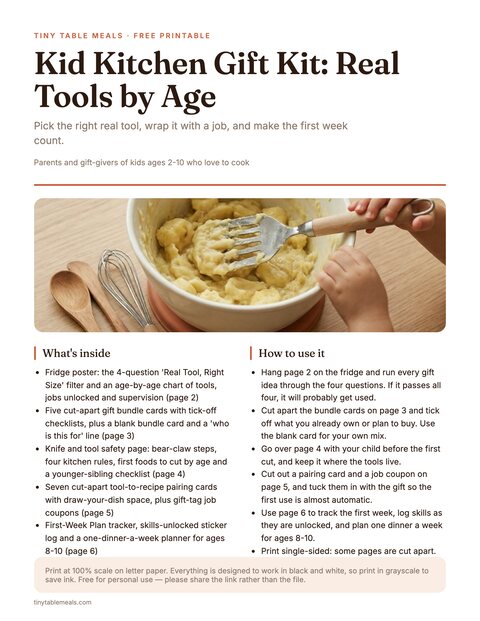
Free printable · 6 pages
Kid Kitchen Gift Kit: Real Tools by Age
A fridge poster with the 4-question Real Tool, Right Size filter and age chart, cut-apart gift bundle cards, a knife and tool safety page, tool-to-recipe pairing cards with job coupons, and a First-Week Plan tracker with a one-dinner-a-week planner for ages 8-10.
Free. Your download link appears right here. You'll also join the Sunday Supper Plan. Unsubscribe anytime. Privacy
This guide covers real kitchen tools for ages 2-10: the job each one unlocks, the supervision it needs, baking gifts, and ready-made bundles. It follows the stages in our age-by-age cooking guide.
In this article (16 sections)
- How to Choose Kitchen Gifts for Kids
- Gifts by Age at a Glance
- Best Kitchen Gifts for Toddlers (Ages 2-3)
- Kitchen Gifts for Ages 4-5: First Knife and Measuring Tools
- Kitchen Gifts for Ages 6-7: Chopping, Grating, and Recipes
- Kitchen Gifts for Ages 8-10: Whole-Meal Tools
- Gifts for Kids Who Love to Bake
- Non-Tool Gifts for Kids Who Cook
- What to Skip (or Approach Carefully)
- Kitchen Safety Rules and First Aid for Young Cooks
- How to Introduce a Kitchen Gift: First-Week Plan
- Kids Cooking Gift Sets and Bundles by Age
- First Recipes to Pair With Each Kitchen Gift
- Keepsake gifts from our sister brands
- Frequently Asked Questions
- Final Thoughts
How to Choose Kitchen Gifts for Kids
Here’s the four-question filter I run every kitchen gift through; a gift that passes all four usually gets used. (No brand names here: good versions exist at every budget, and the kind of tool matters more than the price.)
- Does it do a real job? A whisk should whisk. A peeler should peel. If the gift only makes pretend food, it’s a toy, and toys are fine, but they’re a different gift.
- Can small hands control it? Handle length, weight and grip matter more than the packaging. A tool that’s too heavy or too long wobbles, and that’s when kids get frustrated or hurt.
- Does it unlock a specific job at our table? “Kitchen set” is vague. “Your job is now the salad dressing” is a job. The gift should map to something your family eats weekly.
- Is the supervision it needs something I can actually give? A gift that demands an adult at the stove every time won’t survive a busy Tuesday. Pick tools whose supervision level fits your real evenings.
Why real tools beat toy sets
Pretend sets are fine for imaginative play. But for a child already into real cooking, a toy set can feel like a consolation prize. Real tools say you’re trusted here.
Gifts by Age at a Glance
Here’s the quick reference. The sections below cover each age band: gift types, the first job to hand over, and how to stage the learning.
| Age | Tool type to look for | Kitchen job it unlocks | Supervision it needs |
|---|---|---|---|
| 2-3 | Step stool or learning tower, child-size spoon and spatula, small whisk, heavy bowl, produce brush. | Washing produce, stirring cold batters, tearing greens, mashing soft foods, pouring pre-measured ingredients. | Constant: adult within arm’s reach, hands-on for anything near heat. |
| 4-5 | Nylon or serrated kid-safe knife, vegetable peeler with a comfortable grip, set of measuring cups and spoons, small rolling pin, cookie cutters, apron. | Cutting soft foods (bananas, cooked potatoes, mushrooms), peeling, measuring dry and wet ingredients, rolling dough. | Close: adult at the counter, watching knife work and guiding hands. Stovetop work is adult-only. |
| 6-7 | Short paring knife, kid-size oven mitts, box grater, citrus juicer, simple scale. | Chopping with a claw grip, grating, juicing, cracking eggs, short recipes. Around 7, some kids can stir a pot on a back burner with an adult’s hand on the pot handle. | Directly beside them for knives and any heat; the adult controls the burner. Nearby for practiced cold tasks. |
| 8-10 | Utility or paring knife, steady cutting board, instant-read thermometer, heat-safe spatulas, cooling rack, recipe binder. | Chopping a meal’s veg, stovetop cooking with an adult in the kitchen, baking start to finish, one dinner a week. | In the kitchen for all stovetop work. Hands-on teaching for new skills like hot oil or the oven. |
Across all four rows, the tool gets sharper or hotter and the adult steps back a little at a time. A gift is a natural moment to make that step feel earned.
Best Kitchen Gifts for Toddlers (Ages 2-3)
Toddlers who love to cook mostly want to be where you are, so the best gifts for this age solve the access problem first and the tool problem second.
The gift that matters most: a safe way to reach the counter
The best gift for a toddler who loves to cook is a stable step stool or a learning tower. A learning tower adds a protective railing, and either one puts them at counter height instead of on your hip or a wobbly chair.
What to look for:
- A wide, non-tipping base. If you can rock it with your foot, skip it.
- A railing or enclosed sides for the youngest toddlers, so a lean doesn’t turn into a fall.
- A non-slip surface on the standing platform.
- An adjustable height, if possible, so it grows with them.
- Easy cleaning. It will be coated in flour and banana within the week.
Set it up at the counter where you prep, not in a corner where it feels like a time-out spot.
Safety firstPlace it away from the stove, hot surfaces, and appliance cords. Never leave a child alone on it. Check the weight and age limits, lock any adjustable platform, and test its stability on your own floor.
Stirring and mashing tools
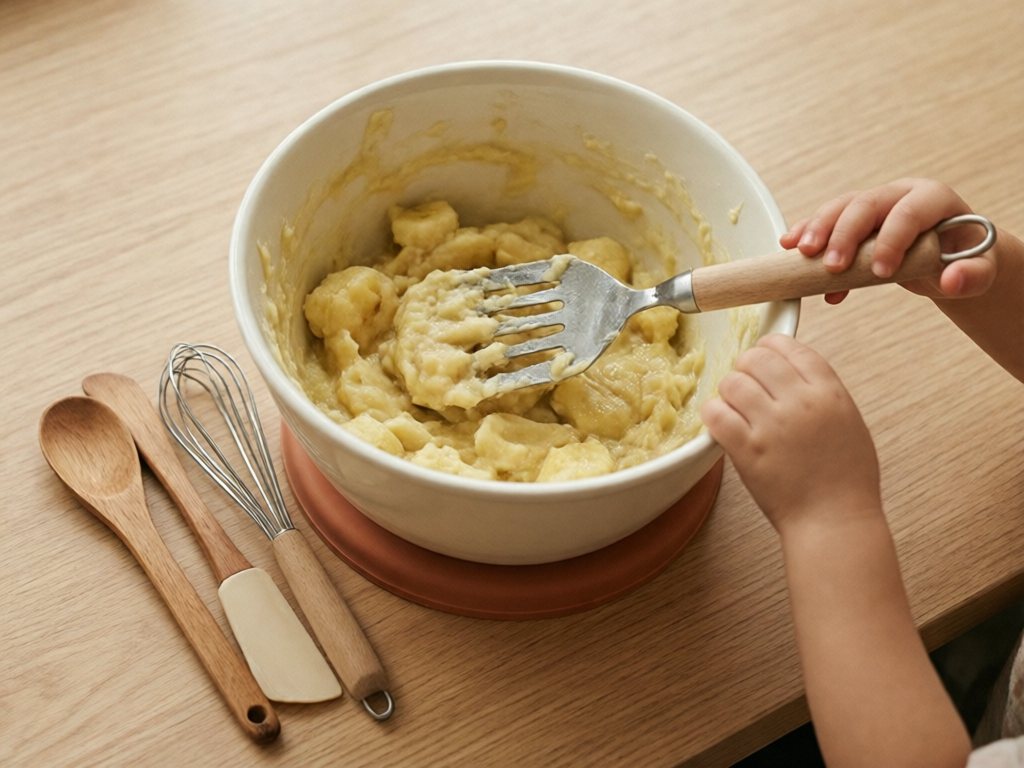
Once they’re at the counter, toddlers need things they can do with their whole hand and arm:
- A child-size wooden spoon or a sturdy silicone spatula. Sized right, it’s easier to control than your big spoon. Silicone is forgiving on bowls and doesn’t splinter.
- A short, sturdy whisk with a silicone or rounded-wire head. Whisking is a toddler superpower: loud and satisfying. Supervise, since thin wire ends can poke.
- A large, heavy mixing bowl, or one with a non-slip base. A bowl that slides is a bowl that ends up on the floor. Heavier ceramic or a bowl with a silicone ring on the bottom stays put while they stir.
- A potato masher. Mashing bananas, cooked sweet potato, or avocado is satisfying and a great first “real” job.
Washing and tearing tools
Some of the most useful toddler jobs have nothing to do with heat or blades:
- A soft produce brush for scrubbing potatoes, carrots, and apples in a bowl of water.
- A salad spinner. Toddlers love to pump or pull, and “spin the lettuce” is a real job that gets greens on the table.
- A small colander that fits in the sink or a basin.
Jobs a 2-3-year-old can take on
Give them a job with a clear beginning and end, and keep the first few simple. Good starters are scrubbing potatoes, tearing lettuce or herbs, stirring cold batter or yogurt dip, and mashing bananas or avocado. They can also dump in ingredients you measured and press a cookie cutter into soft dough.
Supervision for ages 2-3
Safety firstConstant and close, and hands-on for anything near heat. Say no to any sharp tool at this age, including “kid-safe” knives. Keep their jobs cold, soft, and stable.
Safety firstFor children under 4, cut grapes, cherry tomatoes and hot dogs lengthwise into quarters. Grate or cook hard raw vegetables like carrots, skip whole nuts and popcorn, and have kids sit down to taste. No tasting raw dough or batter.
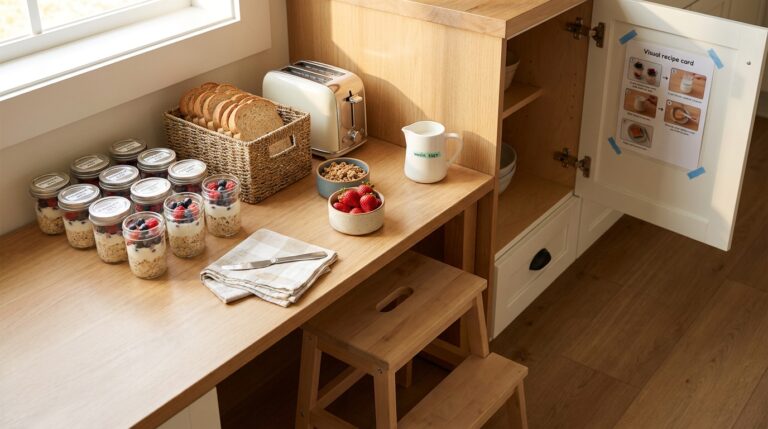
One trick that helps: keep a small basket of their tools in a low drawer or at the bottom of a cabinet so they can find the whisk and spatula themselves.
Kitchen Gifts for Ages 4-5: First Knife and Measuring Tools
This is the leap age. A four- or five-year-old who loves to cook is ready for tools that actually cut, peel, and measure, as long as you pick the right ones and teach them slowly.
The first knife
A kid-safe knife is the gift that feels like a rite of passage, and it deserves a careful choice. For this age, look for:
- A nylon or firm plastic blade with a serrated edge. It cuts soft foods like bananas, cooked carrots, mushrooms, strawberries, and cheese. It is much less likely to cut a finger, but it can still nick skin, so stay right beside them.
- A handle sized for small hands, with a guard or a grip that keeps fingers back from the blade.
- A blade that’s long enough to cut real food but short enough to control.
Avoid anything labeled a “kid knife” that’s really a flimsy novelty piece. If it can’t slice a soft banana cleanly, your child will get frustrated and the knife will go in the drawer.
Safety firstA kid-safe knife can still nick skin. Do the first cuts hand-over-hand, with your hand over theirs on the handle. Stay right beside them for every knife session at this age.
Teach the basics before the first cut:
- Hold the handle firmly, and curl the fingertips of your other hand under like a claw. Knuckles face the blade to guide it. Never lay fingers flat on top. (We call it a “bear claw” at our house.)
- Cut on a stable board. A damp towel or non-slip mat under the board prevents sliding.
- Cut away from your body and away from your holding hand.
- Knife down and hands off when you stop to talk or look around.
Start with food that’s soft and stays put: a banana, a cooked potato, a block of mild cheese, a mushroom. A slippery round tomato is a bad first choice.
Peelers and measuring sets
- A swivel peeler with a comfortable, fat grip. Peeling a carrot or cucumber over a bowl or the sink is a real, satisfying job.
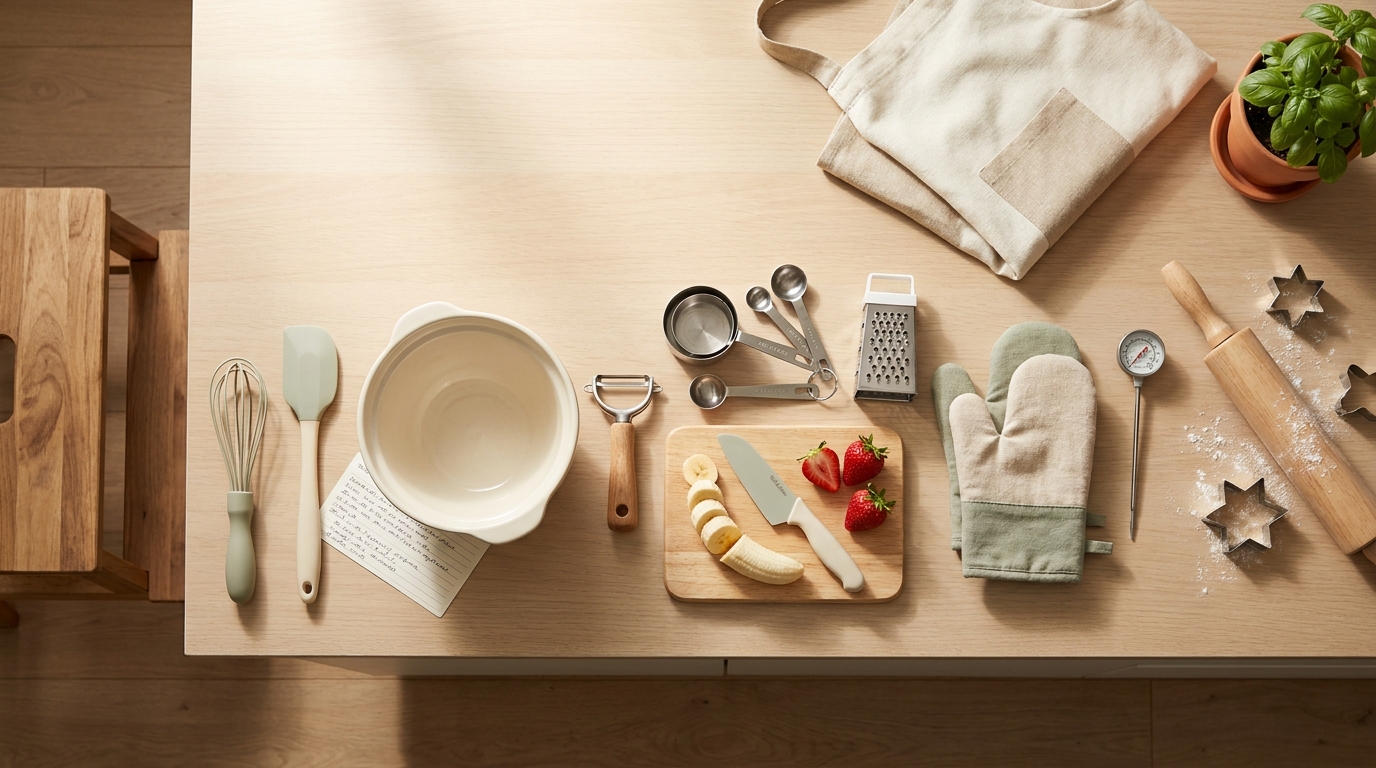
- A set of measuring cups and spoons. One of the best gifts for this age: a child who “owns” the measuring cups can be in charge of the flour for every pancake breakfast. Look for clear, stamped markings that won’t wash off.
- A small rolling pin for cookies, pie dough, or homemade pizza. Wooden ones are classic, and some silicone versions are lighter.
- Cookie cutters in simple shapes. Fewer, simpler shapes beat a giant bag of tiny novelty ones.
- An apron that fits. A real apron makes a child feel like a real cook. Pick one with a breakaway Velcro or snap neck strap, and skip long ties and fixed neck loops, especially for younger kids.
Jobs a 4-5-year-old can take on
Cutting soft foods, peeling carrots and cucumbers, measuring flour and liquids, and rolling out dough. With an adult at the counter, they can also crack eggs into a small bowl first so shell can be fished out; wipe up raw egg right away and wash hands. No-heat recipes like fruit salad, yogurt parfaits, and snack boards are a good fit too.
Looking for first recipes to try with the new tools? Our post on after-school snacks kids can make themselves is full of no-stove, low-risk ideas that fit this age.
Supervision for ages 4-5
Safety firstClose: an adult at the counter, watching knife work and guiding the other hand. Stovetop work is adult-only. Kids can stir a cooled mixture, like batter or a chilled dip, but nothing on a burner from a stool.
Kitchen Gifts for Ages 6-7: Chopping, Grating, and Recipes
By six or seven, many kids can handle most of what a recipe asks, one careful step at a time. This is the age when gifts start to look less like “kid versions” and more like smaller versions of real tools.
Moving up to a real small knife
After steady, supervised practice with a kid-safe knife, some kids are ready for a small paring knife or short utility knife. Readiness varies, so go by your child, not the birthday. Look for:
- A short blade (about 3-4 inches), which is easier to control and less intimidating.
- A sharp edge. Sharp enough to cut a tomato without sawing. A dull knife slips. Keep an adult beside the child, because a sharp edge cuts deeper if it does slip.
- A comfortable, non-slip handle.
- A blade cover or sheath for safe storage.
Introduce it with a clear lesson, not just a handoff. Show the claw grip, the stable board, and the rule that the knife never gets carried while walking. Keep early sessions short, with a single vegetable, and finish while it still feels fun. A cucumber, a zucchini, a bell pepper, or a block of cheese are all good first targets.
Grating, juicing, and whisking
- A box grater. Grating cheese, carrots, or zucchini is a real contribution to dinner. Teach kids to grate with a firm hand, with an adult close by the first few times. Stop when the piece gets small, and set the stub aside to eat or chop.
- A citrus juicer. Hand-held squeezers and reamers let kids make lemonade or juice limes for tacos.
- A mixing bowl and whisk set. At this age, they can whisk eggs for scrambled eggs, mix dry ingredients for muffins, and fold batter without a mess.
- A simple kitchen scale. If your family likes weighing ingredients, a scale gives them a clear, visual, number-based task.
Oven mitts that fit
Properly sized oven mitts are one of the best gifts for this age. Standard adult mitts are huge and clumsy on a small child. Look for:
- Mitts sized for kids’ hands and forearms.
- Heat-resistant material, with a decent grip.
- A snug fit that doesn’t slide around.
Even with the right mitts, oven work at this age should have an adult right there. The mitts protect from brief contact, and the adult handles the heavy or risky lifting.
Jobs a 6-7-year-old can take on
Chopping vegetables for soup or salad, grating cheese, juicing citrus, and cracking and whisking eggs. They can follow a short written or picture recipe and make a simple lunch, like a sandwich, wrap, or bento. Around 7, some kids can also stir at the stove with an adult right beside them.
For lunchbox creativity, our guide to bento box lunch ideas for kids pairs well with a new set of tools. Packing a bento is a real, repeatable job a six- or seven-year-old can own.
Supervision for ages 6-7
Safety firstHeat and knife work are hands-on, with an adult directly beside the child. “Nearby, not hovering” applies to cold tasks only, like whisking or measuring. Stovetop work is still mostly the adult’s job: some 7-year-olds can stir oatmeal on a back burner while the adult keeps a hand on the pot handle and controls the burner. Any new skill needs hands-on teaching again.
Kitchen Gifts for Ages 8-10: Whole-Meal Tools
By eight, a child who loves to cook can often plan, prep, and cook a simple meal with an adult nearby. The best gifts here support independence and pride, not just skill.
A real knife for real prep
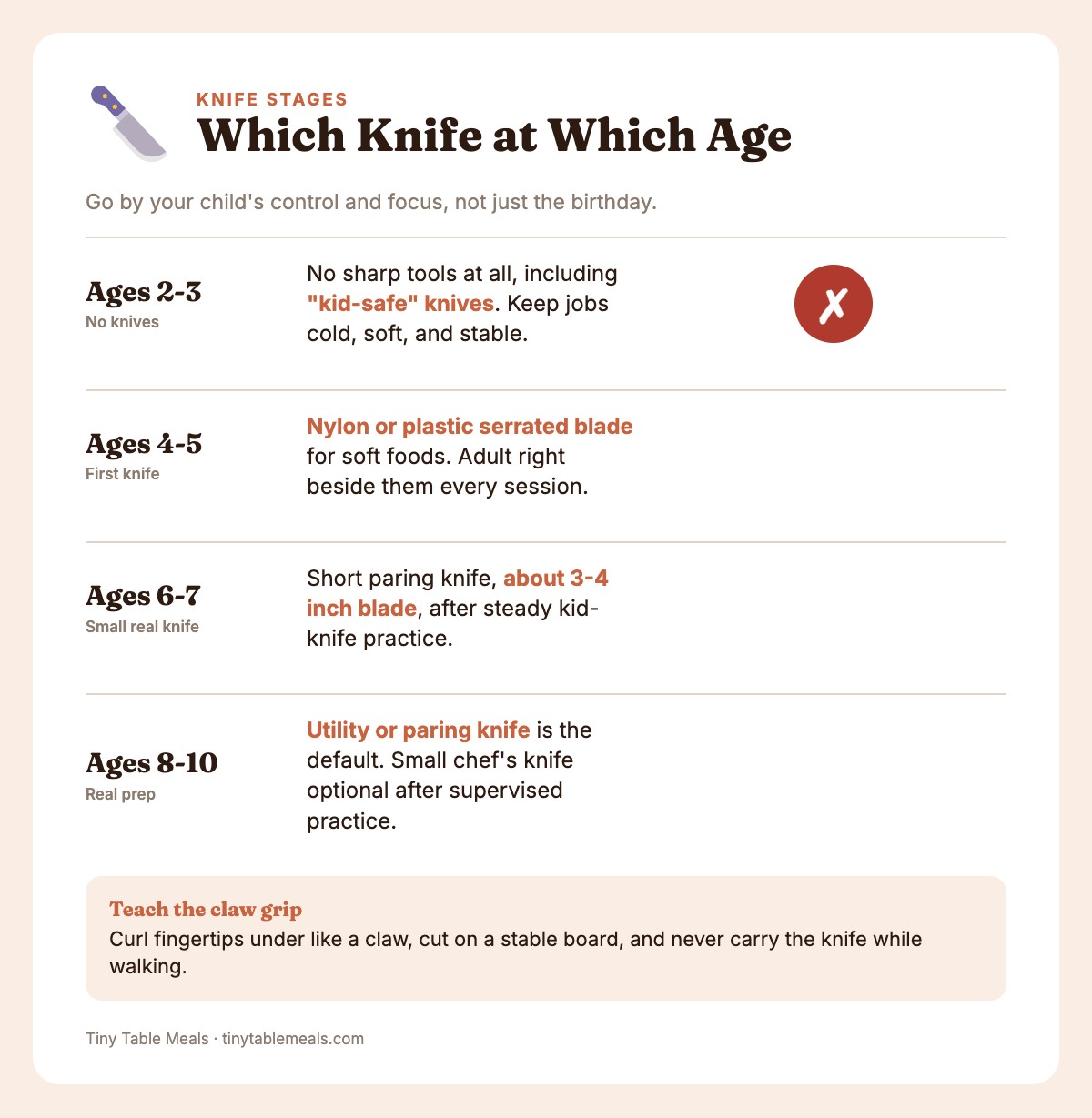
A utility or paring knife is the right default through about age 10. A small chef’s knife is optional, depends on skill, and only comes after steady supervised practice with an adult at the counter. Pair the knife with a few extras:
- A cutting board that stays put. A larger board with a non-slip edge or mat beneath it gives room to work and prevents sliding.
- A knife skills lesson, which makes a great gift in itself. Spend one afternoon showing the rocking motion, how to dice an onion, and how to handle round foods safely.
A thermometer for safe cooking
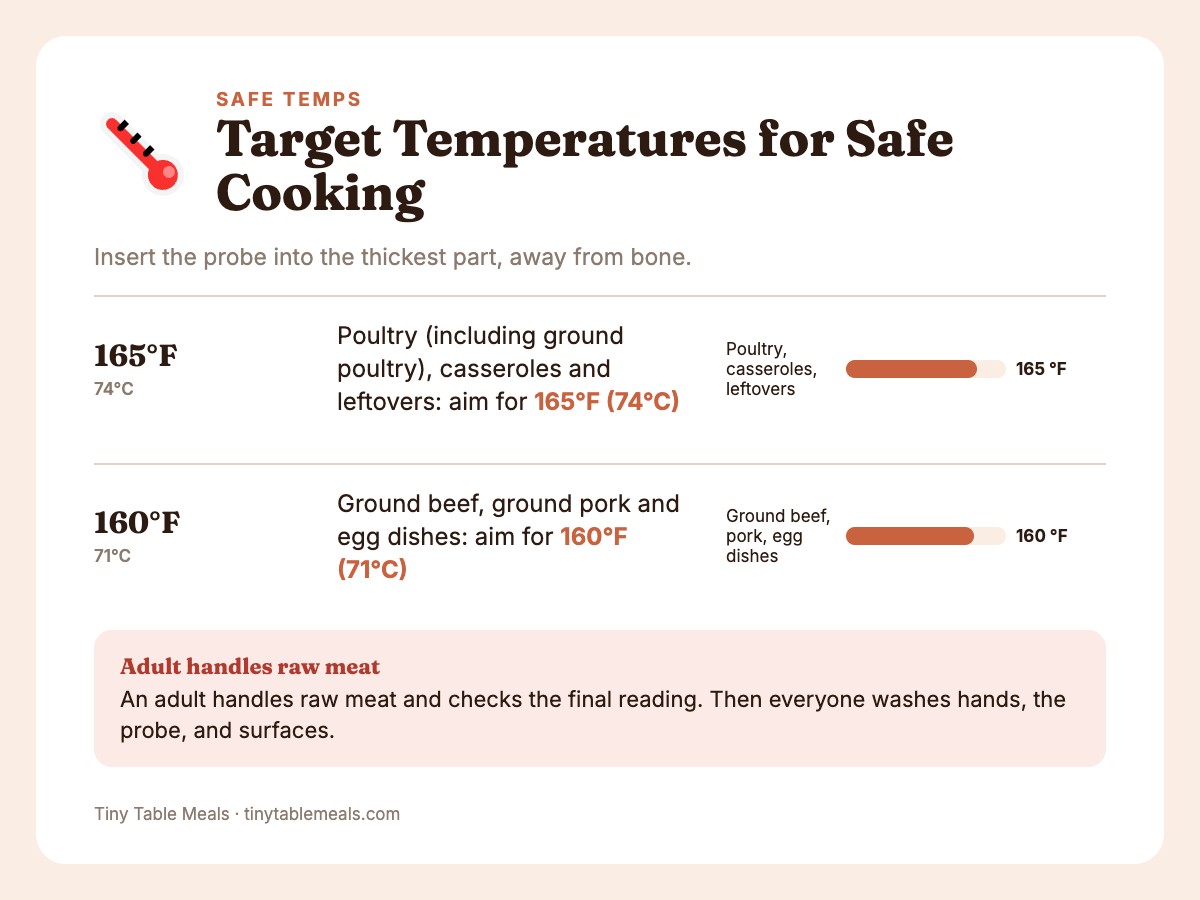
An instant-read thermometer turns food safety into a number kids can read. That number also tells them the job is done, which builds confidence.
Insert the probe into the thickest part, away from bone. These are the targets I’d teach first:
| Food | Safe minimum temperature |
|---|---|
| Poultry (including ground poultry), casseroles, leftovers | 165°F (74°C) |
| Ground beef, ground pork, egg dishes | 160°F (71°C) |
| Whole cuts of beef, pork and lamb (steaks, chops, roasts) | 145°F (63°C), then a 3-minute rest |
| Fish | 145°F (63°C) |
TipAn adult handles raw meat and checks the final reading. Then everyone washes hands, the probe, and surfaces.
Baking and stovetop gear
- Heat-safe silicone spatulas for scraping bowls and for stirring at the stove with an adult in the kitchen.
- A cooling rack, which makes baking feel professional and keeps hot pans off counters.
- A couple of sheet pans and a muffin tin sized for their favorite recipes.
- A small saucepan with a sturdy, heat-safe handle for oatmeal or sauces, used with an adult in the kitchen.
- A personal recipe binder or box. A simple binder with sheet protectors and a few favorite recipes is a gift that feels like a keepsake. Let them add their own notes and drawings.
Jobs an 8-10-year-old can take on
Chopping a full dinner’s vegetables, baking from start to finish, packing their own lunches, and doubling or halving a recipe. They can cook pasta, eggs, and simple sauces with an adult in the kitchen, while adults drain boiling water. Many can also plan and cook one family dinner a week.
A “one dinner a week” job can be the best gift your child gets all year. If your child loves cooking, hand over a night, like Taco Tuesday, and let the new tools do the work. Our Build-Your-Own Noodle Bar idea is a good example of a meal a ten-year-old can lead, with an adult in the kitchen for the stove and for draining the pasta.
Supervision for ages 8-10
Safety firstAn adult stays in the kitchen for all stovetop work and handles draining boiling water and lifting heavy hot pots. Be hands-on for new or risky skills like hot oil or the first few oven sessions, and leave mandolines to adults. For practiced cold tasks, a quick check-in is enough.
Gifts for Kids Who Love to Bake
Baking rewards precision and patience, so it suits kids who like following steps and watching results.
For more kid-run baking ideas, see our treats kids can bake and our breakfasts kids can make.
What a young baker actually uses
Skip the novelty sets and think about the tools used in nearly every recipe:
- Measuring cups and spoons. One set for dry and one for liquid if you can.
- A mixing bowl set. At least one large and one medium bowl.
- A whisk, a silicone spatula, and a wooden spoon.
- A rolling pin and a few cookie cutters.
- A cooling rack and a couple of sheet pans.
- A muffin tin and a loaf pan.
- Parchment paper. It saves scrubbing and makes cleanup easy.
- A simple kitchen scale. Good for kids who like exactness.
Match the baking gift to the recipe
The best baking gift comes with a first recipe. Wrap a rolling pin and cookie cutters with a favorite sugar cookie recipe and a plan for a baking day.
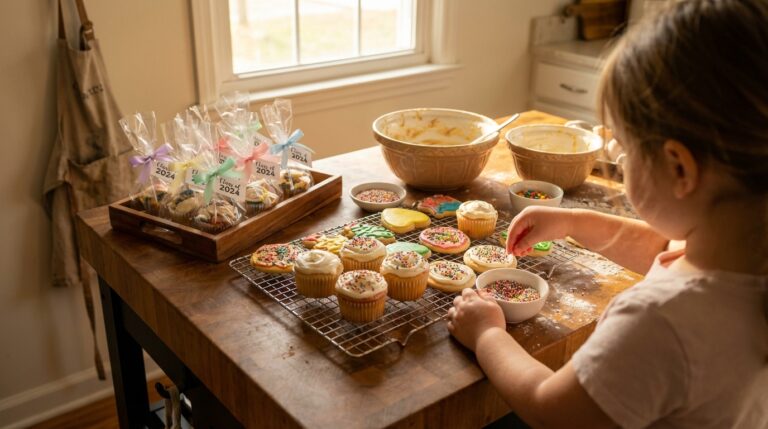
If cookies are the draw, our guide to holiday cookie baking with kids walks through dough, decorating, and keeping the chaos manageable. It works well as a “first project” for a new baker.
A few starter recipes that suit different ages:
| Age | Starter baking project | Why it works |
|---|---|---|
| 2-3 | Banana muffins (mash, stir, pour) | Mostly mashing and stirring, forgiving batter. |
| 4-5 | Cut-out sugar cookies | Measuring, rolling, and cutting shapes (no tasting raw dough). |
| 6-7 | Drop biscuits or simple quick bread | Cracking eggs, whisking, following steps. |
| 8-10 | A full loaf of bread or a layer cake | Timing, temperature, and multi-step planning. |
Baking safety
Safety firstNo tasting raw dough or batter. Wash hands and surfaces after handling raw eggs or flour, and bake eggs and doughs fully. Check labels and household allergies before gifting baking ingredients or kits (see our egg-free baking substitutes).
Ovens are hot, and baking involves more heat than most no-cook recipes. A few rules help:
- Adults handle the oven door and hot pans until a child has shown steady, reliable skill. Ages 6-7 need an adult right beside them for any oven work; older kids need one in the kitchen.
- Always use oven mitts, not towels.
- Keep a clear landing spot on the counter for hot pans.
- Set a timer together and teach kids to check on baked goods rather than assume.
Non-Tool Gifts for Kids Who Cook
Some of the best kitchen gifts are time, space, and encouragement.
Experiences and invitations
- A standing “cook with me” date. A hand-drawn coupon for one dinner a month where they’re the head chef.
- A kid-led menu night. Let them pick and plan a full meal, including a grocery trip.
- A kids’ cooking class or workshop, if there’s one near you. Check the listed age range and whether a parent stays.
- A farmers market trip where they pick one new vegetable to cook.
Their own space
- A low drawer or shelf for their tools, so they can reach them without asking.
- A small apron hook with their name on it.
- A dedicated cutting board that’s theirs.
Books and recipe keepers
- A kids’ cookbook with clear photos and step-by-step instructions. Look for ones with simple, repeatable recipes rather than elaborate ones.
- A blank recipe journal, where they can draw, rate recipes, and note changes.
- A subscription to a kids’ cooking magazine, if your child likes mail and reading.
Ingredients and gardening
- A small herb pot for the windowsill, so they can snip basil or chives for dinner.
- A seed packet and a pot for tomatoes, lettuce, or sprouts.
- A special ingredient like good vanilla, a fun spice, or sprinkles for a baking day.
For gardeners and produce fans, tying a gift to the season makes it more exciting. Our fall produce guide for families is a handy reference when you want to pair a new tool with what’s actually at the market this month.
What to Skip (or Approach Carefully)
Items that are really toys
- Play food sets with no real use. Fun for pretend play, but not the right match for a kid ready to cook.
- “Real” cooking sets that don’t actually work, like tiny ovens that barely heat or tools that break in a week.
- Elaborate novelty gadgets that do one narrow thing, like a gadget that only makes one shape of food.
Items that need more caution
- Anything with exposed heating elements meant for kids. If an appliance really cooks, it can really burn. Treat it like a real appliance and keep the adult close.
- Very sharp or specialized tools like mandolines or large chef’s knives, for kids who haven’t had knife training.
- Gadgets with lots of small parts that get lost or become choking hazards for younger siblings.
- Battery-powered tools and corded appliances. Pick scales and thermometers with secured battery compartments. Keep appliance cords short and out of reach.
Safety firstMany digital scales and thermometers run on button or coin batteries. If you think a child swallowed one, go to the ER immediately, and do not wait for symptoms. In the US, call the National Battery Ingestion Hotline (800-498-8666) or Poison Help (800-222-1222) on the way. Don’t let them eat or drink anything until a clinician says so, and don’t make them vomit. Keep spare batteries away from toddlers.
A note on younger siblings
If you have a toddler in the house, keep the older child’s knives, graters, and small parts out of reach. A dedicated, high drawer or a lidded bin helps. A gift for an eight-year-old shouldn’t become a hazard for a two-year-old.
Kitchen Safety Rules and First Aid for Young Cooks
Clear rules and calm teaching keep the risk of real tools manageable.
Four kitchen rules we use at home
- Wash hands first. Every time. It’s the first step of every recipe.
- Tell an adult before using the stove, oven, or a sharp tool (until that skill is officially “unlocked”).
- Knives stay on the board. No walking with them, no waving them around.
- Tie back long hair, and keep loose sleeves and apron ties away from burners. Wear closed shoes if you can.
When something goes wrong
A small cut or burn will happen at some point. Keep a first-aid kit in the kitchen, stay calm, and treat it as part of learning, not a failure.
Good to knowBurns. Call emergency services for a severe burn. Otherwise, cool the burn under cool (not ice-cold) running water for 20 minutes, and remove rings or tight items nearby. Don’t use ice, butter or creams. Seek care for burns larger than the child’s palm, or on the face, hands, feet, joints or genitals. Also seek care for any blistering burn in a young child, or any burn you’re unsure about.
Good to knowCuts. Call emergency services right away for spurting or heavy bleeding. For a smaller cut, apply firm pressure with a clean cloth for 10 minutes. Call emergency services if the bleeding has not stopped after those 10 minutes. Get care if the cut is deep or gaping.
If a child gets a bad scare, take a break from that tool and come back gently. Confidence returns faster than you’d think.
Know your child
Some seven-year-olds have the focus of a surgeon, and some ten-year-olds still get silly with a knife. Treat the age bands in this guide as a starting point, and move up or down based on what you see.
How to Introduce a Kitchen Gift: First-Week Plan
A gift is only as good as its first week. Here’s how I turn a new tool into a habit instead of a forgotten present.
- Day 1: Open it and use it. Plan a simple recipe that uses the gift the same day or the next.
- Day 2-3: Show the safety basics. Show how to hold the tool, where to use it, and the rules. Keep it short and hands-on.
- Day 4-5: Give a regular job. Name the task: “You’re our official pancake whisker.” Naming makes it feel real.
- Day 6-7: Cook something together. Pick a family meal where their tool plays a clear part, and let them take credit at the table.
- After the first week. Keep the tool visible and accessible. A tool in a basket on the counter gets used. A tool in a high cabinet gets forgotten.
Kids Cooking Gift Sets and Bundles by Age
Bundling a few related items turns a single tool into a ready-to-go activity. Here are combinations I’d put together.
The budget column is a rough order ($ lowest, $$$ highest), not a price; check current ones.
| Bundle | Age | What’s inside | First recipe to pair | Rough budget |
|---|---|---|---|---|
| Toddler Helper | 2-3 | Stable step stool or learning tower, child-size whisk and silicone spatula, heavy mixing bowl, recipe card. | Banana muffins. | $ with a step stool, $$$ with a learning tower |
| Little Chef | 4-5 | Kid-safe serrated knife, fat-handled peeler, measuring cups and spoons, apron that fits. | Fruit salad or snack board. | $ |
| Sous Chef | 6-7 | Small paring knife with sheath, box grater, kid-size oven mitts, picture-based recipe. | Cheesy quesadillas. | $$ (mitts and grater) |
| Head Chef | 8-10 | Utility or paring knife, stable cutting board, instant-read thermometer, heat-safe spatulas, recipe binder, “your night to cook” coupon. | A full family dinner. | $$ (thermometer) |
| Young Baker | Any, adjusted | Measuring set, whisk, spatula, rolling pin, cookie cutters, cooling rack, sheet pan. | Sugar cookies and a baking-day plan. | $ |
First Recipes to Pair With Each Kitchen Gift
I always tuck a recipe card or two in with a kitchen gift, so the first use is almost automatic. Match the card to recipes the family eats anyway. A few ideas to pair with common gifts:
| Tool | Easy first recipes |
|---|---|
| Peeler | Carrot and cucumber ribbon salad, roasted root vegetables, applesauce. |
| Grater | Cheesy quesadillas, zucchini fritters, taco night toppings. |
| Measuring set | Pancakes, muffins, homemade granola. |
| Rolling pin | Pizza night, sugar cookies, hand pies. |
| Juicer | Lemonade, lime dressings, citrus fruit salad. |
| Thermometer | Baked chicken thighs, meatloaf, egg bake. |
| Whisk | Scrambled eggs, vinaigrettes, whipped cream. |
If your family eats a lot of soups and braises in the colder months, a child with a new knife can chop for a pot of something warm. Our slow-cooker fall dinners are a gentle way to start, since the chopping happens in the morning and the cooking runs on its own.
From our sister brands
Keepsake gifts from our sister brands
These do not go in a utensil drawer. They are here because the kitchen is where many families read together after dinner and mark heights on the door frame.
Akoni Books and White Loft are sister brands of this site. When you buy through these links we may earn a portion of the revenue, at no additional cost to you.

Akoni Books
Christmas Magic: a storybook starring your child
A book for after dinner. You enter your child's name, age and interests, upload one photo and pick from nine art styles, and the pictures are drawn to look like them. You see the cover and first pages before paying. Order a printed copy by December 5 and most US orders arrive before Christmas.
Digital $9.99 · Softcover $29.99 · Hardcover $39.99, shipping included
First book? Code WELCOME5 takes $5 off at checkout.
Preview it free
White Loft
The kitchen door frame is where many families pencil in heights. This does the same job on cream canvas with a fabric pen, and it rolls up and comes with you when you move.
$40.99 on Amazon
See it on Amazon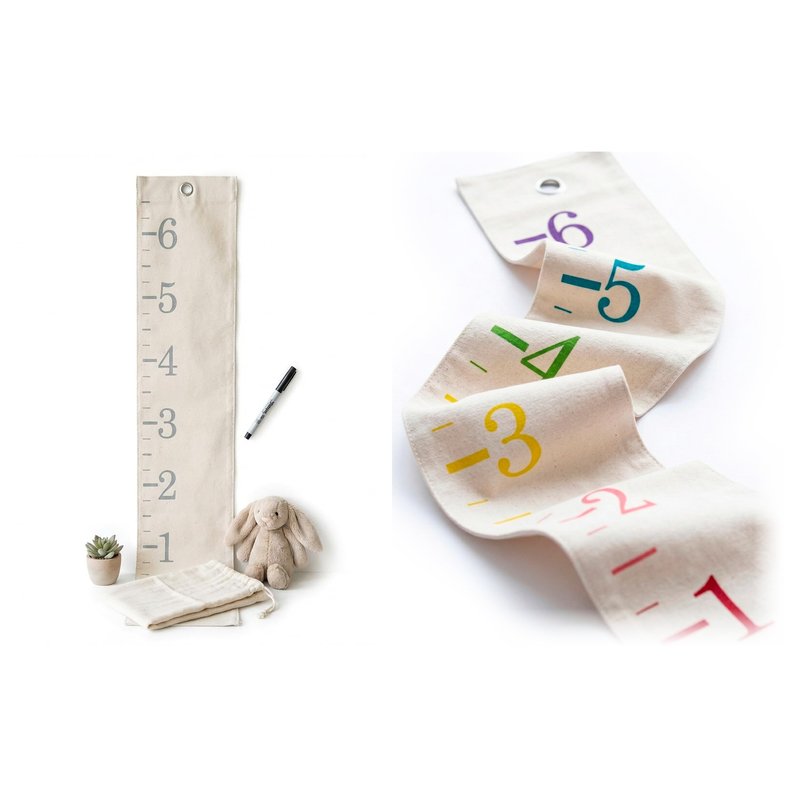
White Loft
For two small cooks: the classic gray chart and the rainbow one, so each child has their own to mark. As a set it costs 15% less than the two bought separately.
$68.83 on Amazon
See it on AmazonPrices checked October 2026; they can change.
Frequently Asked Questions
What are the best gifts for toddlers who love to cook?
For toddlers, start with access and safety. A stable step stool or learning tower is the single most useful gift, because it puts your child at counter height safely. After that, think big and soft: a child-size whisk, a silicone spatula, a heavy mixing bowl that won’t slide, a potato masher, and a gentle produce brush. Skip knives and anything sharp at this age. The jobs that suit toddlers are washing, tearing, mashing, stirring cold batters, and pouring pre-measured ingredients, with an adult within arm’s reach the whole time.
At what age can a child start using a real knife?
Many children are ready for a kid-safe serrated nylon knife around ages 4 or 5. Use it on soft foods like bananas, cooked potatoes, and mushrooms, with an adult close by.
A small paring knife with a real blade often makes sense around ages 6 or 7, after a child has shown steady control and learned the claw grip. Around ages 8 to 10, a utility or paring knife is still the default. A small chef’s knife is optional after steady supervised practice.
These are guidelines, not rules. Watch your own child’s focus and coordination, and teach each new knife skill hands-on before stepping back.
What kitchen gifts are good for kids who love to bake?
Look for the tools used in almost every recipe: sturdy measuring cups and spoons, a mixing bowl set, a whisk, a silicone spatula, a rolling pin, cookie cutters, a cooling rack, and a couple of sheet pans. Add a muffin tin and some parchment paper, and you have a full starter kit. A simple kitchen scale is great for older kids who like precision. The best baking gifts come with a first recipe and a planned baking day, so the gift gets used right away. Adults should handle the oven and hot pans until a child has proven steady, careful skills.
Are kids’ cooking sets worth buying?
It depends on what you want. Pretend cooking sets are fine for imaginative play, especially for younger toddlers. But if your child is already showing real interest in cooking, a toy set often disappoints, because the pretend tools can’t do real jobs. For kids who want to help make dinner, individual real tools sized for small hands tend to get used more. Think of a peeler with a fat grip, a small whisk, or a kid-safe knife.
How do I keep a cooking gift from getting forgotten?
Use it within the first few days, and give it a specific job at your table. Instead of “here’s a peeler,” say “you’re in charge of the carrots for Tuesday’s dinner.” Tuck a simple recipe card in with the gift so there’s no “now what?” moment. Keep the tool visible and reachable, such as in a low drawer or on a counter basket, rather than in a high cabinet. Finally, schedule the first cooking session before the novelty wears off, ideally with a meal your family already eats.
What should I avoid when buying kitchen gifts for kids?
Be cautious with novelty gadgets that do one narrow thing, toy sets that look real but don’t work, and tools with lots of small parts that can be a hazard for younger siblings. Also avoid anything with an exposed heating element unless you’re ready to supervise it like any real appliance, and hold off on very sharp specialty tools like mandolines until a child is much older. Focus on simple, sturdy, real tools in the right size, and match the gift to what your child can safely do at their age.
How much supervision does a child need in the kitchen?
It changes with age and task. Toddlers (2 to 3) need constant, hands-on supervision, and adults handle all heat for them. Children 4 to 5 need close supervision for knife work, and stovetop work is adult-only at this age. Kids 6 to 7 can do practiced cold tasks with an adult nearby, but heat and knife work need an adult directly beside them. Children 8 to 10 need an adult in the kitchen for all stovetop work, plus hands-on teaching for new skills like hot oil or the oven.
Final Thoughts
When my daughter traded that pink plastic set for the real whisk, she was telling me she wanted a place in the work. Every real tool you hand a child answers back: you belong here, and I trust you with this.
So pick one tool that fits your child’s age, find one dinner it can help with, and put it in their hands this week. It doesn’t need to be fancy or perfect, just real and used. Not sure what to teach first? Our age-by-age cooking guide lays out the skills for each stage.