
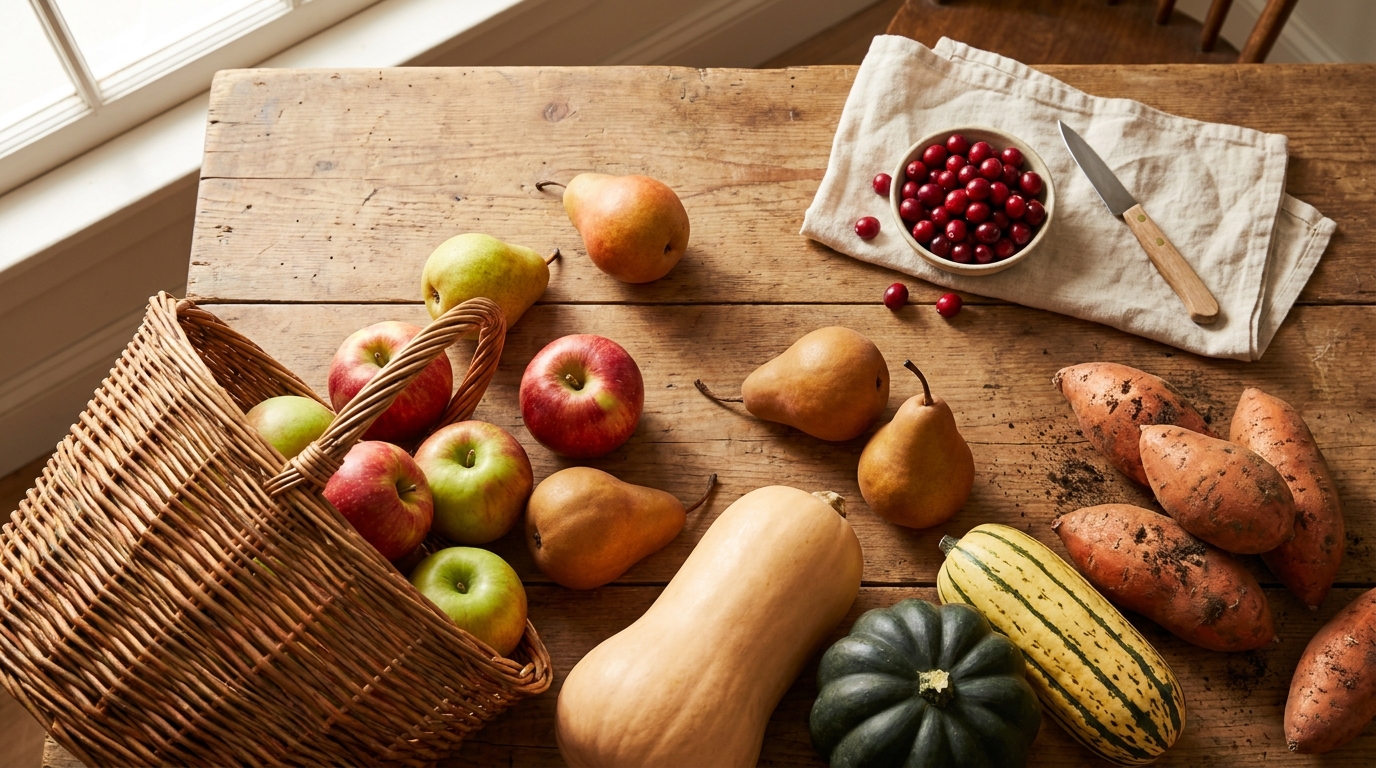
Fall Produce Guide for Families: What’s Fresh Right Now and How to Use It
Discover how to easily incorporate kid-friendly fall produce like apples, pears, and squash into your family's meals. You'll learn what's in season, how to store it, and simple, low-drama ways to get your kids to actually eat it.
- Embrace fall produce; it's naturally sweet, forgiving, and roasts easily for kid-friendly meals.
- Shop less cautiously for fall crops; they're engineered to last for months, unlike summer produce.
- Expect fall produce prices to drop quickly once harvest is in full swing by mid-to-late September.
- Stock a 'produce drawer' with apples, pears, and squash for easy weekly meal planning.
- Choose the right apple variety for the job (e.g., Honeycrisp for eating raw) to ensure kids enjoy them.
The first Saturday after Labor Day, I took my kids to our farmers market expecting the same tomato-and-zucchini stands we’d been visiting all summer. Instead, half the tables had flipped overnight — bins of apples in six different colors, a wall of squash that looked like it belonged in a Halloween display, and a woman handing out samples of something my four-year-old described as “an orange that grew wrong” (it was a persimmon, and he ate three). My eight-year-old picked up a delicata squash, turned it over in her hands, and asked, “Is this a vegetable or a decoration?” Fair question. It genuinely does look more at home on a mantel than a cutting board.
That mix-up is kind of the whole story of fall produce. It shows up looking unfamiliar or intimidating — lumpy, hard-shelled, weirdly shaped — right around the time everyone’s schedule gets tighter with school starting back up. So a lot of it ends up decorating porches instead of feeding dinner. Which is a shame, because fall produce is some of the most forgiving, kid-friendly food of the whole year: naturally sweet, roasts into something caramelized and craveable with almost no effort, and holds up beautifully in the fridge so you’re not racing the clock like you are with summer berries.
This guide picks up where our spring produce guide and end-of-summer produce guide left off. Same approach: what’s actually in season right now, what it costs, and — most importantly — simple, low-drama ways to get your kids to actually eat it. No fancy technique required. Just apples, pears, squash, sweet potatoes, and a handful of supporting players that are about to become the backbone of your weeknight dinners for the next three months.
What “Fresh Right Now” Means This Time of Year
September and October are a genuinely good window for produce shopping, for a reason that’s easy to miss: fall crops are engineered by nature to last. Apples, pears, winter squash, and sweet potatoes all have thick skins or tough rinds specifically so they can be harvested once and stored for months — which means the “fresh right now” you’re buying in September is often still good eating in December. That’s different from, say, peak-summer strawberries, which you have about 48 hours to use before they turn.
Practically, that means you can shop less cautiously. Buy the five-pound bag of apples. Grab two squash instead of one. You have more runway than you think, and I’ll walk through storage specifics later in this guide so nothing goes soft in the back of your fridge.
A few other things shift in fall grocery shopping:
- Prices on summer produce climb as local supply dries up and it starts getting shipped from farther away — tomatoes, corn, and stone fruit all get noticeably more expensive and less flavorful in September.
- Fall crops get cheap fast, especially apples and squash, once harvest is in full swing by mid-to-late September.
- Farmers markets thin out but the stalls that remain are almost entirely apples, pears, squash, root vegetables, and greens — which makes fall actually one of the easier seasons to shop, because there’s less to sort through.
If you’re the type of family that does a Sunday grocery run, fall is a good time to build a rotating “produce drawer” of apples, pears, a couple of squash, and a few sweet potatoes that you restock weekly and dip into for whatever the week needs.
Apples: Fall’s Reliable Workhorse
Apples are the produce equivalent of a Swiss Army knife — raw, cooked, sweet, savory, breakfast, dinner, dessert, all covered. And unlike a lot of “healthy” foods, kids don’t need convincing. The trick with apples isn’t getting kids to eat them; it’s picking the right variety for the job, because a mealy Red Delicious in a lunchbox is how a kid decides they “don’t like apples” for the next five years.
| Variety | Best for | Flavor notes |
|---|---|---|
| Honeycrisp | Eating raw, lunchboxes | Sweet-tart, extremely crisp, kid favorite |
| Gala | Eating raw, applesauce | Mild, sweet, soft enough for younger kids |
| Fuji | Eating raw, salads | Very sweet, dense, holds up well cut ahead |
| Granny Smith | Baking, pairing with cheese | Tart, firm, holds shape when cooked |
| Honeygold | Baking, sauce | Sweet, breaks down nicely when cooked |
| Braeburn | Baking, roasting alongside meat | Balanced sweet-tart, firm |
A rule of thumb that’s served me well: if a recipe calls for baking or cooking the apple down, you want something tart and firm (Granny Smith, Braeburn) so it doesn’t turn to mush. If it’s going in a lunchbox or a snack bowl, go sweet and crisp (Honeycrisp, Gala, Fuji).
Kid-friendly ways to use apples
- Apple “sushi” rolls — thin apple slices spread with sunflower seed butter, sprinkled with granola, rolled and sliced into rounds. Toddlers love the shape; it’s basically a fun-size version of an after-school snack they can build themselves.
- Sheet-pan apple chips — thin-sliced apples, a dust of cinnamon, low oven for 2 hours. Chewy, not crispy, and toddlers can manage them without choking risk the way they might with hard raw apple slices.
- Apple and cheddar quesadillas — thin apple slices and shredded cheddar between tortillas, griddled until melty. Sounds odd, disappears fast.
- Baked apples with oats — core an apple, stuff the center with a spoonful of oats, brown sugar, and cinnamon, bake at 375°F for 30 minutes. Feels like dessert, is basically fruit and oatmeal.
- Applesauce, unsweetened, homemade — quarters, a splash of water, simmer 15 minutes, blend or mash. Freezes well in ice cube trays for baby food or lunchbox pouches.
One practical note for lunches: toss raw apple slices in a little lemon or orange juice before packing so they don’t brown by lunchtime. It’s a small thing but it’s the difference between a kid eating their apple slices and a kid refusing them because they “look weird.”
Pears: The Fruit Kids Forget They Like
Pears get overshadowed by apples every fall, which is a little unfair, because pears solve a specific problem apples don’t: they’re genuinely easier for younger kids and toddlers to eat, since a ripe pear is soft enough to gum without much chewing. If you have a toddler who struggles with raw apple texture, pears are worth putting on rotation instead.
The catch with pears is ripeness — they’re one of the few fruits that should be bought hard and ripened on the counter, not on the tree. A pear that’s ripe at the store is usually already past its best.
How to tell a pear is ready: press gently near the stem with your thumb. If it gives slightly, it’s ready. If the whole pear is soft, it’s overripe (still fine for baking or blending, not great for slicing).
| Variety | Best for | Notes |
|---|---|---|
| Bartlett | Eating raw, canning | Classic pear flavor, turns from green to yellow when ripe |
| Bosc | Baking, roasting | Firm even when ripe, holds shape beautifully cooked |
| Anjou | Eating raw, salads | Mild, doesn’t change color much when ripe — check by feel |
| Comice | Eating raw, cheese boards | Very sweet and juicy, the “dessert” pear |
Kid-friendly ways to use pears
- Pear and yogurt “boats” — halved, cored, a spoonful of yogurt in the well, a few granola crumbles on top.
- Roasted pears with cinnamon — halved, brushed with a little butter, roasted cut-side down at 400°F for 20 minutes until caramelized. Naturally sweet enough that you can skip added sugar entirely.
- Pear puree for babies and toddlers — steam chunks for 8-10 minutes, blend smooth. One of the easiest, most allergy-friendly first foods.
- Pear slices with almond or sunflower butter — the simplest snack in this whole guide and still one of the most reliable.
- Diced pear stirred into oatmeal or overnight oats softens as it sits, which makes it a good fit for 5-minute back-to-school breakfasts kids can throw together without much help.
Winter Squash: Butternut, Acorn, Delicata, and Spaghetti
This is the category that intimidates people, and I get it — a raw butternut squash is a genuinely hard thing to cut into, and nobody wants to explain to their kid why dinner is fifteen minutes late because mom nicked her thumb with a chef’s knife. But once you know the shortcuts, squash becomes one of the easiest fall staples, because it roasts into something naturally sweet and caramelized that most kids eat without complaint — which is more than I can say for broccoli.
| Variety | Shape | Best cooking method | Kid appeal |
|---|---|---|---|
| Butternut | Bell-shaped, tan | Roast, puree into soup | High — sweet, mild, no seeds to fuss with in the neck |
| Acorn | Small, ribbed, green | Roast in halves | Medium-high — fun “boat” shape kids like |
| Delicata | Long, striped cream/orange | Roast with skin on | High — skin is edible, so zero peeling |
| Spaghetti squash | Oblong, yellow | Roast, shred into strands | Medium — novelty of “noodles” wins some kids over |
| Kabocha | Round, dark green | Roast, steam | Medium — very sweet, dense texture |
| Pumpkin (sugar/pie type) | Round, orange | Roast, puree | High — familiar shape, associate with fall baking |
The easiest way to cut hard squash: microwave it whole for 3-4 minutes first. It softens the skin just enough that a knife goes through without a fight. This one tip alone solves 90% of the “I’m scared of cutting squash” problem.
The easiest way to serve it to kids: cut in half, scoop out seeds, drizzle with a little olive oil and maple syrup, roast cut-side down at 400°F for 35-40 minutes until a fork slides in easily. That’s it. No peeling required for acorn or delicata — the skin softens enough to eat.
Kid-friendly ways to use squash
- Squash “fries” — peeled butternut cut into strips, tossed in oil and a pinch of salt, roasted at 425°F for 20-25 minutes, flipping once. Shaped like something familiar, which matters more than you’d think for picky eaters.
- Delicata rings — sliced into half-inch rounds (skin on, seeds scooped out), roasted until edges brown. The ring shape reads as “onion ring” to a lot of kids, which helps.
- Butternut squash mac and cheese — puree roasted squash into your cheese sauce. Adds sweetness, body, and a full vegetable serving to a meal most kids already love. A version of this trick shows up a lot in our fiber-rich meals and snacks roundup, since squash brings a real fiber boost without changing the texture kids expect.
- Spaghetti squash “noodles” — roasted, then shredded with a fork into strands, tossed with butter and parmesan or a simple marinara. Great low-prep swap when you want to sneak in vegetables without a texture fight.
- Acorn squash boats — halved, roasted, then filled with a scoop of seasoned ground turkey or a spoonful of quinoa and dried cranberries. Feels like a fun individual “bowl” meal, which tends to land well with kids who like having their own portion.
- Roasted squash seeds — don’t toss them. Rinse, pat dry, toss with a little oil and salt, roast at 300°F for 20-25 minutes, stirring once. A crunchy snack straight out of dinner prep.
Sweet Potatoes: The Vegetable That Never Gets Complaints
If I had to bet on one vegetable that survives contact with every picky eater I’ve ever cooked for, it’s the sweet potato. Naturally sweet, soft when cooked, and endlessly flexible in shape — fries, mash, cubes, wedges — sweet potatoes are about as close to a guaranteed win as produce gets.
They’re also nutritionally a workhorse: high in fiber, loaded with vitamin A, and — worth flagging if you’re tracking this for a younger kid — a solid source of iron-supporting nutrients when paired with a vitamin C food, which is a combination we go into more in our iron-rich meals guide.
Kid-friendly ways to use sweet potatoes
- Sweet potato fries — cut into wedges or matchsticks, toss in oil, roast at 425°F for 25-30 minutes, flipping halfway. Crisps up better if you don’t crowd the pan.
- Mashed sweet potato — steamed or roasted, mashed with a little butter and cinnamon. One of the easiest baby and toddler foods, and it freezes in portions well.
- Sweet potato toast — sliced lengthwise into ¼-inch planks, toasted (toaster or oven) until tender, topped with nut butter and banana, or cream cheese and a drizzle of honey. A fun swap for actual toast that also works as a grain-free option.
- Loaded sweet potato skins — baked whole, halved, scooped slightly, topped with black beans, cheese, and a spoonful of salsa, broiled 2-3 minutes. A full dinner that reads as “fun food.”
- Sweet potato pancakes — grated raw sweet potato folded into pancake batter. Adds moisture, color, and a vegetable serving to a breakfast kids already love.
- Sweet potato and black bean quesadillas — mashed sweet potato spread thin with black beans and cheese, griddled. This one freezes well pre-cooked, which makes it a strong addition to a freezer-friendly back-to-school dinner stash.
One tip that changed things for us: keep a few sweet potatoes already roasted and cubed in the fridge at all times during fall. They reheat in under a minute and can go into eggs, grain bowls, quesadillas, or just get eaten plain with a little butter when someone needs a five-minute side dish.
The Supporting Cast: Brussels Sprouts, Cranberries, Pumpkin, and Dark Greens
Apples, pears, squash, and sweet potatoes carry most of fall produce shopping, but a few supporting players are worth knowing about, especially as October moves toward November.
Brussels sprouts — Genuinely divisive with kids, but the fix is almost always the same: roast them hot and hard until the outer leaves char, and add something sweet or salty to balance the bitterness. Halved, tossed in oil, roasted at 425°F for 20 minutes, then tossed with a little maple syrup and a pinch of salt in the last five minutes converts a surprising number of skeptics. Shredded raw into a slaw with apple and a light dressing is another good entry point for kids who reject them whole.
Cranberries — Tart on their own, but useful as a mix-in: dried cranberries in oatmeal, trail mix, or a grain salad; fresh cranberries cooked down with a little sugar and orange zest into a quick sauce that’s good on more than just a holiday table — try it swirled into plain yogurt or spread on a turkey sandwich.
Pumpkin (the eating kind, not the giant carving kind) — Sugar pumpkins or pie pumpkins roast and puree just like butternut squash and work in all the same savory applications, plus the obvious baking uses: pumpkin muffins, pancakes, oatmeal mix-ins. Canned pumpkin puree (make sure it’s plain, not pumpkin pie filling) is a completely legitimate shortcut here — even from-scratch households reach for it because homemade pumpkin puree can be watery and needs draining.
Dark leafy greens — Kale, chard, and collards hit their best flavor after the first light frost, which sweetens them up considerably compared to how they taste in summer. Massaged kale salads (a couple minutes of hand-massaging with olive oil and lemon juice breaks down the toughness) are a good way to introduce them; stirred into a pot of chili or soup where they wilt down and soften is an even easier one for skeptical kids.
Root vegetables (carrots, parsnips, turnips) — Not the season’s headline act, but worth grabbing when you see them, since they roast alongside squash and sweet potatoes on the same sheet pan at the same temperature, which makes them an easy, no-extra-effort add to a fall dinner.
A Simple Week of Fall Meals
Here’s what a week actually looks like in our kitchen once fall produce takes over the fridge. Nothing here requires more than about 30-40 minutes of hands-on time.
| Day | Meal | Produce used |
|---|---|---|
| Monday | Sheet-pan roasted sausage with delicata squash rings and apple wedges | Delicata squash, apples |
| Tuesday | Butternut squash mac and cheese with steamed broccoli | Butternut squash |
| Wednesday | Sweet potato and black bean quesadillas, pear slices on the side | Sweet potatoes, pears |
| Thursday | Turkey chili with stirred-in chopped kale, cornbread | Kale |
| Friday | “Build-your-own” bowl night: roasted sweet potato cubes, shredded chicken, rice, black beans, toppings bar | Sweet potatoes |
| Saturday | Acorn squash boats stuffed with quinoa, cranberries, and ground turkey | Acorn squash, cranberries |
| Sunday | Apple and cheddar grilled cheese, roasted Brussels sprouts | Apples, Brussels sprouts |
The pattern worth noticing: most of these dinners lean on one roasted fall vegetable as the anchor, prepped in bulk (roast a full sheet pan, not just what you need for one meal), with leftovers folded into the next day or two of lunches. If you’re already running a toddler-friendly meal prep system, fall produce slots into it easily — roasted squash and sweet potato cubes are some of the most freezer- and fridge-stable prepped ingredients you can batch on a Sunday.
Storage Tricks So Nothing Turns to Mush in the Crisper
Fall produce is forgiving, but only if you store it right. A few specifics that make a real difference:
- Apples last far longer in the fridge (up to 4-6 weeks) than on the counter (about a week), because cold slows the ripening enzyme way down. Keep them away from other produce if you can — apples release ethylene gas that speeds up ripening (and spoilage) in nearby fruits and vegetables.
- Pears should ripen on the counter at room temperature, then move to the fridge once ripe to slow them down for another few days.
- Winter squash (butternut, acorn, delicata, spaghetti, pumpkin) store best in a cool, dry spot — NOT the fridge — and will keep for 1-3 months whole, depending on variety. Once cut, wrap tightly and refrigerate, and use within 4-5 days.
- Sweet potatoes also prefer a cool, dark, dry cupboard over the fridge — refrigerating raw sweet potatoes can actually give them a hard core and off flavor when cooked. They’ll keep 3-5 weeks stored this way.
- Cranberries freeze beautifully straight from the bag — no need to use them all right away.
- Dark leafy greens last longest wrapped loosely in a paper towel inside a bag in the crisper drawer, which absorbs excess moisture that would otherwise cause wilting.
A good habit going into fall: keep a countertop bowl for apples and pears that are actively being eaten this week, and a cool cabinet or pantry shelf for squash and sweet potatoes that are waiting their turn. Nothing in the fridge unless it’s already cut.
Getting Kids Involved With Fall Produce
Fall produce is genuinely some of the best “kid job” food of the year, because so much of the prep is safe, low-mess, and satisfying for small hands — scooping seeds out of a squash, pulling apple skins off with a peeler, mashing cooked sweet potato with a fork. If you’re building out age-appropriate kitchen tasks for the school year, our age-by-age guide to kitchen skills has a full breakdown, but here’s the fall-specific shortlist:
- Ages 2-3: Rinsing produce in a colander, pulling stems off cranberries, “painting” oil onto squash halves with a pastry brush before roasting.
- Ages 4-5: Scooping squash seeds with a spoon, mashing cooked sweet potato with a fork, arranging apple slices into a design on a plate.
- Ages 6-8: Using a peeler on apples and pears, measuring spices for baked apples, assembling quesadillas or squash boats before they go in the oven.
- Ages 9+: Cutting soft cooked squash with a butter knife, roasting a full sheet pan start to finish with supervision, following a simple baked apple or pumpkin muffin recipe independently.
There’s also something to be said for the trip itself. An orchard visit or a farmers market walk-through where kids pick out their own apple variety or squash shape does more for getting them to actually eat it at dinner than almost any amount of coaxing at the table. Ownership over the ingredient tends to translate into willingness to try the finished dish.
Shopping Fall Produce on a Budget
Fall is one of the friendliest seasons of the year for a grocery budget, mostly because apples, squash, and sweet potatoes are genuinely cheap when they’re in season and store well enough that buying in bulk doesn’t mean risking waste. A few specific ways to stretch it further:
- Buy “seconds” or slightly bruised apples at farmers markets for sauce and baking — they’re usually 30-50% cheaper and the cosmetic flaws don’t matter once they’re cooked down.
- Buy squash whole, not pre-cut. Pre-cut squash at the grocery store often costs 2-3x more per pound for the convenience of someone else doing the cutting. The microwave-softening trick above makes cutting it yourself much less of a barrier.
- Sweet potatoes are one of the cheapest calorie- and nutrient-dense foods at the store, often under a dollar a pound even outside of sales, and they stretch across breakfast, lunch, and dinner without feeling repetitive if you vary the preparation.
- Freeze extra roasted squash and mashed sweet potato in portioned bags — both freeze and reheat well, so a big-batch roast on a slow Sunday can cover several weeks of side dishes.
- Watch for pumpkin and squash price drops in the weeks right around Halloween, when grocery stores are trying to move inventory before demand drops off — worth stocking the freezer then if you have space.
If budget planning across the whole week (not just produce) is something you’re actively working on, our budget meal planning guide goes deeper into stretching a grocery budget without cutting nutrition corners, and fall produce genuinely makes that easier than almost any other time of year.
Frequently Asked Questions
What fall produce is best for babies starting solids?
Pears and sweet potatoes are two of the easiest and most allergy-friendly first foods. Both steam or roast to a soft texture that mashes or purees smoothly, and their natural sweetness tends to go over well with new eaters. Squash (butternut or acorn) is a close third — just make sure it’s cooked until very soft before pureeing or offering in soft, age-appropriate pieces.
My kid says they don’t like squash. Is there any hope?
Usually, yes — texture and preparation matter more than the vegetable itself. A lot of “I don’t like squash” reactions come from mushy, unseasoned, or watery squash (boiled, in particular, tends to get a bad reputation). Try roasting hot and hard until the edges caramelize, cutting it into a familiar shape like fries or rounds, or blending it into something already accepted, like mac and cheese or a smoothie. Reintroducing a food in a new form doesn’t reset the clock — it’s genuinely one of the most effective ways to shift a picky eater’s opinion.
How do I cut a butternut squash without hurting myself?
Microwave the whole squash for 3-4 minutes to soften the skin slightly, then let it cool for a minute before cutting. This alone removes most of the resistance a knife meets against raw squash. Cut off both ends first to create flat, stable surfaces, then stand it upright to slice through the middle, and finally peel and cube. A sharp knife (counterintuitively) is safer than a dull one, since it requires less force and is less likely to slip.
Are canned pumpkin and canned sweet potato as nutritious as fresh?
Yes, close enough that it’s not worth stressing over. Canning locks in nutrients at the point of processing, and both canned pumpkin puree and canned sweet potato (plain, unsweetened, not the pie-filling version) are legitimate shortcuts on a busy week. The main tradeoff is texture and a slightly less “fresh” flavor, not nutrition.
How long do apples actually last in the fridge?
Whole, unbruised apples typically keep 4-6 weeks in the refrigerator crisper drawer, considerably longer than the roughly one week they’ll last sitting out on the counter. Store them away from other produce when possible, since apples release ethylene gas that speeds up ripening — and eventual spoilage — in nearby fruits and vegetables.
What’s the difference between sweet potatoes and yams?
In most U.S. grocery stores, what’s labeled “yam” is actually still a sweet potato — true yams are a different, starchier tuber rarely sold outside specialty markets. For nearly all family cooking purposes, “yam” and “sweet potato” on a U.S. grocery shelf can be treated as the same ingredient.
Can I freeze raw apples, pears, or squash for later use?
Apples and pears freeze best after some prep — sliced and tossed with a little lemon juice, or cooked into sauce, since raw slices go mushy once thawed. Squash freezes very well after roasting and cubing or pureeing; raw squash chunks also freeze reasonably well for soups, where texture matters less. Sweet potatoes follow the same rule as squash: cooked and mashed or cubed freezes best.
One Season, a Lot of Easy Wins
Fall produce has a reputation for being fussier than it is — hard rinds, odd shapes, a little intimidation at the produce aisle. But once you’ve roasted your first sheet pan of squash or talked your way through cutting a butternut in half, it becomes one of the easiest, most reliable stretches of the year to feed a family well. Grab an extra bag of apples this week, throw a squash in the cart even if you’re not sure what you’ll do with it yet, and let dinner get a little sweeter and a little simpler for the next few months.