5-Minute Back-to-School Breakfasts Kids Can Make Themselves
Discover how to set up a self-serve breakfast station so your kids can make their own back-to-school meals, fostering independence and saving you precious morning minutes. You'll learn how to build a station, find zero-cook recipes, and scale tasks by age.
- Empower your child with independence by letting them make their own breakfast.
- Reclaim morning minutes by setting up a self-serve breakfast station.
- Leverage daily repetition to build your child's permanent breakfast-making skills.
- Notice improved appetite when your child has ownership over their meal.
- Assess your child's readiness for self-serve tasks like pouring and opening containers.
Last September, on the third morning of first grade, my daughter stood in the kitchen in one shoe, hair half-braided, watching me pour cereal with the particular outrage of a kid who has just realized mornings are going to be like this every single day now. I remember thinking: I am doing everything for her, and she is furious about it anyway. That was the morning I stopped pouring the cereal.
It wasn’t a grand parenting epiphany — it was closer to surrender. I set a box of cereal, a small pitcher of milk she could actually lift, and a bowl on the bottom shelf of the pantry and told her that was hers now. She poured milk on the counter twice that week. By the following Monday, she had it down, and something shifted in her whole morning mood. She wasn’t waiting on me anymore. She had a job, and the job was breakfast.
That’s really what this whole approach is about — not just saving you five minutes of flipping toast while you’re also finding a missing shoe, but handing your kid a genuine slice of independence at the exact moment of day when everyone’s patience is thinnest. Back-to-school mornings are chaos by nature: alarms, backpacks, the hunt for the one water bottle lid that isn’t lost, someone insisting they’re “not hungry” until the bus is two minutes away. A breakfast your child can make solo — start to finish, no help needed — doesn’t just get food into them. It gives them one thing on that chaotic morning that’s fully, proudly theirs.
Below is everything I’ve learned setting this up for my own kids and talking to other parents who’ve done the same: how to build a breakfast station that actually works for small hands, which recipes are truly zero-cook and five-minutes-or-less, how to scale tasks to your child’s age, and a full week’s rotation so you’re not reinventing this every single night. None of it requires your child to use the stove, and almost none of it requires you to be in the room.
Why Handing Over Breakfast Actually Works
There’s a reason this feels different from just “getting kids to help in the kitchen.” Breakfast is uniquely suited to independence because it happens at the same time, in the same place, under the same time pressure, every single school day. That repetition is exactly what turns a shaky new skill into an automatic one. A kid who makes their own yogurt parfait 180 mornings a year isn’t “helping with breakfast” by October — they’ve just added a skill to their permanent toolkit, the same way they learned to tie their shoes or zip their own coat.
There’s also a quieter benefit that surprised me: kids eat differently when they’ve made the food themselves. My daughter went through a stretch of pushing away perfectly good oatmeal I’d made her, then turning around and cheerfully eating the exact same oatmeal when she’d scooped it into the bowl herself. Ownership changes appetite. If you’re dealing with a kid who stalls, negotiates, or picks at breakfast, self-serve options solve more of that standoff than a new recipe ever will. If pickiness is a bigger, ongoing issue at your table, it’s worth taking the picky eater quiz to understand what’s actually driving it before you build your station — it’ll tell you whether your child needs more choice, more predictability, or more exposure, and that shapes which of the options below you lean into first.
And practically: this is time back for you. If your child can assemble breakfast solo, you get five uninterrupted minutes to pack a lunch, sign a form, or just drink coffee standing up instead of walking in circles. Multiply that by every school morning of the year and it adds up to something real.
Is Your Child Ready? A Quick Readiness Check
You don’t need a magic age — you need a few specific green lights. Before you hand off breakfast entirely, your child should be able to:
- Climb onto and safely get down from a step stool without help
- Pour from a small pitcher without needing a redo more than half the time
- Open a jar, a bag clip, or a snap-lid container
- Follow a two-to-three-step visual sequence (a photo chart works better than words at this age)
- Understand “ask for help” as an option, not a failure
Most kids hit this cluster somewhere between kindergarten and second grade — roughly ages 5 to 8, which is exactly the “early elementary” range this whole approach is built for. If your child isn’t quite there yet, that’s not a reason to wait on independence altogether — it just means you start with fewer steps and more of your presence nearby, and build up. For a fuller picture of what kids can safely handle at each age in the kitchen generally (not just breakfast), Teaching Kids to Cook: The Complete Age-by-Age Guide to Kitchen Skills is worth reading start to finish — it’ll help you calibrate what’s reasonable for your specific kid rather than a hypothetical average one.
What “5 minutes” actually means here
I want to be honest about the math, because “5-minute breakfast” can be a bit of a moving target with a 6-year-old at the helm. What I mean is: five minutes of active task time once the ingredients are staged and ready. The prep — batching muffins, portioning parfait jars, pre-measuring oats — happens on your schedule, usually on a Sunday, not at 7:12 AM while the bus is coming. The genius of these recipes isn’t that they’re fast to invent from scratch every morning. It’s that the morning-of task list is short enough that a first-grader can complete it without adult help and without rushing.
Building a Breakfast Station Kids Can Actually Use
This is the part that makes or breaks the whole system, and it has nothing to do with recipes. If your child has to ask you where anything is, reach above their head, or wrestle a drawer that sticks, you haven’t actually handed off the job — you’ve just added a step where they interrupt you to ask.
Here’s what an effective kid breakfast station needs:
| Element | Why it matters | Simple fix |
|---|---|---|
| Everything at kid height | No reaching, no asking, no climbing on chairs | Low fridge shelf or drawer, low pantry shelf, step stool for the counter |
| Labeled bins or shelves | Removes decision paralysis and “where is it” questions | Painter’s tape + marker, or a $2 label maker |
| Kid-sized pouring vessels | Full-size milk jugs are a guaranteed spill | Small pitcher, measuring cup with a spout, or pre-portioned milk in small bottles |
| Unbreakable dishware | One dropped glass bowl and the whole system stalls | Plastic or bamboo bowls, silicone cups |
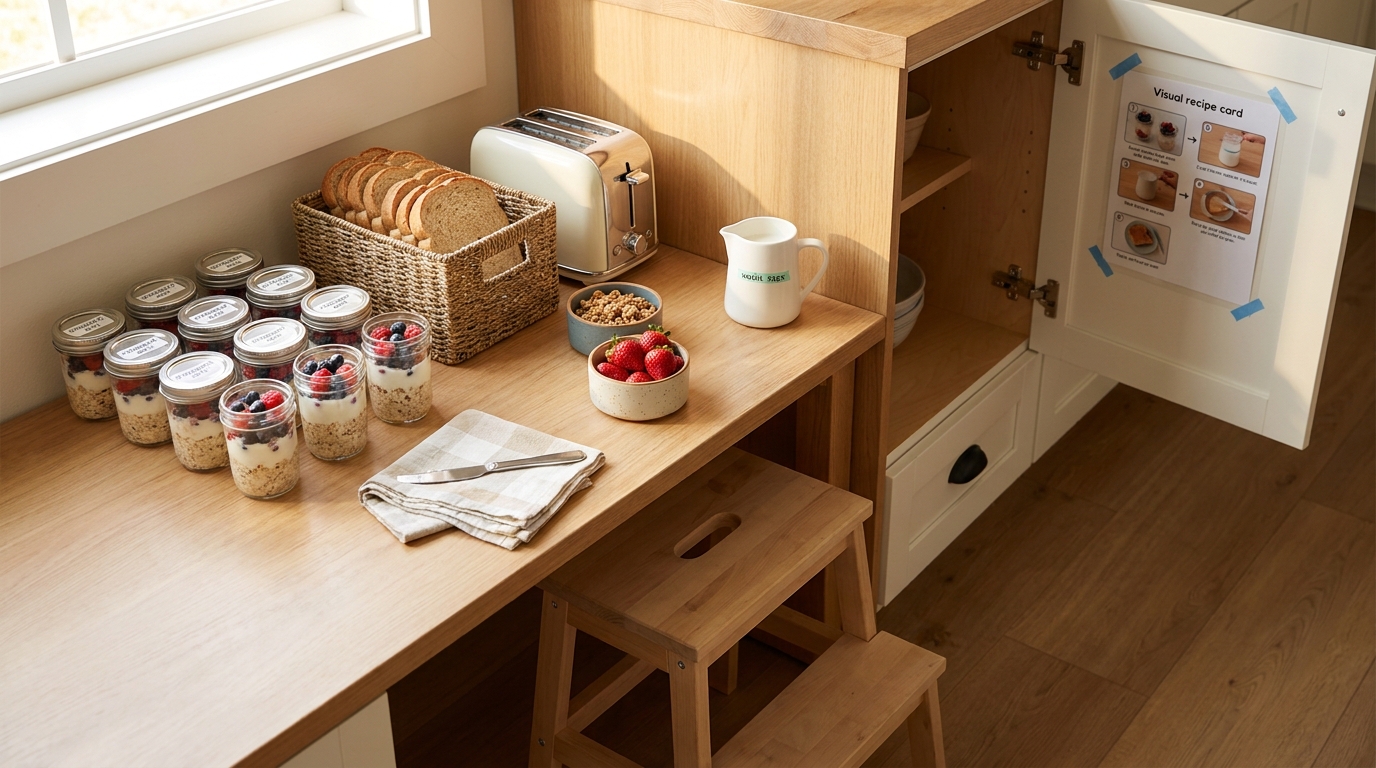
| A visual step chart | Kids this age read pictures faster than instructions | Photos of each step taped inside a cabinet door, or a laminated card |
| A designated “mess station” | Removes your anxiety about spills, which removes their anxiety too | A dish towel and small hand broom kept right there, no lecture required |
The single highest-leverage move is clearing one shelf of your fridge — just one — and making it entirely theirs. Pre-portioned parfait cups, a labeled milk pitcher, cut fruit in a clear container, yogurt tubes: whatever’s on the week’s rotation goes there and nowhere else. When a kid opens the fridge and everything they’re allowed to touch is right at eye level, you’ve removed 90% of the “can I have” negotiations before they start.
If you’re setting up a station for the first time, do it together on a Saturday, not on the Monday you need it to work. Let your child stock their own shelf, pick their own bowl, and do a dry run when there’s no time pressure. The first real school-morning test should be the second or third time they’ve done it, not the first.
The Core Skills to Teach Before Day One
You don’t need a full cooking lesson — you need about fifteen minutes, twice, over a weekend, focused on exactly the motions your child will repeat every school morning. Practice these in isolation before you expect a smooth full sequence:
- Pouring liquid to a line. Put a piece of tape at the “fill line” inside a bowl or cup. Practice pouring milk to the line, not “until it looks full.” This single trick eliminates most spill disasters.
- Opening and reclosing containers. Yogurt tube caps, granola bags with clips, jars with screw lids — whatever’s in your rotation, do a dedicated practice round.
- Using the toaster safely. Show them exactly how far down the lever goes, that fingers stay clear, and what to do if something’s stuck (unplug and ask, never dig with a utensil).
- Spreading with a butter knife. Nut butter, cream cheese, jam — spreading takes more coordination than kids expect, and it’s worth a few minutes of just practicing on crackers.
- The “if something goes wrong” script. Spilled milk, dropped bowl, toast stuck — give them one calm, repeatable response (“grab the towel, wipe it up, try again” or “come get me”) so a small mishap doesn’t turn into a meltdown that undoes their confidence.
Once those five motions are solid, almost every recipe below becomes a simple matter of sequencing skills they already have.
No-Cook, Zero-Heat Breakfasts (Ready for the Youngest Kids)
These require no toaster, no microwave, no heat source at all — just opening, pouring, and assembling. They’re the right starting point for a first-time solo cook, roughly ages 5 to 6, or for any kid who’s brand new to the station.
Yogurt Parfait Cups. Pre-layer yogurt, granola, and berries in clear cups on Sunday (or let your child do the layering as a weekend activity — it doubles as practice). Morning task: open the fridge, grab a cup, grab a spoon, done. If you’re worried about sugar, plain yogurt with a drizzle of honey added by you ahead of time keeps the morning task purely “open and eat.”
Cereal and Milk, the Foolproof Way. Portion cereal into small resealable bags or a low bin on Sunday so your child isn’t wrangling a giant box. Pair with a small, kid-gripped pitcher of milk poured to a taped fill line. This is the classic starter recipe for a reason — it’s genuinely two steps.
Cottage Cheese or Yogurt Bowls with Toppings. Set out a low bin with cottage cheese or yogurt cups, plus small containers of toppings — cut strawberries, blueberries, a sprinkle bin of granola. Kid scoops, kid tops, kid eats.
Overnight Oats Jars. Prep five jars on Sunday (oats, milk or milk alternative, a spoonful of yogurt, a drizzle of maple syrup, whatever mix-ins your kid likes), screw the lids on, and line them up on the fridge shelf. Morning task is just grabbing one and unscrewing the lid — genuinely zero assembly required at 7 AM. This is one of the highest-payoff make-ahead options because the “5 minutes” is really more like 30 seconds.
Breakfast Trail Mix Bowls. A dry mix of whole-grain cereal, a few nuts or seeds if your child’s school allows them, dried fruit, and a small handful of mini chocolate chips, portioned into snack bags on Sunday. Not a nutritional powerhouse on its own, so I pair it with a piece of fruit and a glass of milk your child pours themselves — but on the mornings when everything else has failed, it’s a five-second grab that still counts as a real breakfast.
Nut-Free-Safe Sunflower Butter and Banana Roll-Ups. If your family avoids peanuts and tree nuts for school, pre-spread sunflower seed butter on a tortilla Sunday night, refrigerate, and let your child add banana slices and roll it up in the morning — no knife needed if the spreading is already done. For more ideas built specifically around nut allergies, our nut-free school lunch ideas roundup has swaps that work just as well at breakfast.
Toaster and Microwave Breakfasts (For Kids Ready for a Little Heat)
Once your child has mastered the no-cook basics and you’ve done a safety walkthrough, these add one appliance step — still well within five minutes, and still fully within a 6-to-8-year-old’s ability with a clear routine.
The Toast Bar. This is the single best “upgrade” move for a kid breakfast station. Bread goes in a low bin (pre-sliced from a fresh loaf, or store-bought sliced bread). Toppings live in small labeled containers at the same shelf: butter, jam, cinnamon sugar mixed ahead of time, sunbutter. Toast, butter knife, spread, done. Rotate toppings weekly so it doesn’t get boring.
Toaster Waffles or Pancakes with a Topping Station. Frozen waffles into the toaster, then the same topping bar logic — a small pitcher of syrup (not the giant bottle, which guarantees a flood), sliced banana, a shaker of powdered sugar. Kids this age genuinely love waffle assembly; it feels more like a treat than a chore, which is exactly the trick.
English Muffin Pizza (Microwave). Split an English muffin, spread a spoonful of pre-portioned marinara from a small container, top with a pinch of pre-shredded cheese, and microwave 30 seconds. It sounds like dinner food, but a savory breakfast option is a genuine relief for kids who reject sweet breakfasts across the board — and it’s a full three food groups in one 5-minute build.
Instant Oatmeal Cups (Microwave). Pre-measure oats and a splash of milk into a microwave-safe mug or bowl on Sunday, cover, and refrigerate. Morning task: microwave 90 seconds, add pre-portioned toppings (berries, a drizzle of honey, cinnamon) from the shelf. Skip loose sugar packets if you can — a pre-mixed cinnamon sugar shaker keeps the mess contained.
Reheated Breakfast Quesadilla. Make a batch on the weekend (tortilla, shredded cheese, folded and pan-cooked by an adult), cool, and freeze individually wrapped. Morning task is unwrap and microwave 45 seconds. Savory, portable, and eaten one-handed on the walk to the bus if it comes to that.
If your household is managing an egg allergy, or just has a kid who won’t touch eggs on principle, almost everything on this list already sidesteps the issue — but for even more variety, Egg-Free Breakfast Ideas for Kids has 25 more options built specifically around that constraint, several of which adapt easily into a self-serve format with a little pre-portioning.
Make-Ahead Options That Turn Sunday Into Monday’s Breakfast
The real secret weapon of a five-minute kid breakfast isn’t the recipe — it’s what you do the day before. A single hour of batch prep on the weekend can cover the entire week’s mornings. Here’s what freezes and refrigerates well, and how to store it so your child can serve themselves without you standing there.
Baked Egg Bites (Muffin Tin). Whisk eggs with a splash of milk and mix-ins (cheese, chopped spinach, diced ham), pour into a greased muffin tin, and bake at 350°F for about 18 minutes. Cool completely, then store in a labeled container in the fridge (good for 4 days) or freezer (good for a month). Morning task: microwave one or two for 30-40 seconds. High-protein, genuinely filling, and a good option if your kid tends to melt down by 10 AM from a too-light breakfast — for more on that specifically, High-Protein Meals and Snacks for Kids breaks down how much protein kids actually need at each age and why it matters for school-morning stamina.
Baked Oatmeal Cups. Similar concept to egg bites but oat-based — mix oats, mashed banana, egg, milk, and cinnamon, bake in a muffin tin, and store the same way. Naturally sweet enough that you can skip added sugar entirely.
Freezer Breakfast Burritos. Scrambled eggs, black beans, cheese, and a little salsa rolled into a tortilla, wrapped individually in foil or parchment, and frozen in a labeled bag. Morning task: unwrap, microwave 60-90 seconds (flip halfway for even heating), and it’s ready. This is one of the most filling options on this whole list and travels well if breakfast has to happen in the car.
Batch Muffins. Banana, pumpkin, zucchini, apple cinnamon — whatever your family likes, baked in a batch and frozen individually. Pull two the night before to thaw on the counter, or microwave 20 seconds straight from frozen. Muffins are an easy “yes” for kids who resist heavier breakfasts, and pairing one with a piece of fruit and a glass of milk rounds it out.
Smoothie Freezer Packs. Portion fruit, spinach, and yogurt into freezer bags on Sunday — one bag per school day. Morning task (with your help blending, or a countertop blender your child can safely operate) is dumping the bag in with a splash of milk and pressing one button. If your child can run a blender independently, this becomes a true solo job; if not, it’s a nice “we do this part together” bridge recipe.
The freezer-stocking mindset here is the same one that makes dinner easier on busy weeks — if you haven’t already built out a freezer stash for the school year, Freezer-Friendly Back-to-School Dinners is worth doing alongside your breakfast prep, since you’re already elbow-deep in foil and freezer bags anyway.
Matching Tasks to Your Child’s Age
Not every kid on the “early elementary” spectrum is working with the same skill set, and forcing a 5-year-old through a 8-year-old’s routine (or babying an 8-year-old with a 5-year-old’s tasks) is the fastest way to kill their interest. Here’s a rough guide — treat it as a starting point, not a hard rule, since kids vary a lot:
| Age | Can typically handle solo | Still needs help with |
|---|---|---|
| 5 | Pouring pre-portioned milk, opening yogurt tubes, assembling a parfait from staged ingredients | Toaster operation, spreading thick toppings, cleaning up bigger spills |
| 6 | All of the above, plus operating a toaster with supervision nearby, spreading soft toppings, simple assembly (roll-ups, toast bar) | Microwave timing, multi-step recipes, judging portion sizes |
| 7 | Toaster and microwave use independently, following a 3-4 step visual recipe card, basic cleanup | Recognizing when something’s gone wrong (burnt toast, spoiled milk) without prompting |
| 8 | Full solo breakfast start to finish, choosing between rotation options, light problem-solving (toast didn’t pop, tries again) | Batch weekend prep (still your job, or a shared activity) |
If you’ve got siblings spanning this range, the easiest fix isn’t separate systems — it’s separate stations at different heights, or a “buddy” pairing where an 8-year-old helps a 5-year-old with the toaster step while handling their own breakfast. A lot of families I’ve talked to found that siblings actually motivate each other here faster than any chart does; there’s real pride in a 7-year-old showing a younger sibling how the toast bar works.
A Full Week of Self-Serve Breakfasts
Here’s a sample rotation that spreads the prep across one Sunday session and covers five school mornings without repeating a single breakfast, mixing no-cook, toaster, and grab-from-freezer options so kids don’t get bored:
| Day | Breakfast | Sunday prep needed | Morning task (kid solo) |
|---|---|---|---|
| Monday | Overnight oats jar | Assemble 5 jars, refrigerate | Grab jar, unscrew lid, eat |
| Tuesday | Toast bar (jam + cinnamon sugar) | Slice bread if needed, portion toppings into small containers | Toast, spread, eat |
| Wednesday | Yogurt parfait cup | Layer 5 cups, refrigerate | Grab cup, spoon, eat |
| Thursday | Frozen breakfast burrito | Make and freeze batch (lasts multiple weeks) | Unwrap, microwave, eat |
| Friday | Toaster waffle + fruit | Stock freezer waffles, pre-cut fruit into a container | Toast, top, add fruit from container |
Once this rotation is running, most families find they only need a real prep session every other weekend, since burritos, egg bites, and muffins all freeze well past a single week. The first week or two will be slower as your child learns the sequence — budget extra patience, not extra time, since rushing a kid who’s still learning the steps usually backfires into more spills, not fewer.
Troubleshooting the Real Morning Snags
“They spilled the milk and now they’re too upset to keep going.” This is almost always a setup problem, not a kid problem — either the pouring vessel is too big or the fill line isn’t marked. Fix the tool before you address the behavior. And normalize spills out loud, ahead of time: “Spills happen, we wipe it up and keep going” said calmly on a Tuesday when nothing’s gone wrong lands a lot better than said in the moment of a meltdown.
“They pick the same breakfast every single day and refuse to rotate.” Some sameness at breakfast is developmentally normal, especially for younger kids who find predictability calming right when the rest of the day feels uncertain (new teacher, new classroom, new schedule). I’d let this ride for the first month of school rather than fighting it — familiar breakfasts during a season of big changes elsewhere is a reasonable trade. If it’s still happening in November and you’re worried about nutritional gaps, that’s a good moment to revisit the picky eater quiz — it’ll help you tell the difference between “comfort in repetition” and “sensory avoidance,” which call for different responses.
“Breakfast is done but it’s not exactly balanced — is that okay?” A five-minute kid-assembled breakfast doesn’t need to hit every food group every single day; it needs to get your child fed and out the door without a fight, and it needs to average out reasonably over the week. If you’re noticing energy crashes by mid-morning, that’s usually a protein gap rather than a “bad breakfast” — see the protein guide linked above, or lean your rotation toward the egg bite and burrito options a few more days a week.
“My kid wants to help but keeps making a mess of the shared kitchen space, not just their own station.” This is a station design problem more than a supervision problem. If their bin, shelf, and tools are genuinely separate from yours — not adjacent to your coffee setup or the “grown-up” fridge shelf — the mess usually stays contained to their zone, which makes it much easier to let go of.
“We’re always out the door and there’s zero margin for a mistake.” Build in a five-minute buffer specifically for the learning period — wake the family five minutes earlier for the first couple of weeks. Once the routine is automatic (usually two to three weeks in), you can claw that time back, because a practiced kid genuinely is faster than you hovering over them.
Beyond Breakfast: Building the Whole Independent Morning
Once breakfast is running on its own, a lot of parents find the same self-serve logic spreads naturally to the rest of the morning — a kid who pours their own cereal is often ready to help pack their own snack or check their own backpack list. If you’re building out that fuller morning independence, our After-School Snacks Kids Can Make Themselves guide uses the exact same station-and-rotation approach for the other end of the school day, and pairing it with Back-to-School Lunch Prep means the whole school-day food question — breakfast, lunch, and the after-school crash — is handled by a system instead of a daily scramble.
None of this has to happen all at once. Most families I know started with just breakfast, ran it for a month, and only then layered on the next piece once it felt solid. There’s no prize for doing it all in one weekend, and a kid who’s mastered one station confidently will pick up the next one faster anyway.
Frequently Asked Questions
What age can kids realistically start making their own breakfast?
Most kids can start with simple, no-cook assembly (pouring pre-portioned milk, opening a yogurt tube, building a parfait from staged ingredients) around age 5, once they can climb a step stool safely and follow a two-step visual sequence. Toaster and microwave use with supervision typically comes online around 6 to 7, and a fully independent routine — start to finish, no adult in the room — is realistic for most kids by 7 or 8. Go by your specific child’s coordination and follow-through rather than a strict age cutoff.
How do I stop the morning routine from turning into a huge mess?
Almost all breakfast-station messes trace back to one of two things: a pouring container that’s too big for small hands, or ingredients that aren’t actually within easy reach. Use a small pitcher poured to a taped fill line instead of a full milk jug, keep everything on one low, dedicated shelf, and stock a towel right at the station so a spill is a two-second wipe-up rather than a crisis. Expect some mess for the first couple of weeks regardless — it’s part of the learning curve, not a sign the system is failing.
What if my child picks the exact same breakfast every day and won’t rotate?
That’s very common, especially in the first month or two of a new school year, when predictability at breakfast can genuinely help a kid manage everything else that’s new and uncertain about their day. Let it ride for a few weeks. If the repetition continues long-term and you’re concerned about variety or nutrition, it’s worth exploring whether it’s rooted in comfort-seeking or genuine sensory pickiness — those call for different approaches.
Do I need special kid-safe kitchen tools, or can we use what we already have?
You don’t need to buy much. The essentials are a step stool, unbreakable bowls and cups (plastic or bamboo works fine), a small pitcher or spouted measuring cup for pouring, and a butter knife for spreading. Most families already own all of this. The bigger investment is time, not gear — an hour on a Saturday to set up labeled bins and do a practice run matters far more than any specific product.
Is it safe for a 6- or 7-year-old to use the toaster or microwave alone?
With a clear safety walkthrough — how far the toaster lever goes, keeping fingers clear, never digging out stuck toast with a utensil, and what to do if something seems off (unplug and get an adult) — most kids in this age range can use a toaster safely with an adult nearby in the house, if not standing right at their elbow. Microwave use for reheating pre-made items (not raw cooking) is generally fine for a 7- or 8-year-old following a simple routine. Use your judgment on your specific child and kitchen setup, and keep supervision closer for the first few weeks.
How much prep time does this actually save me, realistically?
The morning time savings are real but modest — usually five to ten minutes, since you’re not the one pouring, toasting, or spreading. The bigger win most parents report isn’t the clock time, it’s the mental load: one less thing you have to actively manage while you’re also finding shoes, signing forms, and packing lunches. The batch prep itself (muffins, egg bites, parfait jars) takes about an hour on a weekend day and covers most of the week.
What if we have food allergies — can this still work?
Yes, and honestly a self-serve station can make allergy management easier, not harder, because you control exactly what goes on the shelf. If nuts, eggs, or dairy are off the table, stock the station only with safe versions (sunflower seed butter instead of peanut butter, dairy-free yogurt, egg-free options) so there’s nothing on that shelf your child needs to double-check. Just make sure any household member who shares the kitchen understands the station is off-limits for adding anything that isn’t pre-approved.
You’ve Got This
Handing your kid the breakfast job isn’t about getting five extra minutes back, though you will. It’s about giving them one small, real piece of the morning that’s entirely theirs to run — and watching them walk into the school year a little more capable than they were in June. Start with one recipe, one shelf, one Saturday of practice. The rest builds itself from there.