Toddler Thanksgiving Plate Ideas (Printable Portion Chart)
You can create a toddler-friendly Thanksgiving plate with specific portion sizes and safe food preparation tips. Learn how to adapt your holiday dishes and manage meal timing for ages 1-3 to avoid meltdowns and choking hazards.
- Start with 1 Tbsp of each food per year of your toddler's age.
- Modify dishes (shred, mash, moisten) for safe, easy eating.
- Identify and avoid common choking hazards for ages 1-3.
- Adjust meal timing to fit your toddler's schedule and prevent meltdowns.
- Download the free kit for a portion chart, safety checklist, and sample plates.
This post contains affiliate links. As an Amazon Associate I earn from qualifying purchases.
Two Thanksgivings ago, I made my daughter a plate just like mine, only smaller. She squeezed one cranberry flat and fed the rest to the floor, one item at a time, like an inspector.
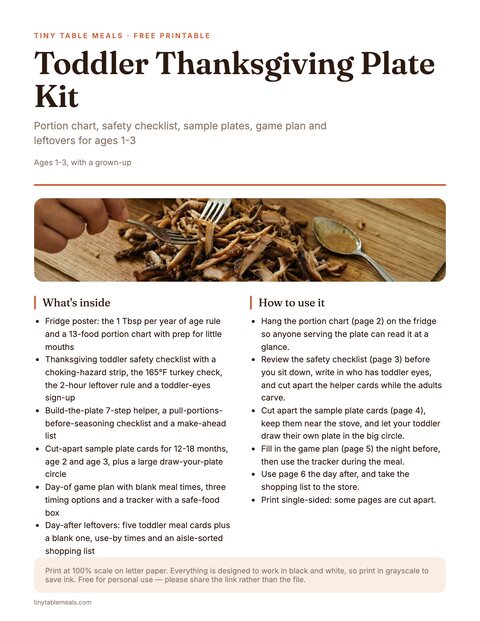
Free printable · 6 pages
Toddler Thanksgiving Plate Kit (Ages 1-3)
A fridge portion chart for 13 Thanksgiving foods (ages 1-3), a choking and food-safety checklist with a build-the-plate helper, cut-apart sample plate cards with a big draw-your-plate circle, a day-of timing planner with tracker, and day-after leftover meals with a shopping list.
Free. Your download link appears right here. You'll also join the Sunday Supper Plan. Unsubscribe anytime. Privacy
It took me a couple of seasons to learn that a toddler’s plate isn’t a shrunken adult plate. This guide builds it from your real Thanksgiving spread for ages 1 to 3: a portion chart, safe prep for each dish, a choking checklist, and three sample plates. The free Toddler Thanksgiving Plate Kit has the printable version.
In this article (14 sections)
- Why Thanksgiving Is Such a Weird Meal for Toddlers
- The Toddler Portion Rule That Takes the Guesswork Out
- The Printable Toddler Thanksgiving Portion Chart (Ages 1–3)
- Building the Plate: A Toddler-Sized Version of Your Real Dinner
- Dish-by-Dish Guide: How to Adapt the Foods Already on Your Table
- The Thanksgiving Toddler Safety Checklist
- Three Sample Thanksgiving Plates by Age
- Late Thanksgiving Mealtime: How to Time Toddler Meals
- What to Do If Your Toddler Eats Almost Nothing
- Make-Ahead Tips for Toddler Thanksgiving Plates
- Using Up the Leftovers: Day-After Toddler Meals
- A Simple Game Plan for the Day Itself
- Frequently Asked Questions
- Final Thoughts
Why Thanksgiving Is Such a Weird Meal for Toddlers
Most Thanksgiving food is great for adults but awkward for toddlers:
- The textures are hard to manage. Dry turkey breast, crusty stuffing, tough roll crust, and stringy casserole beans are all things small mouths with few molars struggle to chew.
- The meal is late. Many families eat at 2, 3, or even 4 p.m., which sails right past most toddlers’ lunch and straight into nap or meltdown territory.
- Some foods are genuinely risky. Whole cranberries, nuts, dried fruit, marshmallows, whole grapes, popcorn, raw hard veggies, and big chunks of meat are all on the choking list.
Nearly everything on the Thanksgiving table can be made toddler-friendly with a fork, a knife, and about five minutes. You don’t need special recipes. You just need to know what to pull, how to adjust it, and how much to serve.
The Toddler Portion Rule That Takes the Guesswork Out
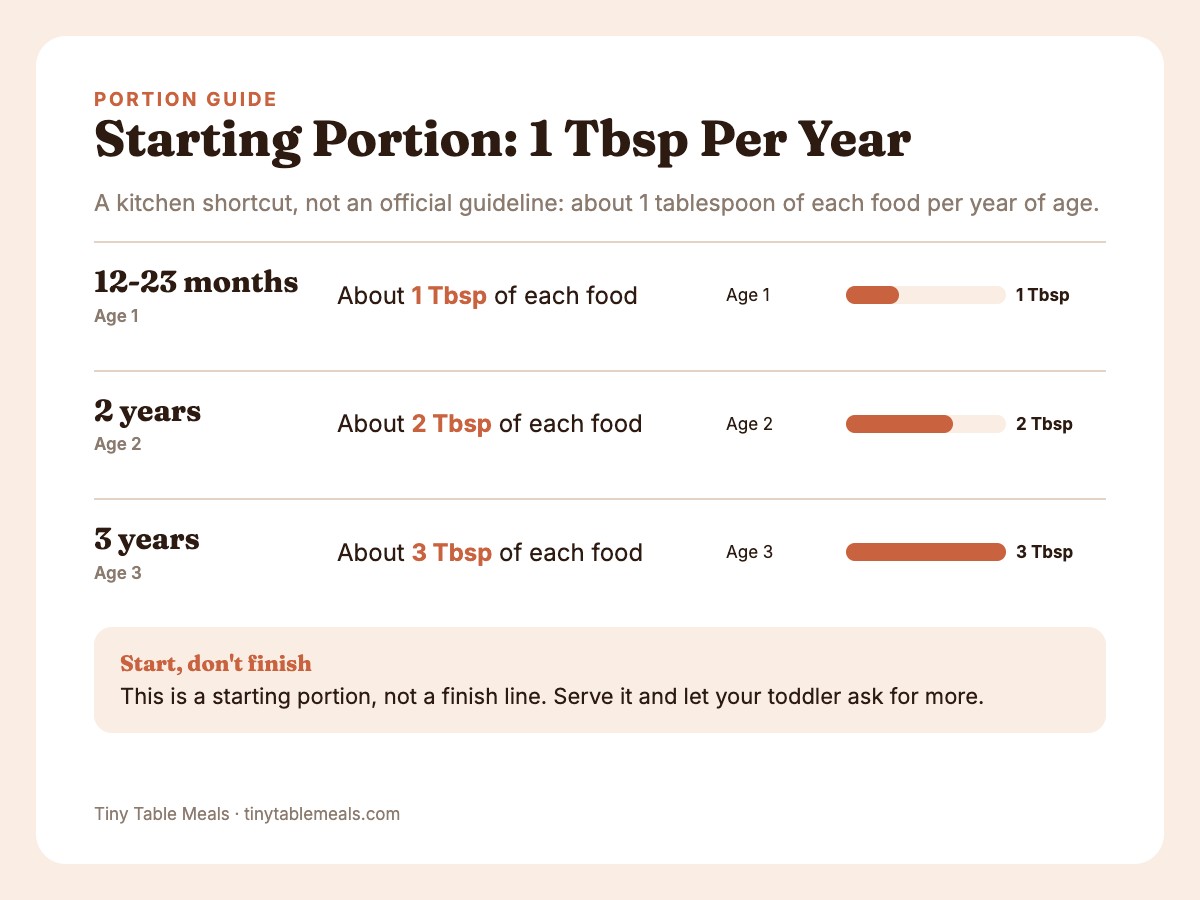
A common rule of thumb for a starting portion is about 1 tablespoon of each food per year of age. It’s a handy kitchen shortcut, not an official guideline.
- A 1-year-old (12 to 23 months) starts with about 1 tablespoon of each food.
- A 2-year-old starts with about 2 tablespoons.
- A 3-year-old starts with about 3 tablespoons.
That’s a starting portion, not a finish line. Put that amount on the plate and let your toddler ask for more. A tiny starter portion helps in three ways:
- It doesn’t overwhelm.
- It leaves room for “more please,” which feels like a win for everyone.
- It lets you see what they actually like without wasting a pile of food.
Appetite in toddlers swings enormously from meal to meal and day to day. That’s normal. For the bigger picture across a whole day, my guide on how much a toddler should eat walks through realistic daily amounts. A “bad” meal here and there is no cause for alarm.
One more thing to keep in mind, and it takes pressure off: Thanksgiving is one meal. What matters for your toddler’s nutrition is the pattern across the week, not what happens between 2 and 3 p.m. on one Thursday.
The Printable Toddler Thanksgiving Portion Chart (Ages 1–3)
Here’s the chart. For a fridge-ready printable version, grab the free Toddler Thanksgiving Plate Kit in the card near the top of this page. The icons help a partner or visiting relative serve the plate without reading a paragraph.
How to read it: the portion is what to put on the plate at first. “Prep” is how to change the food so it’s safe and manageable.
| Icon | Thanksgiving Food | Age 1 (about 12–23 mo) | Age 2 | Age 3 | Prep for Little Mouths |
|---|---|---|---|---|---|
| 🦃 | Turkey (white or dark meat) | 1 Tbsp | 2 Tbsp | 3 Tbsp | Shred or mince finely; moisten with a little gravy or broth; no skin, no bones |
| 🥔 | Mashed potatoes | 1 Tbsp | 2 Tbsp | 3 Tbsp | Smooth and plain; loosen with a little milk or unsalted butter; a pre-loaded spoon works great |
| 🍠 | Sweet potato (plain) | 1 Tbsp | 2 Tbsp | 3 Tbsp | Mash or cut into soft small cubes; no marshmallows or sugary toppings |
| 🫘 | Green beans (cooked soft) | 1 Tbsp | 2 Tbsp | 3 Tbsp | Cook very soft; cut into short, small pieces |
| 🥕 | Roasted carrots or squash | 1 Tbsp | 2 Tbsp | 3 Tbsp | Roast until fork-soft; cut small or mash |
| 🍞 | Stuffing / dressing | 1 Tbsp | 1–2 Tbsp | 2–3 Tbsp | Soft interior only; pick out nuts, all dried fruit, celery strings, and sausage chunks; crumble |
| 🍞 | Dinner roll | ¼ roll | ½ roll | ½–1 roll | Tear the soft center into small bits; skip the crust if it’s tough |
| 🍒 | Cranberry sauce | Skip | 1 tsp | 1 Tbsp | It’s sweetened, so skip it at age 1. At 2 and 3, use sauce without whole berries, or mash them; serve as a dip, not a pile |
| 🧀 | Mac and cheese | 1 Tbsp | 2 Tbsp | 3 Tbsp | Check noodle size; short shapes are fine; no breadcrumb crust chunks |
| 🥣 | Gravy | 1 tsp drizzle | 2 tsp drizzle | 1 Tbsp drizzle | Use as moisture or dip; it can be salty, so go light |
| 🍎 | Fruit | 1 Tbsp | 2 Tbsp | 3 Tbsp | Cook apple or pear until soft; ripe melon in small, thin pieces; grapes quartered lengthwise, with the quarters cut smaller again under age 2; no raw apple slices |
| 🥧 | Pumpkin pie | Skip | 1–2 Tbsp | 2–3 Tbsp | The AAP advises no added sugar under 2, so skip it at age 1. At 2 and 3, offer filling and a few crust crumbs, with a little whipped cream if you like |
| 🥛 | Milk or water | 2–4 oz at the meal | 3–4 oz | 4–6 oz | Offer in their usual cup. At 12–23 months, about 16 oz of milk across the whole day is plenty, so don’t let it fill the tank before food |
A few notes on how to use it:
- Don’t serve every food. Pick five or six small items, plus a drink. A plate with ten tiny mounds is more overwhelming than one with five.
- Aim for color and variety, not completeness. One protein, one starch, one or two vegetables, and one fun extra is a perfectly good toddler Thanksgiving.
- Portions go up on request. The numbers are a start. If your toddler finishes the turkey and points at the bowl, refill it.
- If your toddler is a big eater or a tiny one, the chart bends to fit. These are typical, not a rule.
- Textures assume a child who already eats soft table foods. A 1-year-old can be anywhere from barely chewing to confident, so for newer eaters go softer and smaller, and check with your pediatrician if you’re unsure. Pecan pie is nut-based, so skip it under age 4.
Building the Plate: A Toddler-Sized Version of Your Real Dinner
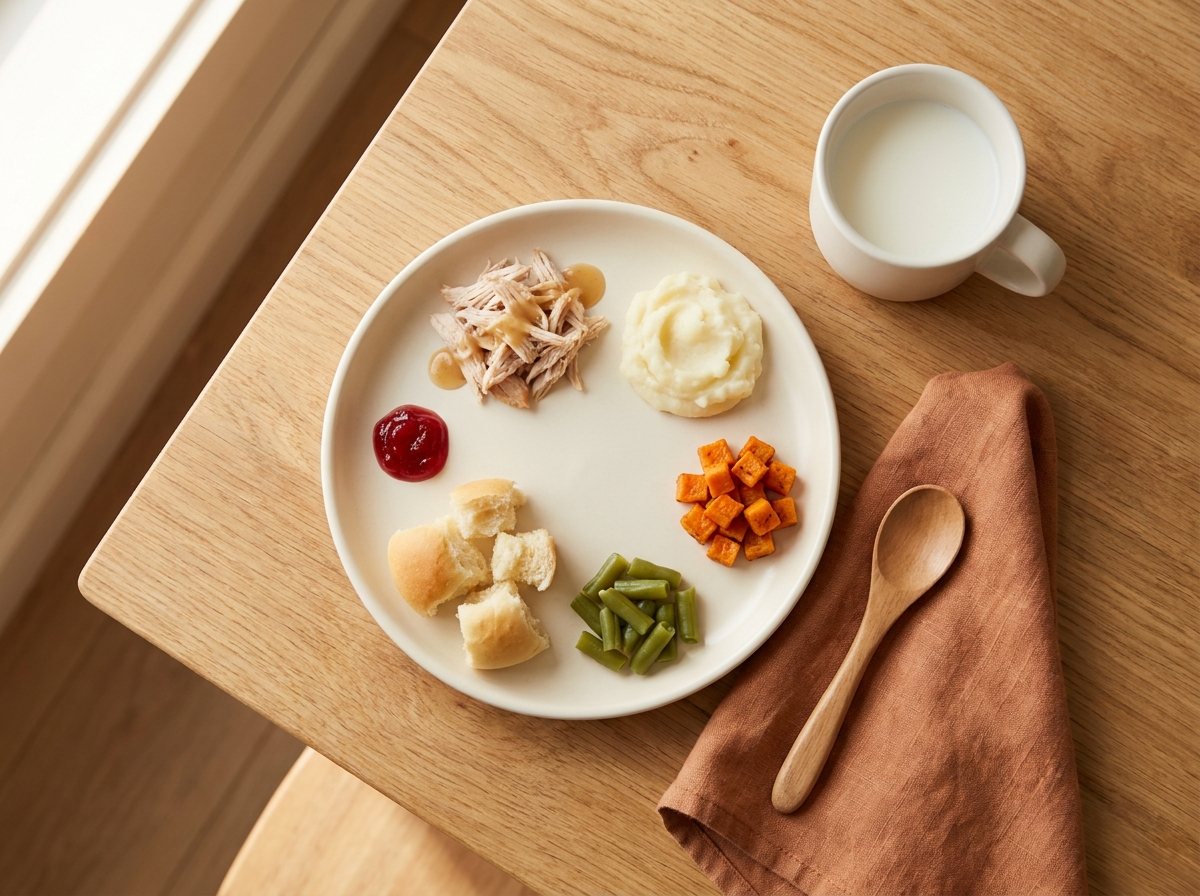
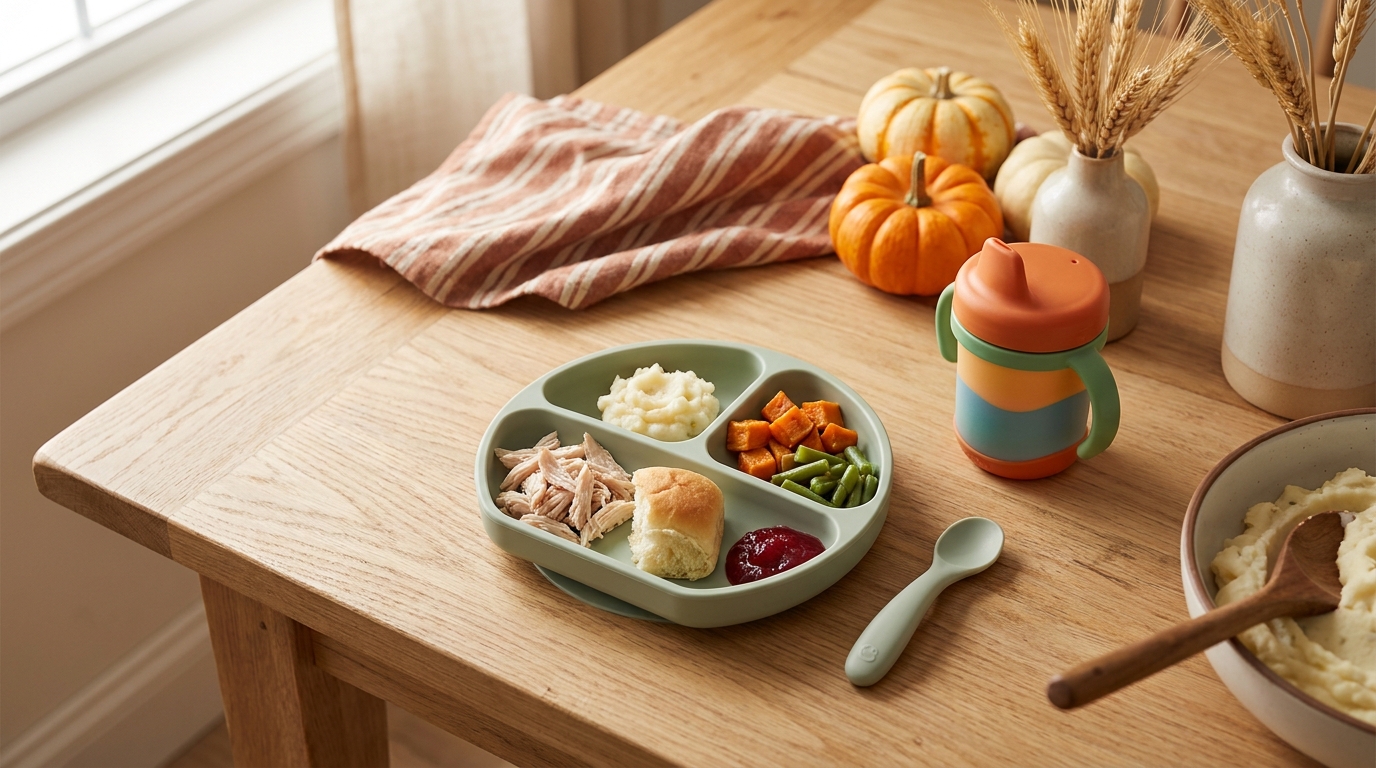
Here’s how to build a plate for a 2-year-old from your real dinner, while the adults are still carving.
- Start with a small plate. Use a kids’ plate, a divided plate, or a salad plate. Divided plates keep foods from touching, and a full dinner plate makes tiny portions look like a huge job.
- Add the protein. 2 tablespoons of finely shredded turkey. If it’s dry, stir in a teaspoon of gravy or warm broth.
- Add the comfort food. 2 tablespoons of mashed potatoes. Toddlers often fill up on this one, and that’s okay.
- Add one vegetable they have a shot at. 2 tablespoons of roasted sweet potato cubes or mashed butternut squash. Want a green one too? Add 2 tablespoons of very soft green beans, cut short, in a separate spot.
- Add a fun side. 1 teaspoon of smooth cranberry sauce as a dip. If it ends up smeared on the tray, that still counts as exposure.
- Add something to tear. Half a dinner roll, with the soft center torn into small bites. It’s a familiar food to reach for when other things feel scary.
- Add one bite of something less familiar. A single spoonful, off to the side, of a dish made only from ingredients they’ve already eaten without a problem. A different soft-cooked vegetable is the easy pick. Stuffing and casseroles often contain wheat, egg, dairy, soy, or nuts, so offer those only if your toddler already tolerates everything in them. No new allergens today. Don’t mention the bite or ask them to try it.
The finished plate for a 2-year-old.
- 🦃 2 Tbsp shredded turkey with a drizzle of gravy
- 🥔 2 Tbsp mashed potatoes
- 🍠 2 Tbsp roasted sweet potato, soft cubes
- 🫘 2 Tbsp soft green beans, chopped
- 🍞 ½ roll, torn into pieces
- 🍒 1 tsp cranberry sauce on the side
- 🥛 A small cup of milk or water
That’s it. It looks small, and that’s the point. It fits on a salad plate and covers a protein, a starch, two vegetables, and a bit of fun. It also leaves room for “more.”
Dish-by-Dish Guide: How to Adapt the Foods Already on Your Table
Here’s how to handle each classic dish, with the changes that make it work for ages 1 to 3.
🦃 Turkey
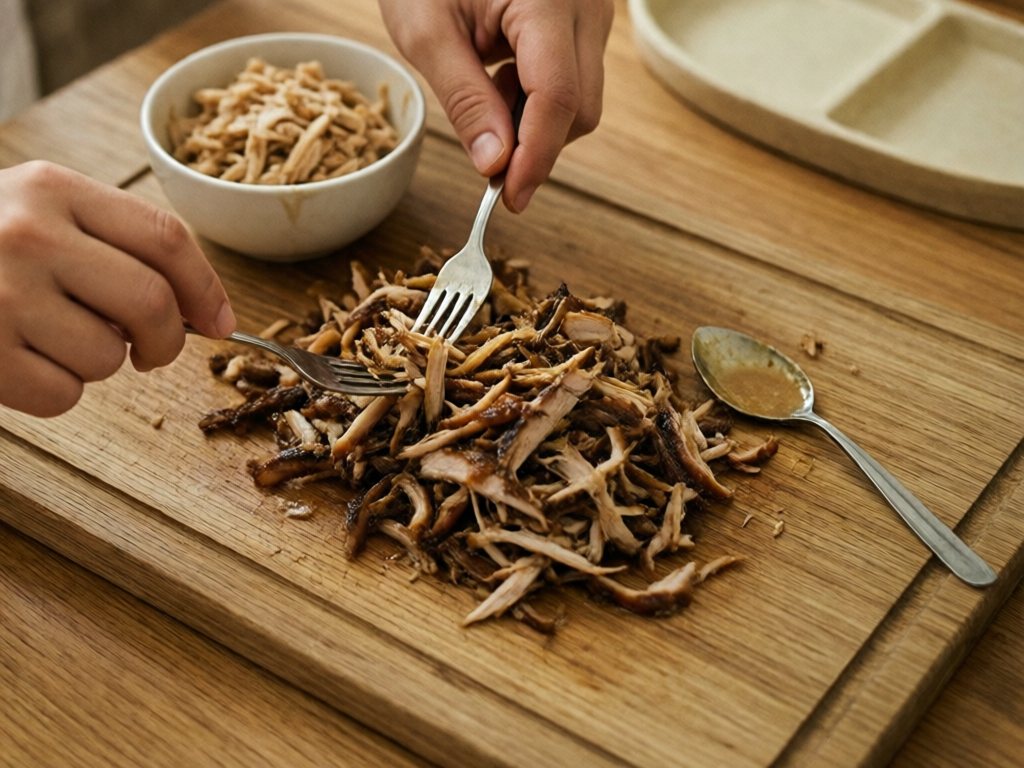
Turkey is a great toddler food. It’s a source of protein and also provides iron and zinc, and it’s mild. The challenge is texture.
- Shred or mince it, don’t cube it. Large, chewy cubes of meat are a choking concern at this age. Small shreds are easier to manage.
- Add moisture. A teaspoon of gravy, broth, or even a little mashed potato mixed in makes dry turkey much easier to swallow.
- Pick dark meat when you can. It’s naturally juicier.
- Skip the skin. It’s tough, fatty, and heavily salted.
- Check for bones. Small bones and cartilage hide in carved meat. Run your fingers through it.
- Make sure it’s fully cooked. The safe internal temperature for poultry is 165°F (74°C). Young children get sicker from foodborne bacteria, so use a thermometer.
If your toddler isn’t into turkey, offer it as a dip-and-scoop with mashed potatoes. A lot of kids will eat meat when it’s mixed into something they trust.
🥔 Mashed Potatoes
They’re soft, comforting, and nearly universally accepted. A few small tweaks help:
- Serve them before you’ve added lots of salt, garlic, or heavy seasonings if you can. Scoop a toddler portion out of the pot first.
- Stir in a little milk or unsalted butter to loosen them to a soft, smooth texture.
- Let your toddler hold their own spoon. Pre-loading the spoon and handing it over is a great move for 1-year-olds.
🍠 Sweet Potatoes
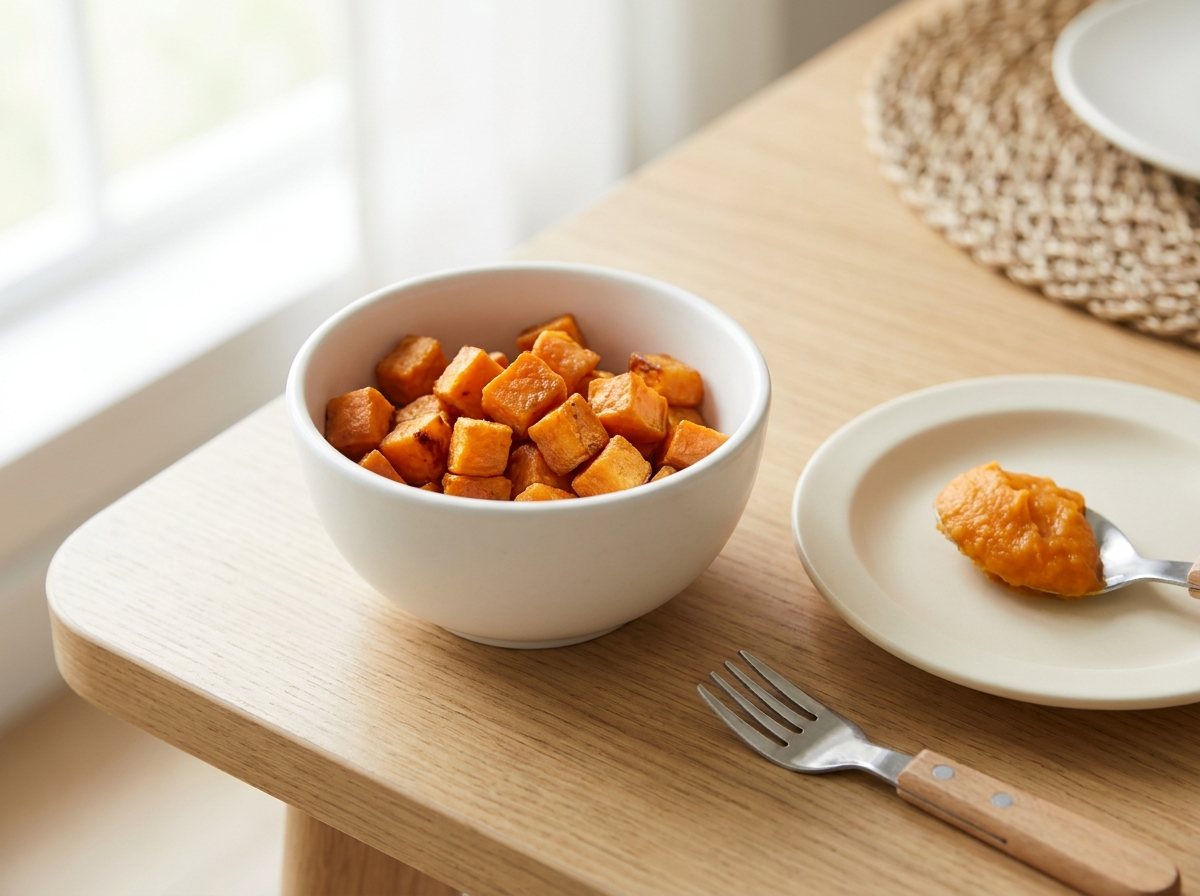
Sweet potatoes are one of the best toddler vegetables on the table. They’re naturally sweet, soft, and full of vitamin A.
- Keep the toddler portion plain: baked, roasted, or mashed.
- If your recipe has marshmallows, brown sugar, or a pecan topping, scoop a portion before the topping goes on. Skip marshmallows entirely under age 4, mini ones included, since they’re soft, sticky and easy to choke on. Leave off nuts too, whole or chopped.
- Cut roasted cubes small, about the size of your pinky nail for 1-year-olds.
If sweet potatoes and squash are a hit in your house, my fall produce guide has more ideas for using the same flavors all season.
🫘 Green Beans and Other Cooked Vegetables
Green bean casserole, roasted Brussels sprouts, and glazed carrots are all fine in small amounts, with some adjustments:
- Cook them very soft. Fork-tender is the goal for 1- and 2-year-olds.
- Chop into short pieces. Long, stringy vegetables can be hard to chew.
- Skip the crispy fried onions on top under age 4. They’re hard and brittle, which makes them a choking and scratch risk.
- If your toddler refuses vegetables at the table, try putting one little green piece on the plate and say nothing. It still counts as a repeat exposure.
🍞 Stuffing and Dressing
Stuffing varies a lot. It can be soft and perfect, or it can be crusty, studded with nuts, dried fruit, sausage chunks, and celery strings.
- Take the soft middle. Crumble it so it’s fine and moist.
- Pick out nuts, all dried fruit (raisins and dried cranberries) and big sausage pieces under age 4. Dried fruit is sticky and hard to chew, even when the pieces are small.
- Stuffing is often high in sodium, especially the boxed kind, so keep the portion modest.
- Stuffing cooked inside the turkey must reach 165°F too.
- If your stuffing is full of onion and sage, some toddlers love it and some hate it. Both are fine.
🍒 Cranberry Sauce
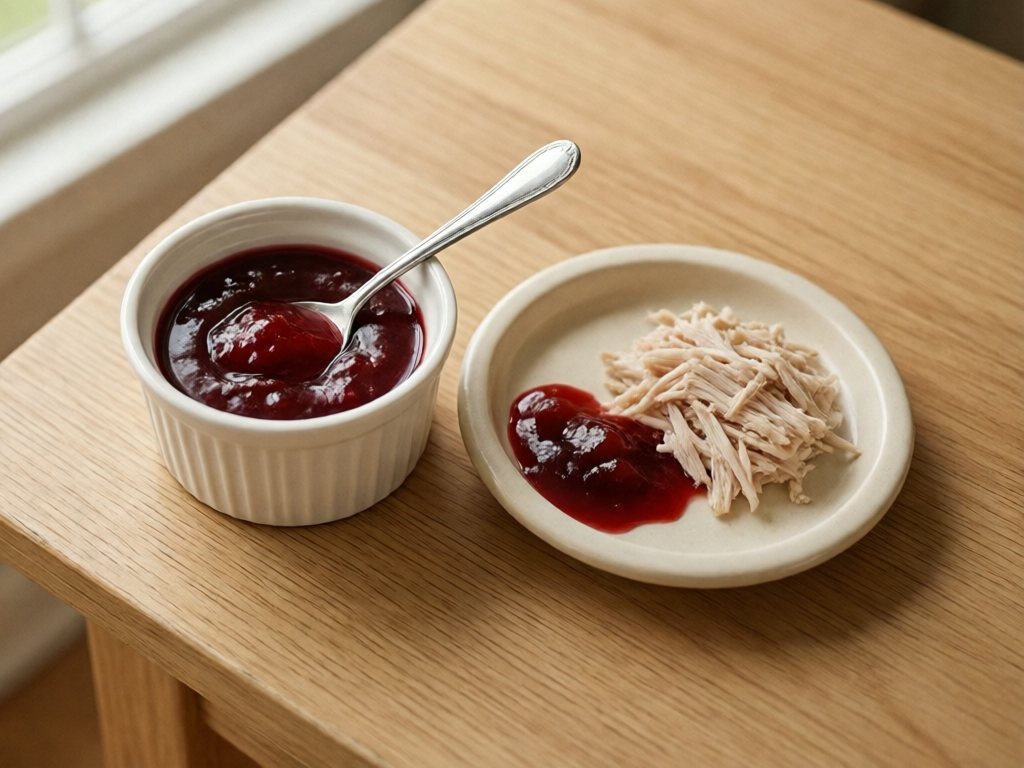
Whole cranberries are a choking risk for toddlers because they’re round, firm-skinned, and slippery.
- Choose smooth, jellied cranberry sauce or mash whole-berry sauce with a fork so nothing round remains.
- Serve it as a dip, a spoonful on the side, or a little smear on turkey.
- Canned and homemade versions are both high in sugar. Skip it for a 1-year-old, and keep it to about a teaspoon at age 2 and a tablespoon at age 3.
🍞 Dinner Rolls and Bread
Soft bread can form a sticky ball in the mouth, so offer it torn into small pieces rather than a big hunk. Skip crusty bread for younger toddlers. A half-roll is a fine portion, and soft bread torn small is a reliable familiar food to anchor the plate.
🧀 Mac and Cheese
If your table includes mac and cheese, it’s likely a safe win. Serve a few tablespoons. If it has a baked breadcrumb crust, scoop from underneath so there aren’t hard crunchy bits.
🥧 Pumpkin Pie and Dessert
Toddlers can have a taste of dessert. Pie is mostly sugar and fat, and the AAP advises no added sugar under age 2, so skip it for a 1-year-old.
- At age 2, offer 1 to 2 tablespoons of filling and a few crust crumbs. At age 3, 2 to 3 tablespoons is plenty.
- Pecan pie is nut-based, so skip it under age 4. Check pumpkin pie crusts for nuts too.
- A dollop of whipped cream is fine.
- If you’d like a more toddler-friendly alternative, a few spoonfuls of mashed baked apple or pumpkin yogurt with cinnamon works great.
- Serve dessert with no pressure or bargaining, and don’t make it a reward for finishing vegetables. That tends to make the vegetables seem like a punishment.
If you’re hunting for pumpkin ideas that go beyond pie, my savory pumpkin recipes kids will eat roundup has a few easy ones.
The Thanksgiving Toddler Safety Checklist
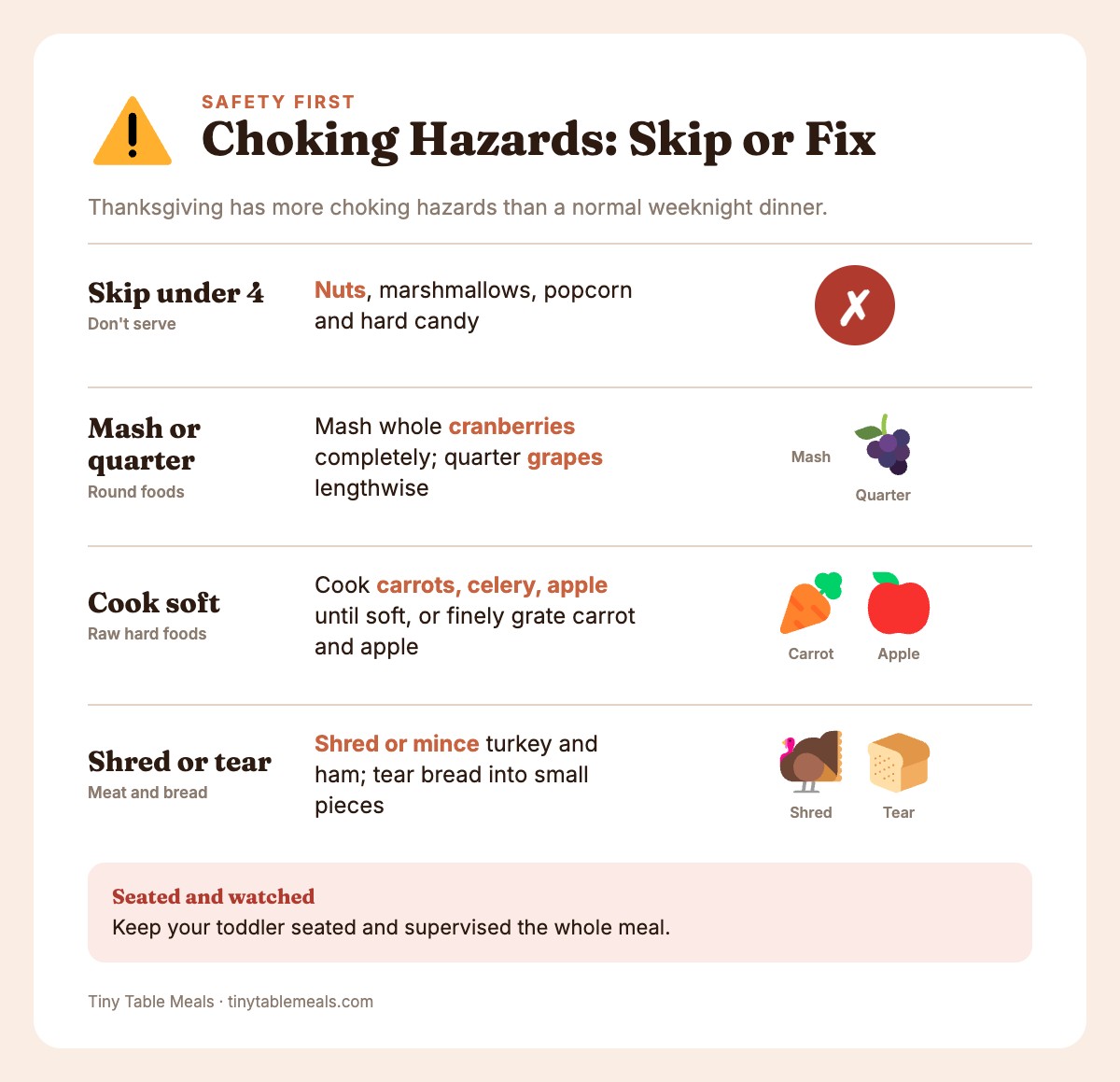
Because the holiday spread has more choking hazards than a normal weeknight dinner, I like to run through this list before we sit down. Feel free to copy it too.
Safety firstUnder age 4, skip nuts (whole or chopped), dried fruit (raisins and dried cranberries), marshmallows, popcorn and hard candy. Mash whole cranberries completely, and shred or mince large chunks of turkey or ham. Quarter grapes lengthwise, and cut the quarters smaller again under age 2. Pit olives, then quarter olives and cherry tomatoes lengthwise. Cook raw carrots, celery and apple until soft (or finely grate carrot and apple), and tear bread into small pieces. Keep your toddler seated and supervised the whole meal.
| ✅ / ⚠️ | Food or Situation | What to Do |
|---|---|---|
| ⚠️ | Whole cranberries | Mash completely or skip |
| ⚠️ | Nuts (pecans, walnuts), whole or chopped, in stuffing, pies, or salads | Leave them off under age 4; pick them out of stuffing |
| ⚠️ | Whole grapes on the cheese board | Quarter lengthwise, and cut the quarters smaller again under age 2 |
| ⚠️ | Dried fruit (raisins, dried cranberries) in stuffing or salads | Pick all of it out under age 4 |
| ⚠️ | Large chunks of turkey or ham | Shred or mince |
| ⚠️ | Turkey skin and small bones | Remove entirely |
| ⚠️ | Raw carrots, celery, or apple slices on the veggie tray | Cook until soft, or finely grate raw carrot and apple; no raw hard sticks or slices |
| ⚠️ | Popcorn and hard candy | Skip under age 4 |
| ⚠️ | Whole olives and cherry tomatoes | Pit the olives; quarter both lengthwise |
| ⚠️ | Marshmallows on sweet potatoes | Skip entirely under age 4, mini ones included |
| ⚠️ | Sticky blobs of bread | Tear into small pieces |
| ✅ | Seated, upright, and supervised | Always, in a high chair or booster with straps |
| ✅ | A grown-up watching, not on their phone | Assign one adult as “toddler eyes” at the table |
| ✅ | Turkey cooked to 165°F | Check with a thermometer |
| ✅ | Leftovers refrigerated within 2 hours | Don’t leave the spread out for the afternoon |
AllergiesThanksgiving is not the day to introduce a new allergenic food (egg, dairy, wheat, tree nuts, peanut, sesame, soy, fish, shellfish). Guests and a late meal make a reaction harder to spot, so stick to foods already tried and tolerated. With a known allergy, ask hosts about stuffing, gravy, and pie crusts, which often hide milk, wheat, or nuts.
Good to knowThese plates are for toddlers ages 1 to 3 who already eat soft table foods. If a baby under 12 months is at the table, honey is off-limits, so check glazes and rolls. Still moving off purees? Start with my guide to transitioning from purees to table food.
If your toddler is still mastering the feeding basics, it’s worth a quick look at first finger foods, which covers sizes and shapes that work well for beginning self-feeders. Many of the same principles apply on Thanksgiving.
Three Sample Thanksgiving Plates by Age
Here are three plates built from the same dinner. The 2-year-old plate swaps in mac and cheese, carrots, and fruit, so you can see a second way to fill the step-by-step plate above.
🍽️ Plate for a 12–18 Month Old
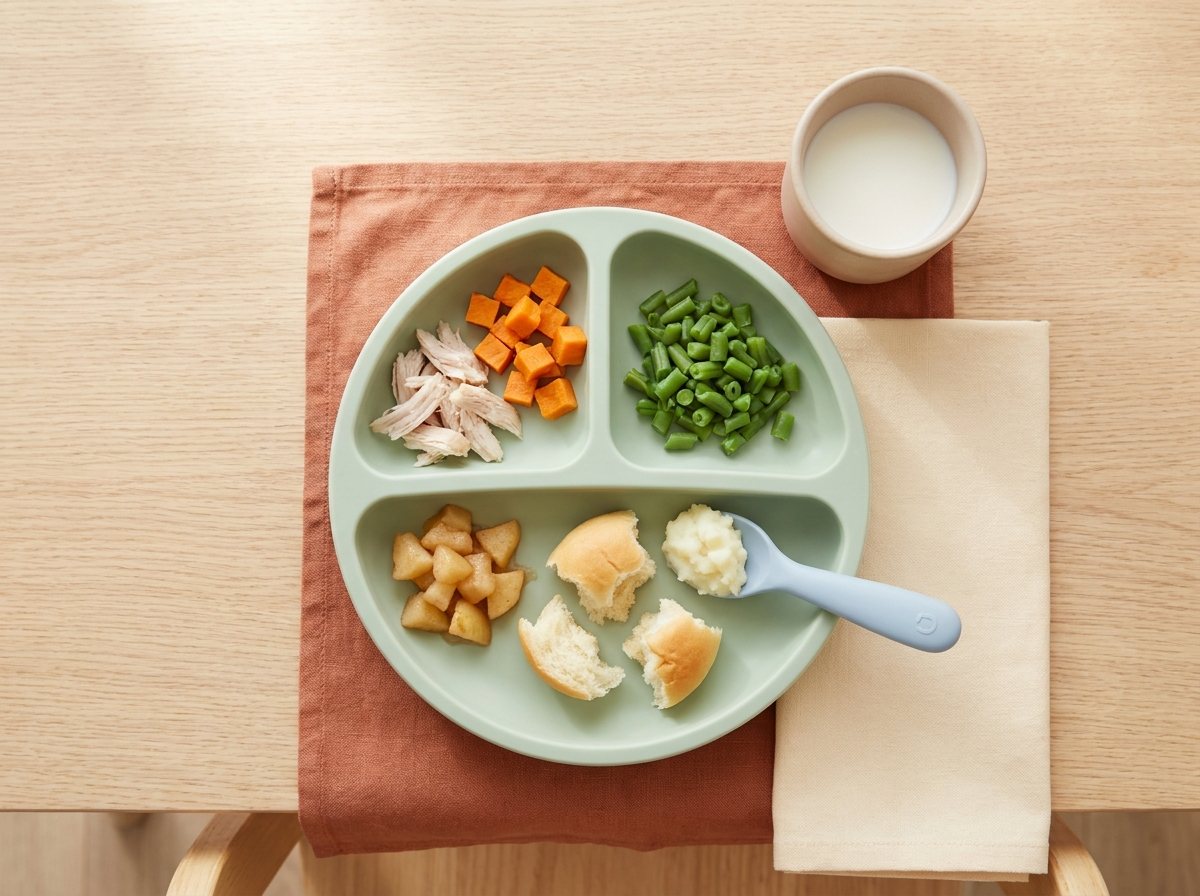
This plate is about soft textures, simple tastes, and practicing self-feeding.
| Food | Amount | How it’s served |
|---|---|---|
| 🦃 Turkey | 1 Tbsp | Finely shredded, moistened with gravy |
| 🥔 Mashed potatoes | 1 Tbsp | On a pre-loaded spoon |
| 🍠 Sweet potato | 1 Tbsp | Soft, pea-sized cubes or mashed |
| 🫘 Green beans | 1 Tbsp | Chopped very small, cooked soft |
| 🍞 Roll | ¼ roll | Torn soft center only |
| 🍎 Cooked apple or pear | 1 Tbsp | Cooked soft, mashed or cut small |
| 🥛 Whole milk or water | 2–4 oz | In an open cup or straw cup |
Why it worksIt’s small, soft, and varied without being a lot. Nothing needs much chewing, and every item is easy to pick up or scoop. Expect a lot of mashing and smearing, and don’t expect it all to be eaten.
🍽️ Plate for a 2-Year-Old
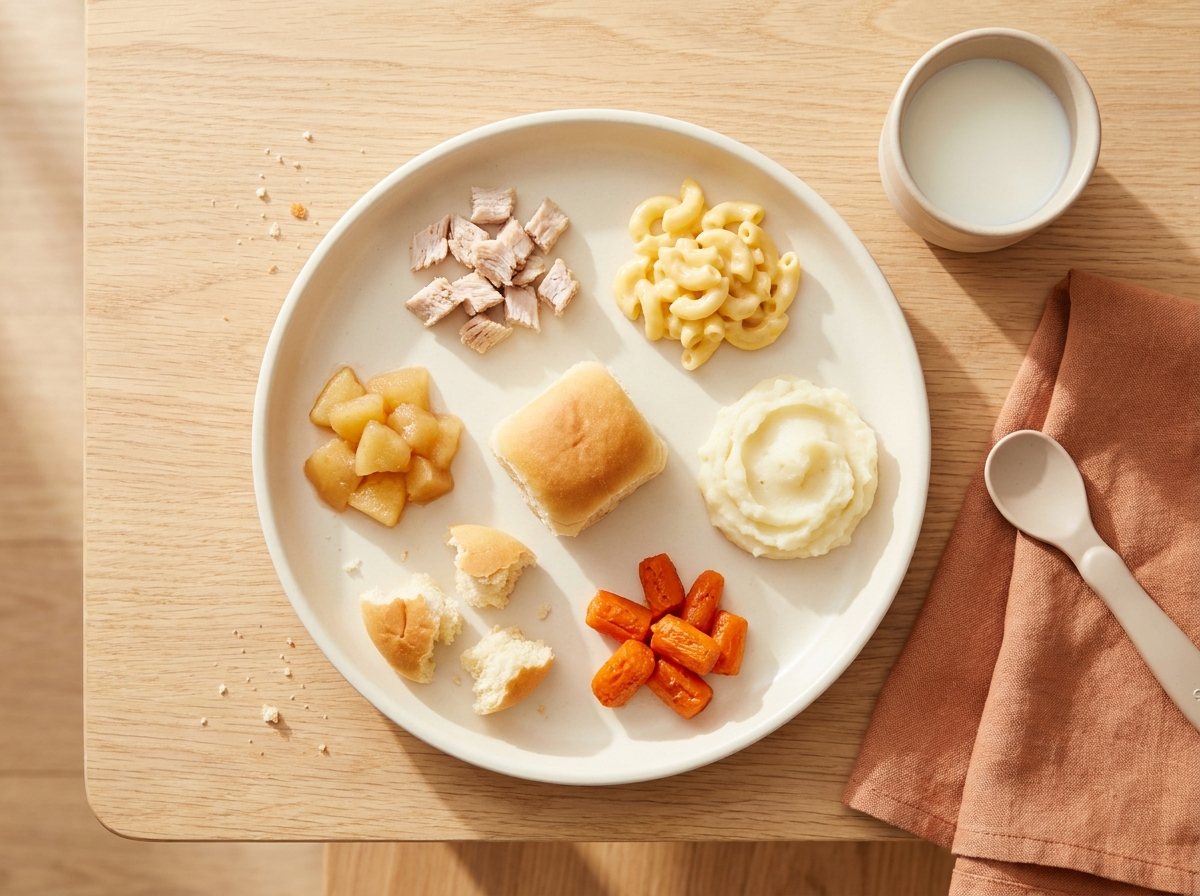
At two, many kids are in a strong opinions phase. This plate is built for control and choice.
| Food | Amount | How it’s served |
|---|---|---|
| 🦃 Turkey | 2 Tbsp | Small shreds or tiny pieces |
| 🧀 Mac and cheese | 2 Tbsp | Their trusted favorite |
| 🥔 Mashed potatoes | 2 Tbsp | Separate scoop |
| 🥕 Roasted carrots | 2 Tbsp | Soft, cut small |
| 🍞 Roll | ½ roll | Torn into bite-size pieces |
| 🍎 Cooked apple or pear | 2 Tbsp | Cooked soft, cut small |
| 🥛 Milk or water | 3–4 oz | Usual cup |
Why it worksIt includes a guaranteed favorite (mac and cheese), which lowers the stakes for everything else. A 2-year-old gets to feel in charge, and the plate still has protein, vegetable, and fruit.
🍽️ Plate for a 3-Year-Old
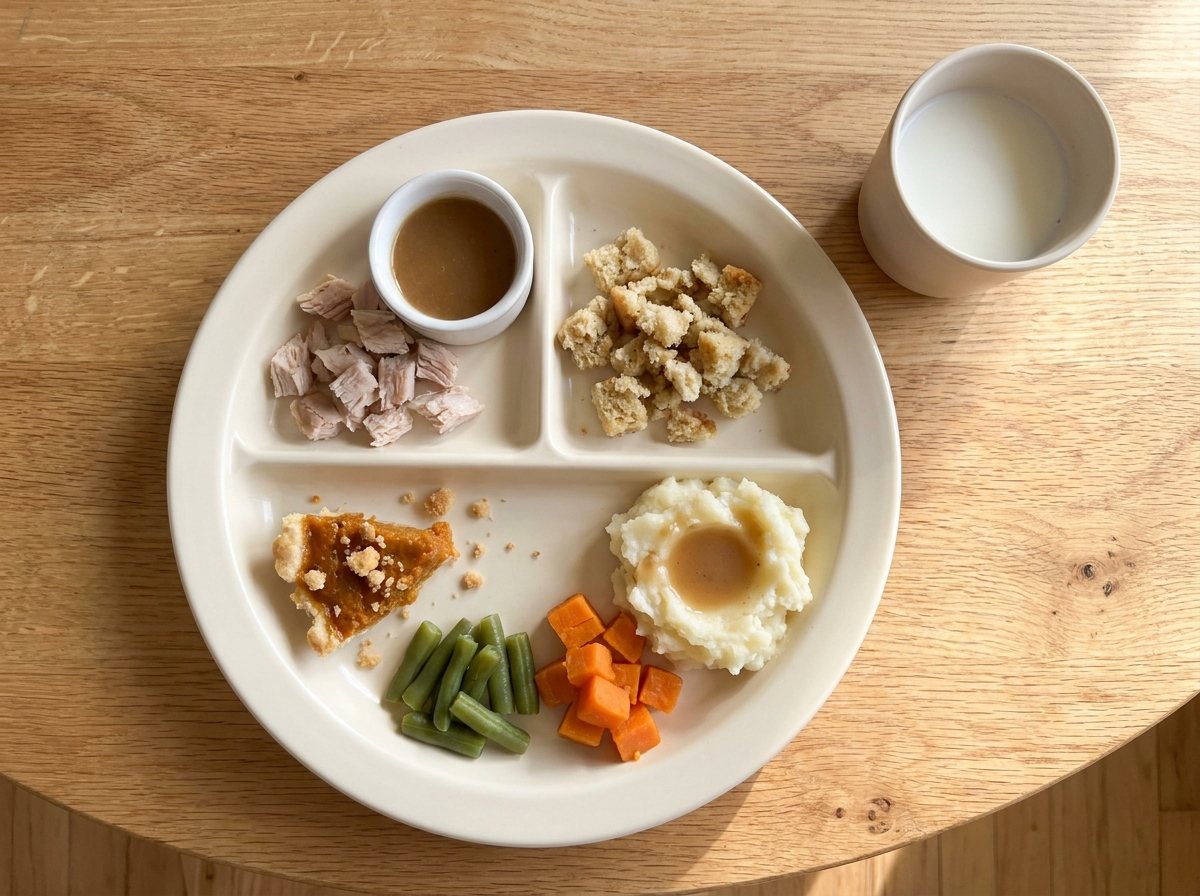
A 3-year-old can handle more of the actual spread and often likes to “build” their own plate.
| Food | Amount | How it’s served |
|---|---|---|
| 🦃 Turkey | 3 Tbsp | Small pieces, a little gravy to dip |
| 🍞 Stuffing | 2 Tbsp | Soft middle; no nuts, dried fruit or big sausage pieces |
| 🥔 Mashed potatoes | 3 Tbsp | Plain or with a gravy well |
| 🍠 Sweet potato | 3 Tbsp | Cubes or mash |
| 🫘 Green beans | 3 Tbsp | Soft, short pieces |
| 🥧 Pumpkin pie | 2 Tbsp | Filling plus a few crust crumbs |
| 🥛 Milk or water | 4–6 oz | Usual cup |
Why it worksThis is nearly the “real” Thanksgiving plate, scaled down. A 3-year-old gets a sense of belonging at the table, and the portions stay safe and sized for their appetite. Serve the stuffing and pie only if your child already tolerates what’s in them, since both usually contain wheat, egg, and dairy. Let them serve themselves one item with a spoon if they’d like.
Late Thanksgiving Mealtime: How to Time Toddler Meals
You can have the perfect plate and still lose the battle if the timing is off.
Feed your toddler on their own clock, not the family’s. If the big meal is at 3 p.m. and your toddler normally has lunch at noon and naps at 1, you have a few choices:
- Option 1: Serve a mini-Thanksgiving lunch at their usual time. Use the same plate formula before the big meal. Later, let your toddler sit at the big table and graze, with no pressure.
- Option 2: Offer a real snack at 11:30 or noon. Pick something filling, like yogurt and fruit, cheese and crackers, or a banana with a thin smear of sunflower seed butter they’ve had before.
- Option 3: Move the nap. If the schedule allows it, nap earlier and eat Thanksgiving after waking.
The goal is to avoid the combination of a very hungry toddler and a long wait while the adults finish carving. That’s the recipe for meltdowns. Hand over a snack plate (cooked or grated apple, some crackers, shredded cheese, soft-cooked carrot cut into small pieces) while dinner is coming together. Just keep it small enough that your toddler still has an appetite for the main event.
For more no-fork finger foods that bridge the wait, try my healthy toddler snack ideas.
What to Do If Your Toddler Eats Almost Nothing
It happens. You make the beautiful plate, your toddler eats two bites of roll, and then wants to climb out of the chair. Here’s how I think about it.
Relax your definition of success. Success at a toddler Thanksgiving is a calm table and a chance to see the food, not a clean plate. Your toddler touching, smelling, or squishing a new food is learning.
- Stick to the division of responsibility. This is Ellyn Satter’s Division of Responsibility. The adult decides what is served, when, and where. The toddler decides whether to eat and how much. That means no bribing, no “three more bites,” and no commentary on the plate.
- Keep a safe food on the plate. A roll, mac and cheese, plain fruit, or whatever your toddler reliably eats. This takes the pressure off and keeps hunger at bay.
- Let them leave when done. If they want to get down, let them. If they’re hungry again 20 minutes later, offer a plate or a snack that feels like the meal, not an all-day buffet of crackers.
Don’t panic about nutrition. One low-eating day doesn’t derail anyone’s growth. Most toddlers balance out over several days. If you’re worried about your toddler’s overall intake or growth, that’s a conversation for your pediatrician, not a Thanksgiving plate.
If mealtimes are a recurring struggle in your house, the picky eater quiz can help you figure out what type of eater you’re dealing with and what tends to help.
Make-Ahead Tips for Toddler Thanksgiving Plates
You’re already busy cooking for a crowd. Here are a few ways to set your toddler up without adding work:
- Cook a little extra sweet potato and carrots a day ahead. Soft, cold roasted cubes are an easy pre-dinner snack plate.
- Pull toddler portions before seasoning. When the potatoes are cooked, scoop a small bowl out before adding salt, garlic, and lots of butter. Same with vegetables.
- Poach a small piece of chicken or turkey breast if your bird won’t be done until late. It can be shredded and ready to go.
- Make a mini-batch of simple mac and cheese, or keep a safe backup like plain pasta with butter in your back pocket.
- Cut and portion fruit ahead and keep it in a small container for an easy, no-cooking side.
- Pack a “safe plate kit” if you’re traveling: a small plate, a spoon and fork, a bib, a few wipes, a pouch or a container of something they love.
Cooking for the whole crowd? Here are my make-ahead Thanksgiving sides that kids will actually eat.
Using Up the Leftovers: Day-After Toddler Meals
The day after Thanksgiving is often an easier meal for toddlers than the holiday itself. It’s calmer, there’s no audience, and everything’s already cooked.
Some easy ideas:
- 🥪 Turkey and cheese mini quesadilla. Shredded turkey and a little cheese in a soft tortilla, cut into strips.
- 🥣 Turkey and sweet potato mash. Mix leftover shredded turkey with mashed sweet potato and a splash of broth for a soft, high-protein lunch.
- 🥕 “Thanksgiving bowl.” A little of everything in a muffin tin: turkey, mashed potatoes, green beans, and cranberry on the side.
- 🥞 Mashed potato pancakes. Mix leftover mashed potatoes with a little flour and egg, then pan-fry small patties until firm and no longer wet in the middle. Serve with applesauce.
- 🍲 Turkey and veggie soup. Simmer leftover turkey, carrots, and potatoes in broth, and cook until very soft.
These pair nicely with the strategies in my toddler-friendly meal prep guide, which shows how to batch and portion a week of toddler lunches without spending your whole weekend in the kitchen. Leftover turkey freezes well. Portion it into ice cube trays or small containers for quick lunches in the weeks after.
Leftover safetyRefrigerate leftovers within 2 hours of serving (1 hour if the room is above 90°F). Reheat leftovers to 165°F, steaming hot throughout. Use refrigerated turkey within 3 to 4 days, or freeze it in small portions inside that window.
A Simple Game Plan for the Day Itself
If you want a short, glanceable version, here’s my toddler Thanksgiving cheat sheet:
- Morning: Normal breakfast. Don’t skip it to “save room.”
- Late morning: A real snack, with protein and fiber.
- Before sitting down: Pull toddler portions, cut and mash everything, and check for bones, nuts, dried fruit, and whole berries.
- At the table: Small plate, starter portions from the chart, one safe food, and one tiny less-familiar bite. No new allergens today.
- During the meal: Eat your own food, talk about anything but the toddler’s plate, and stay within arm’s reach.
- After: Let them be done when they’re done. Offer a little dessert if you’re doing dessert.
- Evening: If they’re hungry before bed, a simple snack or a bowl of yogurt is totally fine.
Frequently Asked Questions
How much should a toddler eat at Thanksgiving dinner?
A good starting point is about 1 tablespoon of each food per year of age, so roughly 1 tablespoon for a 1-year-old, 2 for a 2-year-old, and 3 for a 3-year-old. Serve that amount and let your toddler ask for more. Appetite varies a lot from meal to meal, and one holiday plate isn’t a measure of how well your toddler is eating overall.
What Thanksgiving foods are choking hazards for toddlers?
The big ones are whole cranberries, nuts (whole or chopped), large chunks of meat, turkey skin and bones, whole grapes, and whole olives and cherry tomatoes. Raw hard vegetables and fruit like carrots, celery and apple, dried fruit like raisins and dried cranberries, popcorn, hard candy, and marshmallows are on the list too. Shred or mince the turkey and mash cranberries completely. Quarter grapes lengthwise, and cut the quarters smaller again under age 2. Pit olives, then quarter olives and cherry tomatoes lengthwise. Cook vegetables until soft, and always keep your toddler seated and supervised while eating.
Can my toddler eat the same Thanksgiving food as everyone else?
For the most part, yes, with modifications. Most dishes work once you adjust the texture and size and go light on salt, sugar, and rich toppings. Scoop a toddler portion out before adding heavy seasoning when you can, and skip items that are hard to make safe, like nut-topped dishes or crusty stuffing with big add-ins.
What if my toddler refuses everything on the plate?
Stay calm and keep it low pressure. Include one food you know they usually accept, like a roll, mac and cheese, or fruit, and let them decide how much to eat. Avoid bribing or forcing bites. Many toddlers need to see a food many times before they try it, and an untouched plate still counts as an exposure. If your toddler is eating very little across many days, check in with your pediatrician.
Is it okay for toddlers to have pumpkin pie and dessert?
A small taste is fine, but added sugar is best avoided under 2, so skip it for 1-year-olds. Offer a spoonful or two of the filling with a few crust crumbs, and skip using dessert as a reward or a bargaining chip. For a gentler option, you can serve mashed baked apple or pumpkin yogurt. If your toddler has an egg or dairy allergy, check the recipe, since pie filling usually contains both.
How do I handle a late Thanksgiving mealtime with a toddler?
Feed your toddler on their normal schedule instead of waiting. Either serve a mini Thanksgiving-style lunch at their regular time or give a filling snack in the late morning, then let them join the big meal later as a bonus. This avoids the hungry, overtired meltdown that happens when a long wait collides with nap time.
Can I give my toddler gravy and stuffing?
Yes, in small amounts, as long as your toddler has already had the ingredients. Stuffing and gravy often contain wheat, egg, or dairy, and Thanksgiving isn’t the day for a first taste of an allergen. Both can be quite salty, so use a light drizzle of gravy to moisten food and offer just a spoonful or two of the soft inside of the stuffing. Pick out nuts, all dried fruit, and big sausage pieces, and avoid crusty edges for younger toddlers who are still learning to chew.
Final Thoughts
That first Thanksgiving, my daughter wasn’t being difficult. She was exploring: poking, squishing, and deciding whether the food was safe.
The plate that works for a toddler is smaller, softer, and calmer than ours. Use the chart, keep one familiar food on it, and let the rest be practice.
Whether they eat the turkey or only the roll, it was a good Thanksgiving. You showed up, and that’s the whole job. Happy Thanksgiving, Mama.