Quick Family Dinners for Fall Sports Season: Meals Ready Before Practice
Navigating fall sports dinners is tough, but you can solve it with a system of flexible, fast, and make-ahead meals. Learn how to build a rotation of 20-minute dinners and manage varied eating schedules.
- Recognize fall sports dinner challenges as a scheduling problem, not just cooking.
- Build a rotation of 7-10 true 20-minute dinners you can make on autopilot.
- Plan for flexible meals that hold well or reheat, accommodating varied eating times.
- Prioritize meals that provide pre-practice fuel without causing stomach issues.
Last Tuesday I stood in my kitchen at 4:52 PM holding a raw chicken breast in one hand and a shin guard in the other, while my daughter yelled from the car that practice started in eight minutes and my son informed me, with the calm cruelty only a seven-year-old can manage, that he “didn’t really like rice anymore.” That’s the exact moment fall sports season announces itself every year. One day it’s lazy August dinners on the porch, and the next you’re doing math in your head — can we eat, can we eat in the car, can we eat after, will anyone actually eat — while somebody’s cleats are somehow already on the dining table.
If you’ve got a kid (or three) starting soccer, football, dance, cross country, or all of the above this month, you already know the calendar just got a lot less forgiving. Practice doesn’t care that dinner isn’t ready. Games don’t move because you had a rough day. But dinner still has to happen, and it still has to be something more nourishing than granola bars eaten in a cupholder, night after night, for the next twelve weeks.
The good news: this is a solvable problem, not a season you just white-knuckle through. What actually works isn’t one clever recipe — it’s a system: a rotation of true 20-minute dinners, a stash of make-ahead meals that need zero attention on the worst nights, a short list of portable pre-practice fuel that won’t cause a stomachache on the field, and a plan for what happens when everyone gets home starving at 7:45. Let’s build all four pieces.
Why Fall Sports Season Breaks Normal Dinner Routines
Before we get to the meals, it helps to name what’s actually happening, because it’s not just “we’re busier.” Three things collide at once in September and October:
- The clock moves up, not down. Practice at 5:30 means you need food on the table (or in a bag) by 4:45, which is exactly when most parents are still finishing their own workday.
- Kids can’t perform on an empty stomach, but they also can’t run sprints on a full one. There’s a real physiological window — eat too close to activity and you get cramps and nausea; wait too long and you get a kid who’s shaky, cranky, and can’t focus.
- You’re often feeding people at two or three different times. One kid eats at 4:30 before practice, another eats at 7:00 after games, and you’re reheating the same pot of something three separate times.
Once you see it as a scheduling problem rather than a cooking problem, the solution gets a lot clearer: you need meals that are flexible across time (hold well, reheat well, or split into “fuel now, meal later”), not just meals that are fast.
Build a 20-Minute Dinner Rotation
The single best thing you can do before the season gets rolling is stop trying to invent dinner from scratch every night and instead build a rotation of 7-10 meals you can make on autopilot. These are meals where you already know the steps, you already have most of the ingredients on your default grocery list, and nobody has to think.
Here’s a starter rotation that’s fed a lot of exhausted families through fall sports season. All of these are true 20-25 minutes, active time included, using one pan or one pot whenever possible.
| Meal | Time | Why It Works for Sports Nights |
|---|---|---|
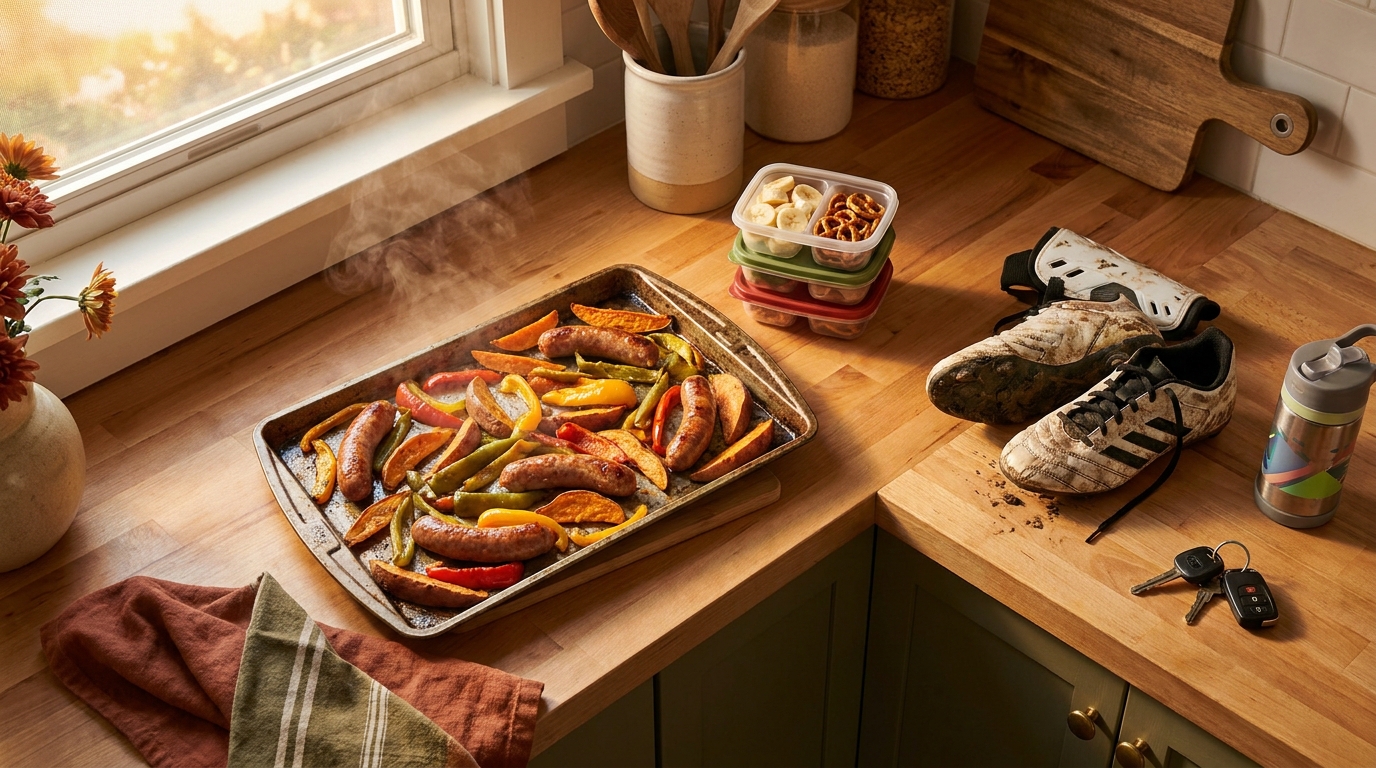
| Sheet-pan sausage, peppers & sweet potato | 22 min | One pan, no babysitting, reheats great for the late eater |
| Ground turkey taco skillet | 18 min | Kids build their own bowls; toppings cover every picky preference |
| 15-minute egg fried rice with frozen veggies | 15 min | Uses up leftover rice; protein + carbs in one bowl |
| Pasta with white beans, spinach & parmesan | 20 min | Vegetarian, holds heat well in a thermos for later eaters |
| Quesadillas with black beans and cheese | 15 min | Griddle-and-go; great for a kid eating solo before practice |
| Sheet-pan teriyaki salmon and broccoli | 20 min | High-protein recovery meal, mild flavor most kids accept |
| Turkey and cheese quesadillas + quick slaw | 18 min | Doubles as pre-practice fuel or dinner depending on timing |
| One-pot cheesy tortellini with peas | 15 min | Kid-favorite, minimal cleanup, freezes in portions too |
| Chicken and rice soup (quick version, rotisserie chicken) | 20 min | Warm, easy to eat fast, good for cooler fall evenings |
A few notes on why these specific meals made the list: they all use pantry staples or a rotisserie chicken as a shortcut, they don’t require a marinade or overnight prep, and every single one can be portioned into a to-go container for the kid who’s eating in the car. If your crew is still building comfort in the kitchen, pair this rotation with Teaching Kids to Cook: The Complete Age-by-Age Guide to Kitchen Skills — even a 20-minute dinner goes faster when a 9-year-old can be trusted to shred cheese or set the table without supervision.
The rule that makes a rotation actually work: post it. Literally tape a laminated card inside a cabinet door with these nine meals listed. When you’re standing there at 4:40 PM with zero brain capacity left, you don’t want to invent — you want to pick from a list. Decision fatigue is the real dinner killer in September, not lack of good recipes.
Make-Ahead Meals for the Nights You Can’t Even Do 20 Minutes
Some nights, 20 minutes is still too much — back-to-back practices, a late game, or one of those days where you’re just running on fumes. This is where make-ahead and freezer meals earn their keep. The goal is to do the thinking and the chopping on a Sunday (or whenever you have a spare hour) so that a busy Wednesday just requires pushing a button.
Your best options fall into three categories:
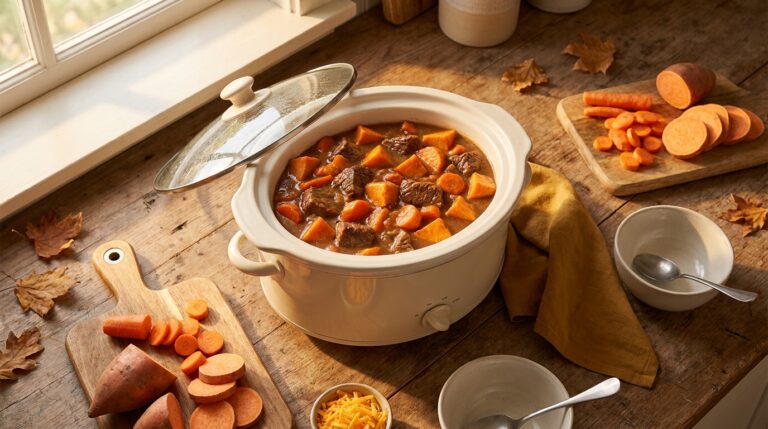
- Slow cooker meals that go in before school and are done by the time anyone walks in the door starving. If you haven’t already built out a slow-cooker rotation for the season, 5 Slow-Cooker Fall Dinners Kids Will Actually Eat (Ready When You Walk In) is exactly the resource to pull from — it’s built around the same “ready when you walk in” logic this whole season demands.
- Freezer meals assembled ahead and thawed the morning of. These are the ones that save you when the week gets away from you entirely, and stocking even six or eight of them before the season ramps up means you always have a backup. Freezer-Friendly Back-to-School Dinners: 20 Meals to Stock Before the School Year Starts has a full list, and most of those recipes work just as well for a Tuesday-night soccer scramble as they do for the first week of school.
- Double-batch nights, where any time you’re already cooking something that freezes well — chili, meatballs, baked ziti, taco meat — you make double and freeze half. This is the lowest-effort way to build a freezer stash because you’re not adding a separate cooking session; you’re just scaling up one you were already doing.
A practical target: aim to have four to six make-ahead meals in rotation in your freezer or slow cooker repertoire at any given point during the season. That’s roughly one “no-cook-required” night per week, which takes an enormous amount of pressure off the other six days.
Portable Fuel for the Car Ride to Practice
Here’s where a lot of well-meaning dinner plans fall apart: you make a great meal, but practice starts in 20 minutes and there’s no way anyone’s sitting down to eat a full plate of teriyaki salmon before running suicides. This is the moment for pre-practice fuel, which is a different category than dinner entirely. Think of it as bridging food — enough to prevent the shaky, hangry meltdown on the field, light enough not to cause cramping.
The timing rule of thumb that sports dietitians generally recommend:
- 60-90 minutes before activity: a real mini-meal — carbs plus a little protein, moderate fat and fiber (both of which slow digestion and can cause discomfort during exercise)
- 15-30 minutes before activity: something very light and mostly carbs — a banana, a few crackers, a small applesauce pouch
- During long practices or games (60+ min): a small snack or diluted sports drink for kids doing sustained, intense activity
Good pre-practice options that travel well in a car (bonus points if a kid can eat them one-handed while buckled in):
- Half a turkey and cheese sandwich on whole wheat, cut into strips
- A banana with a tablespoon of peanut or sunflower butter (nut-free schools/teams: swap to sunflower or soy butter)
- A small container of pretzels and string cheese
- A homemade granola bar or muffin, made ahead over the weekend
- Applesauce pouch plus a handful of whole-grain crackers
- Greek yogurt tube (drinkable, mess-free in a moving car) plus a few dry cereal squares
- Half a bagel with a thin layer of cream cheese
If your kids are old enough to grab their own pre-practice snack without you standing over them, this is a great use of After-School Snacks Kids Can Make Themselves: 20 Easy Recipes for Independence — a lot of those recipes are exactly the right size and macro balance for a pre-practice bridge snack, and having your kid make their own means one less thing on your plate at 4:30 PM.
What to avoid right before activity: anything heavy in fat or fried, large amounts of dairy for kids who are sensitive to it, very high-fiber foods (think raw broccoli or beans), and anything brand-new they haven’t eaten before a practice — race day (or practice day) is not the time to test a new food and find out it doesn’t sit well.
Post-Practice Recovery: What Growing Athletes Actually Need
The other half of the sports-dinner equation is what happens after — and this is the part that gets skipped most often because everyone’s exhausted and it’s already past bedtime. But the post-practice window matters: kids who’ve just spent an hour running around need protein to support muscle recovery and growth, carbohydrates to replenish energy stores, and fluids to rehydrate.
This doesn’t mean you need a complicated recovery protocol for an 8-year-old’s rec league practice. It means the dinner (or snack) that follows practice should lean a little more protein-forward than an average family meal, especially for kids in multiple weekly practices or a heavy competitive schedule.
Good post-practice options:
| Timing | Food | Why |
|---|---|---|
| Right after practice (car ride home) | Chocolate milk or a smoothie | Classic recovery ratio of carbs to protein, easy to drink when tired |
| Within 30-60 min | Full dinner from your 20-minute rotation | Get real food in before the “too tired to eat” window closes |
| If dinner’s delayed | String cheese + fruit + a few crackers | Holds them over without ruining appetite for the real meal |
| Multi-sport days | Eggs, Greek yogurt, or a protein-forward smoothie bowl | Extra protein for kids training more than once a day |
If you have a kid in a heavy training schedule — competitive club soccer, travel teams, daily practices — it’s worth taking a closer look at whether their overall protein intake across the day is keeping pace with what their body’s asking for. High-Protein Meals and Snacks for Kids: An Age-by-Age Guide for Growing Bodies breaks down actual gram targets by age, which is genuinely useful once you’re feeding an athlete rather than just a kid.
It’s also worth knowing that active kids, especially girls entering the tween and teen years, are at higher risk for low iron, which shows up as fatigue, difficulty recovering between practices, and trouble concentrating — symptoms that are easy to mistake for “just tired from sports.” If your athlete seems perpetually drained no matter how much they’re sleeping, Iron-Rich Meals and Snacks for Kids: An Age-by-Age Guide to Preventing Deficiency is worth a read, and it’s easy to weave iron-rich choices (lean beef, beans, dark leafy greens, iron-fortified cereal) into the same 20-minute rotation above.
A Sample Two-Week Fall Sports Dinner Calendar
Theory is nice, but what you actually want during a chaotic season is something you can screenshot and follow without thinking. Here’s a realistic two-week calendar assuming a household with practices Monday, Wednesday, and Thursday evenings, plus a Saturday game — adjust the days to match your own schedule, but keep the pattern: one make-ahead night, a couple of true 20-minute nights, and one “easy enough for anyone to help” night.
Week One
| Day | Dinner Plan |
|---|---|
| Monday (practice) | Slow-cooker chicken and rice (started in the morning) |
| Tuesday | Ground turkey taco skillet — 18 min |
| Wednesday (practice) | Sheet-pan sausage, peppers & sweet potato — 22 min |
| Thursday (practice) | Leftover taco skillet reheated as quesadillas |
| Friday | Frozen pizza night + quick salad — everyone’s earned it |
| Saturday (game) | Pre-game: banana + peanut butter; post-game: chicken and rice soup |
| Sunday | Prep day — double batch chili, portion freezer meals |
Week Two
| Day | Dinner Plan |
|---|---|
| Monday (practice) | Freezer chili (from Sunday prep) — reheats in 10 min |
| Tuesday | One-pot cheesy tortellini with peas — 15 min |
| Wednesday (practice) | Quesadillas + quick slaw — 18 min |
| Thursday (practice) | Sheet-pan teriyaki salmon and broccoli — 20 min |
| Friday | Breakfast-for-dinner (eggs, toast, fruit) — 15 min, zero stress |
| Saturday (game) | Pre-game: string cheese + crackers; post-game: pasta with white beans |
| Sunday | Prep day — restock freezer, plan next two weeks |
Notice the shape: every week has exactly one built-in “no cooking required” night (Friday pizza or breakfast-for-dinner) and one prep day. That’s not slack in the system — it’s the thing that keeps the rest of the system from collapsing by week six.
Timing It Right: Matching Meals to Different Sports Schedules
Not all fall sports run on the same clock, and your dinner strategy should flex with the sport, not just the day of the week.
- Soccer and football, typically 5:00-7:00 PM practices: this is the toughest window because it lands right in the middle of dinner hour. Your best bet is a pre-practice bridge snack around 3:45-4:00, then a light, quick dinner (or reheated leftovers) as soon as everyone’s home, even if that’s 7:30. Don’t wait for a “proper” sit-down dinner time — eat when the window opens.
- Dance and gymnastics, often evening classes 6:00-8:00 PM: these tend to run later and longer, so a fuller dinner before class (5:00-5:30) works better than a snack-and-wait approach, since kids need sustained energy for a two-hour session. Follow up with a small protein snack after if bedtime allows.
- Cross country and track, frequently early-morning or after-school practices ending by 5:00: this is actually the easiest schedule to feed around — a normal dinner time still works, just make sure the pre-practice fuel (if it’s an after-school practice) happens right when they walk off the bus, not right before they leave for practice.
- Multi-sport households (one kid in soccer, one in dance, staggered practice times): this is where the make-ahead strategy stops being a nice-to-have and becomes mandatory. A slow-cooker meal that holds well for two hours, or a big pot of something everyone can serve themselves from whenever they’re actually home, solves the “three different dinner times” problem better than trying to time three separate cooked meals.
Sunday Prep: The 45-Minute Habit That Saves Your Whole Week
Every strategy above works dramatically better with about 45 minutes of prep on Sunday (or whatever your slowest day is). You don’t need a full meal-prep marathon — you need four small tasks:
- Chop the aromatics for the week — onions, peppers, garlic — and store in one container. This alone shaves 5-8 minutes off almost every recipe in the rotation.
- Cook a batch of a base protein — shredded rotisserie chicken, browned ground turkey, or a pot of black beans — that shows up in two or three meals across the week in different forms.
- Portion pre-practice snacks into grab-and-go containers so nobody’s assembling a snack bag at 4:40 PM while also finding shin guards.
- Check what’s freezer-stocked and plan one night around whatever’s already made.
If you’re trying to keep costs down while feeding a house full of hungry athletes (protein isn’t cheap, and neither is the volume of food active kids go through), Budget Meal Planning for Families: Feed Your Crew for Less Without Sacrificing Nutrition pairs well with this Sunday habit — buying your proteins and produce with the week’s rotation already mapped out is one of the biggest cost-savers there is. And since fall produce is genuinely at its best right now, Fall Produce Guide for Families: What’s Fresh Right Now and How to Use It is a good companion for swapping seasonal vegetables into the sheet-pan and skillet meals above — squash and Brussels sprouts roast beautifully alongside sausage, and they’re often cheaper than out-of-season options right now.
Getting Kids to Help, Even on the Busiest Nights
It sounds counterintuitive to add “teach your kid to cook” to a list of strategies for surviving your busiest season, but a kid who can assemble their own quesadilla or build their own taco bowl is a kid who takes work off your plate on exactly the nights you need it most. Even a 6-year-old can shred cheese, tear lettuce, or stir a pot under supervision; an 11-year-old can realistically make a full quesadilla or scrambled eggs solo.
Start small on a low-stakes night (not the night of the championship game) and build from there. The goal by mid-season isn’t a kid who cooks dinner — it’s a kid who can make their own pre-practice snack or reheat their own portion of leftovers without needing you to stop what you’re doing. That single skill, multiplied across a dozen practices a month, adds up to real time back.
When the Season Wins Anyway: A Permission Slip
Some weeks, none of this works. There’s a tournament, a sick kid, a work deadline that eats your Sunday prep time, and you end up doing drive-through in the car between practice and homework. That’s not a failure of the system — that’s just what an intense season occasionally looks like, and one drive-through dinner doesn’t undo a rotation that’s working the other five nights of the week. The goal of everything above isn’t a perfect season. It’s a default that’s good enough to fall back on most nights, so the occasional chaos night doesn’t feel like a crisis.
Frequently Asked Questions
How long before practice should my child eat dinner?
Aim for a full meal 2-3 hours before intense activity, or a lighter snack 60-90 minutes before if dinner timing doesn’t allow for that. Right before practice (within 15-30 minutes), stick to something small and easy to digest, like a banana or a few crackers — heavier or high-fat foods eaten too close to activity commonly cause cramping or nausea.
What should my kid eat if practice runs right through normal dinner time?
Give them a light pre-practice snack (like half a sandwich or a banana with nut or seed butter) about an hour before, then feed them a full dinner as soon as you’re home, even if that’s later than your usual dinner time. Don’t skip the real meal — the bridge snack is meant to hold them over, not replace dinner.
Is chocolate milk actually a good post-practice recovery drink?
Yes — it’s become a go-to recommendation among youth sports nutrition experts because it naturally has close to the ideal 3:1 or 4:1 carbohydrate-to-protein ratio recommended for post-exercise recovery, plus fluids for rehydration. It’s not magic, but it’s a genuinely solid, kid-friendly option in the 30-60 minutes after intense activity.
How many make-ahead meals should I keep on hand during sports season?
A good target is four to six ready-to-go meals in your freezer or slow-cooker rotation at any point, which covers roughly one no-cook night per week. That’s usually enough to absorb the chaos of a typical multi-sport week without leaving you scrambling.
My kid says they feel sick if they eat before a game. What should I do?
This is common and usually means the timing or food choice needs adjusting, not that they should skip eating entirely — running on empty leads to worse performance and can cause dizziness or headaches. Try moving the meal earlier (2-3 hours out instead of 1), switching to something lighter and lower in fat and fiber, and testing new pre-game foods during practice weeks rather than before an actual game.
How do I feed kids on different practice schedules without cooking three separate dinners?
Lean on meals that hold well over a few hours — slow-cooker dishes, soups, and casseroles are ideal because everyone can serve themselves whenever they walk in the door. Keep a pot on the stove or in the slow cooker rather than trying to time a from-scratch meal to multiple arrival times.
What are good pre-practice snacks for a kid with a nut allergy?
Sunflower seed butter or soy butter on whole-grain bread or crackers works as a direct swap for peanut or almond butter, and pairs well with a banana or apple slices. String cheese, yogurt tubes, and pretzels are also naturally nut-free and travel well in a car.
You’ve Got This Season
Fall sports season is loud, fast, and genuinely exhausting some weeks — but it doesn’t have to mean abandoning real food for three straight months. With a rotation you can run on autopilot, a few backup meals waiting in the freezer, and a clear sense of what your athlete needs before and after they hit the field, dinner stops being the thing you’re dreading at 4:30 PM. Pick two or three ideas from this list to start with this week, build from there, and give yourself grace on the nights the system loses to the schedule anyway. You’re doing more right than you think.