Halloween Classroom Party Snack Checklist
Use this checklist to plan your Halloween classroom party snacks, covering how to get an accurate headcount, manage allergy flags, and balance your snack offerings for a successful event.
- Calculate your real headcount, including adults and a buffer, not just the class list.
- Plan for one sweet, one savory, and one fruit/veg item per child, in small portions.
- Identify all classroom allergy rules and common flags before choosing any snacks.
- Suggest splitting snack categories (sweet, savory, fruit) among parent volunteers.
This post contains affiliate links. As an Amazon Associate I earn from qualifying purchases.
Last October, at 10:40 p.m., I had eleven browser tabs open, a sign-up sheet that said “Halloween snacks: Mama Munch!” and exactly zero decisions.
The recipes were never the problem; the missing decision order was. So I built this checklist: headcount, allergy flags, snack mix, a matching grocery list, and day-of logistics.
Copy it into your notes app so you have it handy.
In this article (12 sections)
- Step 1: Get Your Real Headcount (It’s Not Just the Class List)
- Step 2: Set Your Allergy Flags Before You Open a Single Recipe
- Step 3: The Classroom Snack Decision Checklist
- Step 4: Your Matching Grocery Lists
- Halloween Classroom Party Snack Ideas (Fruit, Savory, Sweet)
- Halloween Party Prep Timeline That Keeps You Sane
- Day-Of Logistics for a Classroom Party
- Balancing the Party Table (Without Being the Fun Police)
- Sample Plan: 22 Students, Nut-Free and Dairy-Free
- Adapting the Checklist for Other Halloween Parties
- Frequently Asked Questions
- You Don’t Need Fifty Recipes, Just a Plan
Step 1: Get Your Real Headcount (It’s Not Just the Class List)
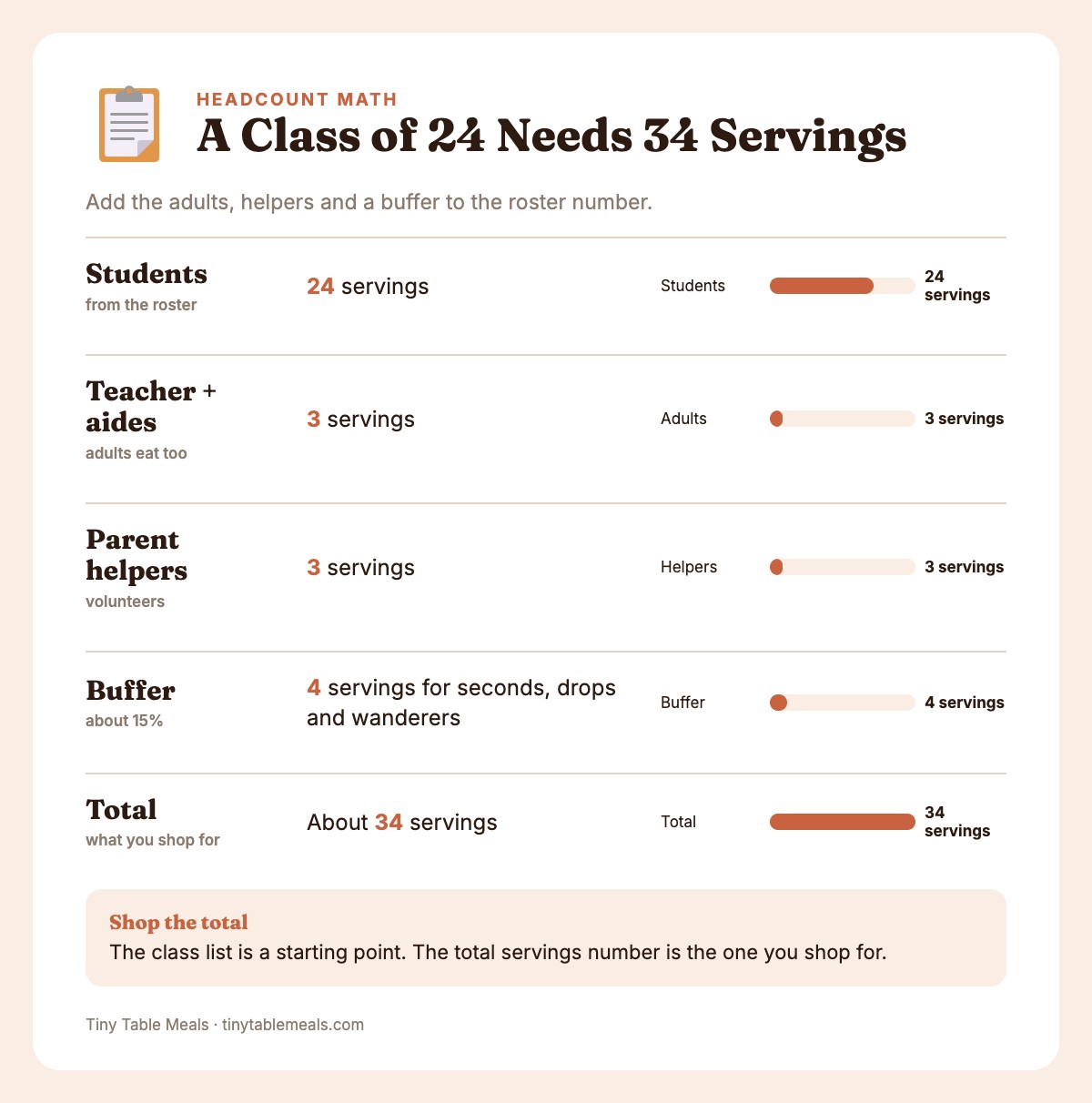
The number on the class roster is a starting point, not your number. Here’s what I add up every time.
| Who | Count | Notes |
|---|---|---|
| Students in the class | ___ | Ask the teacher for the real number, including part-timers |
| Teacher + aide(s) | ___ | Adults eat too, and teachers rarely get to sit down |
| Parent helpers/volunteers | ___ | Usually 2-4 at a party |
| Buffer (about 15%) | ___ | Seconds, drops, a kid from the next class who wanders in |
| Total servings needed | ___ |
For a class of 24, that usually works out to about 24 + 3 adults + 3 helpers + a buffer of 4 = about 34 servings. That number is what you shop for.
How Many Servings Per Kid?
This is where people over- or under-buy. A classroom party is usually 30-45 minutes, often right after lunch or just before dismissal, and the kids are also doing a craft, a parade, or a game. They’re not sitting down to a meal.
My rule of thumb:
- One sweet item + one savory item + one fruit or veg item per child, each in a small portion.
- If the party is within an hour of lunch, cut portions to about two-thirds.
- If it’s the last hour of the school day, expect hungrier kids and bump the savory item up.
Splitting Snacks Among Parents
Most classes split the party across several families: one brings drinks, one brings a sweet, one brings a savory. If the room parent hasn’t assigned categories, propose it. It stops the classic problem of five trays of cupcakes and nothing a kid can eat three bites of without a sugar crash.
A quick message that works: “Happy to bring the savory + fruit. Could someone take sweets and someone take napkins/cups/plates? Happy to coordinate allergy labels too.”
Step 2: Set Your Allergy Flags Before You Open a Single Recipe
This is the step that most roundups skip, and it’s the most important one. Do it before you shop, before you bake, before you even pick a theme.
Find Out the Rules
Schools vary a lot. Some are strictly nut-free. Some ban homemade food entirely and require sealed, store-bought items with ingredient labels. Some allow anything as long as you label it. Some restrict specific ingredients that a child in the class is allergic to.
Before you plan, ask the teacher or room parent these four questions:
- Are there any allergies in the class I should plan around? (Ask for the ingredients, not names.)
- Is the classroom or school nut-free (peanuts and tree nuts)?
- Is homemade food allowed, or does it need to be store-bought and sealed?
- Are there any other rules, such as no food dyes, no sugar-heavy items, or no candy?
Don’t assume. I once spent a Sunday afternoon making cute pretzel-and-pumpkin-seed bags before learning the class had a seed allergy. The cute bags went to my husband’s office. The party got a different plan.
The Common Flags to Plan Around
In the US, the most common food allergens are milk, eggs, peanuts, tree nuts, soy, wheat, fish, shellfish, and sesame. For a classroom party, the ones you’re most likely to run into are:
| Flag | What it means for snacks | Easy swap direction |
|---|---|---|
| Peanut / tree nut | No nut butters, trail mix, granola bars with nuts, many chocolates | Seed butter (if seeds are okay), plain popcorn, fruit, labeled nut-free treats |
| Dairy | No cheese, yogurt, milk chocolate, many cookies and frostings | Fruit, dairy-free labeled snacks, veggies with a labeled dairy-free dip (hummus only if sesame is not a flag); check pretzel labels |
| Egg | No baked goods made with egg, many marshmallow treats | Fruit, plus crackers and dips only after checking the label for egg (ranch and mayo-based dips often contain it); egg-free-labeled cookies |
| Gluten / wheat | No pretzels, crackers, cookies, cupcakes | Fruit, popcorn, rice-based snacks, labeled gluten-free items |
| Soy | Hidden in many chocolates, breads, and packaged snacks | Whole fruits and vegetables, careful label reading |
| Sesame | Hidden in some crackers, hummus, and breads | Read labels; skip hummus unless you’ve checked it |
A few honest cautions: “nut-free” on a package and “made in a facility that processes nuts” are different things, and families manage this differently. The only reliable approach is to read the label every time. For a child with a diagnosed allergy, ask the teacher to pass your ingredient list to that family and relay their preferences.
Wheat allergy and celiac disease are different, so ask which one applies. Either way, check labels on every item, including popcorn, chips, sprinkles and chocolate, which can carry gluten or cross-contact. Fish and shellfish rarely show up in these snacks, but read labels on anything packaged. If you’re unsure, a whole fruit or a sealed, individually wrapped item with a clear label is the safest bet.
If you want more ideas built around these flags, my post on allergy-friendly party food goes deeper on swaps, cross-contact, and how to label a table so nobody has to ask. For Halloween-specific ideas, see my allergy-friendly Halloween classroom treats.
The “Safe-For-Everyone” Strategy
When I don’t have specific allergy info yet, I default to a mix that’s easy to make safe:
- Whole fruit (clementines peeled, seeds removed and segments halved for under 4s; grapes quartered lengthwise for children under 5; apple slices cut paper-thin or cooked for under 4s)
- Plain popcorn, only for kids 4 and older (skip it in mixed-age or preschool groups)
- A single-ingredient veggie or fruit platter
- One sealed, labeled treat that’s free of the top allergens
That mix works for most classrooms and leaves room to add one fun themed item.
Nut-Free Options That Don’t Feel Boring
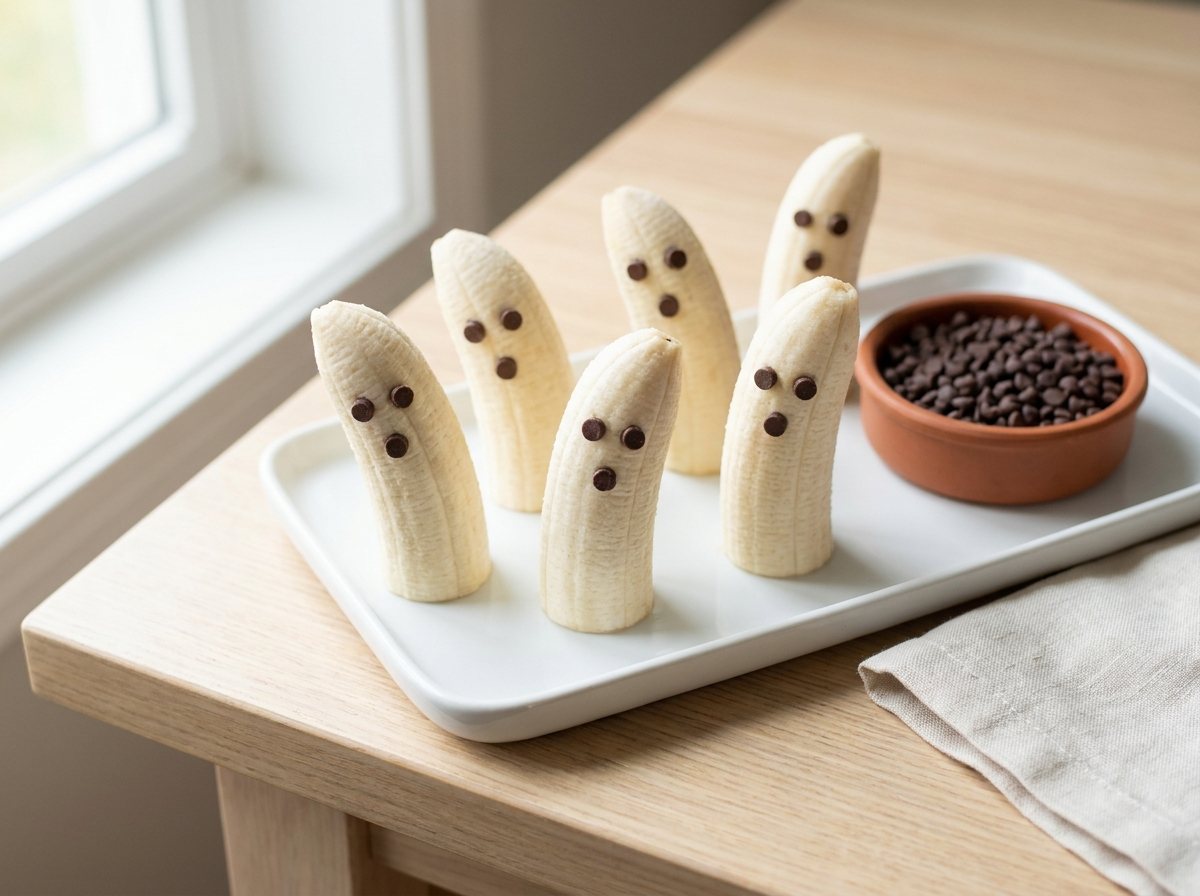
Nut-free is the most common classroom requirement, so here’s a quick list of Halloween-friendly options that are usually nut-free, but verify every package:
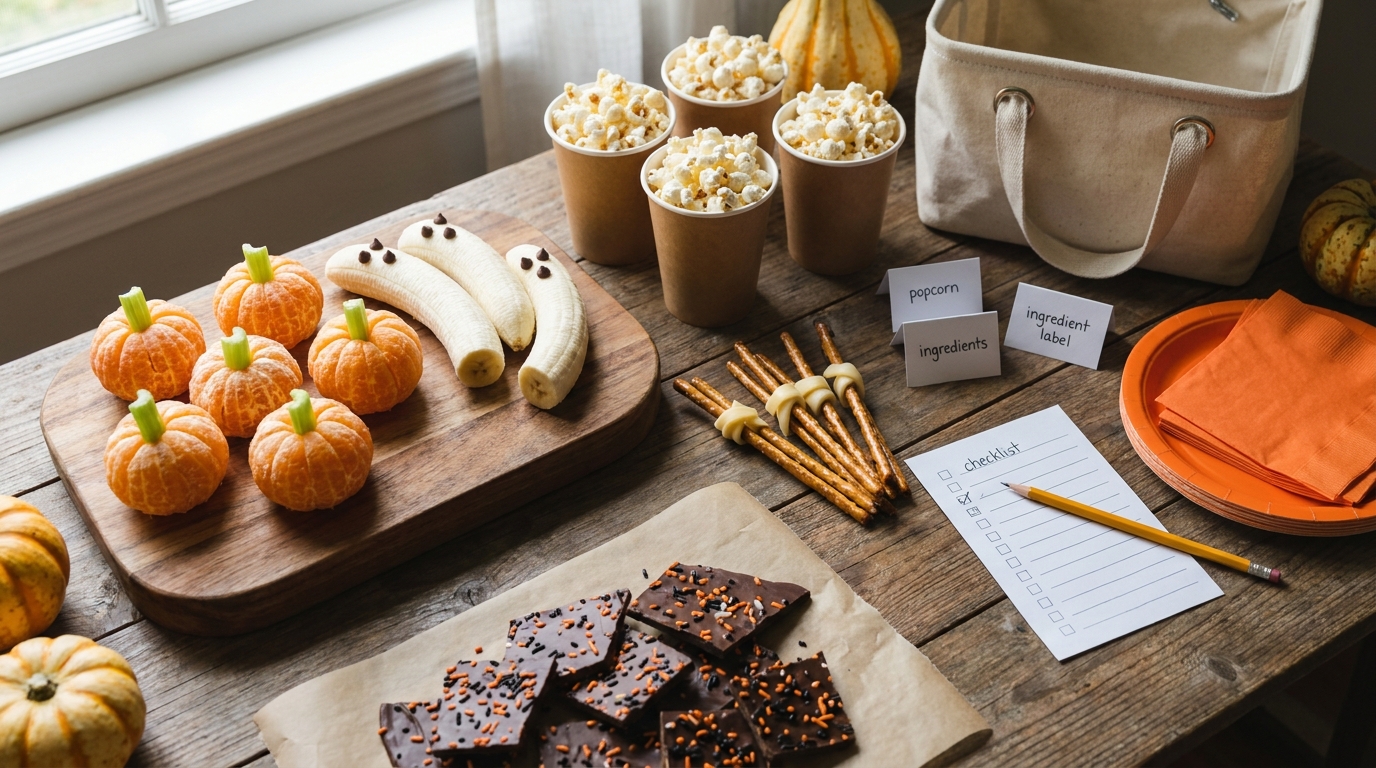
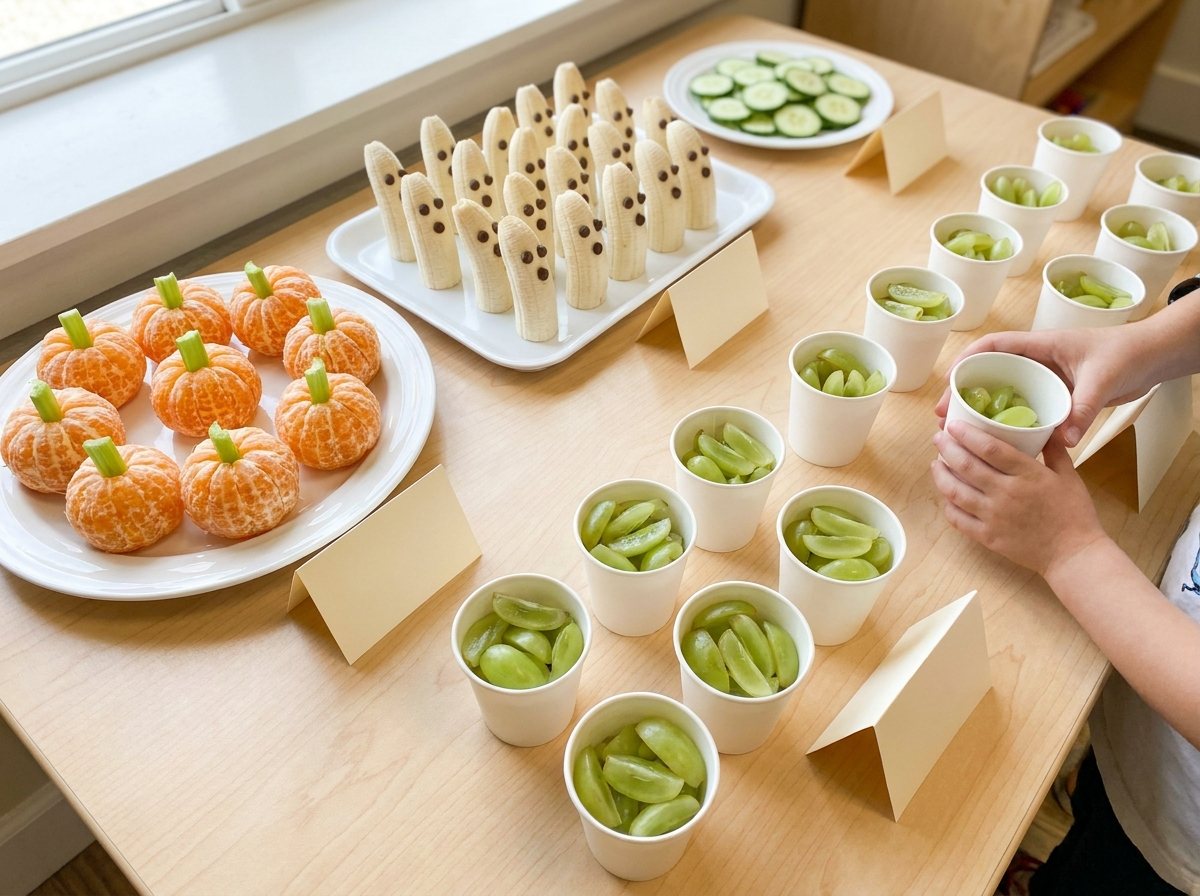
- Clementine “pumpkins” with a celery-stem top (decoration only; remove the stem before a child under 5 eats it)
- Banana “ghosts” with mini chocolate chip eyes (check the chips’ label for nut warnings)
- Pretzel sticks and cheese sticks or thin strips as “witch brooms” (if wheat and dairy are okay; for under 4s, thin cheese strips and no hard pretzels)
- Popcorn in small paper cups or cones (kids 4 and older only; skip in mixed-age or preschool groups)
- Apple slices, plain or with a labeled allergen-free dip (paper-thin or cooked for under 4s)
- Individually wrapped, nut-free-labeled cookies
For more everyday nut-free inspiration that travels well, my nut-free lunchbox ideas are a solid reference, especially for the savory side of the table.
Step 3: The Classroom Snack Decision Checklist
Here’s the full tool. Copy it into a notes app, paste it into a message, or print this page and fill it in with a pen. I keep mine on the fridge door for a week before the party.
Part A: Headcount
| Field | Fill in |
|---|---|
| Class / teacher | ____________ |
| Party date + time | ____________ |
| Party length (min) / right after lunch? | _____ min / Yes or No |
| Students | ____ |
| Teacher + aides | ____ |
| Parent helpers | ____ |
| Buffer (about 15%) | ____ |
| Total servings | ____ |
Part B: Allergy Flags
Tick every box that applies, then follow the arrow.
- Nut-free required → choose only items labeled nut-free; skip nut butters and trail mix
- Dairy-free needed → skip cheese, yogurt, milk chocolate; use fruit and label-checked dairy-free snacks and pretzels
- Egg-free needed → skip homemade baked goods; use fruit, and check labels on crackers, dips and cookies for egg
- Gluten-free needed → skip pretzels/crackers/cupcakes; use fruit and labeled gluten-free items, and check popcorn, chips and sprinkles too
- Sesame / soy / seed flag → read every label; keep to whole fruits and veggies
- School requires store-bought, sealed items only → skip homemade; use Scenario 4 below
- No known allergies, but I’m playing it safe → use the “safe-for-everyone” mix
Part C: Snack Mix (Pick One From Each Row)
| Category | Option 1 | Option 2 | Option 3 |
|---|---|---|---|
| Fruit / veg | Clementine pumpkins | Apple slices + lemon water (paper-thin or cooked for under 4s) | Grapes (quartered lengthwise) + cheese cut into thin strips |
| Savory | Popcorn cups (ages 4+) | Pretzel “brooms” | Veggie sticks + dip |
| Sweet | Banana ghosts | No-bake Halloween bark | Sealed labeled cookie |
| Drink | Water | Small 100% juice boxes | Milk (skip if a dairy flag applies) |
Circle your picks. Three picks plus a drink is a full classroom spread.
Safety firstQuarter grapes lengthwise for any child under 5. If any child is under 4, also cut cheese into thin strips, and skip popcorn, hard pretzels, candy eyes, sprinkles and gummy snacks. Popcorn is only for kids 4 and older. Raw carrot sticks, whole olive rounds and raw apple wedges are also choking risks at that age: steam or shred the carrots, cut olives small, and slice apples paper-thin or cook them.
Part D: Day-Of Logistics
- Everything fits in one bin or bag
- Ingredient labels or a printed ingredient list ready
- Napkins, plates, cups, serving utensils packed
- Wipes and a small trash bag
- Perishables are out no longer than 2 hours (1 hour if the room is above 90°F)
- Delivered to the classroom by the time agreed with the teacher
- Teacher has a heads-up on what’s in each item
Step 4: Your Matching Grocery Lists
This is the part that saves the most time. Instead of writing a list from ten recipes, you pick the scenario that matches your answers, and the list is already there. Quantities below are scaled for about 34 servings (a class of around 24 plus adults and buffer). Scale up or down proportionally to your own total. Costs vary a lot by store and region. Scenario 4 usually costs the most, because individually wrapped items cost more per serving than whole fruit and a big bag of popcorn.
Scenario 1: Nut-Free, No Other Flags (Most Common)
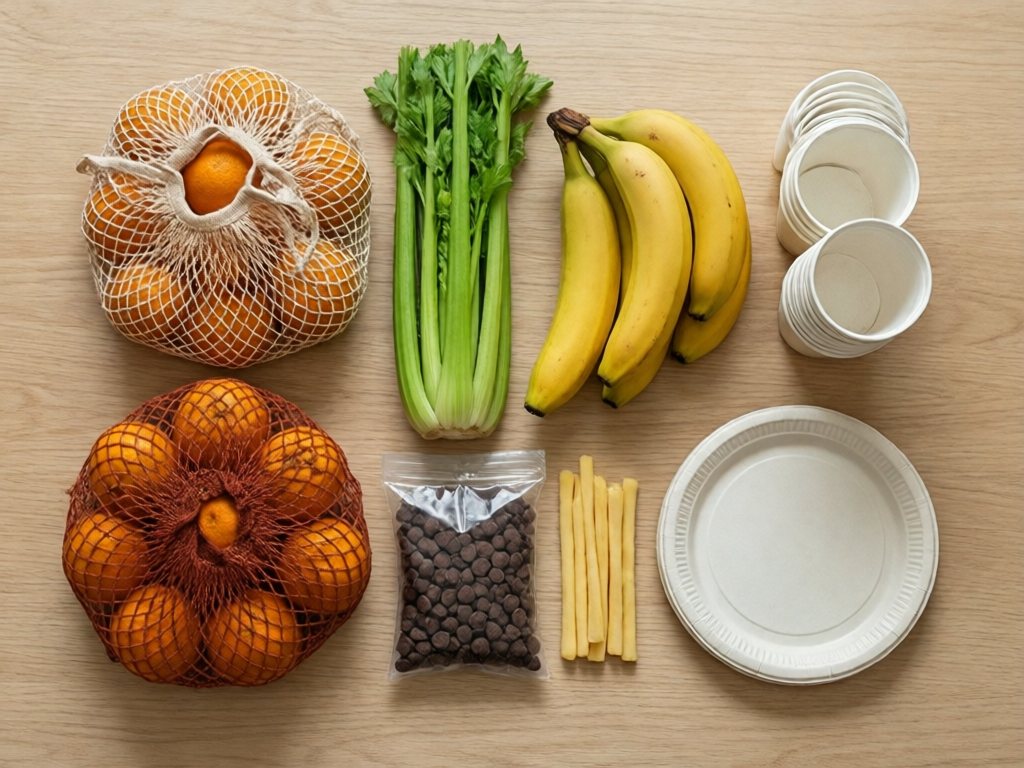
| Item | Quantity | Notes |
|---|---|---|
| Clementines | two 3 lb bags (about 36-40) | One per serving; peel and halve for younger kids |
| Celery | 1 bunch | Stems for “pumpkin” tops; decoration only, remove before a child under 5 eats it |
| Bananas | 17 medium | For ghosts, cut in half (about 34 halves) |
| Mini chocolate chips | 1 small bag | Check the nut-free label |
| Pretzel sticks | 1 large bag | Check the label for nut cross-contact; skip for under 4s |
| Cheese sticks | 17 sticks | Cut in half; thin strips only for under 4s |
| Plain popcorn kernels or bagged popcorn | 1 large bag | Ages 4+ only; skip in mixed-age or preschool groups |
| Paper cups, plates, napkins | 34 each | |
| Small trash bag + wipes | 1 each |
Scenario 2: Nut-Free and Dairy-Free
| Item | Quantity | Notes |
|---|---|---|
| Clementines | two 3 lb bags | |
| Celery | 1 bunch | Decoration only for under 5s |
| Bananas | 17 medium | |
| Dairy-free mini chocolate chips | 1 small bag | Check labels carefully |
| Pretzel sticks | 1 large bag | Verify dairy-free; skip for under 4s |
| Hummus (only if sesame is not a flag) or a labeled allergen-free dip | 1-2 small tubs | Check sesame/soy flags |
| Veggie sticks (carrots, cucumber) | 2 lb | Cut into sticks; steam or shred carrots for under 4s |
| Plain popcorn | 1 large bag | Ages 4+ only; skip in mixed-age or preschool groups |
| Paper goods | 34 each |
Scenario 3: Nut-Free, Dairy-Free, and Gluten-Free
| Item | Quantity | Notes |
|---|---|---|
| Clementines | two 3 lb bags | |
| Apples | 11 medium | Slice and toss with lemon juice (about 3 slices per serving); slice paper-thin or cook for under 4s |
| Bananas | 17 medium | |
| Nut-free, dairy-free, gluten-free chocolate chips | 1 small bag | Verify all three on the label |
| Plain popcorn | 1 large bag | Ages 4+ only; popcorn is usually gluten-free, but confirm on the package |
| Veggie sticks | 2 lb | Steam or shred carrots for under 4s |
| Sealed cookies labeled gluten-free, nut-free and dairy-free | 2 small packs | For a “treat” option. Read the full ingredient list; many gluten-free cookies use almond flour or dairy |
| Paper goods | 34 each |
Scenario 4: Store-Bought Sealed Only (Strict School Policy)
| Item | Quantity | Notes |
|---|---|---|
| Individually wrapped fruit cups | 34 | Check label for added allergens; for under 5s, skip cups with whole grapes, and for under 4s, choose cups with small, soft pieces |
| Single-serve popcorn bags | 34 | Ages 4+ only; skip in mixed-age or preschool groups |
| Sealed nut-free-labeled cookies | 34 | Individually wrapped |
| Whole fruit (clementines, apples) | 34 pieces | Whole fruit is usually fine; for under 4s, choose clementines over whole apples, then peel them, remove any seeds, and halve the segments before serving |
| Juice boxes or water bottles | 34 | |
| Napkins | 34 |
Scenario 5: No-Bake Only (No Oven, No Fuss)
If you’re short on time or the school doesn’t allow anything that needs reheating, no-bake is your friend. No oven needed for any of these.
| Item | Quantity | Notes |
|---|---|---|
| Bananas | 17 medium | For ghosts |
| Mini chocolate chips | 1 small bag | |
| Pretzel sticks | 1 large bag | Skip for under 4s |
| Melting chocolate or candy melts | 1 bag | For bark and dipping; verify allergens |
| Sprinkles (Halloween mix) | 1 jar | Check labels; skip for under 4s |
| Clementines | two 3 lb bags | |
| Celery | 1 bunch | |
| Parchment paper | 1 roll | For setting bark |
For a full set of ideas in this category, see my no-bake Halloween treats kids can make themselves.
Halloween Classroom Party Snack Ideas (Fruit, Savory, Sweet)
Now that you’ve narrowed your constraints, here are the actual ideas. I’ve kept the list short on purpose. These are the ones that survive real classrooms.
Fruit and Veg That Look Like Halloween
Clementine pumpkins (peel the night before; kids love helping):
- Peel. Keep the segments together.
- Top. Press a small piece of celery stem into the top.
- Serve. The stem is decoration only; remove it before a child under 5 eats it.
Banana ghosts (make within an hour of serving):
- Cut. Halve a banana crosswise and stand it up.
- Face. Press in two mini chocolate chips for eyes and one for a mouth.
- Keep fresh. A tiny squeeze of lemon juice slows browning if you need to prep ahead.
Apple wedges. Slice and toss with a little lemon water to keep them fresh. For classroom use, skip nut butter and serve plain or with a safe, labeled dip. Slice paper-thin or cook for kids under 4.
Orange-and-black veggie tray. Carrot sticks, black olives, and cucumber slices arranged in a spider-web pattern. It looks fancier than it is. For under 4s, steam or shred the carrots and cut the olives small.
Grapes. Quarter grapes lengthwise for children under 5. Keep this rule at parties, where kids are running and excited.
Savory Snacks That Balance the Sugar
Pretzel “witch brooms.” A pretzel stick tied to a cheese-stick half with a chive or a thin strip of cheese. For under 4s, use thin cheese strips and skip the hard pretzel. If dairy or wheat is an issue, skip this one.
Popcorn cones or cups. Plain, lightly salted popcorn in small paper cups. It’s one of the cheapest options per serving. Popcorn is only for kids 4 and older; skip it in mixed-age or preschool groups because of choking risk.
Mini cheese-and-cracker “mummies.” A square cracker with two thin cheese strips and two candy eyes. Skip candy eyes for kids under 4; use a dot of cream cheese or a mini chip, or leave them off. Verify allergens on the crackers and candy eyes.
Veggie sticks with a mild dip. Many kids will skip the veggies at a party, but the ones who do eat them are often the kids who are hungriest. Keep the dip mild.
Sweet Treats That Won’t Take Over Your Weekend
No-bake Halloween bark. Melt chocolate or candy melts, spread on parchment, sprinkle with Halloween sprinkles, chill, and break into pieces. Verify the allergen status of the chocolate and sprinkles, because many brands process nuts. Best for ages 4 and up.
Pretzel-and-chocolate “bones.” Dip pretzel rods in melted chocolate and add sprinkles. Best for ages 4 and up, with supervision. Individually wrap for classroom ease.
Sealed, labeled cookies. When allergies are complicated, a store-bought, individually wrapped, clearly labeled cookie is often the safest and least stressful option.
If you’re also planning for the candy that follows trick-or-treating, my no-fight Halloween candy plan for kids pairs well with this checklist and takes some of the pressure off the classroom party being the “big sugar event.”
Younger Siblings and Toddlers
If you have a little one tagging along or the party includes a preschool or pre-K group, adjust the shapes. Soft, small-bite fruit and cut-up pieces are better choices. For more ideas at that age, see my toddler-safe Halloween snacks.
Safety firstQuarter grapes lengthwise for kids under 5. For kids under 4, also cut cheese into thin strips and skip popcorn (it’s for ages 4 and up), candy eyes, sprinkles, hard pretzels, gummy snacks, hard candy and whole nuts. Also skip raw carrot sticks, whole olive rounds and raw apple wedges: steam or shred carrots, cut olives small, and slice apples paper-thin or cook them.
Halloween Party Prep Timeline That Keeps You Sane
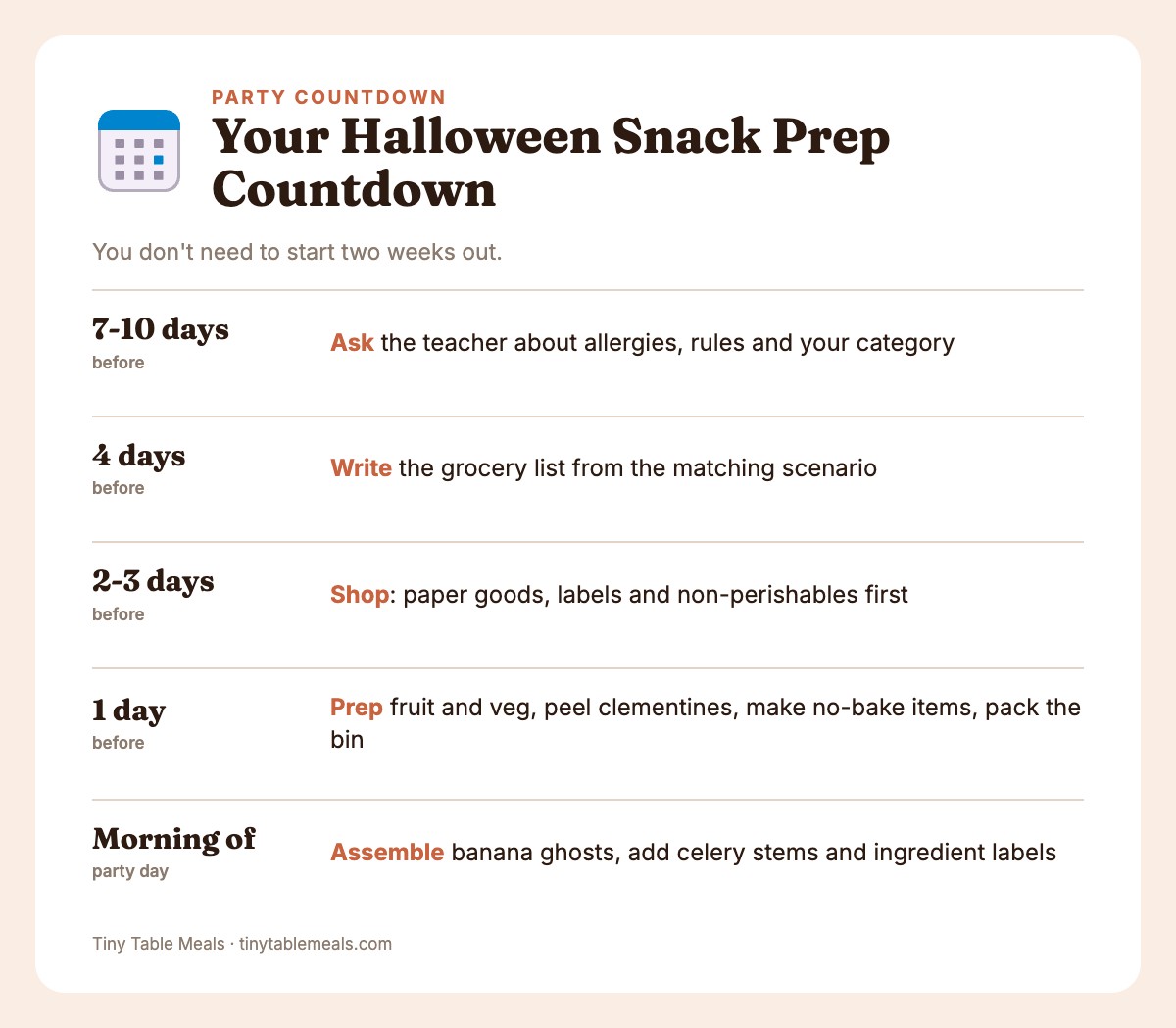
You don’t need to start two weeks out. But a rough countdown prevents the 10:40 p.m. tab spiral.
| When | What to do |
|---|---|
| 7-10 days before | Ask the teacher or room parent about allergies, rules, and your assigned category. |
| 5-6 days before | Fill out the headcount and flag sections. Pick one item from each row of the snack mix. |
| 4 days before | Write the grocery list from the matching scenario above. |
| 2-3 days before | Shop. Buy paper goods, labels, and non-perishables first. |
| 1 day before | Wash and prep fruit and veg, and peel the clementines. Make no-bake items that hold well, like bark or dipped pretzels. Pack the bin. |
| Morning of | Add celery stems to the peeled clementines and assemble the banana ghosts. Pack ice packs if needed. Add ingredient labels. |
| At drop-off | Hand the teacher the ingredient list. Mention anything that needs to be kept cool. |
TipReading this the night before? Skip straight to Scenario 1, buy clementines, bananas, pretzels, and a sealed treat, and add popcorn only if every kid is 4 or older. That’s one grocery run.
Day-Of Logistics for a Classroom Party
The food is half the job. The other half is surviving the classroom environment.
Pack One Bin
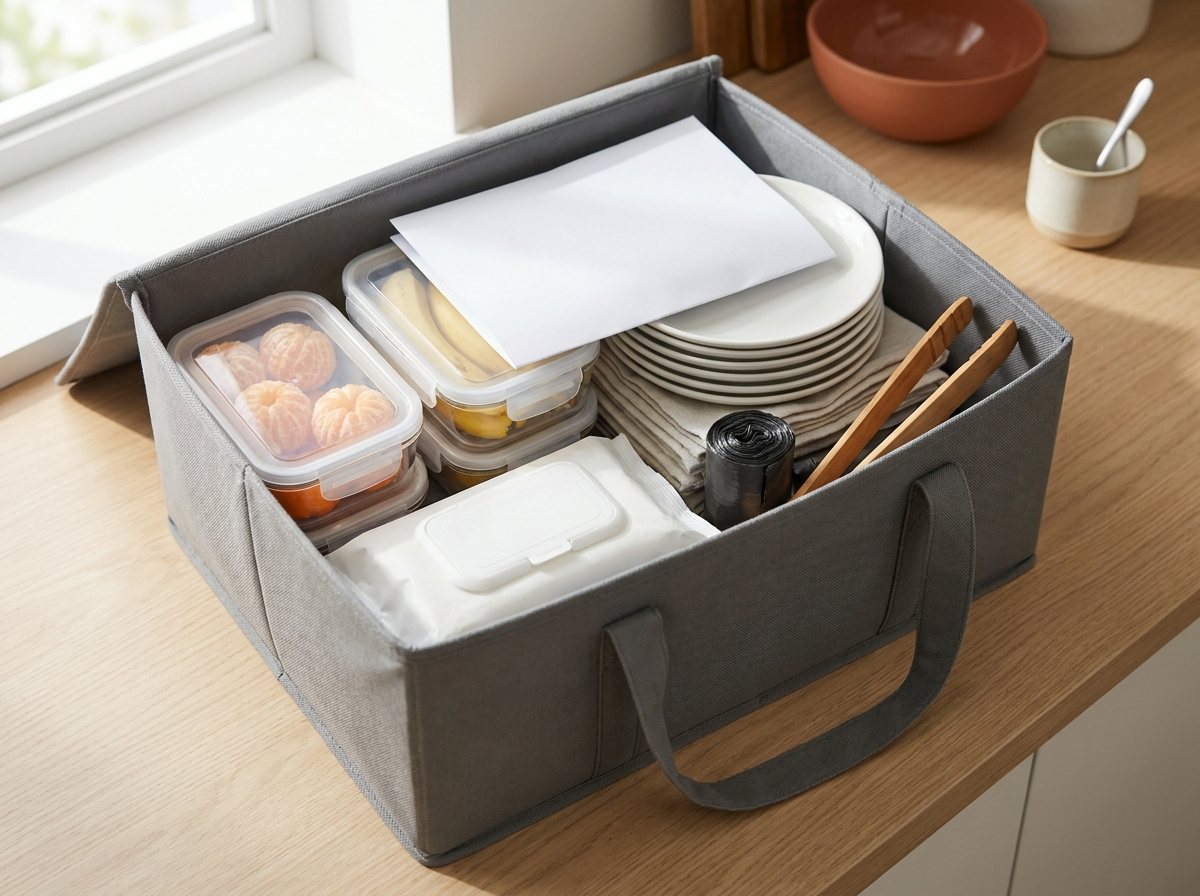
Everything goes in a single reusable bin or tote: the food, plates, napkins, wipes, a small trash bag, serving utensils, and a printed ingredient list. If you’re juggling a stroller or a younger kid at drop-off, one container is the difference between a smooth handoff and a spill in the hallway.
Label Everything
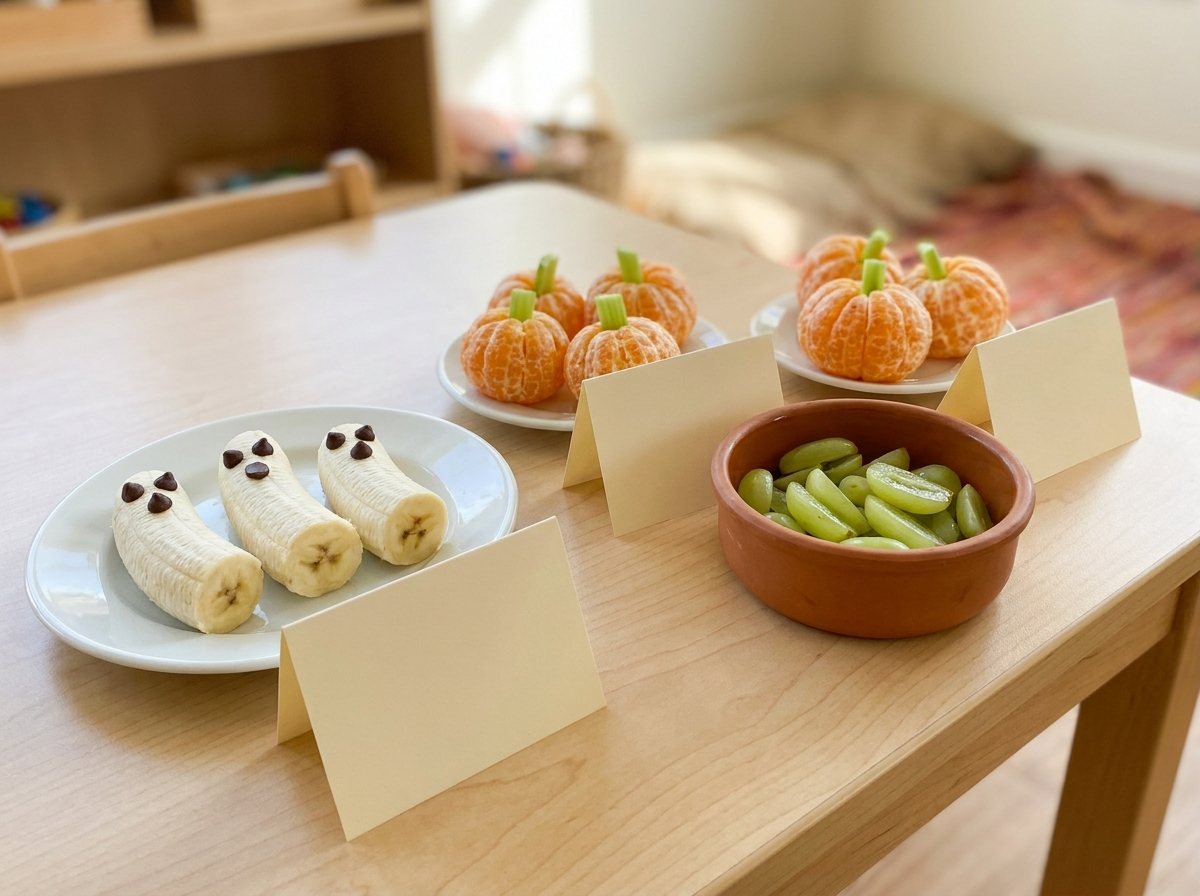
A small folded card in front of each item with the name and the main ingredients saves the teacher from questions and gives allergy parents a quick way to check. Something like:
Example card: Banana Ghosts — banana, dairy-free mini chocolate chips (soy). Nut-free (checked on package).
Copy the allergens from your own packages rather than this example, since they vary by brand.
You don’t need to design anything. A sticky note works.
Think About Temperature
Classrooms warm up fast. Cheese, yogurt, and cut fruit shouldn’t sit out more than two hours, or one hour if the room is above 90°F. For a 30-45 minute party, that’s rarely an issue, but if the snacks will sit in a cubby from morning drop-off until afternoon, pack ice packs or hold off on perishable items.
Plan for Cleanup
Teachers deserve a clean room. Bring wipes, a trash bag, and a few extra napkins. If you’re in charge of a sticky treat, put a handful of paper towels in the bin too.
Serve It Simply
Pre-portioned is better than a big bowl and a serving spoon. Cups of popcorn (ages 4+), individually wrapped treats, and fruit already peeled mean fewer hands in shared containers and fewer questions about who touched what.
Balancing the Party Table (Without Being the Fun Police)
I’m not here to take the fun out of Halloween. Kids at a classroom party want to feel like it’s a party. But a table that’s all sugar leads to a rough hour after the bell, and a table that’s all fruit gets side-eyed.
My balance formula is simple:
- About half the table is fruit, veg, or savory.
- About a quarter is a fun, themed sweet.
- The rest is drinks and extras.
When the fruit looks like a pumpkin or a ghost, it gets eaten. When the savory snack comes in a little paper cup, kids treat it like a treat.
Want to see how snacks and meals feed growing kids across the week? My guides to high-protein meals and snacks for kids and fiber-rich meals and snacks kids will actually eat help you balance the rest of the day.
A Quick Sugar Sanity Check
If you’re bringing a sweet, one small item per child is plenty. Between the party, the candy bucket from trick-or-treating, and Halloween-week treats at home, most kids get far more sugar than anyone planned. Keeping the classroom portion modest lets the family make its own decision later.
Sample Plan: 22 Students, Nut-Free and Dairy-Free
Here’s a complete example so you can see how the pieces fit.
The situation: 22 students, 1 teacher, 1 aide and 3 volunteers make 27 people, plus a 15% buffer (4) for 31 servings. The classroom is nut-free and one child has a dairy allergy, so I use Scenario 2. The party runs 40 minutes right after lunch, so portions stay small.
Snack mix:
- Fruit/veg: Clementine pumpkins
- Savory: Popcorn cups (every child is 4 or older; this class is mostly 6-7)
- Sweet: Banana ghosts with dairy-free chocolate chips
- Drink: Water
Shopping: Clementines (two 3 lb bags), celery, bananas (16), dairy-free chocolate chips, popcorn, paper cups, napkins. The Scenario 2 quantities cover about 34 servings, which is close enough to use as listed for 31. The only change is one fewer banana.
Timeline: Ask about allergies a week out, shop 3 days before, prep clementines and pop popcorn the night before, assemble banana ghosts that morning.
That’s the entire point of the tool. You make five small decisions, and everything else follows.
Adapting the Checklist for Other Halloween Parties
The same logic works outside the classroom.
Party at home. You have more control, so you can add warm items. Still ask guests’ parents about allergies when you send the invite. A short line like “Let me know about any food allergies!” works.
Neighborhood or block party. Headcount is fuzzy, so plan on the high side. Individually wrapped items travel and share better than a big bowl.
Before trick-or-treating. Kids need a real meal first, not just snacks. My fast Halloween dinners to eat before trick-or-treating are built for exactly that evening.
Younger kids (toddlers and preschoolers). Prioritize soft, small-bite foods and avoid choking hazards. Keep portions small and everything cut appropriately.
Frequently Asked Questions
What are the best Halloween snacks for classroom parties?
The best ones are easy to make, easy to serve without a kitchen, and safe for the widest range of kids. Clementine pumpkins, banana ghosts, popcorn cups (only for ages 4 and up), pretzel sticks (skip for under 4s), and a sealed, labeled treat cover most classrooms. Start by checking headcount and allergy rules, then choose one fruit or veg item, one savory item, and one sweet.
How much food should I bring for a Halloween school party?
Plan on one small portion of each item per person: students, teacher, aides, and helpers, plus about 15% extra. For a class of 24, that’s roughly 34 servings. If the party is right after lunch, you can trim portions to about two-thirds. If it’s the last hour of the day, bring a bit more of the savory item.
How do I make Halloween treats for kids with no bake?
No-bake treats rely on assembly rather than an oven. Good options include banana ghosts, clementine pumpkins, pretzel rods dipped in melted chocolate, and chocolate bark with sprinkles. The dipped pretzels and sprinkle bark are best for ages 4 and up; for younger kids, stick to banana ghosts and clementine pumpkins, and remove the celery stem for under 5s. Always check the allergen information on the chocolate, sprinkles, and any toppings, since many brands process nuts or dairy.
What if I don’t know about the allergies in the class?
Ask the teacher or room parent before you plan. If you can’t get an answer in time, choose lower-risk items: whole fruit and sealed, clearly labeled treats that are free of the top allergens. Add plain popcorn only if every child is 4 or older. Bring an ingredient list for everything so the teacher can check against the class’s needs.
Is it okay to bring homemade food to a school party?
It depends on the school. Many schools require store-bought, sealed items with ingredient labels so that allergens can be verified. Others allow homemade food if it’s labeled. Ask the teacher or check the school handbook before you bake anything. If homemade isn’t allowed, a sealed fruit cup, individually wrapped cookie, and whole fruit make an easy, compliant spread.
What are good nut-free Halloween snacks for school?
Clementines, bananas, apple slices, plain popcorn, pretzels, cheese sticks, and many store-bought cookies are commonly nut-free, but you need to read each label every time because manufacturing practices change. When in doubt, choose whole fruit or items clearly labeled nut-free, and avoid nut butters and trail mix altogether.
Serve popcorn only to kids 4 and older. For under 4s, skip hard pretzels, cut cheese into thin strips, and slice apples paper-thin or cook them.
Can I use this checklist for a party at home instead of the classroom?
Yes. The headcount and allergy steps work the same way. At home you can add warm foods and more variety, but it’s still smart to ask guests’ parents about food allergies on the invitation and to label each dish.
You Don’t Need Fifty Recipes, Just a Plan
Halloween party food doesn’t have to eat your week. Count the people, check the allergy flags, pick one item from each row, and shop from the matching list. The kids will remember the costume parade and the pumpkin-shaped clementine, not whether your snack was pinned a thousand times.
Copy the checklist, tape it to the fridge, and give yourself permission to stop scrolling. The 10:40 p.m. tabs can finally close.