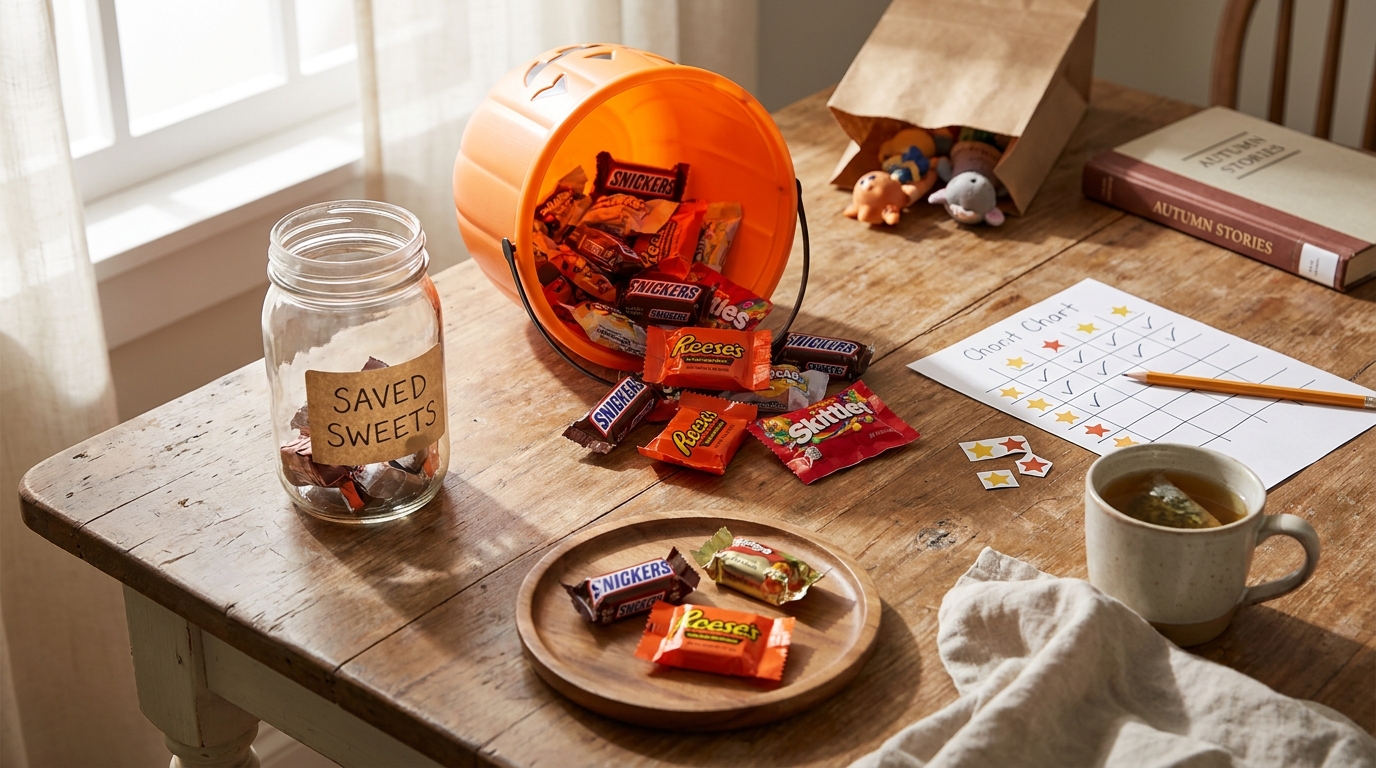
The No-Fight Halloween Candy Plan for Kids (Ages 4 to 10)
This article provides a balanced Halloween candy plan for kids aged 4-10, helping you avoid battles and teach healthy eating habits. You'll learn how to set clear boundaries for candy consumption while giving your child agency in their choices.
- Implement a balanced candy plan, avoiding strict control or total free-for-alls.
- You set candy times & limits; your child chooses what and how much within them.
- Establish a clear Halloween night plan: dinner first, then a set candy window.
- Designate a daily candy time with a set "ceiling" (e.g., 1-3 pieces by age).
- Never use candy as a bribe, reward, or punishment for other behaviors.
This post contains affiliate links. As an Amazon Associate I earn from qualifying purchases.
Last year, at 6:40 a.m. on November 1st, I found my six-year-old cross-legged on the rug with a pillowcase between her knees and a Snickers wrapper stuck to her sock. Her system was “eat it before Mom wakes up and makes a rule.” Nine days of negotiating followed, plus one memorable tantrum over a single lollipop.
This year I’m using our dinner-table approach: I decide when candy happens, and my kids decide how much within that structure. This post covers Halloween night, a daily treat pick box, how much is too much, house rules, trade-ins, leftovers, and the whole plan summed up on one screen.
In this article (13 sections)
- Why Banning Candy and Free-For-All Both Backfire
- Halloween Candy Plan at a Glance
- Halloween Night: Set the Stage Before You Leave the House
- The Week After: The Daily Treat Pick Box
- How Much Halloween Candy Is Too Much?
- How to Save Halloween Candy for Later (Jar Tracker)
- Halloween Candy Trade-In Ideas
- What to Do With Leftover Halloween Candy
- House Rules for Halloween Candy (Kid-Friendly Language)
- Troubleshooting: When Real Life Gets in the Way
- Our Halloween Candy Plan on One Page
- Frequently Asked Questions
- Keeping Halloween Candy Calm
Why Banning Candy and Free-For-All Both Backfire
Most families land in one of two camps after trick-or-treating.
Camp one: strict control. The parent takes the haul, rations it, and decides everything. It feels responsible. The trouble is what it can teach. Some research on restrictive feeding suggests heavy restriction can make kids more preoccupied with the restricted food, and some kids gorge or sneak wrappers when they finally get the chance.
Camp two: total free-for-all. The pillowcase is theirs, and they can eat whatever they want whenever they want it. It feels relaxed and kind. The trouble is that a child who has never practiced stopping has little chance to learn it when the supply is unlimited and the adult has left the room. Stomachaches, meltdowns, and a rough bedtime are common.
There is a third way, and it comes from the division of responsibility in feeding, developed by registered dietitian and family therapist Ellyn Satter. The idea is simple. The parent is responsible for what is offered, when it is offered, and where. The child is responsible for whether to eat it and how much. If you want the full background, I wrote about it in how to use the division of responsibility at your own table, and the same logic carries straight over to sweets.
Applied to candy, it looks like this:
- You set the schedule, the setting, and the size of the offering.
- They choose which pieces, how many (up to the ceiling you set), how fast, and whether to save some.
- Nobody uses candy as a bribe, a reward, or a punishment.
That last point matters more than it seems. When candy is the prize for eating broccoli, broccoli becomes the chore and candy becomes the treasure. Keep the two separate.
Halloween Candy Plan at a Glance
Here is the plan in a nutshell. Everything after this section is detail and troubleshooting.
| Piece of the plan | Who decides | What it looks like |
|---|---|---|
| Halloween night | Parent sets the window, child chooses | A set candy time after dinner; child eats what they like in that window |
| Where candy lives | Parent | One container, kept in a regular spot, not hidden and not out on the counter |
| Daily candy time | Parent sets the time and the box size | Same time each day, usually with or right after a meal or snack |
| Which pieces | Child | Child picks from the stash during candy time |
| How many | Child, up to the box ceiling | Child can take fewer and bank the rest |
| Save-for-later jar | Child | Unused picks go in the jar for a later day |
| Trade-ins | Child decides, parent offers | Child can swap pieces for a non-candy option |
| Wrap-up date | Parent | After a set date, the leftover stash gets a destination |
The key phrase is ceiling, not quota. If the daily box allows three pieces, your child is allowed three. They are not required to eat three. A child who takes one and banks two is practicing exactly the skill you want them to have: noticing when they have had enough and trusting that more is coming.
Halloween Night: Set the Stage Before You Leave the House
The evening itself is where a lot of the battles start, so plan for it. Here is the whole sequence, with detail below.
- Feed a real dinner. Do it before costumes go on.
- Tell the plan. Say it in plain language before you leave.
- Bucket only. Candy stays in the bucket until you are home.
- Sort and check. Sort together, then do the adult candy check.
- Timed window. Kids eat freely for 20 to 30 minutes, sitting down. Kids 5 and under eat only from their checked, hazard-free pile.
- Close it up. Container goes to its spot, then brush teeth.
Before trick-or-treating
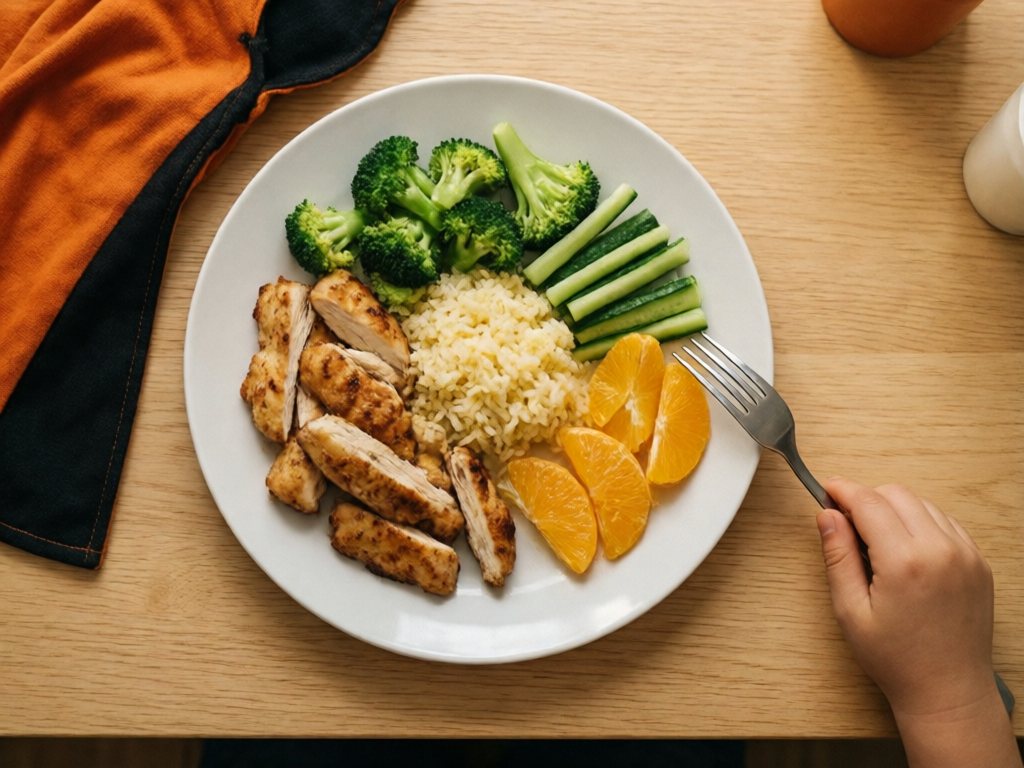
Feed a real dinner first. This is the single most useful thing you can do. A child who walks out the door hungry will want to eat from the bucket the whole route. A child who has had protein, a starch, and something fresh will be curious about candy rather than desperate for it. If you need ideas that are fast enough to eat before costumes go on, I put together fast Halloween dinners to eat before trick-or-treating for exactly this crunch. The Halloween costume-night dinner ideas work well too.
Tell your kids the plan before you leave, in plain language. Something like:
“Tonight you’re going to collect lots of candy. When we get home, you’ll get a chunk of time to sort it and eat some. Tomorrow we’ll set up the plan for the rest.”
Kids handle rules much better when they hear them before the emotional peak, not during it.
During trick-or-treating
My rule is simple: candy goes in the bucket, not in mouths, until we’re home. This isn’t about restriction. It protects safety, because you want to check items first and nobody should eat unwrapped treats while walking in the dark. It also makes the “sorting and eating” moment a shared event at home rather than a steady drip along the sidewalk.
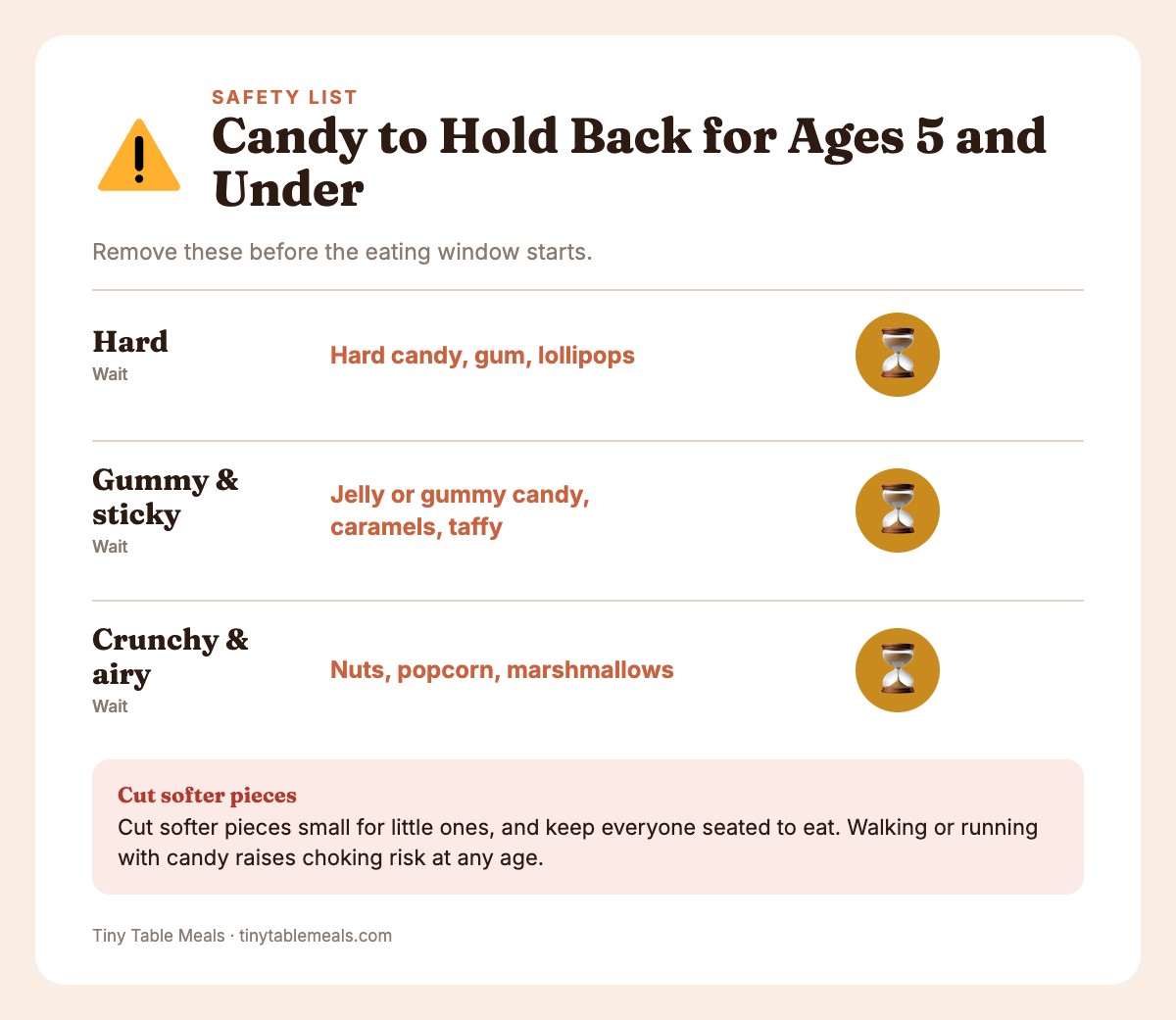
Safety firstChildren 5 and under should not be given hard candy, gum, lollipops, jelly or gummy candy, caramels, taffy, nuts, popcorn or marshmallows. Cut softer pieces small for them. Store the candy container and the jar out of reach of toddlers and pets. Everyone sits down to eat, since walking or running with candy raises choking risk at any age. Even a generous big sibling can hand over a hazard, so tell them the rule too. For toddler-friendly options, see these toddler-safe Halloween snacks.
When you get home: the sorting ritual
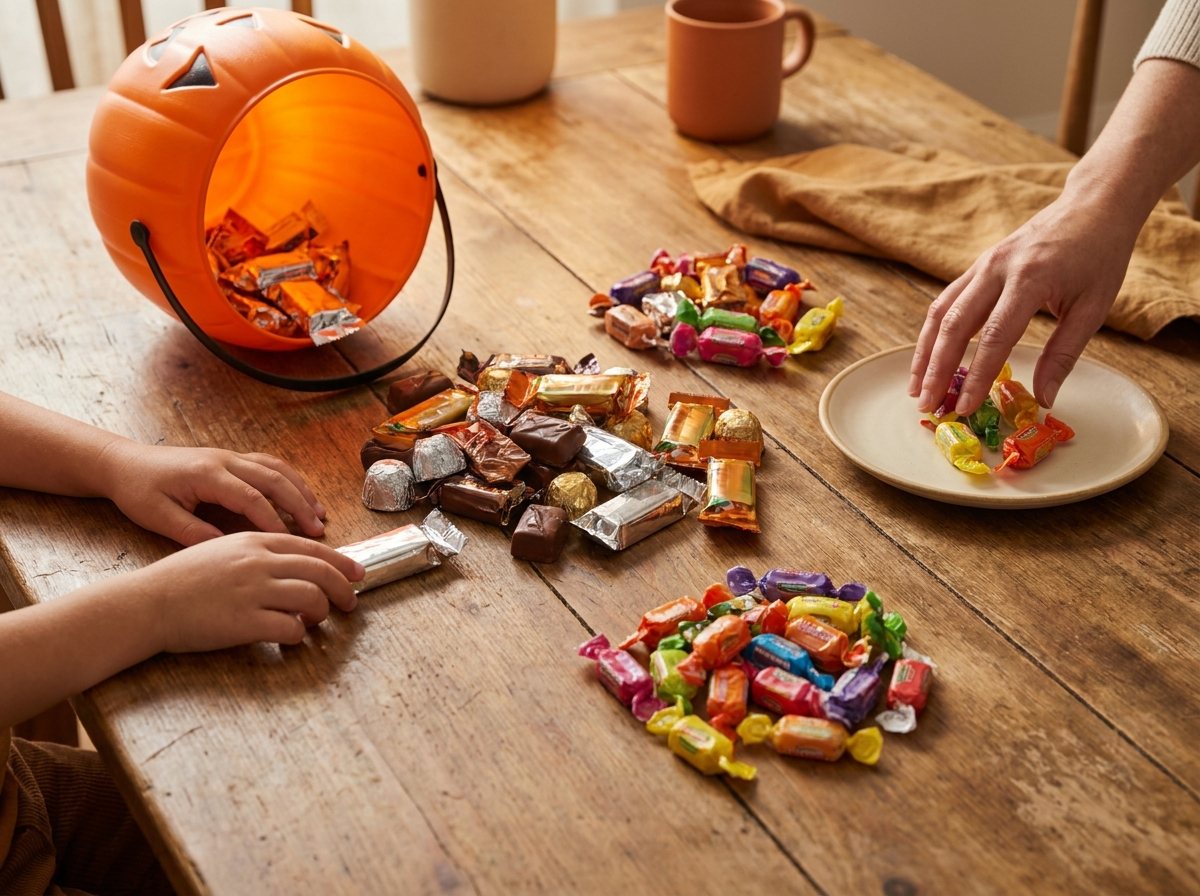
This is the best part, and kids love it. Dump the haul on the floor or table and let them sort it however they like: by color, by type, by “love it,” “fine,” and “no thanks.” Sorting is a great math activity, and it gives them ownership. Then do a quick candy check with an adult:
- Discard anything unwrapped, opened, or homemade by someone you don’t know.
- Read labels and set aside anything that conflicts with allergies in your house.
- For any child 5 or under, remove hard candy, gum, lollipops, gummy and jelly candy, caramels, taffy, nuts, popcorn and marshmallows. Cut softer pieces small.
- Keep all candy away from pets. Chocolate and xylitol gum are toxic to dogs.
Safety firstIf your child has diabetes, celiac disease, a food allergy, a history of disordered eating or feeding difficulties, or severe dental problems, ask your clinician first. Use the pick-box version from night one instead of the open window.
Then comes the part that surprises most parents: let them eat during the window you’ve set. On Halloween night, I give my kids a defined stretch after dinner, roughly 20 to 30 minutes. They can eat as much as they want from their pile during that time. No commentary, no counting, no “are you sure you want another?”
For kids 5 and under, “their pile” means what’s left after the candy check: no hard candy, gum, lollipops, gummy or jelly candy, caramels, taffy, nuts, popcorn or marshmallows. Cut softer pieces small, and keep them seated with an adult beside them.
Satter’s Halloween advice is along the lines of letting kids eat freely on the day, then having candy at meals and snacks afterward. The timed window is my own adaptation of that idea. What kids learn is that candy is allowed and the tight grip is not coming.
If a free window feels like too much for your family, use the pick-box version below even on night one. You know your kid. The framework bends.
When the window ends, the candy goes into its container, the container goes to its regular spot, and you brush teeth. Done. No guilt, no drama, no bedtime negotiation.
The Week After: The Daily Treat Pick Box
Now for the part that actually prevents the daily fights. I call this the treat pick box, and it’s not an actual box (though a small tray or bowl helps). It’s a daily window with a size limit that you decide and your child fills.
How it works
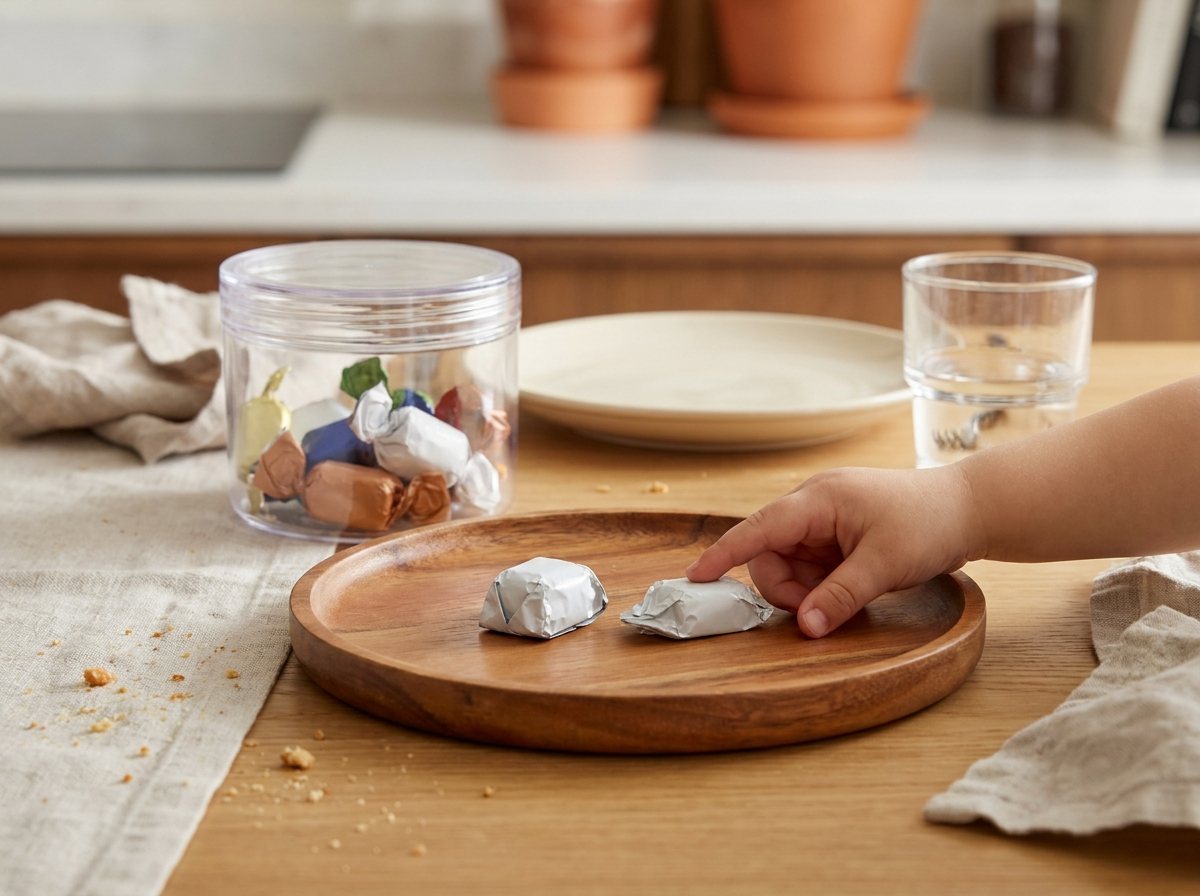
- Pick a time. Choose one regular candy time each day. The best slot is right after a meal or planned snack. Candy with or right after a meal may slow how quickly the sugar is absorbed, and it keeps candy from crowding out the meal. After school snack or after dinner both work. Pick one and stick with it.
- Set the ceiling. Decide how many pieces fit in today’s box. For ages 4 to 10, one to three fun-size pieces depending on age is a common starting point (see the age table in the next section).
- Let your child choose. They open the container, pick their pieces, and set them in the box or tray. You don’t comment on the selection. You don’t steer them toward the “better” candy.
- They decide what to do with them. Eat them now, eat some, or bank the rest in the save-for-later jar.
- Candy time ends. The container closes and goes back in its spot. Neutral tone, same every day.
The neutral tone is the hardest part. It helps to remember that your job is the structure. How your child feels about that structure is allowed to be big. If they’re disappointed at “that’s all for today,” you can say, “I know, it’s hard to stop when it’s yummy. Tomorrow’s candy time is at the same time.” Then move on.
The daily treat pick box chart
Use this chart as a model: copy the columns you’ll use onto paper or a fridge whiteboard, set the ceiling for the week, then check off each day.
Our family’s ceiling per day: ______ pieces
Candy time each day: ______ (e.g., after dinner)
| Day | Date | Ceiling | Pieces picked | Eaten now | Banked in jar | Notes (feelings, favorites) |
|---|---|---|---|---|---|---|
| Night of Halloween | Oct 31 | Open window | ||||
| Day 1 | Nov 1 | |||||
| Day 2 | Nov 2 | |||||
| Day 3 | Nov 3 | |||||
| Day 4 | Nov 4 | |||||
| Day 5 | Nov 5 | |||||
| Day 6 | Nov 6 | |||||
| Day 7 | Nov 7 |
A few notes on using it:
- Kids aged 6 and up can fill in their own row. It turns the chart into their tool rather than your surveillance system.
- For ages 4 and 5, draw a few circles for the ceiling and let them color in each piece they take.
- The “Notes” column is optional but useful. If you see “tummy hurt” three days in a row, that is data you both can use to adjust the ceiling.
How Much Halloween Candy Is Too Much?
This question deserves a straight answer, not a vague “everything in moderation.”
What the guidelines say
The American Heart Association recommends that children ages 2 to 18 have less than 25 grams (about 6 teaspoons) of added sugar per day, and none for children under 2. That total includes added sugar from all sources, such as yogurt, cereal, juice, and granola bars, not just candy.
A single day of Halloween candy can use up that allowance in a few pieces, and in the weeks around Halloween most kids will go over it. The goal of the plan isn’t to hit 25 grams perfectly every day. It’s to keep candy from becoming a constant background hum, and to make the sweet moments predictable, limited, and calm.
A rough sense of the sugar in common candy
These are ballpark figures for typical fun-size items. Labels vary by brand and by wrapper size, so check the ones in your own bucket.
| Candy type (fun-size or snack-size) | Approximate sugar per piece (estimate, check labels) |
|---|---|
| Chocolate bar, fun size | 8 to 12 g |
| Candy-coated chocolates, small pack | 9 to 11 g |
| Fruity chewy candies, small pack | 9 to 12 g |
| Mini lollipop | 4 to 6 g |
| Tootsie Roll midgee | 3 to 4 g |
| Mini chocolate-peanut-butter cup (one) | 4 to 5 g |
Depending on the candy, two to three pieces is roughly 6 to 36 grams of sugar. The table shows total sugar, and in candy nearly all of it is added sugar. Chocolate and fruity candies can reach or pass the 25 gram limit, while a Tootsie Roll or mini lollipop will not. That’s why I call one to three pieces a day a reasonable ceiling for the first couple of weeks, and not a number to push past routinely.
Adjusting the ceiling by age
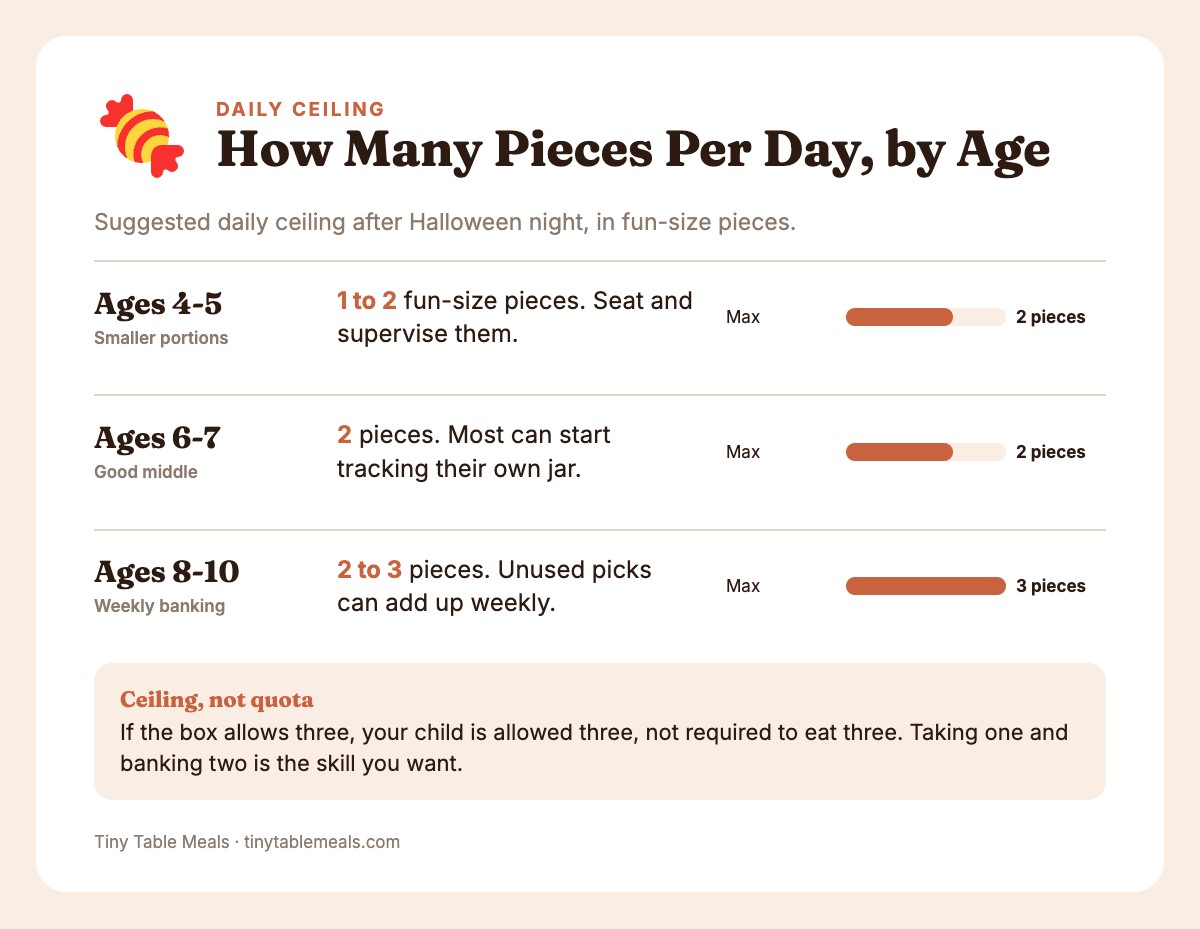
| Age | Suggested daily ceiling after Halloween night | Notes |
|---|---|---|
| 4 to 5 | 1 to 2 fun-size pieces | Smaller bodies, smaller portions. Seat and supervise them. At this age skip hard candy, lollipops, gummy and jelly candy, caramels, taffy, nuts, popcorn and marshmallows, and choose softer pieces or cut them small |
| 6 to 7 | 2 pieces | A good middle; most kids this age can start tracking their own jar |
| 8 to 10 | 2 to 3 pieces | Older kids can handle a weekly banking system, where unused picks add up |
These are starting points. Look at the rest of your child’s day. A kid who ate a balanced day and is going to soccer practice has different needs than a kid who had juice, a fruit pouch, and a snack bar before candy time.
Signs the amount is too much for your child
Ignore the number on the chart and watch the kid:
- Stomachaches or headaches after candy time
- Candy replacing dinner or planned snacks (refusing a meal they’d normally eat)
- Unusual tiredness or crankiness after candy time
- Constant requests or bargaining all day long (this usually signals unpredictability, not too much candy, so tighten the structure before cutting the amount)
- Sneaking or hiding wrappers, which tends to appear when the rules feel arbitrary or punitive
If you see these, shrink the ceiling by one piece for a few days or move candy time to right after a more filling meal. Don’t remove it entirely, because that brings back scarcity.
A word on teeth
Frequency matters as much as quantity for dental health. Sipping soda or grazing on candy through the day keeps teeth bathed in sugar. A single candy time, followed by water and a normal brushing routine, is far gentler than five tiny nibbles spread across the afternoon. Sticky, chewy candy (caramels, taffy, gummies) clings longest, so rinse with water afterward.
Brush twice a day with fluoride toothpaste. Many dentists suggest waiting about 30 minutes to brush after very sour or acidic candy. One candy window keeps the whole routine simpler.
How to Save Halloween Candy for Later (Jar Tracker)
The jar is my favorite piece of this plan, because it quietly teaches the skill that most adults still struggle with: you can say “not now” without it being “never.”
How the jar works
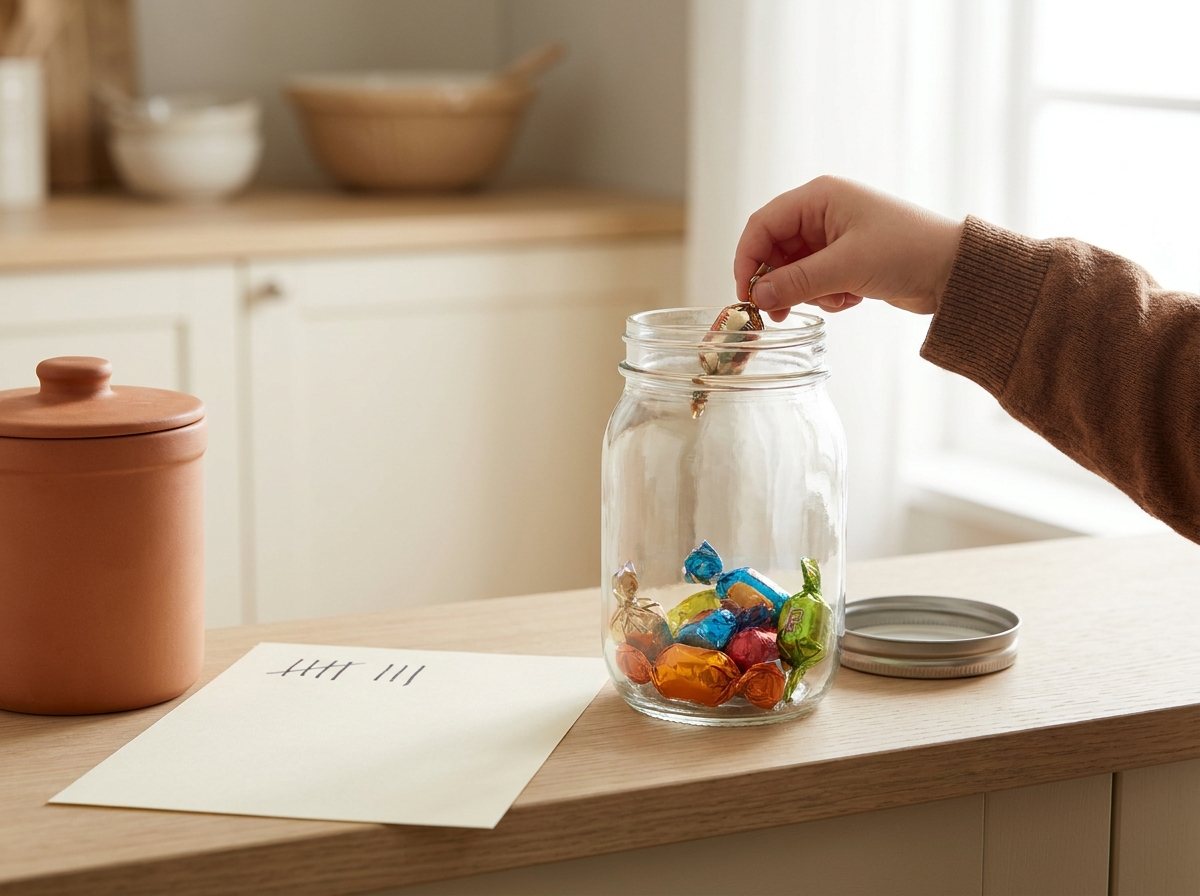
- Your child has a clear jar (a clean pasta-sauce jar works great) with their name on it.
- During candy time, any pieces they pick but don’t eat go in the jar.
- The jar stays in the candy container’s spot, not in their bedroom, and both are kept out of reach of children under 4 and pets.
- Banked pieces are eaten on a weekly “jar day,” capped at the daily ceiling plus three extra pieces.
I let my kids choose one rule for the jar. My seven-year-old decided on a Saturday “jar day,” when she can use up to three banked pieces on top of her regular two. She skipped candy on Tuesday just to build up her jar, which I found equal parts hilarious and proud-making.
Why banking works
When kids can save, the stash stops feeling like something that will vanish. Scarcity thinking is what drives the “eat it all now before it’s taken” behavior. The jar says: this is yours, it’s safe, and it’s coming.
It also gives you a sneaky math lesson. “You have six pieces in the jar and a jar day coming up, so how many can you take?” is subtraction practice they actually want to do.
The save-for-later jar tracker
| Date | Pieces added to jar | Pieces taken from jar | Total in jar | What I’m saving for |
|---|---|---|---|---|
For younger kids, stick a sheet of paper next to the jar and have them add a tally mark or sticker for each piece. It makes the saving visible.
A note on honesty: if banked candy sits for two weeks, it may go stale, especially chocolate that picks up fridge smells or gummy candy that hardens. That’s fine, and it’s part of the lesson. Agree up front that jar candy has an expiration date (usually the wrap-up date in the next section), after which it moves along.
Halloween Candy Trade-In Ideas
Trade-ins give your child another choice, and kids love a deal. The point isn’t to coax candy away from them. It’s to offer options so they feel like a negotiator rather than a victim. Keep the exchange rate generous and the tone friendly.
Ideas that work with ages 4 to 10
- The Switch Witch. Your child leaves out a chosen number of pieces (say, five to ten) on a set night, and the Switch Witch trades them for a small toy or book. Let your child choose how much to leave. It works best when the trade is a surprise they’re excited about, not a replacement you’re pushing.
- Cash for candy. Offer a dollar per five pieces, which goes toward something they’re saving for. This is a quick, tangible lesson in trade-offs.
- Experience swaps. Ten pieces trades for a special outing, like a trip to the library, extra time at the park, a movie night, or a baking project. Experiences tend to outlast toys.
- Kitchen helper trade. Swap candy for time cooking with you. Kids who help make dinner are more curious about what’s on the plate, and it plays right into the way we introduce new foods without pressure: the kitchen becomes a place of interest rather than negotiation.
- Donation trades. Your child chooses a number of pieces to give to a charity drive or a community collection. Some dental offices and local organizations run candy buyback or donation programs in early November, often sending the candy to troops overseas or community groups. Many programs have ended or changed their rules, and some pantries won’t take candy, so confirm first by calling ahead or checking your dentist’s social pages.
- Treasure hunt swaps. Trade five pieces for a clue in a scavenger hunt that ends at a small prize or a family activity.
- Lunchbox or snack-jar swaps. Candy for a favorite non-candy treat, like a special fruit, yogurt cup, or a new cookie cutter shape for weekend baking.
Make the exchange rate fair and consistent
Pick a standard rate, such as “five pieces for one trade,” and post it where the kids can see it. If the deal changes every day, it feels like manipulation. If it’s fixed, it feels like a game.
The trade-in count log
| Date | Pieces traded | What we traded for | Who decided (child / parent offered) | Notes |
|---|---|---|---|---|
Keep a running total at the bottom: Total pieces traded: ______. Seeing that number grow is satisfying, and it makes the quiet point that candy isn’t the only currency of fun.
What to Do With Leftover Halloween Candy
By about the two-week mark, the novelty fades and you’re left with a container of the stuff nobody loves: the sticky taffy, the generic hard candies, the one weird licorice. This is where most parents quietly throw it away in a panic. A better approach is to set a wrap-up date at the start of the plan and treat the end of the stash as an event, not a failure.
Set a wrap-up date
Two weeks after Halloween, around mid-November, is a workable date. Announce it early: “We’ll keep our candy time going until November 14th, and then we’ll decide what to do with whatever’s left.” Because the date is known, nobody feels ambushed.
Ideas for the leftovers
Safety firstAdults handle knives and ovens, and raw dough or batter is not for tasting. Frozen candy is rock hard, so don’t hand it straight to little ones. Keep gummies and hard candy decorations away from children 5 and under, and use warm (not hot) water for science experiments, with supervision and no tasting. Check candy for nuts before baking if anyone has allergies.
- Keep a small amount. It’s perfectly fine for each child to keep a handful of favorites to last a few more weeks. Those can sit in the jar until they’re gone.
- Freeze it. Chocolate bars, peanut butter cups, and many chewy candies freeze well. A freezer bag in the back means you’re not tempted to hand out extras on a bad Tuesday, and you have a stash for cookie add-ins or a holiday baking day.
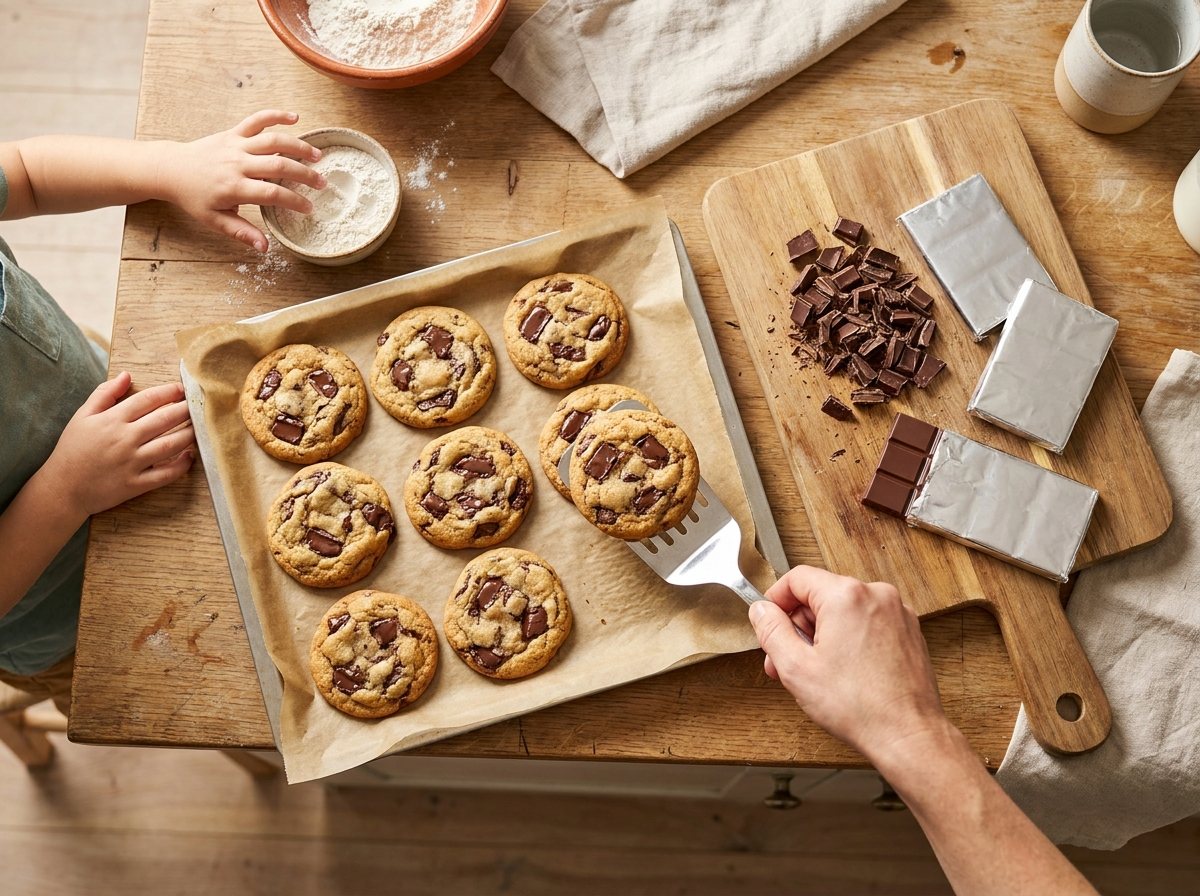
- Bake with it. Chop chocolate bars into cookie dough, crush peanut butter cups into brownie batter, or fold chopped caramel into oatmeal bars. Baking turns candy into an ingredient and stretches the treat into something shared. I like to do one big session and send half to a neighbor.
- Build with it. Use leftover candy for decorating gingerbread houses in December. Store sturdier pieces (hard candy, wrapped chocolate, gumdrops) in a sealed bag.
- Run a candy science experiment. Dissolve different candies in warm water and compare, sort them by whether they sink or float, or watch food coloring bleed from candy-coated pieces. It’s a cheap afternoon project and a gentle way to see candy as an object of curiosity.
- Donate. Give unopened, sealed candy to a food pantry, a school drive, or a troop-care organization, but confirm their policy first (see the donation note above). Let your child choose the amount and pack it themselves.
- Use it as party and piñata filler. Birthday season is right around the corner for many families. A bag stashed in the closet saves you a shopping trip.
- Let it go with grace. Sometimes the right choice is to toss the stale stuff. Do it with your child, not behind their back. “These have been in the jar a long time and they’re not good anymore, so we’re going to compost them” is honest and teaches that food has a lifespan.
What not to do
Don’t sneak into the stash and dispose of it while they’re at school. Kids notice. Even a small betrayal teaches them that the rules can change when they aren’t looking, and it undermines everything the structure has built.
House Rules for Halloween Candy (Kid-Friendly Language)
Most families do better with a handful of short rules than with a long speech. Here is a set you can adapt. Say them out loud, write them down, and tape them near the container.
- Candy happens at candy time. Every day at the same time, in the same spot.
- You pick your pieces. Parents don’t choose for you.
- You decide how many, up to today’s number. Take fewer if you like, and the rest can go in your jar.
- Candy lives in the candy container. Not in backpacks, pockets, or beds.
- Sit down to eat it. Candy is for enjoying, not for running, playing, or eating in the car.
- No candy trades behind someone’s back. Siblings can swap if both agree out loud.
- Candy is never a prize or a punishment. Nobody earns it and nobody loses it for behavior.
- We stop on the wrap-up date, and then we decide together what to do with what’s left.
Rule 5 is a quiet favorite of mine. Eating while seated is safer, and paying attention may help children notice when they’ve had enough. Rule 7 protects the whole system.
Scripts for the hard moments
These are short and boring on purpose. Boring is calming.
| Situation | What to say |
|---|---|
| “Can I have more?” | “Candy time is over for today. Tomorrow at the same time, you get to pick again.” |
| “You’re so mean!” | “I hear that you’re disappointed. It’s okay to be mad. Candy is done for today.” |
| “Can I have it now? I’ll eat dinner after.” | “Candy time is after dinner. That’s how we do it.” |
| “Sam got more than me!” | “Each person has a number that fits their age. Yours is the right number for you.” |
| “I want it all right now.” | “You can have your pieces for today, and you can save some in your jar for later.” |
| Caught sneaking | “I see wrappers. Candy is allowed at candy time. Let’s figure out together what would help you feel less worried about running out.” |
If sneaking happens, avoid shame. Sneaking is a message, usually that the structure feels too tight or too unpredictable. Respond by adjusting the plan, not by punishing the child.
Troubleshooting: When Real Life Gets in the Way
Siblings with different ceilings
A six-year-old and a ten-year-old shouldn’t have exactly the same number, but the difference needs to feel fair. Explain it plainly: “Bigger bodies get a bit more, and when you’re ten, you’ll get that number too.” Keep the gap small, one piece, and keep the rest of the system (time, setting, jar) identical.
Grandparents, school parties, and friends’ houses
Candy shows up in a lot of places in the weeks around Halloween. Don’t try to control all of it. Your plan covers your candy and your home. At a classroom party or a grandparent’s house, let your child eat what’s offered, and don’t count it against the day’s allowance in front of them. If a quiet word with a grandparent helps (“we’re doing a candy time at home, so please don’t feel like you need to bring extra”), say it kindly and leave it there. The more relaxed you are about candy elsewhere, the less outsized it feels.
The child who eats everything in the first hour
It happens, especially with kids who have lived with restriction before. If your child is used to scarcity, expect a bigger pile-up of candy early on. Keep the structure steady, resist the urge to comment, and trust the process. The intensity often eases as kids learn the structure is dependable. If your child eats in secret persistently, seems very distressed around food, loses or gains weight quickly, or refuses meals, talk with your pediatrician or a registered dietitian or therapist.
The child who doesn’t care about candy
Some kids hoard wrappers but never eat the contents. Some forget it exists. That’s fine. Let them keep their jar or trade up without pressure. Not every child is a candy lover, and that’s no cause for concern or celebration.
Food allergies and special diets
If candy needs to be screened for allergens in your home, do the sorting step with an adult and set aside anything that isn’t safe. For ideas on safe swaps and class treats, there is a good set of options in allergy-friendly Halloween classroom treats, many of which also work as trade-in rewards at home.
Picky eaters and candy
Parents of selective eaters often worry that candy will take over the diet. In practice, structure helps. When candy has a clear, predictable time and doesn’t compete with meals, kids are less likely to use it as leverage. Keep serving meals the way you normally do, with at least one food your child reliably eats alongside the rest, and let candy be a separate event. If you’re curious about your child’s overall eating style, the picky eater quiz is a gentle place to start.
Your own feelings about candy
This plan asks for something from the grown-ups too: calm. If you grew up with candy as a forbidden pleasure or a source of guilt, you may notice your own reactions rising. Try to keep your language neutral. Avoid calling candy “bad” or “junk” or describing yourself as “being bad” when you eat some. Kids absorb that language fast. “Candy is a treat we enjoy sometimes” is true, kind, and sufficient.
Our Halloween Candy Plan on One Page
This is the whole plan in one place. Pick your numbers with your kids, jot them on a note and put it on the fridge.
Our Halloween Candy Plan
Child’s name: ____________________ Age: ______
Halloween night window: ______ minutes after dinner, sitting down, eat as much as I want from my checked pile.
Grown-up note for ages 5 and under: take out hard candy, gum, lollipops, gummy and jelly candy, caramels, taffy, nuts, popcorn and marshmallows before the window starts, and cut softer pieces small.
Daily candy time: ______________ (time) in ______________ (place).
My daily ceiling: ______ pieces. I pick them. I can take fewer.
Extra pieces go in my jar. Jar day is: ______________.
Wrap-up date: ______________.
My trade-in options (5 pieces = 1 trade):
- ______________________________
- ______________________________
- ______________________________
Our rules:
- Candy happens at candy time
- I pick my own pieces
- I sit down to eat
- Candy is not a prize or punishment
- I can save for later
Weekly check-in (parent, five minutes on Sunday)
| Question | Yes / No / Notes |
|---|---|
| Is candy time happening on schedule? | |
| Are meals still being eaten? | |
| Any stomachaches, tiredness or crankiness after candy? | |
| Is my child using the jar? | |
| Do we need to adjust the ceiling up or down? | |
| Am I keeping my tone neutral? |
If most answers are yes, leave it alone. A good plan is a boring plan.
Frequently Asked Questions
How much Halloween candy is too much for a kid in one day?
The American Heart Association recommends that children ages 2 to 18 stay under 25 grams of added sugar per day from all sources, and two to three fun-size pieces can use that up quickly. On Halloween night itself, a larger amount is common, and for most healthy kids a single night is not a lasting problem. For the days after, a daily ceiling of one to three small pieces, depending on age and the rest of the day’s food, is a sensible starting point. Watch your child more than the number: stomachaches, skipped meals, and unusual crankiness are signs to scale back.
What should I do with leftover Halloween candy?
Set a wrap-up date, usually about two weeks after Halloween, and let your child help choose where the rest goes. Good options include freezing chocolate for baking, donating sealed candy to a drive, using sturdy pieces for gingerbread houses, saving some for piñatas or party bags, or running a quick candy science experiment. Let kids keep a small handful of favorites in their jar, and toss stale candy together rather than quietly throwing it out while they are at school.
What are good Halloween candy rules for kids?
Short, predictable rules work best. Candy happens at one set time each day, and kids pick their own pieces. They can take fewer than the daily number and save the rest in a jar. Candy is eaten sitting down, and it is never a reward or a punishment. Parents control when and how much is offered. Kids control which pieces and whether to eat them. Post the rules where everyone can see them so you aren’t renegotiating each afternoon.
What are some good Halloween candy trade-in ideas?
Popular options include the Switch Witch, who swaps candy left out overnight for a small toy or book. You can also trade candy for cash toward a savings goal, or swap a set number of pieces for an experience like a movie night or baking project. Donating candy to a charity drive is another choice. Some dental offices run candy buyback events in early November, but programs vary, so call ahead. Let your child decide whether to trade and keep the exchange rate consistent so it feels fair rather than like a trick.
Is it okay to let my kids eat as much candy as they want on Halloween night?
For most healthy children, yes, within a defined window. A set stretch of 20 to 30 minutes after a real dinner lets kids experience candy without restriction, and the normal structure resumes the next day. For kids 5 and under, take out hard candy, gum, lollipops, gummy and jelly candy, caramels, taffy, nuts, popcorn and marshmallows before the window starts, and keep everyone seated. If your child has diabetes, celiac disease, a food allergy, severe dental problems, or a history of disordered eating or feeding difficulties, talk with your pediatrician, dietitian or dentist first. In those cases, use the daily pick-box version from the start.
Won’t allowing candy every day make my child crave it more?
Some research on restrictive feeding suggests heavy restriction can make kids more preoccupied with the restricted food, and predictable access often helps. The key word is predictably. A set daily window with a clear limit feels safe, while an on-again, off-again approach keeps kids on high alert. If candy demands are constant, tighten the structure rather than taking candy away entirely.
What if my child sneaks candy even with a plan in place?
Treat sneaking as information, not misbehavior. It often means the child doesn’t trust that candy will keep coming, or the rules feel unpredictable. Stay calm, skip the shaming, and review the plan together: is candy time consistent, is the ceiling realistic for their age, and is the container accessible at candy time but not in their room? Reaffirm that candy is allowed at its set time and give the jar a bigger role. Sneaking often eases as kids learn the structure is dependable.
Keeping Halloween Candy Calm
The goal isn’t a perfect candy week. It’s a calmer one, where nobody is hiding wrappers, nobody is crying over a lollipop, and your kid learns that a treat can be enjoyed, saved, traded, or simply left alone. Set your numbers, tell your kids the plan before the costumes go on, and keep your voice boring and kind. In a few weeks the pillowcase will be nearly empty, and the plan will have done its job. That is a pretty good return on a bucket of fun-size Snickers.