Quick Family Dinners for Fall Sports Season: Meals Ready Before Practice
You'll learn to conquer fall sports dinner chaos with a rotation of 9 quick (15-25 min) meals, strategic snack timing, and a printable kit to manage your family's varied eating schedules.
- Create a rotation of 7-10 quick 15-25 minute dinners.
- Dedicate 45 minutes on Sunday for meal prep like chopping veggies.
- Choose meals that hold or reheat well for varied eating schedules.
- Download your free Fall Sports Night Dinner Kit for a 2-week plan.
- Strategically time pre-practice snacks to fuel without discomfort.
This post contains affiliate links. As an Amazon Associate I earn from qualifying purchases.
Last Tuesday at 4:52 PM I was holding a raw chicken breast in one hand and a shin guard in the other, while my daughter yelled from the car that practice started in eight minutes. Fall sports season had arrived again, and dinner still had to happen.
Here are nine dinners that take about 15-25 minutes, freezer backups, pre-practice snack timing and a two-week plan. The Fall Sports Night Dinner Kit printable on this page pulls it all into one place.
Free printable · 6 pages
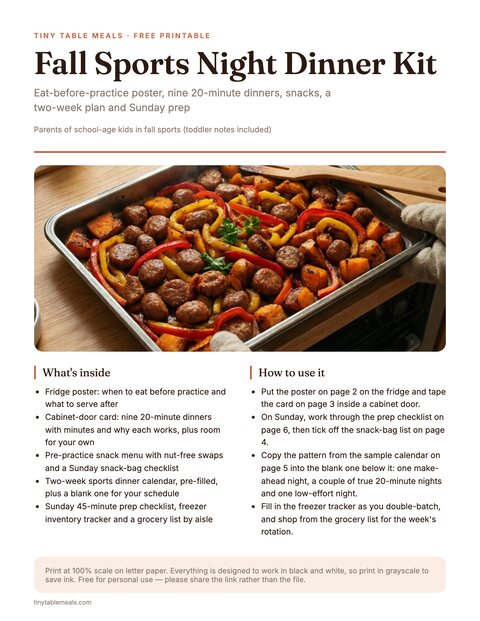
Fall Sports Night Dinner Kit
A fridge timing poster with a recovery strip, a cabinet-door card of nine 20-minute dinners, a pre-practice snack menu with nut-free swaps, a pre-filled and a blank two-week dinner calendar, a 45-minute Sunday prep checklist, a freezer tracker and a grocery list by aisle.
Free. Your download link appears right here. You'll also join the Sunday Supper Plan. Unsubscribe anytime. Privacy
In this article (12 sections)
- Why Dinner Falls Apart During Fall Sports
- Quick Dinners Before Practice: Build a 20-Minute Rotation
- Make-Ahead Meals for the Nights You Can’t Even Do 20 Minutes
- Pre-Practice Snacks for Kids That Travel Well
- When to Eat Before Practice: Snack Timing by Sport
- What to Eat After Practice: Recovery for Growing Athletes
- Sample Two-Week Meal Plan for Fall Sports Nights
- Sunday Prep: The 45-Minute Habit That Saves Your Whole Week
- Getting Kids to Help, Even on the Busiest Nights
- What to Do When You Have No Time to Cook (Drive-Through Nights)
- Frequently Asked Questions
- Your Next Step for Sports Night Dinners
Why Dinner Falls Apart During Fall Sports
It’s not just that we’re busier. Three things collide at once in September and October:
- Practice lands right at dinner time. A 5:30 practice means a snack or light meal by about 4:15-4:30, while many parents are still working.
- Kids need fuel, but not a full stomach. Eat too close to practice and you get cramps and nausea. Wait too long and you get a shaky, cranky kid.
- You’re feeding people at different times. One kid eats at 4:30, another at 7:00, and the same pot gets reheated three times.
Once you see it as a scheduling problem, not a cooking problem, the fix gets clearer. Fast alone isn’t enough. You need meals that hold well, reheat well or split into “fuel now, meal later.”
Quick Dinners Before Practice: Build a 20-Minute Rotation
Before the season gets rolling, stop inventing dinner from scratch every night. Build a rotation of 7-10 meals you can make on autopilot instead. You already know the steps, most of the ingredients are on your default grocery list, and nobody has to think.
Here’s a starter rotation built for exhausted sports-season evenings. Most take about 15-25 minutes, hands-on and cooking time together, and use one pan or one pot. The times assume the oven is already hot and the veggies are chopped (that’s what Sunday prep is for). Starting from whole vegetables and a cold oven, add about 10 minutes.
| Meal | Time (approx.) | Why It Works for Sports Nights |
|---|---|---|
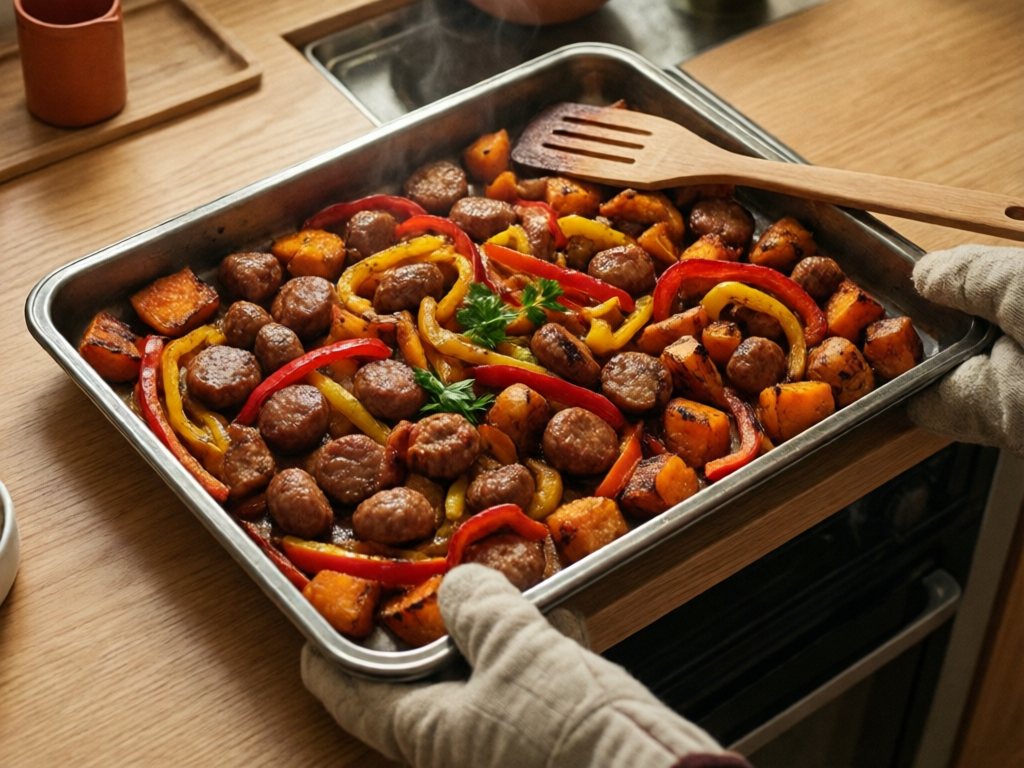
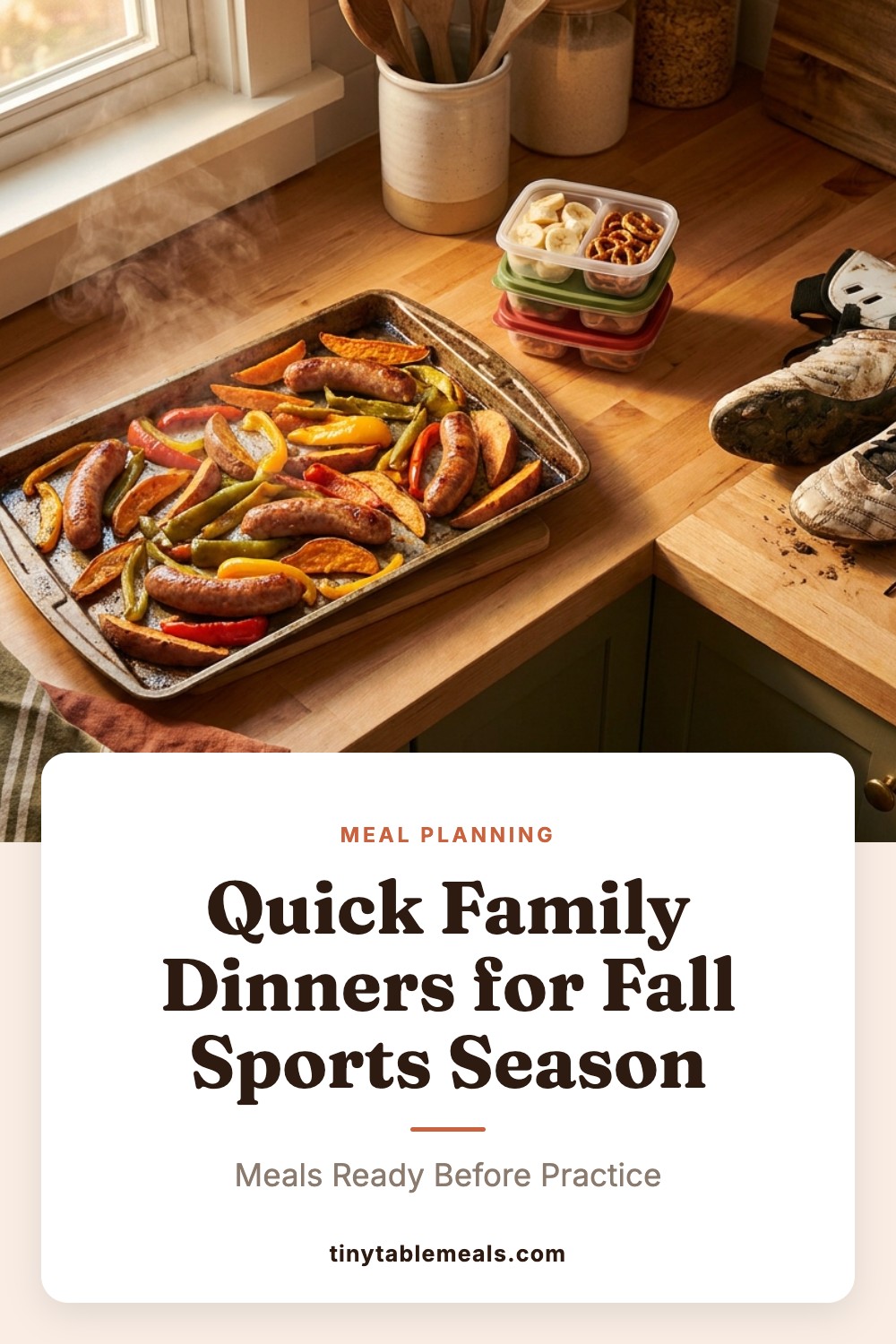
| Sheet-pan sausage, peppers & sweet potato | 22 min | One pan, no babysitting, reheats great for the late eater. |
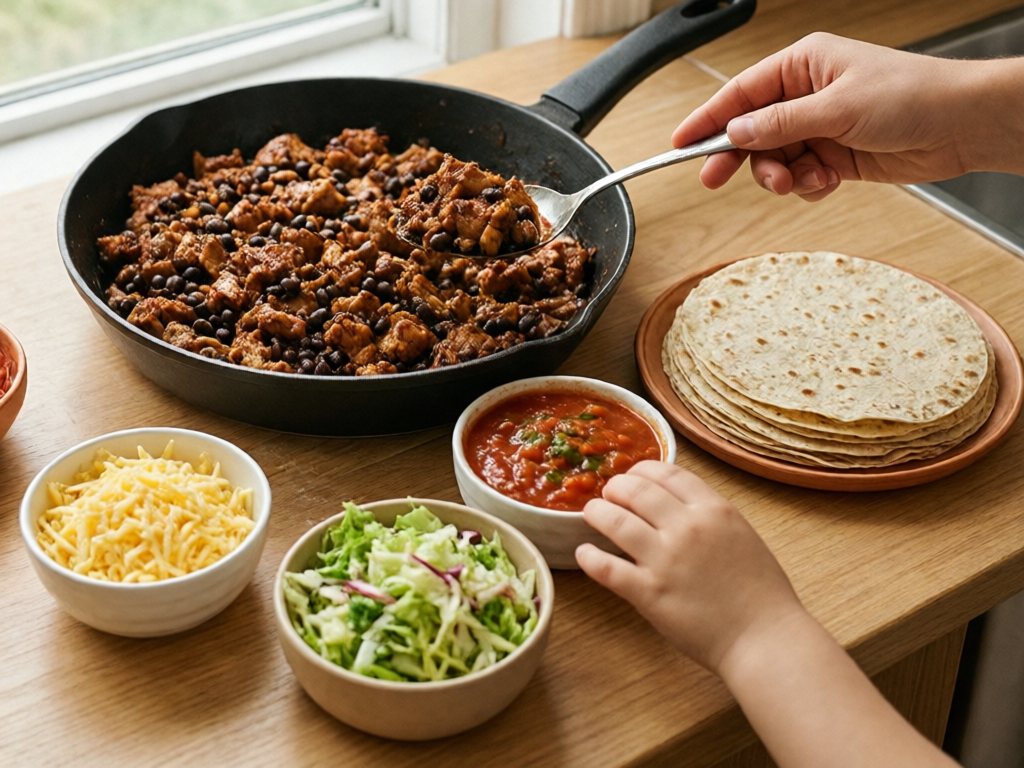
| Ground turkey taco skillet | 18 min | Kids build their own bowls; toppings cover every picky preference. |
| 15-minute egg fried rice with frozen veggies | 15 min | Uses up leftover rice; protein + carbs in one bowl. |
| Pasta with white beans, spinach & parmesan | 20 min | Vegetarian, holds heat well in a thermos for later eaters. |
| Quesadillas with black beans and cheese | 15 min | Griddle-and-go; good for a kid eating solo 2-3 hours before practice. |
| Sheet-pan teriyaki salmon and broccoli | 20 min | High-protein recovery meal, mild flavor most kids accept. |
| Turkey and cheese roll-ups + quick slaw | 15 min | Doubles as pre-practice fuel or dinner depending on timing. |
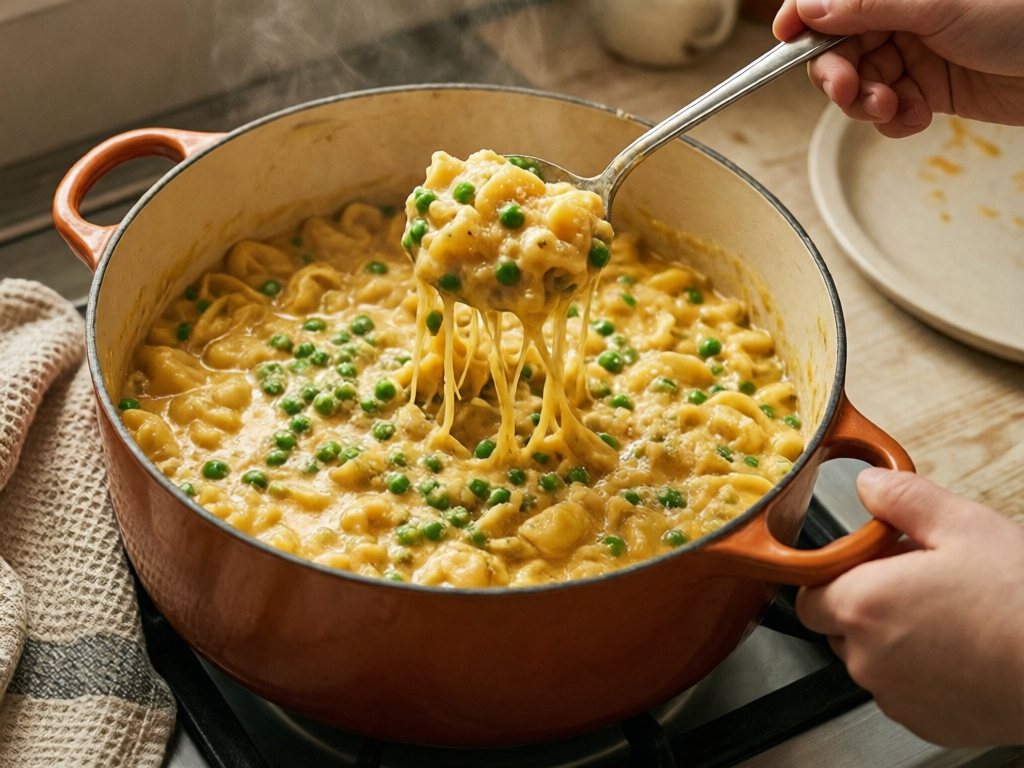
| One-pot cheesy tortellini with peas | 15 min | Kid-favorite, minimal cleanup, freezes in portions too. |
| Chicken and rice soup (quick version, rotisserie chicken) | 20 min | Warm, easy to eat fast, good for cooler fall evenings. |
None of these needs a marinade or overnight prep, and each packs into a to-go container for the kid who eats later. In our house, the taco skillet and the tortellini show up almost every week. My youngest picks every pepper off the sheet pan, so I leave one corner pepper-free.
Here’s the taco skillet start to finish (serves 4), so you can see how little it asks of you on a practice night:
- Brown the turkey (8 min). Cook 1 lb ground turkey in a large skillet over medium-high heat, breaking it up, until cooked through.
- Season (2 min). Stir in 1 packet taco seasoning and the water the packet calls for, usually about 2/3 cup.
- Add beans and simmer (5 min). Stir in 1 can (15 oz) black or pinto beans, drained and rinsed, and simmer until the sauce thickens.
- Set out toppings (3 min). Put out warm tortillas or leftover rice, shredded cheese, lettuce and salsa, and let everyone build their own bowl.
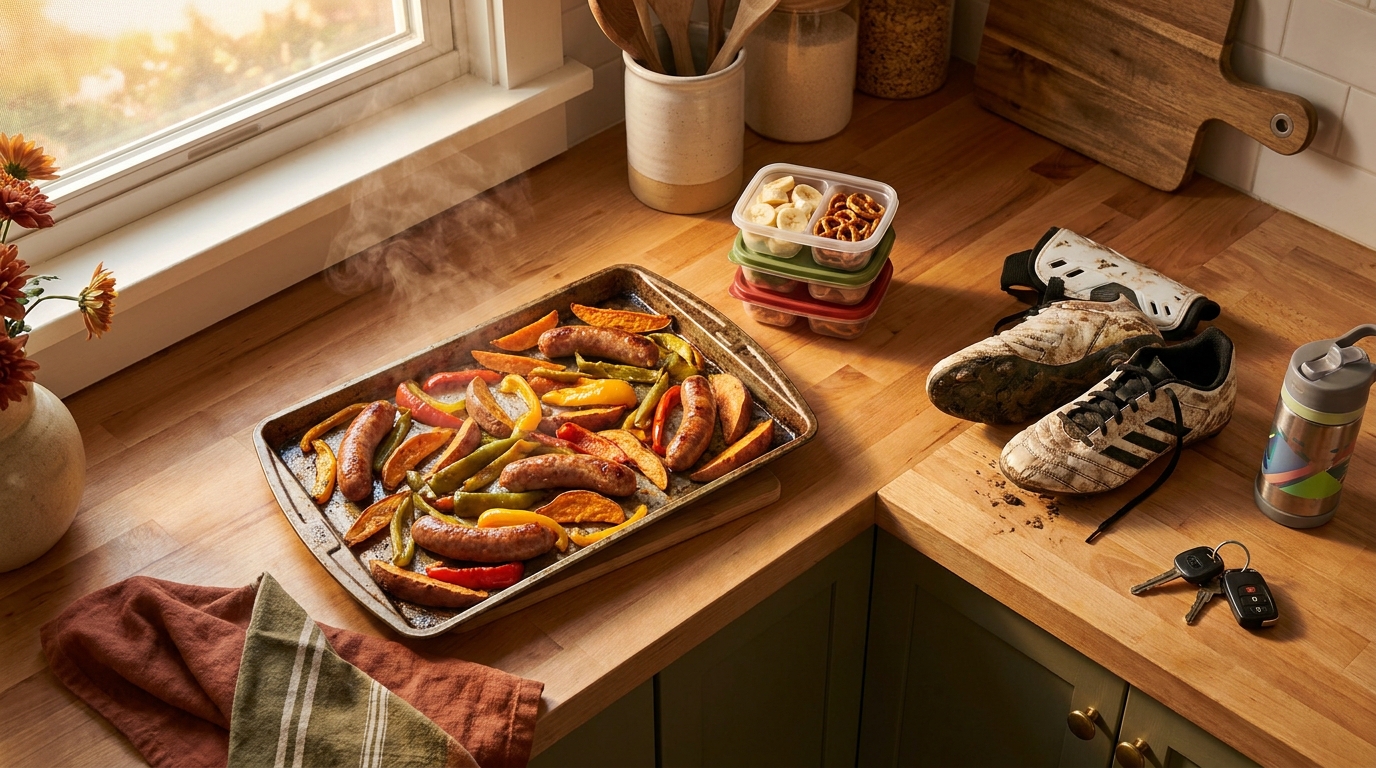
For the sheet-pan sausage (also serves 4), heat the oven to 425°F. Toss 2 medium sweet potatoes, cut into 1/2-inch cubes, and 2 sliced bell peppers with 2 tablespoons olive oil and a pinch of salt. Add a 12-ounce package of precooked chicken sausage, sliced. Roast about 20 minutes, stirring once, until the sweet potatoes are tender.
For the egg fried rice, scramble a few eggs in the pan, add cold leftover rice and frozen veggies, and finish with a splash of soy sauce.
Sheet-pan teriyaki salmon and broccoli (serves 4). You need 4 salmon fillets (about 1 1/2 lb), 4 cups broccoli florets, 2 tablespoons olive oil and 1/3 cup store-bought teriyaki sauce.
- Start the broccoli (5 min). With the oven at 425°F, toss the broccoli with the oil and a pinch of salt on a sheet pan and roast 5 minutes.
- Add the salmon (12-15 min). Push the broccoli to one side, add the fillets and brush them with teriyaki sauce. Roast until the salmon flakes easily and reaches 145°F.
- Serve. Spoon a little extra sauce over the top. Flake the salmon and check for bones before serving it to little kids.
One-pot cheesy tortellini with peas (serves 4). You need a 20-ounce package of refrigerated cheese tortellini, 1 cup frozen peas, 2 tablespoons butter and 1 cup shredded mozzarella or cheddar.
- Boil the water (about 10 min). Bring a large pot of salted water to a boil.
- Cook (4 min). Cook the tortellini as the package directs, usually 3-4 minutes, and add the peas for the last minute. Scoop out 1/2 cup of the cooking water, then drain.
- Make it cheesy (1 min). Return everything to the pot and stir in the butter, cheese and a splash of the saved water until creamy.
Pasta with white beans, spinach and parmesan (serves 4). You need 12 ounces small shells or elbows, 1 can (15 oz) cannellini beans (drained and rinsed), 3 cups baby spinach, 2 tablespoons olive oil, 1 minced garlic clove and 1/2 cup grated parmesan.
- Cook the pasta (about 15 min). Bring a large pot of salted water to a boil and cook the pasta as the package directs. Scoop out 1/2 cup of the cooking water, then drain.
- Warm the beans (3 min). In the same pot, cook the oil and garlic over medium heat for 1 minute. Add the beans and spinach and stir until the spinach wilts.
- Toss (2 min). Add the pasta, parmesan and a splash of the saved water, and toss until glossy.
The last three barely need a recipe, which is exactly why they’re on my list:
- Quesadillas: Mash a drained, rinsed 15-ounce can of black beans and spread it on half of each tortilla. Top with shredded cheese, fold, and cook in a skillet over medium heat for 2-3 minutes per side, until the cheese melts.
- Turkey and cheese roll-ups + quick slaw: Roll deli turkey and sliced cheese in tortillas and cut them into rounds. Toss a bag of coleslaw mix with a spoonful of mayo and a splash of apple cider vinegar.
- Chicken and rice soup: Simmer 6 cups low-sodium chicken broth with 1 cup chopped carrots and celery for 8 minutes. Add 1 cup instant rice and 2 cups shredded rotisserie chicken, then simmer until the rice is tender.
Good to knowUse a food thermometer. Cook ground turkey and chicken to 165°F, raw pork sausage to 160°F and salmon to 145°F. Heat precooked sausage and leftovers to 165°F.
The build-your-own taco bowl is a lifesaver with a selective eater, and our picky-eater meal plan uses the same low-pressure idea all week. The Fall Sports Night Dinner Kit printable on this page puts the steps and shopping lists for all nine meals in one place.
If your crew is still building kitchen skills, try our age-by-age guide to teaching kids to cook. Dinner goes faster when a 9-year-old sets the table or shreds cheese with an adult nearby to watch the grater.
TipPost the rotation. Tape a card inside a cabinet door with these nine meals listed. At 4:40 PM with no brain capacity left, you don’t want to invent dinner; you want to pick from a list. Decision fatigue is what sinks most of my September dinners.
Make-Ahead Meals for the Nights You Can’t Even Do 20 Minutes
Some nights, even 20 minutes is too much. Back-to-back practices, a late game or a long workday can leave you running on fumes. That’s when make-ahead and freezer meals earn their keep.
Do the thinking and chopping on a Sunday, or whenever you have a spare hour. Then a busy Wednesday just takes a button push.
Your best options fall into three categories:
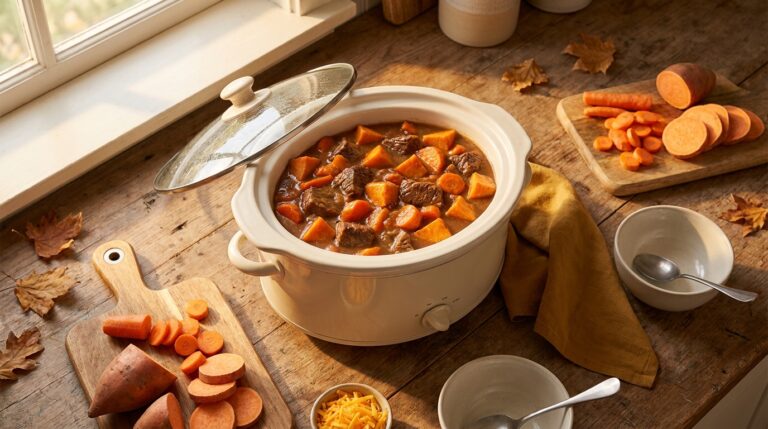
- Slow cooker meals that go in before school and are done when everyone walks in starving. Our slow-cooker fall dinners are built around that same “ready when you walk in” idea.
- Freezer meals assembled ahead and thawed in the fridge (overnight or the day before). These save you when the week gets away from you. Our list of freezer-friendly dinners works just as well for a Tuesday-night soccer scramble as for the first week of school.
- Double-batch nights, when you’re already cooking something that freezes well, like chili, meatballs, baked ziti or taco meat. Make double and freeze half. You’re scaling up a meal you were cooking anyway, so it’s the lowest-effort way to build a freezer stash.
A practical target: keep four to six make-ahead meals in your freezer or slow-cooker repertoire at any point in the season. Replenish the stash by double-batching whatever you’re already cooking. That covers roughly one no-cook night per week and takes pressure off the other six.
I write the meal name and date on every freezer bag in marker, because by October frozen chili and frozen taco meat look exactly the same to me. Here’s what’s usually in there by then:
- Chili
- Meatballs
- Baked ziti
- Taco meat
- Chicken and rice soup
- Cheesy tortellini portions
Safety firstHolding and leftovers. Keep hot food at 140°F or above. A slow cooker on warm is fine for holding, but it heats too slowly to reheat cold food, so reheat leftovers to 165°F on the stove or in the microwave first. Refrigerate leftovers within 2 hours and use them within 3-4 days. Cool big pots of chili in shallow containers.
Safety firstFreezer meals and thermoses. Thaw freezer meals in the fridge, not on the counter, and use them within 1-2 days. Reheat them to 165°F, checking the center with a thermometer. For a thermos, an adult should fill it with boiling water, let it sit a few minutes, pour it out and add food heated to 165°F. Eat it within about 2 hours, and toss anything that’s gone lukewarm.
Pre-Practice Snacks for Kids That Travel Well
Here’s where a lot of dinner plans fall apart. You make a great meal, but practice starts in 20 minutes and nobody wants a full plate of teriyaki salmon before sprints.
That’s the moment for pre-practice fuel, a different category than dinner. Think of it as bridging food: enough to prevent a shaky, hangry meltdown, light enough not to cause cramping.
Here’s a general rule of thumb for active kids. Every child is different, so adjust to what sits well with yours.
| When | What | Example |
|---|---|---|
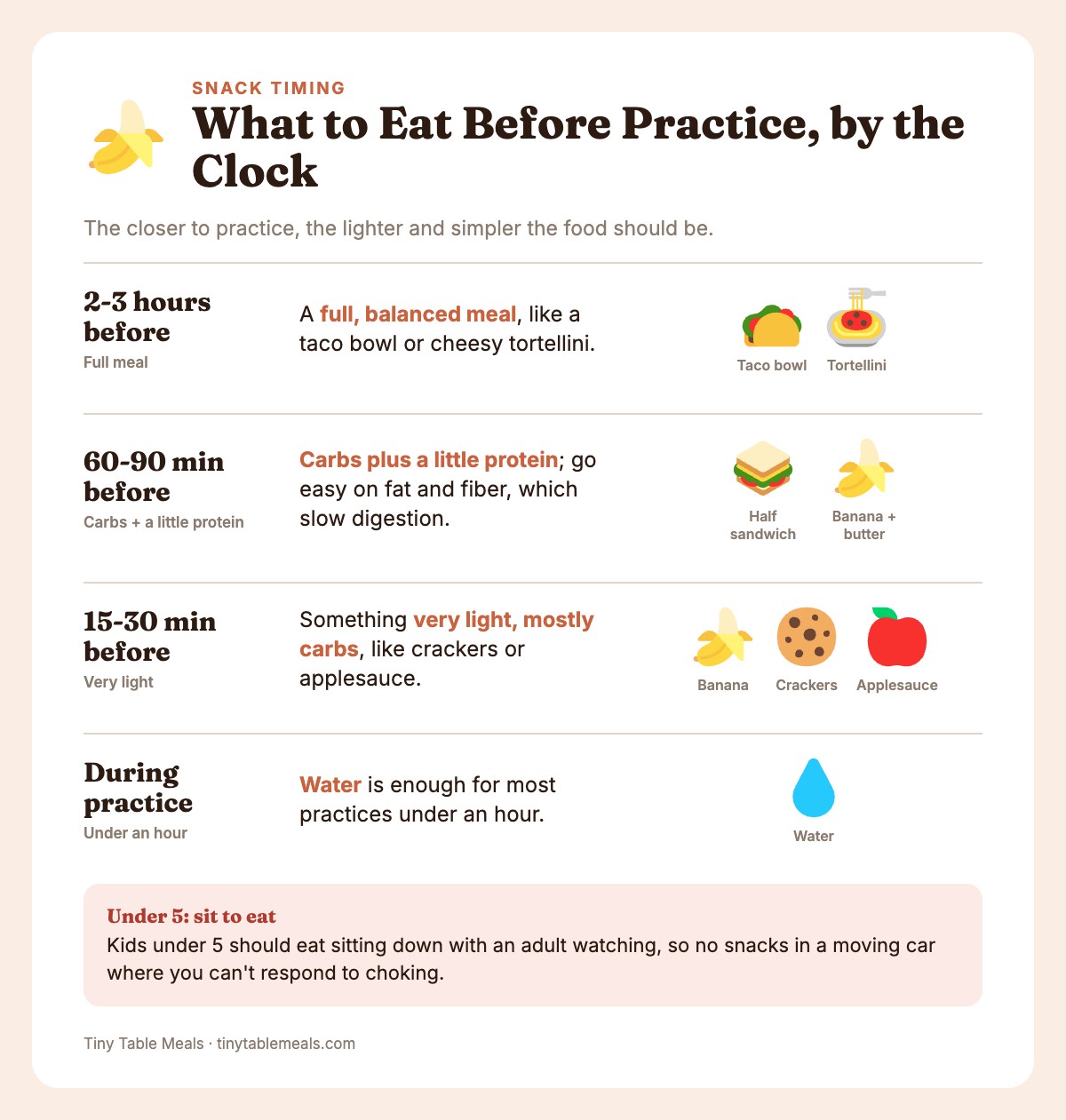
| 2-3 hours before | A full, balanced meal | Taco bowl or cheesy tortellini from the rotation |
| 60-90 minutes before | Carbs plus a little protein; go easy on fat and fiber, which slow digestion | Half a turkey and cheese sandwich, or a banana with a thin spread of sunflower butter |
| 15-30 minutes before | Something very light, mostly carbs | A banana, a few crackers or a small applesauce pouch |
| During practices and games | Water | Water is enough for most practices under an hour. Ask your pediatrician before using sports drinks, which add sugar. |
Safety firstKids under 5 should eat sitting down with an adult watching, so no snacks in a moving car, where you can’t see or respond to choking. The same goes for any child eating in a rush: eat before you leave, or pull over. For kids under 4, hard pretzels, whole grapes, popcorn, raw carrots and chunks of cheese are choking risks. Cut string cheese lengthwise and into small pieces, quarter grapes lengthwise, cook or grate carrots, skip hard pretzels and popcorn, and spread nut butter thinly.
My daughter can’t stomach a yogurt tube right before soccer, so hers is crackers and an applesauce pouch at the kitchen counter before we leave. Here are options that pack easily, to eat at home or at the field:
- Half a turkey and cheese sandwich on whole wheat, cut into strips.
- A banana with a thin spread of peanut or sunflower butter. For nut-free teams, use sunflower or soy butter. Soy is also an allergen, so check labels for shared-facility warnings and confirm with your child’s allergist.
- Pretzels and string cheese (for kids under 4, see the safety note above).
- A homemade granola bar or muffin, made ahead over the weekend.
- Applesauce pouch plus a handful of whole-grain crackers.
- A yogurt tube plus soft fruit slices.
- Half a bagel with a thin layer of cream cheese.
If your kids can grab their own snack, try our after-school snacks kids can make. Many are the right size for a pre-practice bridge, and it’s one less thing on your plate at 4:30 PM.
What to avoid right before activity: anything heavy in fat or fried, large amounts of dairy for kids who are sensitive to it, and very high-fiber foods like raw broccoli or beans. Skip anything brand-new, too. Practice day is not the time to find out a food doesn’t sit well.
Good to knowEarly-fall practices can still be hot. Offer water before, during and after, and build in shade and rest breaks. Dizziness, headache, nausea or unusual tiredness means stop and cool down, and call your doctor if it doesn’t pass. Confusion or fainting needs emergency care right away.
When to Eat Before Practice: Snack Timing by Sport
Not every fall sport runs on the same clock, so let the sport, not just the day of the week, shape your dinner plan.
| Sport | Typical practice time | When to eat | Notes |
|---|---|---|---|
| Soccer and football | 5:00-7:00 PM | Snack or mini-meal at 3:45-4:00; dinner once home | Toughest window, but a simple 7:30 dinner is fine. |
| Dance and gymnastics | 6:00-8:00 PM | Fuller meal at 3:30-4:00; small carb snack around 5:30 | Add a small snack after class if bedtime allows. |
| Cross country and track (after school) | Ends by 5:00 | Light snack when they get off the bus | Easiest to feed around, since normal dinner time still works. |
| Cross country and track (early morning) | Before school | Light carb snack like a banana or toast | Full breakfast afterward. |
| Multi-sport households | Staggered | Serve-yourself meal kept at 140°F or above | A slow cooker or big pot works; refrigerate leftovers within 2 hours. |
What to Eat After Practice: Recovery for Growing Athletes
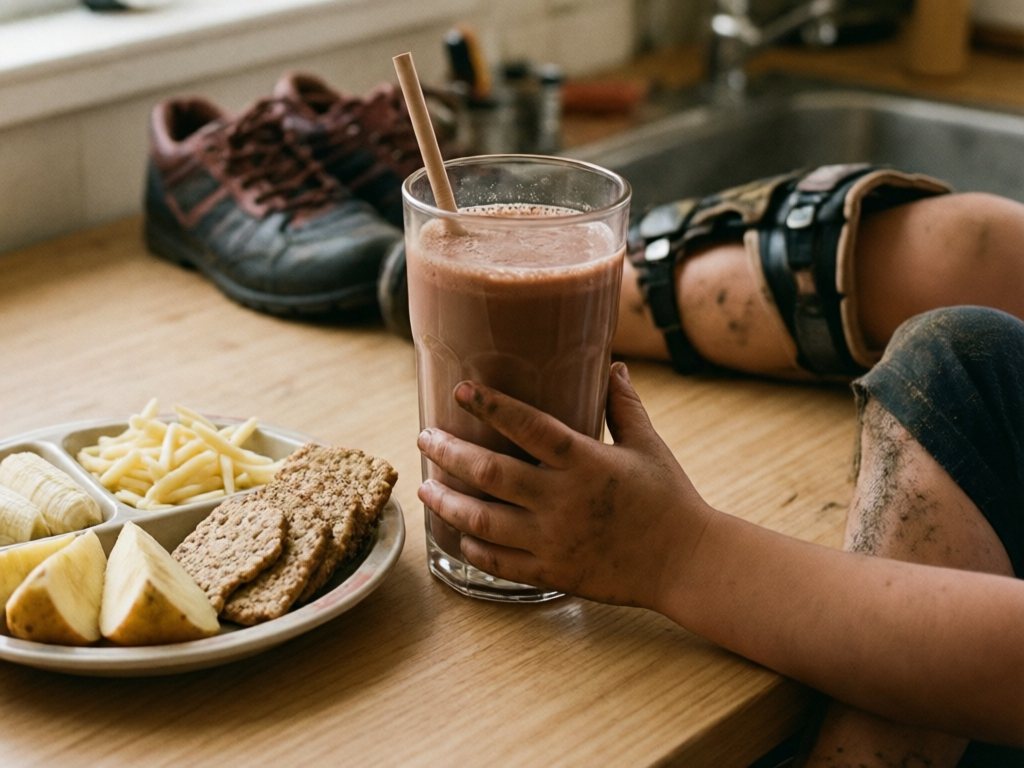
The other half of the equation is what happens after. It often gets skipped because everyone’s exhausted and bedtime is close.
After an hour of running around, kids need fluids, some carbohydrates for energy and some protein. A regular balanced meal usually covers all of it.
You don’t need a recovery protocol for an 8-year-old’s rec league practice. Serve your usual balanced dinner with a protein, a carb and a fruit or veggie. Kids with a heavy schedule may just be hungrier, so offer a bit more.
Good post-practice options:
| Timing | Food | Why |
|---|---|---|
| Right after practice | Chocolate milk or a smoothie | Carbs, protein and fluid in one easy drink when kids are tired. |
| Within an hour or so | Dinner from your 20-minute rotation | A regular balanced meal usually covers recovery. |
| If dinner’s delayed | String cheese + fruit + a few crackers | Holds them over without ruining appetite for the real meal. |
| Multi-sport days | Eggs, Greek yogurt, or a fruit smoothie bowl | A balanced, convenient option when kids need more to eat between sessions. |
Most active kids, athletes included, get enough protein from ordinary meals. If you have a kid in club or travel sports and you’re unsure, ask your pediatrician or a registered dietitian. Our high-protein meals and snacks guide has age-by-age ideas.
Fatigue has many causes, so a kid who seems drained despite good sleep should see the pediatrician. The doctor can check iron with a blood test before you change the diet or add supplements. Meanwhile, beans, lean beef, leafy greens and fortified cereal fit easily into the rotation, and our iron-rich meals and snacks guide has more ideas.
Sample Two-Week Meal Plan for Fall Sports Nights
Here’s a two-week calendar you can screenshot and follow. It assumes practices Monday, Wednesday and Thursday evenings, plus a Saturday game.
Adjust the days to your schedule but keep the pattern: one make-ahead night, a couple of true 20-minute nights and one low-effort night. Use the snack-timing-by-sport table above to fit snacks around your practice time. The prep rows tie each week to the Sunday prep routine below.
Week One
| Day | Dinner Plan |
|---|---|
| Sunday before (prep) | Chop peppers and onions, cube the sweet potatoes, prep Monday’s slow-cooker ingredients and portion practice-day snacks. |
| Monday (practice) | Slow-cooker chicken and rice, started in the morning (or any recipe from our slow-cooker fall dinners). |
| Tuesday | Ground turkey taco skillet — 18 min. |
| Wednesday (practice) | Sheet-pan sausage, peppers & sweet potato — 22 min. |
| Thursday (practice) | Leftover taco skillet reheated as quesadillas. |
| Friday | Frozen pizza night + quick salad — an easy night for everyone. |
| Saturday (game) | Pre-game: banana + peanut butter; post-game: chicken and rice soup. |
| Sunday (prep for week two) | Double-batch chili: refrigerate half for Monday and freeze half. Shred cheese for Tuesday’s tortellini and portion snacks. If your salmon is frozen, move it to the fridge Wednesday morning. |
Week Two
| Day | Dinner Plan |
|---|---|
| Monday (practice) | Chili from Sunday prep — reheats in 10 min. |
| Tuesday | One-pot cheesy tortellini with peas — 15 min. |
| Wednesday (practice) | Turkey and cheese roll-ups + quick slaw — 15 min. |
| Thursday (practice) | Sheet-pan teriyaki salmon and broccoli — 20 min. |
| Friday | Breakfast-for-dinner (eggs, toast, fruit) — 15 min, zero stress. |
| Saturday (game) | Pre-game: string cheese + crackers; post-game: pasta with white beans. |
| Sunday | Prep day — restock freezer, plan next two weeks. |
Every week has one low-effort night (Friday pizza or breakfast-for-dinner) and one prep day. That’s what keeps the system from collapsing by week six.
Sunday Prep: The 45-Minute Habit That Saves Your Whole Week
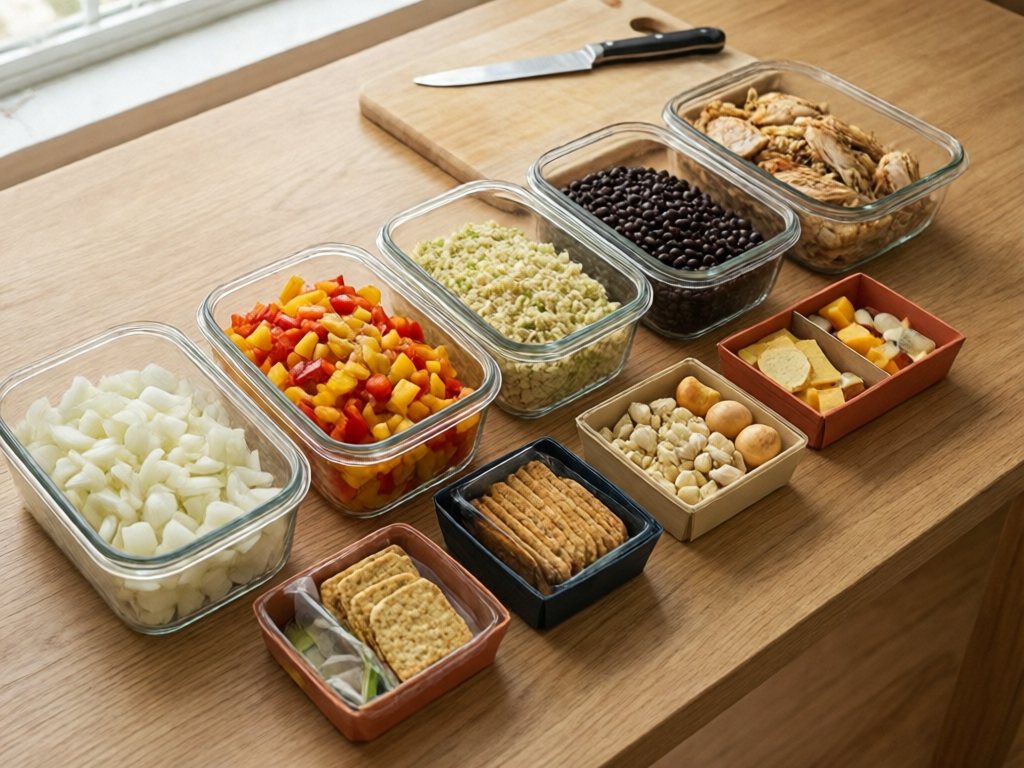
All of this gets easier with about 45 minutes of prep on Sunday, or whatever your slowest day is. Skip the meal-prep marathon. You only need four small tasks:
- Chop the veggies (15 min). Onions, peppers and garlic go in one container. Cube sweet potatoes for sheet-pan night and store them covered in water in the fridge. This alone shaves 5-8 minutes off most recipes in the rotation.
- Cook a base protein (15 min). Shredded rotisserie chicken, browned ground turkey or a pot of black beans can show up in two or three meals across the week.
- Portion pre-practice snacks (10 min). Use grab-and-go containers so nobody’s assembling a snack bag at 4:40 PM while also finding shin guards.
- Check the freezer (5 min). Plan one night around whatever’s already made.
Feeding hungry athletes adds up. Our budget meal planning guide pairs well with this Sunday habit, because buying proteins and produce with the week’s rotation mapped out is one of the biggest cost-savers.
Fall produce is at its best right now, too. Our fall produce guide helps you swap seasonal vegetables into the sheet-pan and skillet meals. Squash and Brussels sprouts roast well alongside sausage.
Getting Kids to Help, Even on the Busiest Nights
A kid who can assemble a quesadilla or build a taco bowl takes work off your plate on exactly the nights you need it.
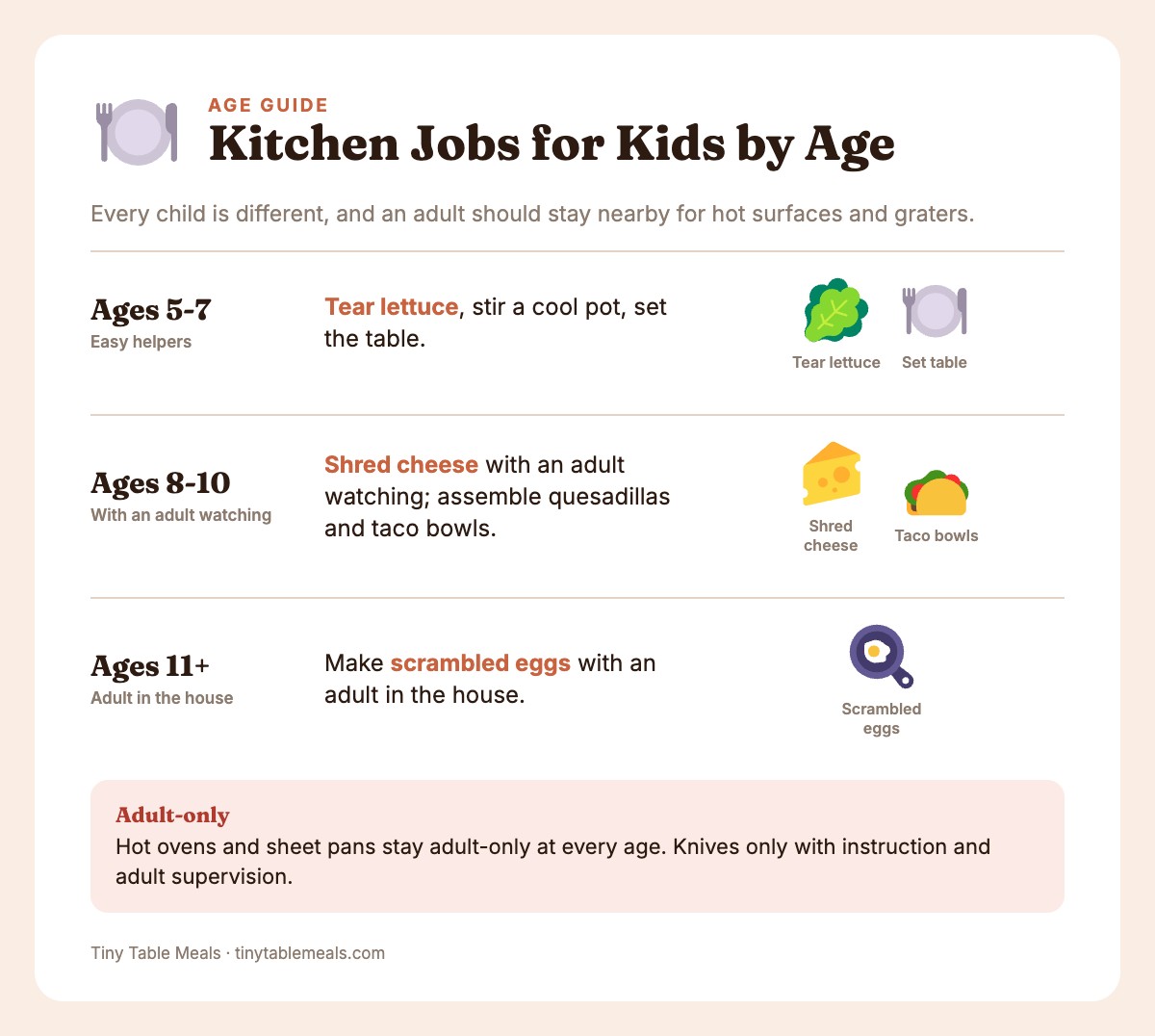
Here’s a rough guide. Every child is different, and an adult should stay nearby for hot surfaces and graters.
- Ages 5-7: tear lettuce, stir a cool pot, set the table.
- Ages 8-10: shred cheese with an adult watching, assemble quesadillas and taco bowls.
- Ages 11+: make scrambled eggs with an adult in the house.
Solo stove use depends on readiness. Some 11-year-olds can handle eggs alone, and some still need you in the room.
Safety firstHot ovens and sheet pans stay adult-only at every age. Knives come out only with instruction and an adult supervising.
Start small on a low-stakes night, not the night of the championship game. By mid-season, aim for a kid who can make their own pre-practice snack or reheat leftovers while you hunt for the shin guards.
What to Do When You Have No Time to Cook (Drive-Through Nights)
Some weeks bring a tournament, a sick kid or a work deadline that eats your Sunday prep, and you end up at the drive-through between practice and homework. When that happens, I order grilled chicken, a fruit side and milk or water, and I remind myself that one drive-through dinner doesn’t undo a rotation that works the other nights.
Frequently Asked Questions
How long before practice should my child eat dinner?
Aim for a full meal 2-3 hours before intense activity, or a snack or mini-meal 60-90 minutes before if dinner timing doesn’t allow for that. Every child is different, so adjust to what sits well with yours. Within 15-30 minutes of practice, stick to something small and easy to digest, like a banana or a few crackers. Heavy or high-fat foods eaten too close to activity can cause cramping or nausea.
What should my kid eat if practice runs right through normal dinner time?
Give them a snack or mini-meal (like half a sandwich or a banana with nut or seed butter) 60-90 minutes before. Then feed them dinner as soon as you’re home, even if that’s later than usual. Don’t skip the real meal — the bridge snack is meant to hold them over, not replace dinner.
Is chocolate milk actually a good post-practice recovery drink?
It’s a convenient, kid-friendly option: it has carbs, protein and fluid, and most kids like the taste. It isn’t required, though. Most kids recover fine from a normal balanced meal, so use chocolate milk when it’s easy.
How many make-ahead meals should I keep on hand during sports season?
A good target is four to six ready-to-go meals in your freezer or slow-cooker rotation at any point, which covers roughly one no-cook night per week. That’s usually enough to absorb the chaos of a typical multi-sport week without leaving you scrambling.
My kid says they feel sick if they eat before a game. What should I do?
This is common. It usually means the timing or food needs adjusting, not that they should skip eating. Running on empty can bring on dizziness, headaches and a rough game. Try moving the meal earlier (2-3 hours out instead of 1) and switching to something lighter and lower in fat and fiber. Test new pre-game foods during practice weeks, not before a real game.
How do I feed kids on different practice schedules without cooking three separate dinners?
Lean on meals that hold well for a few hours, like slow-cooker dishes, soups and casseroles. Everyone can serve themselves whenever they walk in the door. Keep a pot on the stove or in the slow cooker on warm (140°F or above) rather than timing a from-scratch meal to multiple arrival times. Refrigerate leftovers within 2 hours.
What are good pre-practice snacks for a kid with a nut allergy?
Sunflower seed butter or soy butter is a common swap for peanut or almond butter and pairs well with a banana or thin apple slices. Soy is itself an allergen, and seed butters can be made on shared equipment with nuts, so check labels and your team’s allergy policy. String cheese, yogurt tubes and pretzels are often nut-free, but check labels for may-contain or shared-facility warnings and confirm choices with your child’s allergist.
Your Next Step for Sports Night Dinners
Pick two meals from the rotation to try this week. Stock the freezer by double-batching whatever you’re already cooking. And forgive yourself the drive-through nights.