Freezer-Friendly Back-to-School Dinners: 20 Meals to Stock Before the School Year Starts
Prepare 20 freezer-friendly dinners before school starts to avoid last-minute meal stress. You'll learn three ways to build your stash, a labeling system, and safe thawing rules.
- Get 20 freezer-friendly dinner recipes for back-to-school.
- Learn three efficient methods to build your freezer meal stash.
- Use the weeks before school starts to stock your freezer.
- Follow a labeling system and safe thaw/reheat rules.
This post contains affiliate links. As an Amazon Associate I earn from qualifying purchases.
Last August, three days into the school year, I stared into a fridge holding condiments and half a rotisserie chicken. Practice ran late, homework was due, and dinner was cereal. The next July I stocked the freezer, and September felt completely different.
This post gives you 20 freezer dinners, three ways to build the stash, a labeling system, safe thaw and reheat rules, and a four-week rotation. I follow USDA freezer and food-safety guidance throughout. For more dump-style options, see our Freezer-to-Instant-Pot Dump Meals.
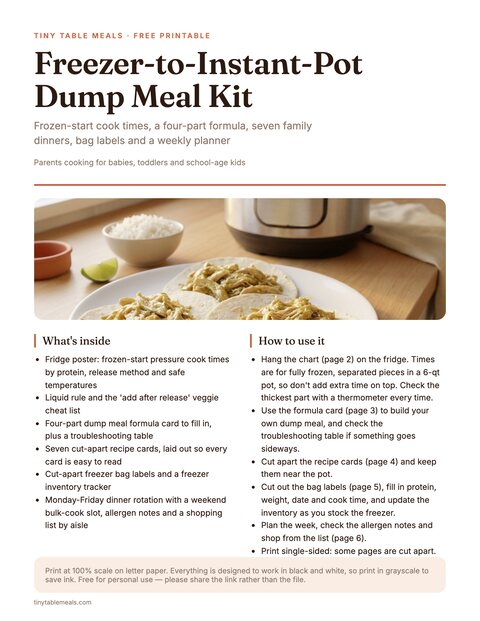
Free printable · 6 pages
Freezer-to-Instant-Pot Dump Meal Kit
A fridge cook-time chart for frozen proteins, a fill-in dump meal formula card with troubleshooting, seven cut-apart recipe cards, freezer bag labels with an inventory tracker, and a Monday-Friday dinner planner with an aisle-by-aisle shopping list.
Free. Your download link appears right here. You'll also join the Sunday Supper Plan. Unsubscribe anytime. Privacy
In this article (12 sections)
- Why the Weeks Before School Start Are Your Best Freezer-Stocking Window
- How to Build the Stash Without Losing a Whole Weekend
- What Actually Freezes Well (and What Turns to Mush)
- The 20 Meals: A Full Back-to-School Freezer Stash
- The Labeling System That Actually Keeps You Organized
- Thawing and Reheating Without Ruining Dinner
- A Sample Four-Week Rotation
- Getting the Kids Involved in Stocking Day
- Budgeting the Stash: What It Actually Costs
- What to Do If You Only Have One Afternoon
- Frequently Asked Questions
- One Weekend, One Calmer Month
Why the Weeks Before School Start Are Your Best Freezer-Stocking Window
August is the window. The evenings are long, the calendar is still loose, and you can see the busy season coming.
Once practices start, you won’t have three free hours to cook a double batch. You’ll have twenty minutes and a hungry table.
A freezer stash fixes that mismatch. You cook when you have time, and you cash it in when you don’t. It’s the same logic behind budget meal planning for families: batching the effort up front saves money and stress later.
A few numbers that make the case for doing this now rather than winging it week to week:
- Time: A 3-4 hour cooking session can produce 5-8 freezer meals, and 4-5 hours gets you 8-12. Cooked one at a time, that food would take as many separate evenings.
- Money: Buying ground beef, chicken thighs, or dried beans in bulk for a big cooking day is almost always cheaper per pound than buying small quantities repeatedly through the month.
- Waste: Produce and herbs bought for one big cook get used up in one go. No more half a bunch of cilantro rotting in the crisper drawer.
- Decision fatigue: “What’s for dinner” stops being a nightly negotiation and becomes a five-second freezer check.
How to Build the Stash Without Losing a Whole Weekend
You don’t need a marathon cooking day to end up with twenty meals in the freezer. You need a system that fits the time you actually have. Here are three approaches — pick the one that matches your summer, or mix all three.
Option 1: The One Big Cooking Day
Block off a Saturday or Sunday and pick 6-8 recipes that share ingredients (ground beef, onions, canned tomatoes, rice). Then cook in relay, so something is always simmering while you assemble the next dish.
Most families can make 8-12 meals in a 4-5 hour session this way. It’s intense, but it’s done. Here is the order I use:
- Shop and prep. Buy everything the day before, then chop all the onions and peppers at once.
- Cook the meats. Brown ground beef and turkey, and start the pulled pork and soups.
- Make the sauces. Simmer meat sauce and chili while the meat finishes.
- Chill what’s cooked. Spread browned meats and finished sauces in shallow containers and get them into the fridge within 2 hours of cooking (1 hour if your kitchen is above 90°F). Don’t leave them on the counter while you work on the next dish.
- Assemble the casseroles and raw bags. Fill pans and bags from the chilled components, pulling each one out of the fridge only when you need it. Keep raw meat in the fridge until you bag it.
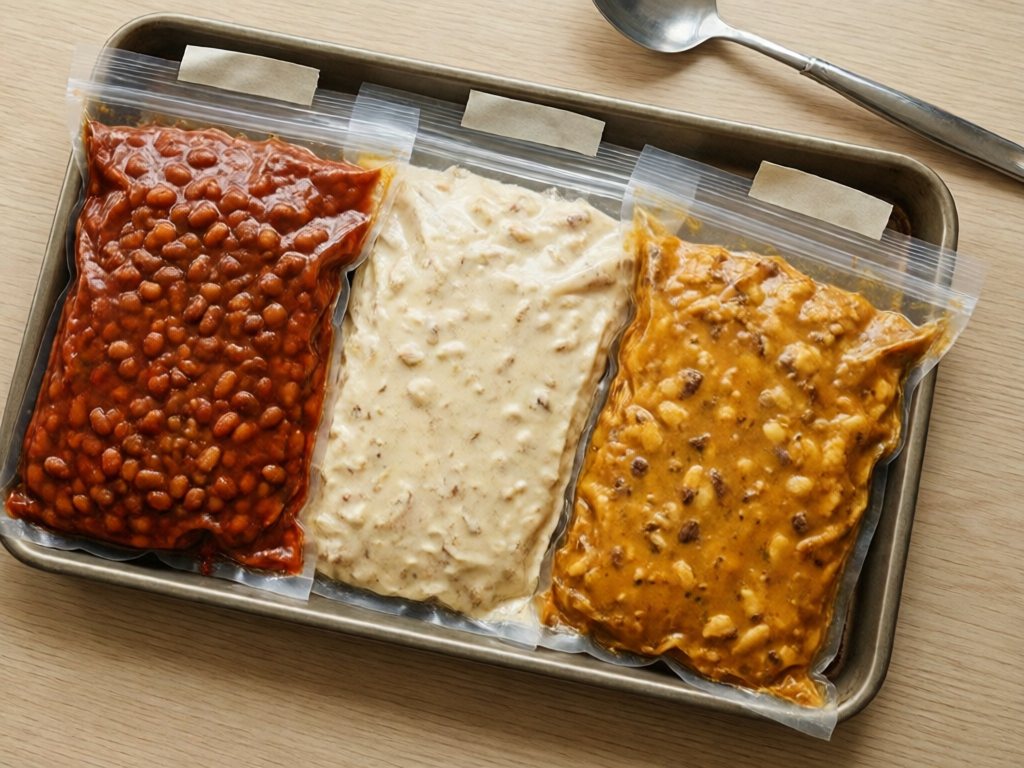
- Label and freeze. Label each pan and bag as you finish it, then freeze it right away, with bags laid flat. Soups and chili get the same shallow-container chill before they go into bags.
Option 2: “Double It” Cooking All Summer
Every time you make a freezer-friendly dinner this summer — a pot of chili, a pan of enchiladas, a batch of meatballs — just make double. Freeze half. By the time school starts, you’ll have accumulated a stash without ever feeling like you were “meal prepping” at all. This is the lowest-effort option and it works well if a big cooking day feels overwhelming.
Option 3: The Freezer Meal Swap
Get three or four other parents together and have each person pick one recipe. Everyone makes a large batch, enough to portion into meal-sized containers for every family in the group. Everyone brings their portions to a swap, and you all walk away with a variety of meals instead of ten containers of the same lasagna. The carpool crew is a natural fit, since you’re already coordinating schedules. Keep swapped meals cold or frozen in a cooler on the way home.
Whichever route you take, the kids don’t have to sit this one out. Older kids can measure, mix, and assemble; younger ones can label containers or peel garlic. For what’s appropriate at each age, see Teaching Kids to Cook: The Complete Age-by-Age Guide to Kitchen Skills.
What Actually Freezes Well (and What Turns to Mush)
Not every dinner survives a trip to the freezer. Before you commit a Saturday to cooking, it helps to know what holds up and what doesn’t.
Freezes beautifully
- Ground meat dishes (chili, meat sauce, meatballs, taco filling)
- Braised or slow-cooked meats (pulled pork, pot roast, braised chicken thighs)
- Soups and stews (minus a few exceptions below)
- Casseroles built with sturdy pasta or rice
- Uncooked marinated proteins (chicken, pork, beef in a bag with marinade)
- Beans and legumes, cooked or in sauce
- Most sauces — tomato-based, curry-based, gravy-based
Skip these for the stash
- Dishes with raw potatoes (they go grainy and weird — cooked, mashed, or roasted potatoes are fine)
- Cream- or milk-based sauces that haven’t been stabilized with a roux (they can separate on thawing)
- Anything with mayonnaise
- Fried foods meant to stay crispy (they’ll reheat soggy — better as a fridge leftover)
- Delicate leafy greens added raw (spinach, arugula — add these fresh after reheating instead)
- Plain cooked rice on its own (it gets soft on reheating). In casseroles, use slightly undercooked rice
If a recipe calls for cream, sour cream, or a dairy finish, the workaround is simple: freeze the base without it, and stir the dairy in fresh after reheating. That one adjustment saves a lot of otherwise-great recipes from the “doesn’t freeze well” pile.
The 20 Meals: A Full Back-to-School Freezer Stash
Here’s the lineup, organized by type so you can cover different proteins and cooking methods. Each row shows how the meal freezes and reheats.
I size every meal for 4-6 people. That means one 9×13 pan per casserole, about 2 quarts of soup or chili per dinner, and one gallon bag per slow-cooker meal. Quick builds for the less obvious dishes follow the tables.
Want more recipes to fill the list? See freezer meals for busy families and my one-day freezer meal prep walkthrough.
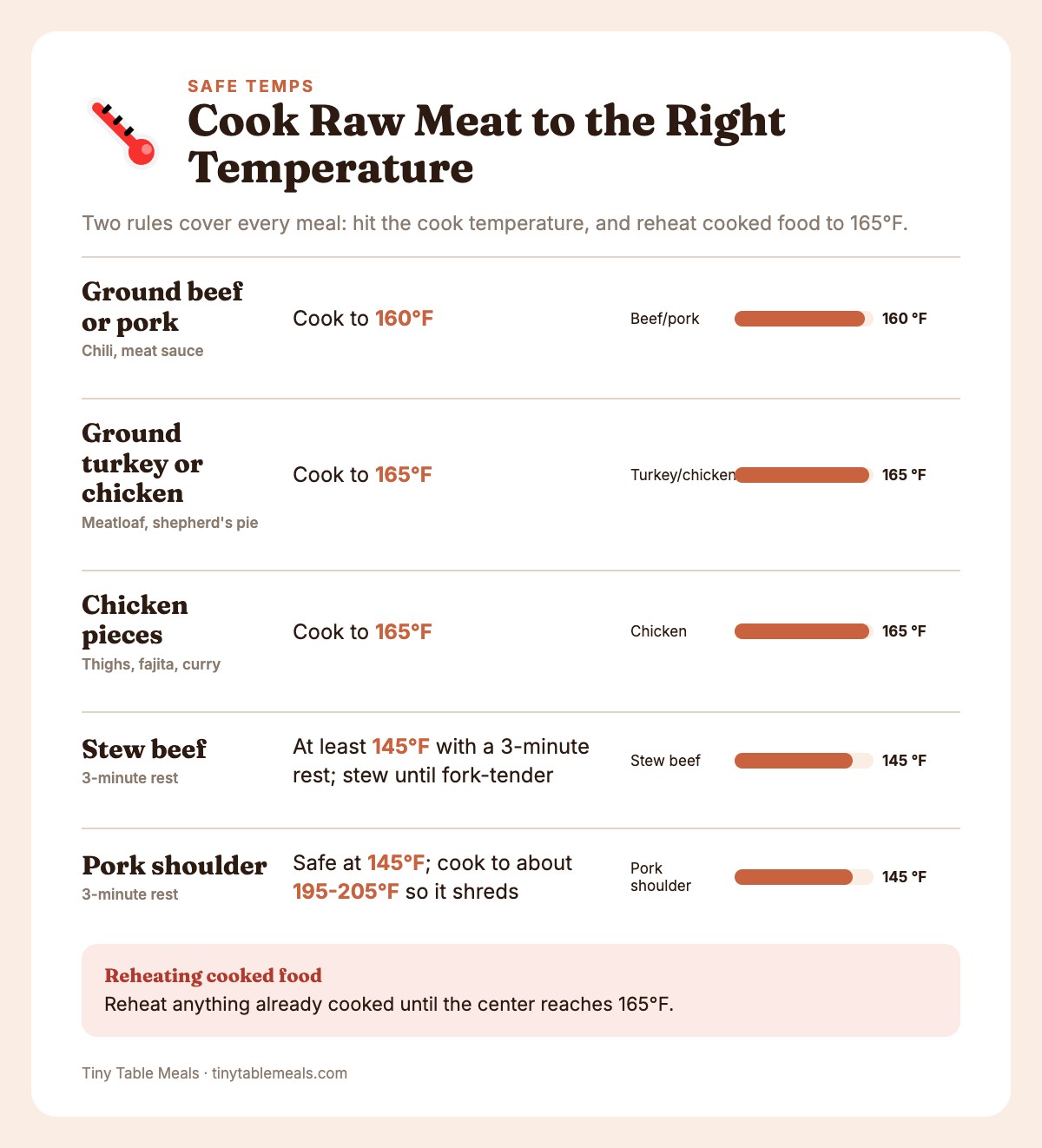
Safety firstTwo rules cover every meal here. Cook raw meat to the temperature in the table below. Reheat anything already cooked until the center reaches 165°F.
| Raw meat | Cook to | Used in |
|---|---|---|
| Ground beef or pork | 160°F | Chili, meat sauce, beef meatballs, shepherd’s pie |
| Ground turkey or chicken | 165°F | Turkey meatloaf, turkey shepherd’s pie |
| Chicken pieces | 165°F | Marinated thighs, fajita bag, curry |
| Stew beef | At least 145°F with a 3-minute rest. Cook until fork-tender for stew | Beef stew bag, beef and barley stew |
| Pork shoulder | Safe at 145°F with a 3-minute rest. Cook to about 195-205°F so it shreds | Pulled pork |
Cool before you freezeCool cooked food within 2 hours, in shallow containers. That includes the curry and the burrito filling. Never fill a freezer bag with hot liquid. Cooked rice needs extra care: cool it quickly and freeze it promptly, and never leave it sitting out at room temperature.
Casseroles & Bakes (6 meals)
| # | Meal | Freeze Method | Reheat | Notes |
|---|---|---|---|---|
| 1 | Baked ziti with meat sauce | Assemble unbaked in foil pan, wrap tightly | Thaw in fridge 24 hrs, bake covered at 375°F 40-60 min, uncover last 15. From frozen: ~1.5 hrs. Center 165°F | Add cheese topping fresh if you don’t want it soggy on thaw |
| 2 | Chicken and broccoli rice casserole | Assemble unbaked, freeze flat | Thaw 24 hrs, bake covered at 350°F 40-60 min. From frozen: ~1.5 hrs. Center 165°F | Slightly undercook the rice before assembling |
| 3 | Enchilada casserole (layered, not rolled) | Freeze fully assembled, unbaked | Thaw 24 hrs, bake covered at 375°F 40-60 min. From frozen: ~1.5 hrs. Center 165°F | Layering instead of rolling saves a ton of time |
| 4 | Shepherd’s pie (beef or turkey) | Freeze in a foil pan, or in foil-lined ramekins: once solid, lift the blocks out and wrap them | Thaw 24 hrs in the fridge (set ramekin blocks back in their ramekins to thaw), then bake covered at 350°F 40-60 min. From frozen, foil pan only: ~1.5 hrs. Never put a frozen ramekin in a hot oven. Center 165°F | Mashed potato topping freezes fine, don’t add butter until reheating |
| 5 | Chicken enchilada bake with green sauce | Assemble unbaked | Thaw 24 hrs, bake covered at 375°F 40-60 min. From frozen: ~1.5 hrs. Center 165°F | A good one to double for a swap — always popular |
| 6 | Sweet potato and black bean enchilada casserole (vegetarian) | Assemble unbaked | Thaw 24 hrs, bake covered at 375°F 40-60 min. From frozen: ~1.5 hrs. Center 165°F | Good rotation option for a meatless night |
Soups, Stews & Chilis (5 meals)
| # | Meal | Freeze Method | Reheat | Notes |
|---|---|---|---|---|
| 7 | Classic beef chili | Freeze flat in a bag or quart container | Stovetop from frozen, low-medium heat, 20-30 min per quart, to 165°F. Don’t reheat it in a slow cooker. Once it reaches 165°F, a slow cooker on warm can hold it at 140°F or above | Freezes and reheats better than almost anything on this list |
| 8 | White chicken chili | Freeze flat, leave cream/cheese garnish for serving | Stovetop from frozen, low heat, 20-30 min per quart, stir often, to 165°F | Add a splash of broth when reheating if it’s thickened too much |
| 9 | Beef and barley stew | Freeze in quart portions | Stovetop from frozen, 20-30 min per quart, to 165°F. Or microwave in a covered bowl, stirring every 2 min | Barley holds up better than potatoes or rice in stews |
| 10 | Chicken tortilla soup | Freeze base without tortilla strips/avocado | Stovetop from frozen, low-medium heat, 20-30 min per quart, to 165°F | Add fresh toppings after reheating for texture |
| 11 | Lentil and vegetable soup | Freeze flat | Stovetop from frozen, 20-30 min per quart, to 165°F. Or microwave in a covered bowl, stirring every 2 min | One of the easiest to make vegetarian and still filling |
Meatballs, Proteins & Sauces (5 meals)
| # | Meal | Freeze Method | Reheat | Notes |
|---|---|---|---|---|
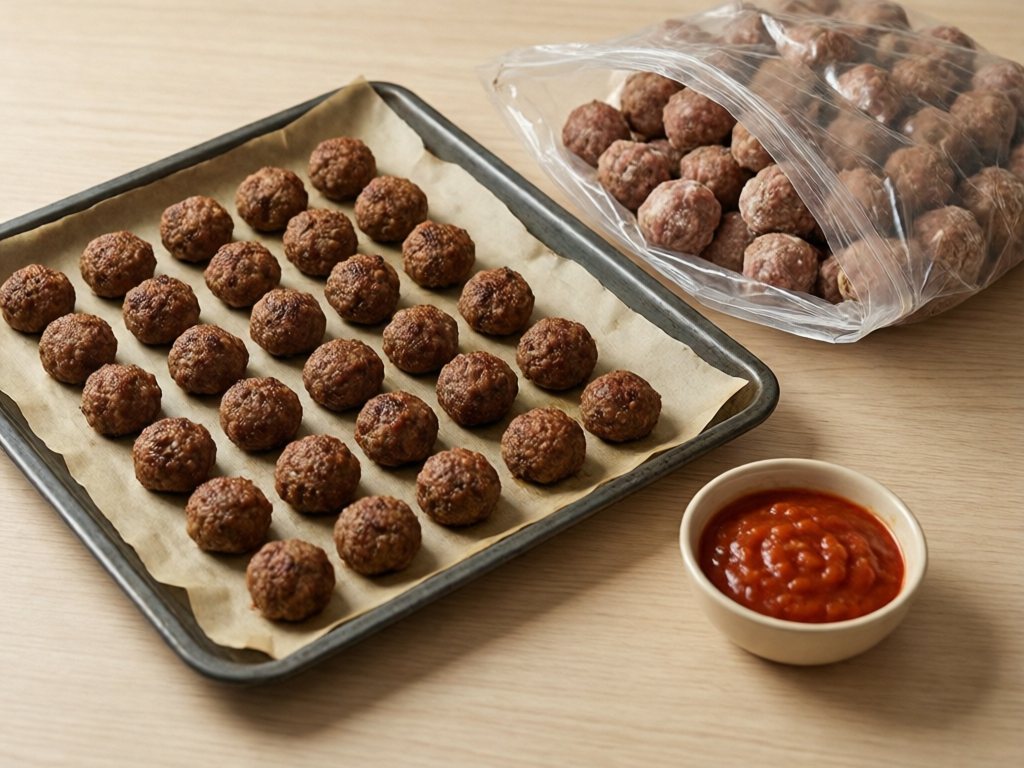
| 12 | Baked meatballs (plain, no sauce) | Freeze on a tray, then bag once solid | Already cooked, so this is a reheat. Simmer in sauce or bake from frozen at 375°F, ~20 min, until 165°F inside | Freezing unsauced keeps them versatile — Italian one night, sweet and sour the next |
| 13 | Marinated chicken thighs (raw, in marinade) | Freeze raw in a zip-top bag with marinade | Thaw overnight in fridge. Bake at 400°F until 165°F: 35-45 min bone-in, 25-30 min boneless. Or grill to 165°F | Thaw on a plate on the bottom shelf to catch drips |
| 14 | Pulled pork (slow cooker, shredded) | Freeze in sauce, flat in bags | Stovetop from frozen, low heat, 20-30 min per quart, to 165°F. Or microwave in a covered bowl, stirring every 2 min | Cook the shoulder until it shreds easily (about 195-205°F) before freezing. Great for tacos, sandwiches, or rice bowls |
| 15 | Turkey meatloaf mix (raw, shaped, unbaked) | Shape into a loaf, wrap, freeze raw | Thaw overnight in fridge, then bake at 350°F about 55-65 min, until 165°F in the center | Saves the mixing step entirely for a busy night |
| 16 | Homemade meat sauce (Bolognese-style) | Freeze flat in quart bags | Stovetop from frozen, low heat, 20-30 min per quart, to 165°F | Base for pasta, but also great over baked potatoes or polenta |
Safety firstMarinade that has touched raw chicken is not a sauce. Discard it, or boil it for 1 minute before serving.
Thaw-and-Cook Slow-Cooker Bags (2 meals)
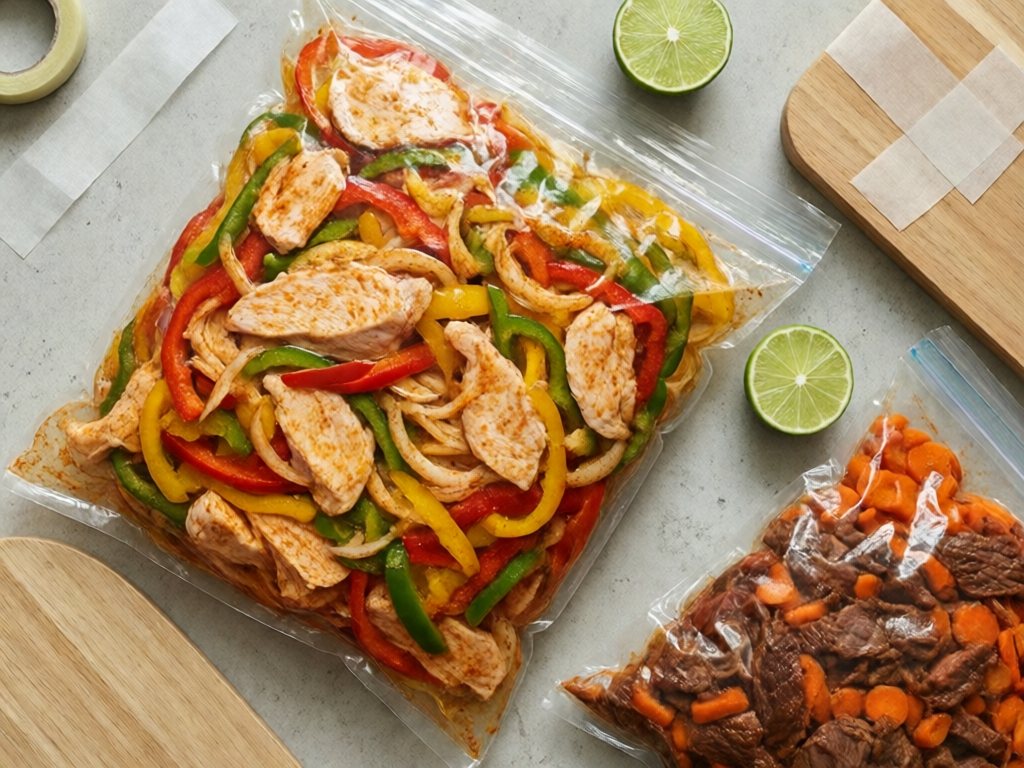
These two bags are frozen raw. They always thaw fully in the fridge, about 24 hours, before they go into the slow cooker. If any ice remains, don’t use the slow cooker.
| # | Meal | Freeze Method | Reheat | Notes |
|---|---|---|---|---|
| 17 | Chicken fajita bag (raw chicken, peppers, onions, spices) | Freeze raw, all in one bag | Thaw 24 hours in the fridge, then slow cooker on low 6-8 hrs; chicken to 165°F. If any ice remains, don’t use the slow cooker | No chopping on cooking day. Only a fully thawed bag goes in the cooker |
| 18 | Beef and vegetable stew bag (raw stew meat, carrots, broth base) | Freeze raw, all in one bag; no potatoes | Thaw 24 hours in the fridge, then slow cooker on low 8 hrs, until the beef is fork-tender (well past its 145°F minimum). If any ice remains, don’t use the slow cooker | Add cubed potatoes on cooking day, since raw potatoes freeze badly |
Global Flavors & Breakfast-for-Dinner (2 meals)
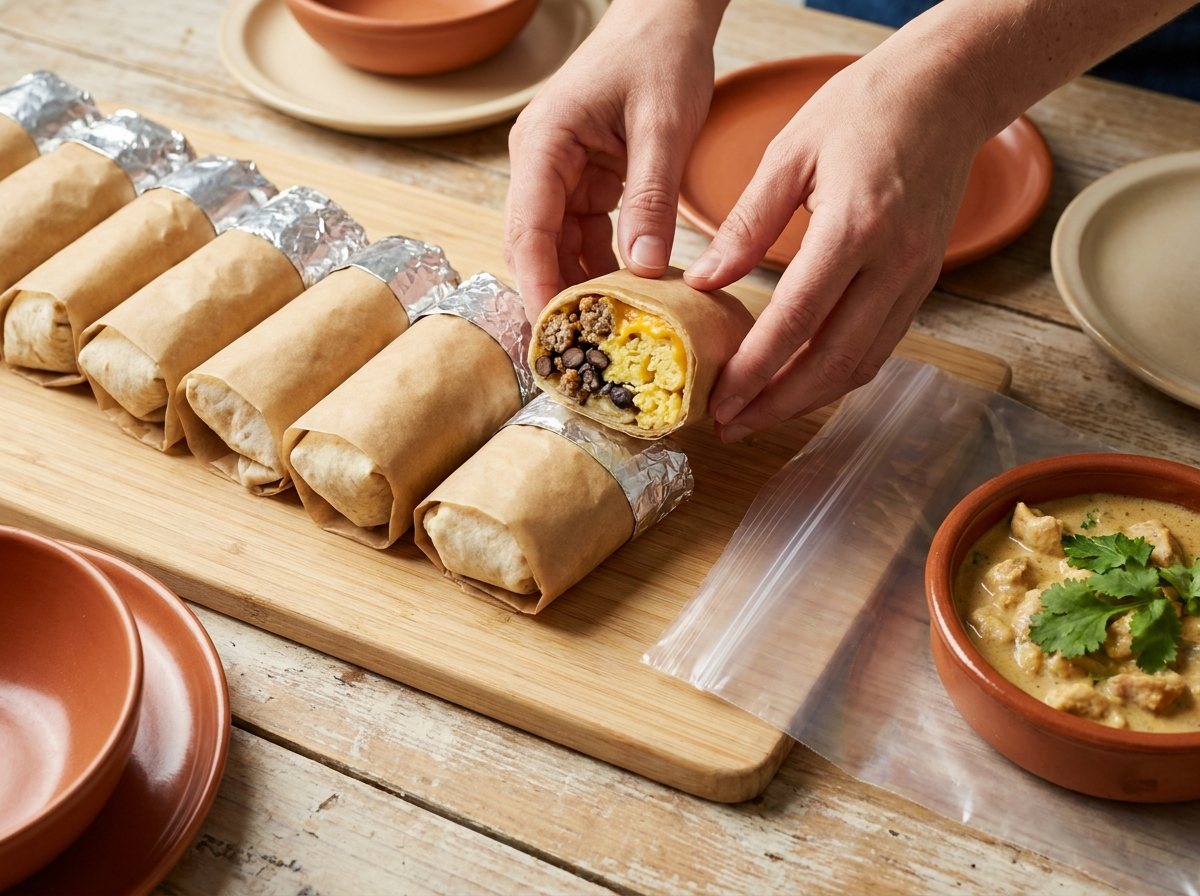
| # | Meal | Freeze Method | Reheat | Notes |
|---|---|---|---|---|
| 19 | Chicken curry with coconut milk base | Freeze base, add fresh cilantro/lime after | Stovetop from frozen, low heat, 20-30 min per quart, stir often, to 165°F | Pairs with Around-the-World Dinner Nights; reheats better than most global dishes |
| 20 | Breakfast burritos (egg, cheese, black beans, sausage or veggie) | Wrap in parchment or plastic wrap, then foil; freeze in a bag | Remove foil and wrap in a paper towel. Microwave on high 2 min, flip, then 1-2 min more (about 3-4 min total for one 8-inch burrito at 1000W). Add 30-second bursts until the center is 165°F, then stand 1 min | Breakfast-for-dinner works on the busiest nights |
Quick builds for the less obvious dishes
Chili and meat sauce you can probably make in your sleep. Here’s how I build the ones that raise more questions. Each makes one family dinner for 4-6.
| Meal | Makes | Quick build |
|---|---|---|
| Shepherd’s pie (#4) | One 9×13 or 6 ramekins | Brown 1.5 lb ground beef or turkey with a diced onion. Stir in 2 cups frozen mixed vegetables and 1 cup gravy. Top with about 4 cups mashed potatoes. |
| Chicken enchilada bake (#5) | One 9×13 | Layer 12 corn tortillas, 3 cups shredded cooked chicken, 2 cups green enchilada sauce and 2 cups shredded cheese, in three layers. |
| Plain meatballs (#12) | About 40 small meatballs | Mix 2 lb ground beef, 2 eggs, 3/4 cup breadcrumbs, 1/2 cup milk and seasoning. Roll and bake at 400°F for 18-20 min, until 160°F inside (165°F if you swap in ground turkey or chicken). Cool, then freeze. |
| Turkey meatloaf mix (#15) | One loaf | Mix 2 lb ground turkey, 1 egg, 3/4 cup breadcrumbs, 1/2 cup milk, a grated onion and seasoning. Shape, wrap tightly and freeze raw. |
| Chicken fajita bag (#17) | One gallon bag | Slice 1.5-2 lb chicken, 3 bell peppers and 1 onion. Add 2 tablespoons fajita seasoning and the juice of a lime. Press the air out and freeze flat. |
| Beef and vegetable stew bag (#18) | One gallon bag | Combine 2 lb stew beef, 4 sliced carrots, 1 diced onion, 2 cups cooled broth and 2 tablespoons tomato paste. Add 1 lb cubed potatoes on cooking day. |
| Chicken curry (#19) | About 2 quarts | Sauté an onion with garlic and ginger. Add 1.5-2 lb cubed chicken thighs, 2-3 tablespoons mild curry powder, one 13.5-oz can coconut milk and 1 cup broth. Simmer 20-25 min, until the chicken reaches 165°F. Cool within 2 hours, then freeze. |
| Breakfast burritos (#20) | 8 burritos | Scramble 8 eggs. Add 8 oz cooked sausage (or sautéed veggies), 1 can drained black beans and 1.5 cups shredded cheese. Cool the filling within 2 hours, then roll in 8-inch tortillas and freeze right away. |
That’s twenty meals spanning six proteins (beef, chicken, turkey, pork, beans, eggs), three cooking methods (oven, stovetop, slow cooker), and enough variety that nobody’s tired of chili by week three. Protein varies by recipe and portion. High-Protein Meals and Snacks for Kids: An Age-by-Age Guide for Growing Bodies has age-specific targets.
Serving kids under 4Round, firm and crunchy foods are choking hazards for little ones. Quarter meatballs and sausage lengthwise or chop them finely, and mash or halve the black beans. Skip the tortilla strips, and serve burritos and casseroles in small bites. Stay with young children while they eat. For babies just starting solids, see first finger foods for babies.
The Labeling System That Actually Keeps You Organized
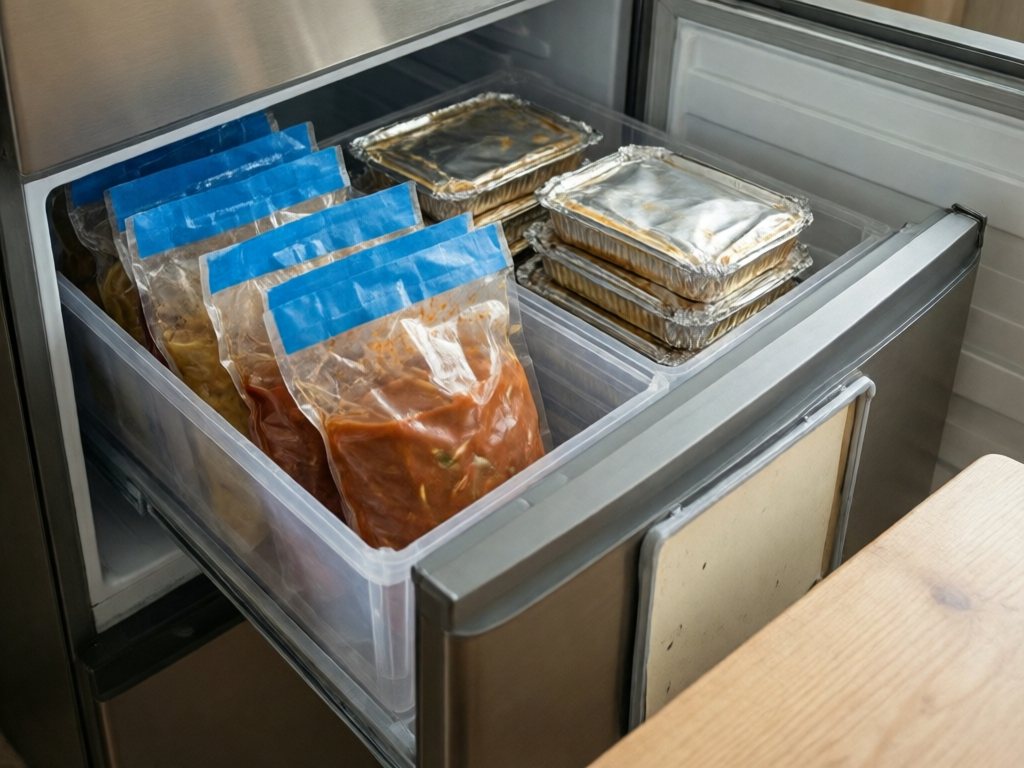
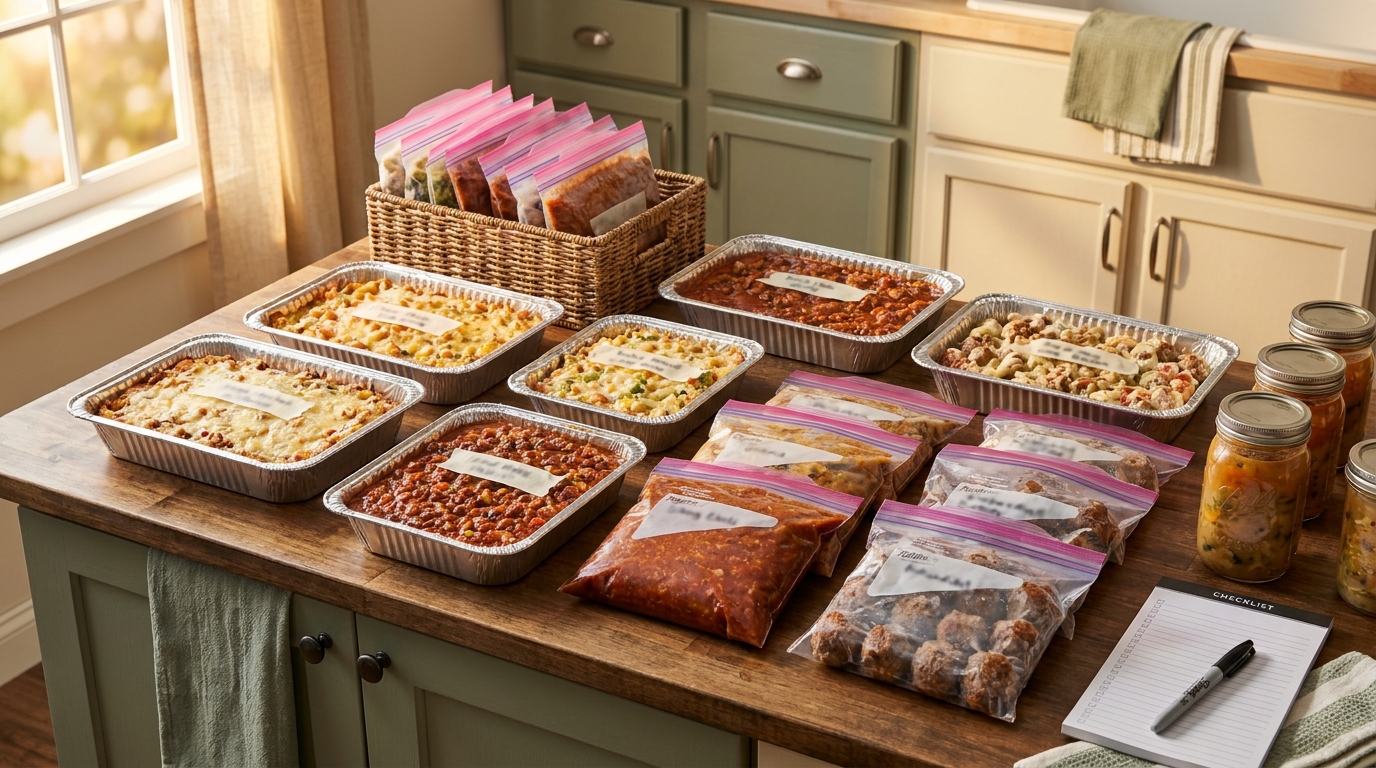
A freezer full of unlabeled foil packets is barely better than an empty one. You’ll spend ten minutes at 5 PM unwrapping mystery dinners. A simple system prevents that.
Every label gets four things:
- Meal name
- Date frozen
- Reheat method
- Thaw first? (yes/no)
The “thaw first” box matters most, because many 5 PM scrambles come from grabbing something that needed a full day in the fridge. A few more habits that have worked for us:
- Painter’s tape + Sharpie, not stickers. Stickers peel off in the cold and stick to everything else. Painter’s tape stays put and comes off clean when you’re washing containers.
- Freeze flat, store upright. Soups, chilis, and sauces frozen flat in gallon bags take up a fraction of the space of a frozen block in a round container, and they thaw faster too. Once frozen solid, stand them up in a bin or basket like files in a drawer — you can see and grab exactly what you want instead of digging.
- Keep a running list on the freezer door. A dry-erase list or even just a sticky note with all twenty meals, crossed off as you use them. This does double duty: it tells you what’s left, and it becomes your shopping list prompt for the next restock.
- Group by reheat method, not by type. Slow-cooker bags in one bin, oven casseroles in another, stovetop soups in a third. The morning before a slow-cooker dinner, pull the bag from the “slow cooker” bin and set it in the fridge to thaw.
Thawing and Reheating Without Ruining Dinner
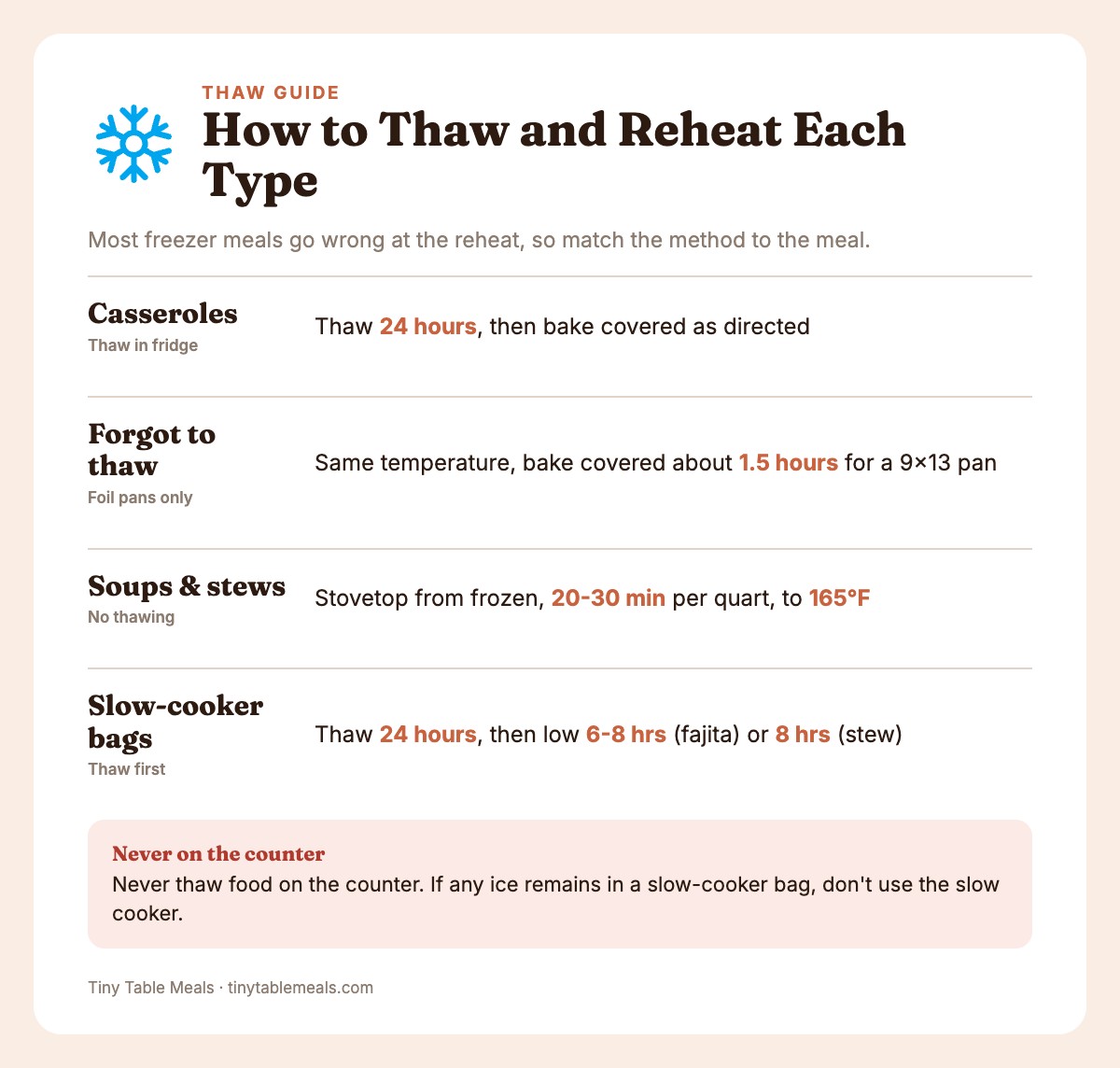
Most freezer meals go wrong at the reheat, not in the recipe. A few rules solve most problems:
Safety firstNever thaw food on the counter. Never start a slow cooker from a frozen or partly frozen block. Never put a frozen glass, ceramic or stoneware dish into a hot oven.
- Move it to the fridge a full day ahead. This is the primary method for casseroles and slow-cooker bags. Both need about 24 hours, not just one night. A casserole thawed for 24 hours bakes evenly and in less time.
- If you forgot to thaw a casserole, add time, not heat. A hotter oven just burns the top before the middle is warm. Keep the temperature as directed and bake covered, about 1.5 hours for a 9×13 foil pan. This shortcut is for foil or metal pans only. A frozen glass, ceramic or stoneware dish has to thaw in the fridge first. Check that the center reaches 165°F.
- Soups and stews go straight from freezer to a stovetop pot — no thawing needed. Start on low, break up the frozen block as it softens, and stir occasionally so the bottom doesn’t scorch. A quart takes about 20-30 minutes on low-medium heat. Heat it to 165°F. Don’t reheat soup or chili in a slow cooker, because it warms too slowly. Once it reaches 165°F on the stove or in the microwave, a slow cooker can keep it hot at 140°F or above.
- Thaw slow-cooker bags for 24 hours in the fridge. Set the bag on a plate on the bottom shelf to catch drips. A gallon bag needs a full day, so move it the morning before you plan to cook it. Feel the bag before it goes in. If any ice remains, don’t use the slow cooker; cook it on the stovetop or in the oven instead, to the same temperatures. Once the bag is fully thawed, cook on low for the time in the table: 6-8 hours for the fajita bag, 8 hours for the beef stew bag. Check that chicken reaches 165°F and that stew beef is fork-tender, which puts it well past its 145°F minimum. A frozen block warms too slowly and lingers between 40°F and 140°F, where bacteria multiply fastest.
- Add anything delicate after reheating, not before. Fresh herbs, a dollop of sour cream, shredded cheese, avocado, tortilla strips — these go on right before serving, not into the freezer. It’s a small step that makes a freezer meal taste like it was made that day.
A Sample Four-Week Rotation
Twenty meals covers about two months at 2-3 a week, or one month if you lean on the freezer most weeknights. Here’s how a first month back at school might look:
| Week | Mon | Tue | Wed | Thu | Fri |
|---|---|---|---|---|---|
| 1 | Fresh dinner | Baked ziti (freezer) | Fresh dinner | Chicken fajita bag (slow cooker) | Fresh/takeout |
| 2 | Fresh dinner | White chicken chili (freezer) | Fresh dinner | Shepherd’s pie (freezer) | Fresh/takeout |
| 3 | Fresh dinner | Beef stew bag (slow cooker) | Fresh dinner | Breakfast burritos (freezer) | Fresh/takeout |
| 4 | Fresh dinner | Chicken curry (freezer) | Fresh dinner | Turkey meatloaf (freezer) | Fresh/takeout |
Notice the pattern: freezer meals land on the two nights most likely to have practice, tutoring, or a late meeting — usually Tuesday and Thursday in our house. Monday and Wednesday stay open for something fresh, and Friday is whatever’s easiest, freezer or not. Adjust the days to match your own chaos points.
Good to knowThis rotation uses 8 of your 20 meals, so about 12 are left for weeks 5-8. Move slow-cooker bags to the fridge 24 hours ahead: Wednesday morning for Thursday’s fajita bag, Monday morning for Tuesday’s beef stew bag. If any ice remains, don’t use the slow cooker.
Getting the Kids Involved in Stocking Day
A big cooking day is loud, a little chaotic, and more fun with help, even help that slows you down. Kids who helped build the stash also tend to be more willing to eat from it later. “I made those meatballs” goes a long way.
Reasonable jobs by age:
- Ages 3-5: Washing produce, tearing herbs, pressing labels onto containers, and tasting fruit or other raw-safe ingredients.
- Ages 6-9: Measuring dry ingredients, mixing meatball mixture with clean hands, peeling garlic and onions (goggles optional but fun), portioning food into containers.
- Ages 10+: Browning meat under supervision, following a recipe step-by-step, assembling a casserole layer by layer, running the labeling system independently.
Safety firstEveryone washes hands with soap after touching raw meat or egg mixtures. Keep young kids away from raw-meat surfaces, and never taste raw meat mixtures.
For knife skills and stovetop tasks by age, see the age-by-age kitchen skills guide before cooking day.
Budgeting the Stash: What It Actually Costs
A full 20-meal stocking day is a real grocery bill up front, usually $150-250 depending on your area and how much meat you buy. Compare that with 20 dinners at even $15 a meal, which is $300, before any take-out runs on exhausted nights.
Buying proteins in bulk for one cooking day brings the per-meal cost down further. Choose a family pack of chicken thighs over four small packages, or a whole pork shoulder over pre-cut stew meat.
If cost is what’s holding you back, read budget meal planning strategies. The same bulk-buying and batch-cooking logic applies to freezer stocking.
What to Do If You Only Have One Afternoon
Not everyone has a full weekend to dedicate to this before school starts, and that’s fine — a scaled-down version still helps enormously. If you’ve only got three or four hours:
- Pick 4-5 recipes, not 20. Chili, meatballs, one casserole, and one slow-cooker bag covers a solid two weeks.
- Choose recipes that share a base ingredient (ground beef works for chili, meatballs, and meat sauce all at once — brown a large batch and split it three ways).
- Skip the labor-intensive casseroles (shepherd’s pie, layered enchiladas) in favor of “dump and freeze” options like marinade bags and slow-cooker bags, which take minutes of active time.
- Buy pre-shredded rotisserie chicken instead of cooking chicken from scratch for anything that calls for cooked, shredded meat.
Frequently Asked Questions
How long do freezer meals actually stay good?
Most cooked freezer meals (casseroles, soups, chili, meatballs) keep their best quality for 2-3 months. Food stays safe indefinitely at a steady 0°F, but texture and flavor decline over time. A freezer thermometer is a cheap way to confirm your freezer holds 0°F. Label everything with the date so you’re rotating through the oldest meals first — first in, first out, just like a small grocery store.
Do I need a chest freezer to make this work, or is a standard freezer compartment enough?
A standard freezer compartment can absolutely hold 15-20 meals if you freeze things flat in bags rather than in bulky containers. Stand the flat-frozen bags upright in a bin like files, and you’ll be surprised how much fits. A chest freezer or standalone unit makes it easier, but it’s not a requirement to get started.
Can I freeze a casserole in a glass dish, or do I need foil pans?
Disposable foil pans are easier because they don’t tie up your everyday bakeware for months. Glass works too: line it with foil, freeze until solid, then pop the foil-wrapped block out and store it separately.
Safety firstNever put a frozen glass, ceramic or stoneware dish into a preheated oven, because thermal shock can crack or shatter it. Thaw it in the fridge first, or use foil pans, unless the manufacturer explicitly says otherwise.
My kids are picky — how do I know they’ll actually eat what I freeze?
Stick to recipes your family already eats and likes fresh — freezer stocking isn’t the time to test five new recipes at once. If you have a picky eater, it helps to understand why certain textures or flavors are a hard no. Figure that out before you commit a whole cooking day to a dish that might come back untouched. Our picky eater meal plan can save you from freezing ten containers of something that ends up in the trash in October.
What’s the single best “starter” meal if I’m new to freezer cooking?
Chili. It freezes and reheats better than almost anything else on this list, and it’s forgiving if your ingredient ratios are a little off. It also works as a full dinner over rice, in a baked potato, or with cornbread. If you make one freezer meal to test the process before committing to a full stocking day, make it chili.
How do I keep the freezer stash from turning into “mystery meat” nobody wants to eat?
Two things: label clearly (meal name, date, reheat instructions) and keep a running list on the freezer door that you update as you use meals. Both take under a minute per container and are the difference between a stash you actually use and a freezer archaeology project six months from now.
Can I do this same stocking approach for lunches, not just dinners?
Some lunch components freeze well — muffins, soups in small portions, and some sandwiches — but most classic lunchbox items (fresh produce, crunchy snacks, dips) don’t freeze successfully. Freezer stocking is really a dinner strategy; for lunches, a weekly prep session works better than a freezer stash. Toddler meal prep lunches covers that shorter-cycle approach if you want to tackle lunches separately.
One Weekend, One Calmer Month
You don’t need all twenty meals. Even eight or ten will change how the first month of school feels in your house. Pick a weekend, pick a handful of these recipes, and let August-you take care of September-you.