5 One-Pan Spring Dinners the Whole Family Will Love (Ready in 30 Minutes)
You'll find 5 quick one-pan spring dinner recipes, each with kid tweaks, safety notes, and storage tips, perfect for your busy weeknights.
- Discover 5 one-pan spring dinners including chicken, salmon, sausage, pasta, and a chickpea bake.
- Utilize kid-friendly tweaks and crucial food safety notes for children under 4.
- Prepare your family meals efficiently, with most recipes ready in 30-40 minutes.
- Access a free printable kit with recipe cards, a shopping list, and a meal planner.
- Learn storage tips and how to manage leftovers for each of your new dinner recipes.
This post contains affiliate links. As an Amazon Associate I earn from qualifying purchases.
It’s 5:32 PM on a Wednesday. I’m standing at the open refrigerator with a toddler attached to my leg, and my seven-year-old wants “the good noodles.”
I have half a bunch of asparagus and a lemon that’s been rolling around the fruit bowl all week. I have no desire to dirty more than one pan.
Here are five one-pan spring dinners my family eats happily: lemon herb chicken, honey garlic salmon, sheet pan sausage, creamy lemon pasta and a chickpea bake. Each has a full recipe, kid tweaks, safety notes and storage tips. They take about 30 to 40 minutes start to finish, and the table below shows which one fits your night.
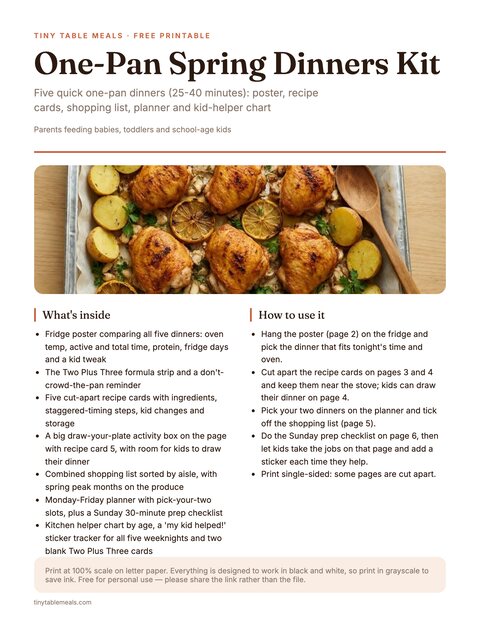
Free printable · 6 pages
One-Pan Spring Dinners Kit
A fridge poster comparing all five one-pan spring dinners, five cut-apart recipe cards with a big draw-your-plate activity, an aisle-sorted shopping list with spring peak months, a Monday-Friday planner, a Sunday prep checklist, and an age-by-age kitchen helper chart with a sticker tracker and two blank Two Plus Three cards.
Free. Your download link appears right here. You'll also join the Sunday Supper Plan. Unsubscribe anytime. Privacy
In this article (11 sections)
- The Five Dinners at a Glance
- Cutting Food Safely for Kids Under 4
- Recipe 1: Lemon Herb Chicken Sheet Pan with Asparagus and Potatoes (40 minutes)
- Recipe 2: Honey Garlic Salmon Sheet Pan with Snap Peas and Rice (about 30 minutes)
- Recipe 3: Sheet Pan Sausage and Spring Vegetables (30-35 minutes)
- Recipe 4: One-Pan Creamy Lemon Pasta with Peas and Spinach (30 minutes)
- Recipe 5: Mediterranean Chickpea Sheet Pan Bake with Artichokes and Feta (30 minutes)
- Why One-Pan Dinners Work for Families
- Tips for Making One-Pan Dinners Work Every Night
- Getting Kids Involved in Spring Dinner Prep
- Frequently Asked Questions
The Five Dinners at a Glance
| Recipe | Protein | Serves | Total time | Method | Kid-friendliness | Leftovers |
|---|---|---|---|---|---|---|
| 1. Lemon herb chicken | Chicken thighs | 6 | 38-40 min | Oven, 425F | High (potatoes help) | 3-4 days |
| 2. Honey garlic salmon | Salmon | 4 | about 30 min (rice alongside) | Oven, 400F | Medium-high (sweet glaze) | 3 days |
| 3. Sheet pan sausage | Chicken or pork sausage | 4 | 30-35 min | Oven, 400F | High (ketchup helps) | 3-4 days, easy to double |
| 4. Creamy lemon pasta | Parmesan (add chicken if you like) | 4 | 28-30 min | Stovetop | High (spinach melts in) | 3 days |
| 5. Chickpea bake | Chickpeas, feta | 4 | 28-30 min | Oven, 425F | Medium (serve it deconstructed) | 3-4 days |
Not every recipe was an instant hit with my kids. The kid tweaks under each one are how I won over the skeptics.
Cutting Food Safely for Kids Under 4
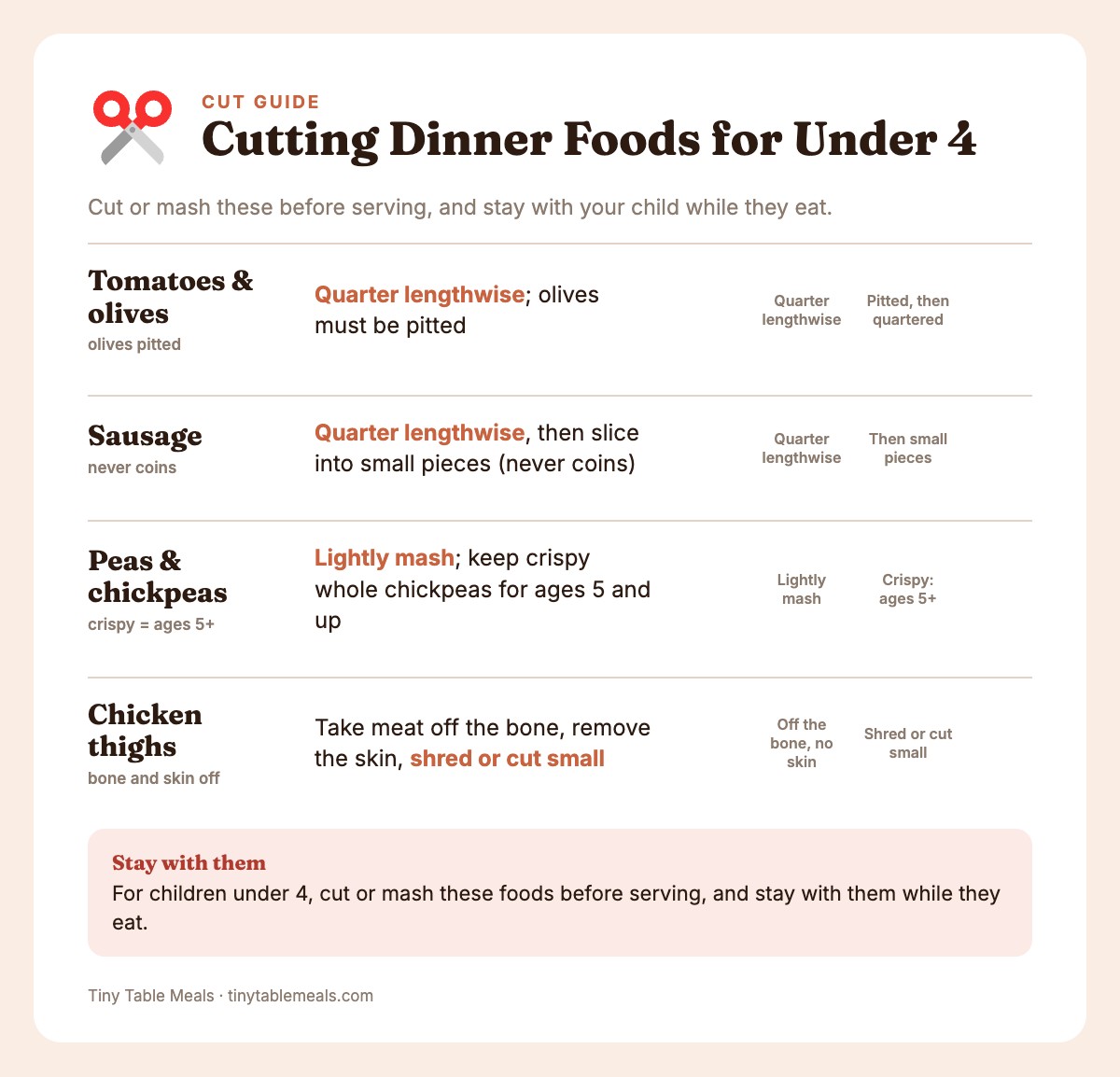
Safety firstFor children under 4, cut or mash these foods before serving, and stay with them while they eat. Check sausage labels for lower-sodium options, and go light on added salt for kids under 2.
| Food | How to serve it under 4 |
|---|---|
| Cherry tomatoes and olives | Quarter lengthwise; olives must be pitted |
| Peas and chickpeas | Lightly mash; keep crispy whole chickpeas for ages 5 and up |
| Edamame and snap peas | Mash the edamame; slice snap peas thin |
| Sausage | Quarter lengthwise, then slice into small pieces (never coins) |
| Chicken thighs | Take the meat off the bone, remove the skin, shred or cut small |
| Salmon | Check for pin bones, then flake into small pieces |
| Potatoes and whole garlic cloves | Cut potatoes small; mash or leave out the garlic cloves |
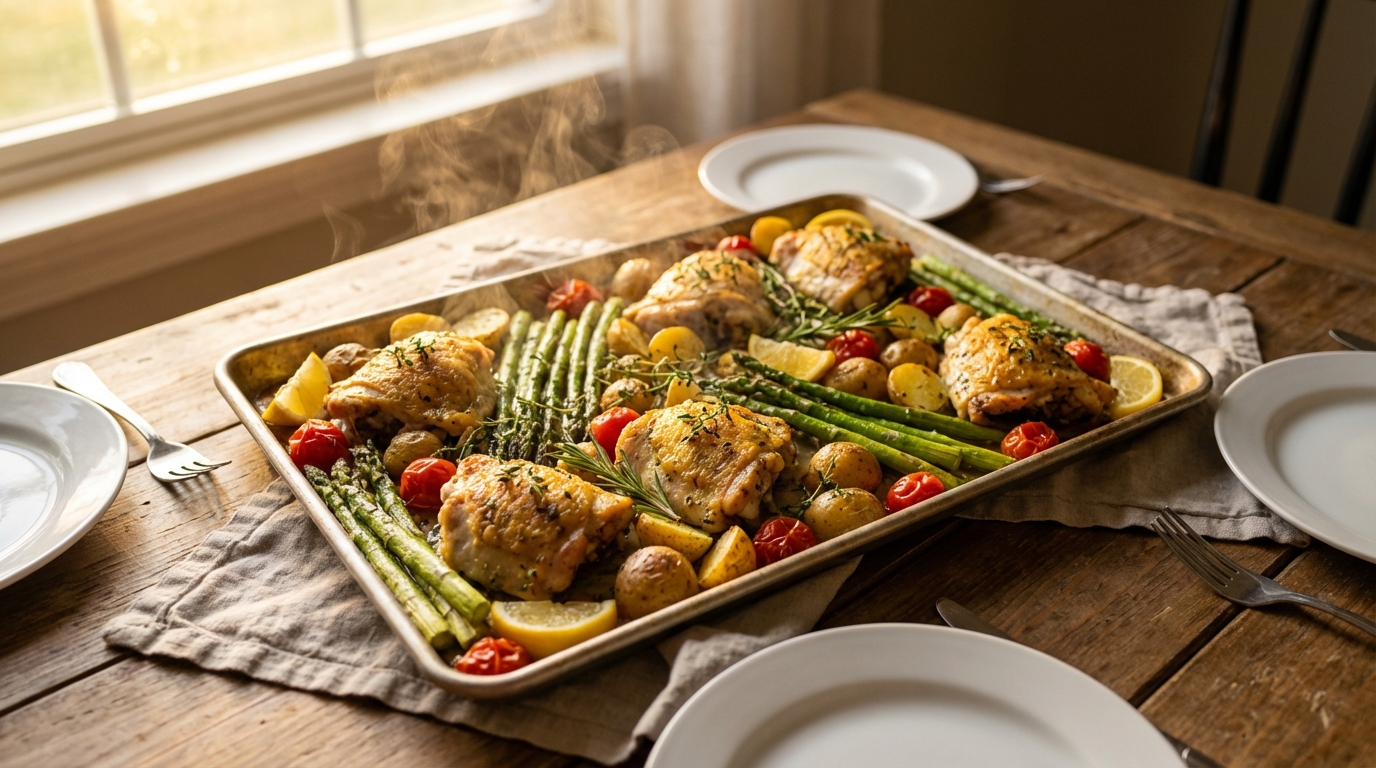
Recipe 1: Lemon Herb Chicken Sheet Pan with Asparagus and Potatoes (40 minutes)
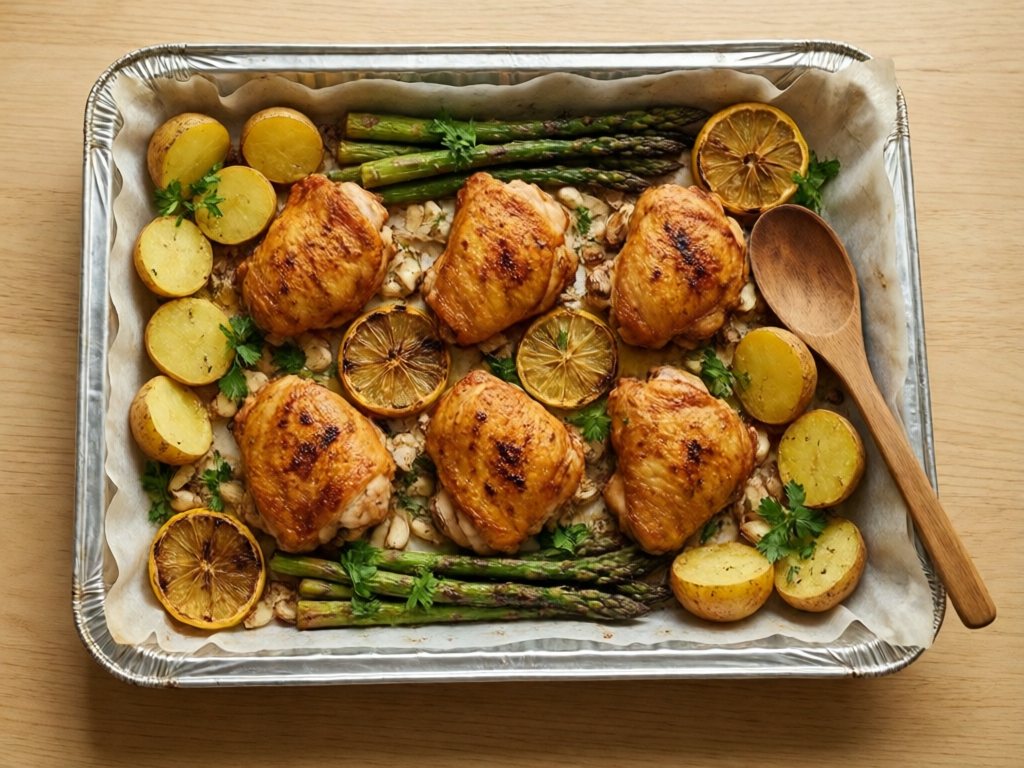
This started as a use-up-the-fridge dinner and became our Tuesday-night staple. The chicken skin crisps while the potatoes turn golden outside and creamy inside.
Ingredients
For the chicken and vegetables:
- 6 bone-in, skin-on chicken thighs (about 2.5 lbs)
- 1.5 lbs baby new potatoes, halved (quartered if large)
- 1 bunch asparagus (about 1 lb), tough ends snapped off, cut into 2-inch pieces
- 4 cloves garlic, smashed
- 1 lemon, half juiced and half sliced into thin rounds
For the seasoning:
- 3 tbsp olive oil, divided
- 1 tsp dried oregano
- 1 tsp dried thyme
- 1/2 tsp garlic powder
- 1/2 tsp onion powder
- 1/2 tsp smoked paprika
- 1 tsp salt
- 1/2 tsp black pepper
- Fresh parsley for serving (optional but pretty)
Instructions
- Preheat your oven to 425F. Line a large sheet pan (18×13 rimmed baking sheet) with parchment paper. The parchment protects the pan from acidic ingredients like lemon.
- Prep the potatoes. Toss halved potatoes with 1 tbsp olive oil, half the salt, and a pinch of pepper. Spread on the sheet pan in a single layer. Roast for 10 minutes while you prep everything else. Potatoes take the longest, so this head start lets everything finish together.
- Season the chicken. Pat chicken thighs very dry with paper towels so the skin crisps. Mix remaining 2 tbsp olive oil with the lemon juice, oregano, thyme, garlic powder, onion powder, smoked paprika, remaining salt, and pepper. Rub all over the chicken thighs.
- Assemble the pan. Remove the pan from the oven. Push the potatoes to the edges. Nestle chicken thighs skin-side up in the center. Scatter smashed garlic and lemon slices around the chicken.
- Roast for 20 minutes at 425F.
- Add the asparagus. Remove the pan and scatter asparagus pieces in any open space. Return it to the oven for 8-10 more minutes. The chicken is done when an instant-read thermometer shows 165F in the thickest part. The potatoes should be golden and the asparagus tips crispy.
- Rest and serve. Let the pan rest for 5 minutes. Squeeze any remaining lemon over the top, sprinkle with fresh parsley, and serve directly from the pan.
Total active time: 12 minutes. Total cook time: 38-40 minutes.
TipCheck the parchment box before roasting at 425F. Some parchment is rated only to 420F.
Kid-Friendly Modifications
- Asparagus resistance: If your kids won’t touch asparagus, cut the spears very short (1-inch pieces) so the tips get extra crispy. Crispy asparagus tips taste more like a chip than a vegetable. Alternatively, swap in green beans or broccoli florets.
- Lemon sensitivity: Some kids find lemon too tart. Use half the lemon juice in the seasoning and skip the lemon slices on their portion. The herbs and garlic carry plenty of flavor without it.
- Bone-in chicken: If your kids prefer boneless, use boneless skinless thighs instead. Reduce the roasting time by 5 minutes. The result is slightly less flavorful but still delicious and easier for small hands.
- Under 4: Take the meat off the bone, remove the skin if needed, and cut it into small shreds or pieces. Check for small bones and cartilage, and cut the potatoes small.
Nutrition Highlights
Good to knowNutrition figures are rough estimates for adult-sized servings. Child portions are smaller.
Each serving (1 chicken thigh + potatoes + asparagus) provides roughly:
- 380 calories
- 32g protein
- 18g fat
- 22g carbohydrates
- Provides vitamin C (lemon + asparagus), potassium (potatoes), and B vitamins (chicken thighs)
Chicken thighs are one of the most affordable high-protein options for families. They’re also more forgiving than breasts, so they stay juicy even if they go a few minutes long.
Storage and Reheating
- Fridge: Store leftovers in an airtight container for 3-4 days, and reheat until steaming hot (165F).
- Reheat: 375F oven for 10-12 minutes to re-crisp the skin. Microwave works but sacrifices the crispy skin and makes the asparagus a bit limp.
- Freezer: Not recommended — the potatoes and asparagus don’t freeze well. The chicken alone freezes beautifully for up to 3 months.
Recipe 2: Honey Garlic Salmon Sheet Pan with Snap Peas and Rice (about 30 minutes)
This is my fish dinner for kids who say they don’t like fish. The honey garlic glaze roasts up sweet and sticky. The snap peas are sweet, crunchy and fun to pop open, so they usually get eaten too.
Safety firstThis recipe contains honey, so it is not for babies under 12 months. For an infant, set aside an unglazed piece of salmon before saucing, or make the glaze with maple syrup. Use only the first portion of sauce on raw fish and never reuse sauce that touched it. Cook the salmon to 145F. This recipe contains fish, soy and sesame, and wheat if your soy sauce has it.
Ingredients
For the salmon:
- 4 salmon fillets (about 6 oz each, skin-on)
- 2 cups sugar snap peas, strings removed
- 1 cup shelled edamame (frozen is fine; thaw and pat dry)
- 2 green onions, thinly sliced
For the honey garlic sauce:
- 3 tbsp honey (use maple syrup if a baby under 12 months is eating)
- 2 tbsp low-sodium soy sauce (or tamari for gluten-free)
- 1 tbsp rice vinegar
- 3 cloves garlic, minced
- 1 tsp fresh ginger, grated (or 1/2 tsp ground)
- 1 tsp sesame oil
- Pinch of red pepper flakes (omit for kids)
For the rice:
- 1 cup jasmine rice (dry)
- Sesame seeds for garnish
Instructions
- Start the rice. Rinse 1 cup jasmine rice until the water runs mostly clear. Cook it your preferred way (rice cooker, stovetop, or Instant Pot). It runs in the background while you handle the pan.
- Make the sauce. Whisk together honey, soy sauce, rice vinegar, garlic, ginger, sesame oil, and red pepper flakes (if using). If a baby under 12 months is eating, use maple syrup instead of honey. Pour half into a separate clean bowl and set it aside for later.
- Preheat your oven to 400F. Line a sheet pan with parchment paper.
- Prep the salmon. Pat fillets dry and run a finger along each one to find and pull out any pin bones. Brush the fillets with the sauce from the first bowl using a clean brush or spoon. Discard whatever is left in that bowl, and set the salmon on a plate.
- Roast the vegetables first. If your edamame is frozen, thaw it and pat it dry so it roasts instead of steaming. Spread the snap peas and edamame on the pan with a splash of oil. Roast for 5-6 minutes.
- Add the salmon. Nestle the glazed fillets skin-side down among the vegetables. Roast for 10-12 minutes, drizzling the reserved sauce over everything for the last 2 minutes. The salmon is done when it flakes easily with a fork or reaches 145F internal, and the snap peas are bright green and just tender.
- Serve over rice. Spoon any pan sauce over the top. Garnish with sliced green onions and sesame seeds.
Total active time: 15 minutes. Total cook time: 15-18 minutes in the oven (plus rice time).
Kid-Friendly Modifications
- “I don’t like fish”: The glaze caramelizes during roasting into a sweet, sticky coating that softens any “fishy” flavor. If your child is truly fish-averse, start with a small portion alongside foods they already love. No pressure, no commentary.
- Texture concerns: Some kids dislike the flaky texture of salmon. Try pressing the cooked salmon gently with a fork to break it into smaller pieces and mixing it into the rice. “Salmon rice bowls” feel completely different from “a piece of fish on a plate.”
- Snap pea strings: Those fibrous strings along the seam of snap peas bother some kids. Remove them before cooking — just snap the tip and pull. It takes two minutes for the whole batch and removes the most common texture complaint.
- Spice level: Omit the red pepper flakes entirely for young kids. The honey and garlic carry all the flavor you need.
- Under 4: Slice the snap peas thin, lightly mash the edamame, and double-check each fillet for pin bones before flaking it.
- Under 12 months: Honey is off the menu, even baked into a glaze. The easiest route is an unglazed piece of salmon set aside before saucing. To make the whole pan baby-safe, swap the honey for maple syrup in the glaze, and use low-sodium soy sauce sparingly or skip it. Fish, soy and sesame are common allergens, so if any are new to your baby, read my guide to introducing allergens first.
Nutrition Highlights
Rough estimate per adult-sized serving (1 salmon fillet + snap peas + edamame + 3/4 cup rice); child portions are smaller:
- 520 calories
- 38g protein
- 16g fat
- 52g carbohydrates
- Provides omega-3 fatty acids (salmon), vitamin C and K (snap peas), and plant protein (edamame)
Salmon is one of the best sources of DHA omega-3s, which play a role in brain development.
The FDA, EPA and Dietary Guidelines suggest about 2 servings a week of low-mercury fish such as salmon. Keep the portions child-sized. Per the FDA’s Advice About Eating Fish chart, that is roughly 1 oz at ages 1-3 and 2 oz at ages 4-7. Soy sauce adds sodium, so choose low-sodium and skip extra salt for kids under 2.
Storage and Reheating
- Fridge: Store salmon and vegetables separate from rice for up to 3 days. Refrigerate cooked rice within 1 hour and reheat until steaming hot.
- Reheat: Gently — 300F oven for 8 minutes, or microwave at 50% power. Salmon dries out quickly when overheated.
- Freezer: Cooked salmon freezes well for up to 2 months. Rice freezes separately for up to 3 months. Snap peas don’t freeze well after cooking.
Recipe 3: Sheet Pan Sausage and Spring Vegetables (30-35 minutes)
This is the one I make when I’m too tired to think. It takes about four decisions: sausage, vegetables, oil, oven. Swap any vegetable, sausage or seasoning and it still works.
Ingredients
For the sheet pan:
- 1.5 lbs Italian sausage links (sweet or mild — I use chicken sausage for a lighter option)
- 1 lb new potatoes, quartered
- 1 bunch asparagus, cut into 2-inch pieces
- 1 large red bell pepper, cut into thick strips
- 1 medium zucchini, sliced into half-moons
- 1 pint cherry tomatoes
- 4-5 spring onions, trimmed and halved lengthwise
- 5 cloves garlic, peeled and left whole
For the seasoning:
- 3 tbsp olive oil
- 1 tsp Italian seasoning
- 1/2 tsp garlic powder
- 1/2 tsp smoked paprika
- 1 tsp salt
- 1/2 tsp black pepper
- Fresh basil for serving
Instructions
- Preheat oven to 400F. Line two sheet pans with parchment paper, or use one very large pan. Crowding leads to steaming instead of roasting.
- Prep and par-roast the potatoes. Toss quartered potatoes with 1 tbsp olive oil and a pinch of salt. Spread on one pan and roast for 10 minutes. (Same head-start trick as Recipe 1.)
- Prep the sausage and vegetables. While potatoes par-roast, slice sausage links into 1-inch rounds (or leave whole and slice after cooking for juicier results). In a large bowl, toss the asparagus, bell pepper, zucchini, cherry tomatoes, spring onions, and garlic with the remaining 2 tbsp olive oil. Add the Italian seasoning, garlic powder, smoked paprika, salt, and pepper, and toss again.
- Assemble. Remove the potatoes from the oven. Add the sausage rounds and seasoned vegetables to the pan(s), spreading everything in a single layer. Don’t crowd — airflow is what creates caramelization.
- Roast for 20-25 minutes, tossing once halfway through, until the sausage reaches 165F on an instant-read thermometer and the vegetables are golden at the edges.
- Finish and serve. Remove from oven, tear fresh basil over the top, and serve directly from the pan. Optional: finish with a drizzle of balsamic glaze.
Total active time: 10 minutes. Total cook time: 30-35 minutes.
Kid-Friendly Modifications
- Sausage choice matters: Mild Italian chicken sausage is the most universally kid-friendly option. Avoid hot sausage or anything with visible fennel seeds, which some kids find surprising. Pre-cooked sausages (like Aidells brand) work too and reduce cook time.
- Vegetable negotiations: If your kids won’t eat “mixed vegetables,” give them a section of the pan with just potatoes and sausage. Add one vegetable of their choice. It’s exposure without pressure. Over time, the other vegetables look more interesting when they see you eating them.
- Cherry tomato caution: Roasted cherry tomatoes burst and release hot juice. Let them cool for several minutes, and for children under 4 also quarter them lengthwise to lower the choking risk.
- Under 4: Quarter the sausage lengthwise, then slice it into small pieces instead of coins. Cut the potatoes small, and mash or skip the whole garlic cloves.
- Dipping sauce: Ketchup. I know. But a small cup of ketchup for dipping sausage and potatoes turns this from “dinner” into “fun dinner” for many kids. Choose your battles.
Nutrition Highlights
Rough estimate per serving (about 1/4 of the pan; this varies a lot with the sausage you pick):
- 420 calories
- 28g protein
- 22g fat
- 30g carbohydrates
- Provides vitamins A and C (bell pepper, tomatoes), potassium (potatoes), and B vitamins (sausage)
Chicken or turkey sausage is often lower in fat than pork, so check the label. Pre-cooked sausages can be high in sodium, so pick a lower-sodium one and go light on added salt for kids under 2.
Storage and Reheating
- Fridge: Store everything together in an airtight container for 3-4 days. This is great as leftovers. Reheat until steaming hot (165F).
- Reheat: 400F oven for 10 minutes. The vegetables re-crisp nicely. Microwave works in a pinch but the textures suffer.
- Freezer: The sausage and potatoes freeze well for up to 3 months. The vegetables get soft but are still good mixed into pasta or grain bowls.
- Meal prep note: This is the easiest recipe in this collection to double. Two sheet pans, same oven, same time — now you have lunch for the week.
Recipe 4: One-Pan Creamy Lemon Pasta with Peas and Spinach (30 minutes)
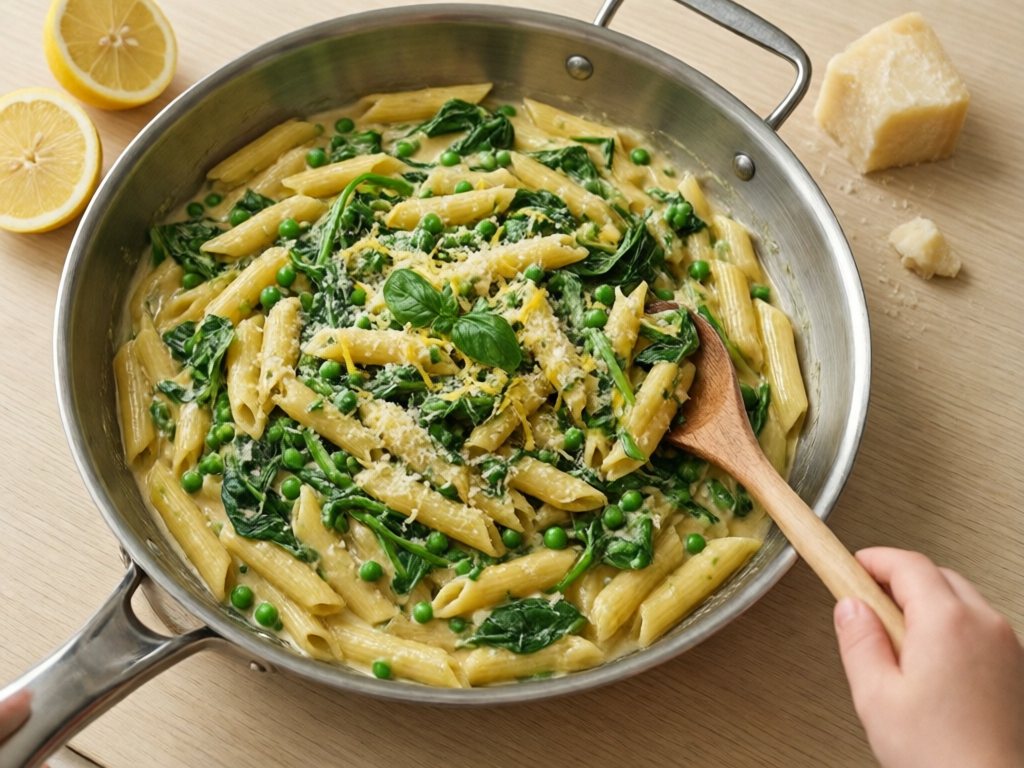
This pasta is on the table faster than delivery. It’s creamy without being heavy and bright with lemon, and the spinach melts into the sauce. I call it my “stealth vegetable” dinner.
This one cooks on the stovetop in a large 5-quart saute pan or Dutch oven rather than the oven. You still get one pan, about 30 minutes, and minimal cleanup.
Ingredients
For the pasta:
- 1 lb short pasta (penne, rotini, or orecchiette)
- 2 tbsp butter
- 3 cloves garlic, minced
- 4 cups chicken or vegetable broth
- 1 cup whole milk (or half-and-half for extra richness)
- 1 cup frozen peas
- 3 big handfuls fresh baby spinach (about 4 cups, loosely packed)
- 1/2 cup freshly grated Parmesan cheese, plus more for serving
- Zest and juice of 1 large lemon
- Salt and pepper to taste
- Fresh basil, torn (optional)
Instructions
- Melt the butter in a 5-quart saute pan or Dutch oven over medium heat. Add garlic and cook for 30 seconds until fragrant. Don’t let it brown.
- Add the broth, milk, and pasta. Yes, raw pasta straight into the liquid. Stir to combine. The pasta will cook directly in the sauce, absorbing all that flavor and releasing starch that makes the sauce creamy without cream.
- Bring to a boil, then reduce to a steady simmer. Cook uncovered for 12-15 minutes, stirring every 2-3 minutes so nothing sticks. The pasta should be al dente, with most of the liquid absorbed. The sauce should coat the pasta, not pool in the pan. If it’s too thick, add a splash of broth. If it’s too thin, cook another minute or two. If the pasta is still firm when the liquid is gone, add hot water 1/4 cup at a time.
- Add the peas and spinach. Stir the frozen peas directly into the hot pasta — they’ll thaw in about a minute. Add spinach by the handful, stirring each addition until it wilts before adding the next. This takes about 2 minutes total.
- Finish with lemon and cheese. Remove from heat. Stir in Parmesan, lemon zest, and lemon juice. Season with salt and pepper. The sauce will thicken as it sits, so serve promptly.
- Serve in bowls with extra Parmesan and torn basil on top.
Total active time: 15 minutes (mostly stirring). Total cook time: 28-30 minutes.
Kid-Friendly Modifications
- Spinach visibility: If your kids pick out green things, chop the spinach very finely before adding it to the pasta. It will melt into the sauce almost completely, turning it slightly green but with no identifiable spinach leaves. My son ate three bowls of this before he noticed it was “green pasta,” and by then he’d already decided he liked it.
- Lemon intensity: Start with half the lemon juice and taste. Some kids love the brightness; others find it too sour. You can always add more to individual adult servings.
- Pea texture: If your kids dislike whole peas, pulse the frozen peas briefly in a food processor before adding them. They’ll blend into the sauce as tiny green specks. For children under 4, lightly mash whole peas either way.
- Protein boost: Add shredded rotisserie chicken, diced cooked ham, or sauteed shrimp at the same time you add the peas. This turns a side-dish-level pasta into a protein-heavy dinner.
Nutrition Highlights
Rough estimate per adult-sized serving (1/4 of the pan, about 2 cups); child portions are smaller:
- about 580 calories
- about 23g protein
- about 13g fat
- about 90g carbohydrates
- Good source of calcium (Parmesan, milk), vitamin A (spinach), vitamin C (peas, lemon), and iron (spinach, pasta)
This is a carb-heavy bowl, so for kids I serve a smaller portion with yogurt, cheese or the chicken add-in. Parmesan and milk add some calcium, a small win for kids who won’t drink a glass of milk.
Storage and Reheating
- Fridge: Store in an airtight container for up to 3 days. The pasta will absorb the sauce as it sits, which is normal.
- Reheat: Add a splash of milk or broth when reheating (stovetop over medium-low or microwave) to restore the creamy consistency. Stir well.
- Freezer: Not ideal. Milk-based pasta sauces can separate when frozen and reheated. If you must, freeze in portions and expect a slightly different texture.
Recipe 5: Mediterranean Chickpea Sheet Pan Bake with Artichokes and Feta (30 minutes)
I didn’t expect my kids to eat chickpeas, artichokes and feta, but this one became a family favorite. The chickpeas crisp up, the feta goes soft and salty, and the artichokes turn golden. My seven-year-old calls it “the crunchy bean dinner” and requests it weekly.
It’s also the most budget-friendly recipe here. Two cans of chickpeas and a jar of artichokes are the main cost, and swapping in frozen spinach (thawed and squeezed dry) cuts it further. If budget-friendly family meals are your priority, this one should be in heavy rotation.
Safety firstCrispy whole chickpeas are a choking risk for young children. Keep them for ages 5 and up, seated and supervised. For children under 5, set aside a few spoonfuls of chickpeas before roasting, warm them on the pan for the last 3-5 minutes, and lightly mash them before serving. For children under 4, also quarter the tomatoes and olives lengthwise.
Ingredients
For the bake:
- 2 cans (15 oz each) chickpeas, drained, rinsed, and patted dry
- 1 jar (14 oz) marinated artichoke hearts, drained and quartered
- 1 pint cherry tomatoes, halved
- 1/2 red onion, sliced into thin half-moons
- 4 cloves garlic, sliced
- 4 cups fresh baby spinach (or 1 cup frozen, thawed and squeezed dry)
- 6 oz feta cheese, cut into large cubes or crumbled
- 1/3 cup pitted Kalamata olives, halved (optional — leave out for kids who aren’t olive fans)
For the seasoning:
- 3 tbsp olive oil
- 1 tsp dried oregano
- 1 tsp ground cumin
- 1/2 tsp smoked paprika
- 1/2 tsp garlic powder
- 1 tsp salt
- 1/2 tsp black pepper
- Squeeze of lemon juice
- Fresh herbs for serving (parsley, dill, or mint)
For serving:
- Warm pita bread, crusty bread, or cooked couscous
- A dollop of plain yogurt or tzatziki
Instructions
- Preheat oven to 425F. Line a large sheet pan with parchment paper rated for that temperature.
- Season the chickpeas. Toss the patted-dry chickpeas with 2 tbsp olive oil, oregano, cumin, smoked paprika, garlic powder, salt, and pepper. Feeding a child under 5? Set a few spoonfuls aside now. Spread the rest on the sheet pan in a single layer.
- Roast chickpeas for 15 minutes. You want them starting to crisp on the outside. Warm chickpeas are boring, and crunchy ones disappear fast.
- Add the vegetables. Remove pan from oven. Add artichoke hearts, cherry tomatoes, red onion, and sliced garlic. Toss with remaining 1 tbsp olive oil. Spread in a single layer (use two pans if needed to avoid crowding).
- Roast for 10 more minutes. The tomatoes should be blistered and the artichokes golden at the edges.
- Add spinach and feta. Scatter fresh spinach over the hot vegetables. It wilts almost immediately. Dot large cubes of feta over the top, and add any chickpeas you set aside for children under 5 to one corner of the pan. Return to the oven for 3-5 minutes, just until the feta softens and starts to get golden spots.
- Finish and serve. Remove from oven, squeeze lemon juice over the top, scatter with fresh herbs and olives (if using). Serve with warm pita, crusty bread, or over couscous, with a dollop of yogurt.
Total active time: 10 minutes. Total cook time: 28-30 minutes.
Kid-Friendly Modifications
- Chickpea skeptics: Get them properly crispy in step 3. Crispy roasted chickpeas are closer to croutons than to the mushy canned beans kids might be imagining. Crispy ones are for ages 5 and up, seated and supervised. Children under 5 get the soft portion you set aside, lightly mashed.
- Feta too strong: Feta can be intense for young palates. Substitute small cubes of mozzarella, which melt into mild, stretchy pockets that kids love. Or use a milder feta (French feta is creamier and less salty than Greek).
- Artichoke resistance: Some kids are wary of artichokes because they look unfamiliar. Cut them small so they blend in with the other vegetables rather than being a distinct, identifiable thing. Marinated artichoke hearts are much milder than fresh artichokes and have a texture similar to roasted zucchini.
- Olive aversion: Just leave them out. Olives are divisive even among adults. The dish doesn’t need them.
- Cherry tomatoes: For children under 4, quarter the tomatoes lengthwise.
- Serving style: Serve it deconstructed for kids: a pile of chickpeas, a few tomatoes, torn warm pita and a little bowl of feta cubes. Use crispy chickpeas for ages 5 and up and soft, mashed ones for children under 5. Let them build their own bites.
Nutrition Highlights
Rough estimate per adult-sized serving (about 1/4 of the pan, without bread); child portions are smaller:
- about 500 calories
- 18g protein
- 25g fat
- 40g carbohydrates
- A good source of fiber (chickpeas, roughly 9g per serving), vitamin K (spinach), vitamin C (tomatoes), calcium (feta), and iron (chickpeas, spinach)
This is one of the most filling recipes in the collection. Chickpeas are high in protein and fiber, and they’re one of the cheapest protein sources around. If you want more plant-based meals in your rotation, start here.
Storage and Reheating
- Fridge: Store in an airtight container for 3-4 days. The chickpeas lose some crispiness but the flavor holds up. Reheat until steaming hot.
- Reheat: 400F oven for 10 minutes to restore some crispiness. Alternatively, reheat in a skillet over medium heat — this actually re-crisps the chickpeas better than the oven.
- Freezer: Freezes well for up to 3 months (minus the feta — add fresh feta after reheating).
- Repurpose: Leftover chickpea bake is incredible stuffed into pita with fresh greens and tzatziki for lunch the next day.
Why One-Pan Dinners Work for Families
Cleanup is the big one. A typical weeknight dinner at my house used to leave me a pot, a pan and a colander. A parchment-lined sheet pan leaves almost nothing.
Roasting everything together also builds flavor, because the chicken fat bastes the potatoes and the asparagus caramelizes. Most of these recipes double easily on two pans, so tonight’s dinner becomes lunch for two days.
Spring Produce Used in These Recipes
Spring vegetables need little more than olive oil, salt and high heat. For more on what’s at peak season in spring and how to use it, see my full spring produce guide for families.
| Produce | Peak season | Where it shows up | Kid tip |
|---|---|---|---|
| Asparagus | April-June | Recipes 1 and 3 | Crispy tips are the gateway |
| New potatoes | April-July | Recipes 1 and 3 | Almost always a hit |
| Snap peas | April-June | Recipe 2 | Remove the strings first |
| Peas | April-June | Recipe 4 | Frozen peas work fine |
| Spinach | March-June | Recipes 4 and 5 | Melts into the sauce |
| Spring onions | March-June | Recipe 3 | Milder than regular onions |
| Artichokes | March-May | Recipe 5 | Start with marinated hearts |
Tips for Making One-Pan Dinners Work Every Night
After years of one-pan cooking, these are the habits that take a pan dinner from fine to great.
Master the Sheet Pan Basics
- Don’t crowd the pan. This is the single most important rule. Vegetables that are touching each other steam rather than roast. Use two pans if you need to. The extra pan is still less cleanup than a multi-pot dinner.
- Use parchment paper. It prevents sticking, makes cleanup easy, and protects the pan from acidic ingredients like lemon. Check the box rating, since some parchment tops out around 420F.
- Pat proteins dry. Whether it’s chicken, salmon, or tofu — dry surfaces brown. Wet surfaces steam. That crispy golden exterior comes from removing moisture before cooking.
- Stagger additions by cook time. Dense vegetables (potatoes, carrots, beets) go in first. Quick-cooking items (asparagus tips, spinach, cherry tomatoes) go in last. This way everything finishes at the same time.
- Hot oven, lower rack. 400-425F is the sweet spot for one-pan dinners. Position your rack in the lower third of the oven for maximum bottom heat, which is where caramelization happens.
The Improvised One-Pan Formula
If you need to improvise a one-pan dinner without a recipe, use this formula:
- One protein (chicken thighs, sausage, salmon, chickpeas, tofu)
- One starchy vegetable (potatoes, sweet potatoes, winter squash)
- Two non-starchy vegetables (whatever’s in season or in your fridge)
- One flavor base (lemon-herb, honey-garlic, Italian, Mediterranean, Asian-inspired)
- One finishing touch (fresh herbs, cheese, a drizzle of sauce, a squeeze of citrus)
Choose one from each category, toss with olive oil and salt on a sheet pan, and roast at 425F. That gets you a balanced dinner most nights.
Prep on Weekends, Coast on Weeknights
If you spend 30 minutes on a Sunday doing the following, your weeknight one-pan dinners take about 5 minutes to assemble:
- Wash and chop vegetables, store in containers in the fridge
- Make 2-3 sauce/seasoning blends, store in small jars
- Marinate chicken in a zip bag for 1-2 days at most, and fish for no more than 30 minutes before cooking. Discard any used marinade
- Pre-cook grains (rice, couscous, quinoa) to serve alongside sheet pan meals
This is where one-pan cooking meets meal prep strategy. You’re not prepping full meals, just the ingredients that make weeknight cooking quick.
Getting Kids Involved in Spring Dinner Prep
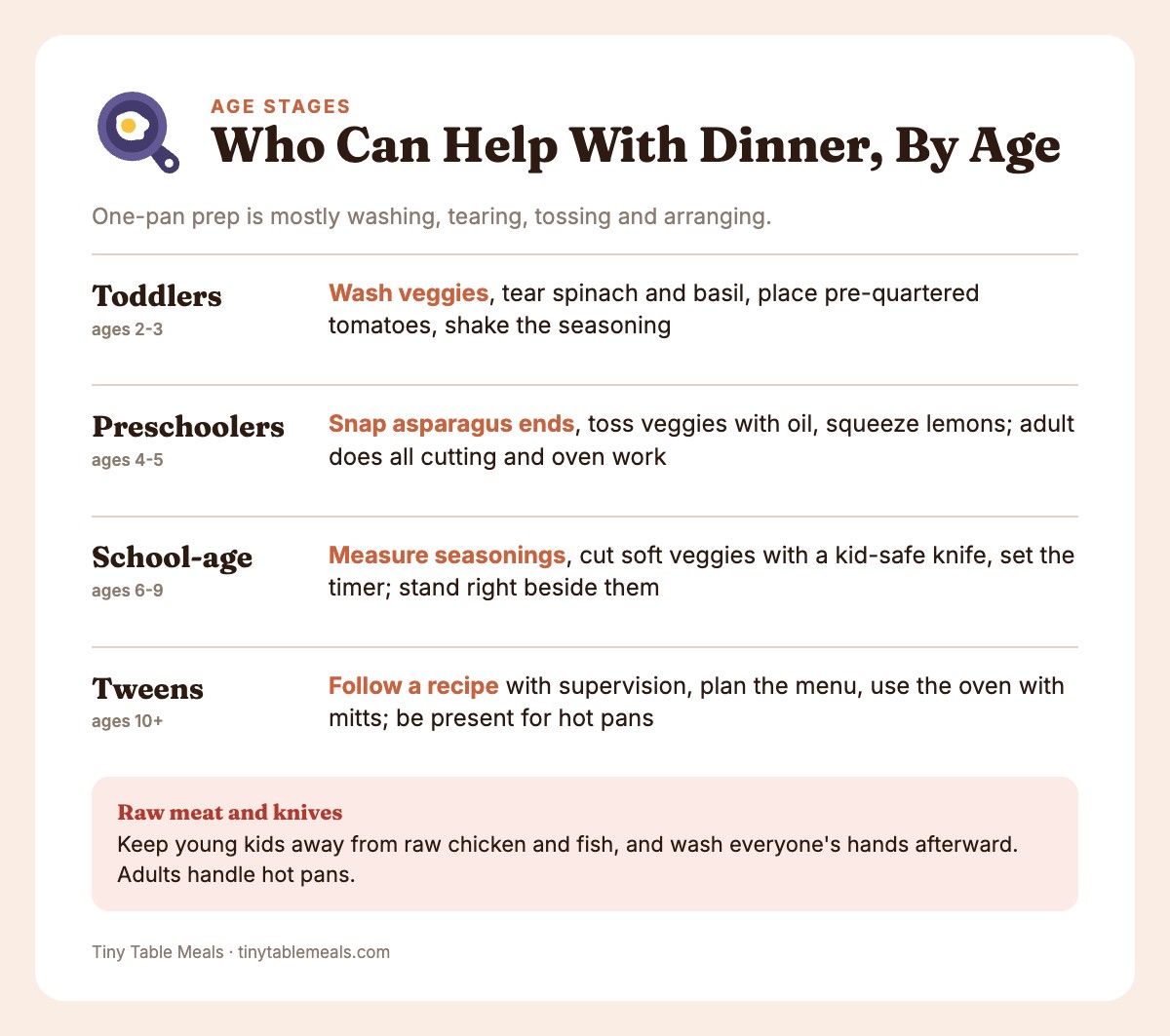
One-pan dinners are easy for kids to help with. Most of the prep is washing, tearing, tossing and arranging, which even toddlers can manage.
Safety firstKeep young kids away from raw chicken and fish, and wash everyone’s hands afterward. Stay right beside children for any knife work, and adults handle hot pans. Quarter cherry tomatoes before toddlers handle them, since whole ones are a choking hazard under 4.
Age-Appropriate Tasks
| Age group | Tasks | Adult needs to do |
|---|---|---|
| Toddlers (2-3) | Wash vegetables in a bowl of water, tear spinach and basil, place pre-quartered cherry tomatoes on the pan one at a time, shake the seasoning container | Quarter the cherry tomatoes first, stay close, handle anything raw or hot |
| Preschoolers (4-5) | Snap asparagus ends, toss vegetables with oil (expect mess), arrange items on the pan, squeeze lemons with a handheld juicer, sprinkle cheese | Do all cutting and oven work |
| School-age (6-9) | Measure seasonings, cut soft vegetables with a kid-safe knife, make sauces, set the timer, plate and garnish | Stand right beside them for knife work |
| Tweens (10+) | Follow a recipe with supervision, adjust recipes to taste, plan the week’s one-pan menu, use the oven with oven mitts | Be present for hot pans and removing items |
For more kitchen skills by age, see my guide to teaching kids to cook.
Why It Matters
Kids who help cook are often more willing to try the food. In my kitchen, the reason seems to be ownership: they made it, so they want to taste it.
My daughter used to refuse asparagus. The first time she snapped the ends herself, she tried a bite. Now she eats it. I’m not saying it’s magic, but I’m also not saying it’s not magic.
Cooking together also teaches kids where food comes from and how flavors work together. A one-pan dinner is an easy place to start.
If the kitchen feels overwhelming enough without small helpers, I get it. I wrote about one-handed meals for new parents for the season when you cook with a baby in one arm.
One-pan dinners work for that too. Do the prep with the baby settled nearby, slide the pan into the oven, and use the cook time for feeding, playing or just sitting down.
Frequently Asked Questions
Can I use frozen vegetables instead of fresh for one-pan dinners?
Yes, but they release moisture and can steam instead of roast. Add them in the last 10-12 minutes, and thaw and squeeze frozen spinach very dry first. Peas, corn and green beans work best.
What if my oven runs hot or cold? How do I adjust?
An inexpensive oven thermometer is one of the most useful kitchen tools. If your oven runs hot, lower the temperature by 15-25 degrees and check 5 minutes early. If it runs cold, raise it by the same amount and add 5-10 minutes. Always confirm doneness with an instant-read thermometer: 165F for poultry and sausage, 145F for salmon.
How do I prevent different items from cooking at different rates on one pan?
Cut dense vegetables (potatoes, carrots) smaller than quick-cooking ones (zucchini, cherry tomatoes). Then stagger the additions: slow-cooking items go in first and fast-cooking items partway through. Every recipe here does this.
Are one-pan dinners nutritionally complete for kids?
Each recipe has protein, a starch or grain, and vegetables. The protein figures for Recipes 1-3 (about 28-38g) are for adult-sized servings, and child portions are smaller. The pasta (about 23g) and chickpea bake (about 18g) are lower, so pair child portions with yogurt, cheese or another protein.
Can I meal prep these recipes for the whole week?
Yes. Recipes 1, 3 and 5 reheat especially well for 3-4 days. I cook one on Sunday and another on Wednesday, and the leftovers cover lunches all week.
What’s the best sheet pan to use?
A heavy-duty, rimmed half-sheet pan (18×13 inches) is the standard. Light-colored aluminum conducts heat evenly. Dark or nonstick pans can burn the bottoms before the tops are done. I own four and use them more than any other pan in my kitchen.
My partner and I like spicier food than our kids. How do we handle that with one-pan cooking?
Season the whole pan kid-friendly, then make one corner the “adult zone” with chili flakes or sliced jalapenos before roasting. At the table, adults can add sriracha or chili crisp while kids get ranch or yogurt. (Hot honey is fine for adults, but not for babies under 12 months.)