Spring Produce Guide for Families: What’s Fresh Right Now and How to Use It
Discover what spring produce is in season from March to June, how to safely prepare and cut it for babies and toddlers, and get tips for picky eaters. You'll learn age-specific cutting guidelines for various fruits and vegetables.
- Identify fresh spring produce available from March to June in your region.
- Safely prepare produce for kids under 4 by cutting round foods lengthwise.
- Follow age-specific cutting guides for babies, toddlers, and older children.
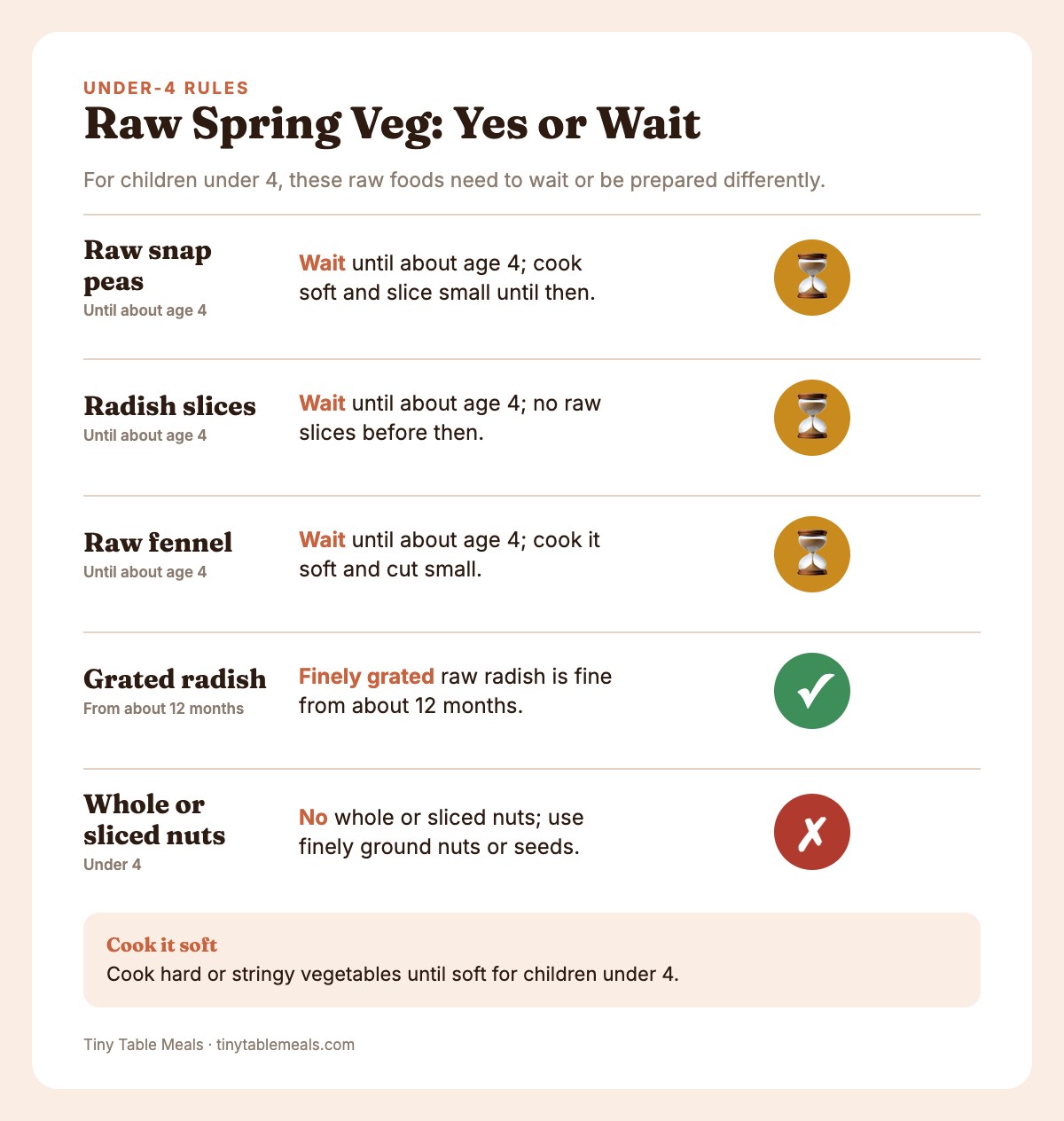
- Avoid raw snap peas, radish slices, or raw fennel for children under 4.
This post contains affiliate links. As an Amazon Associate I earn from qualifying purchases.
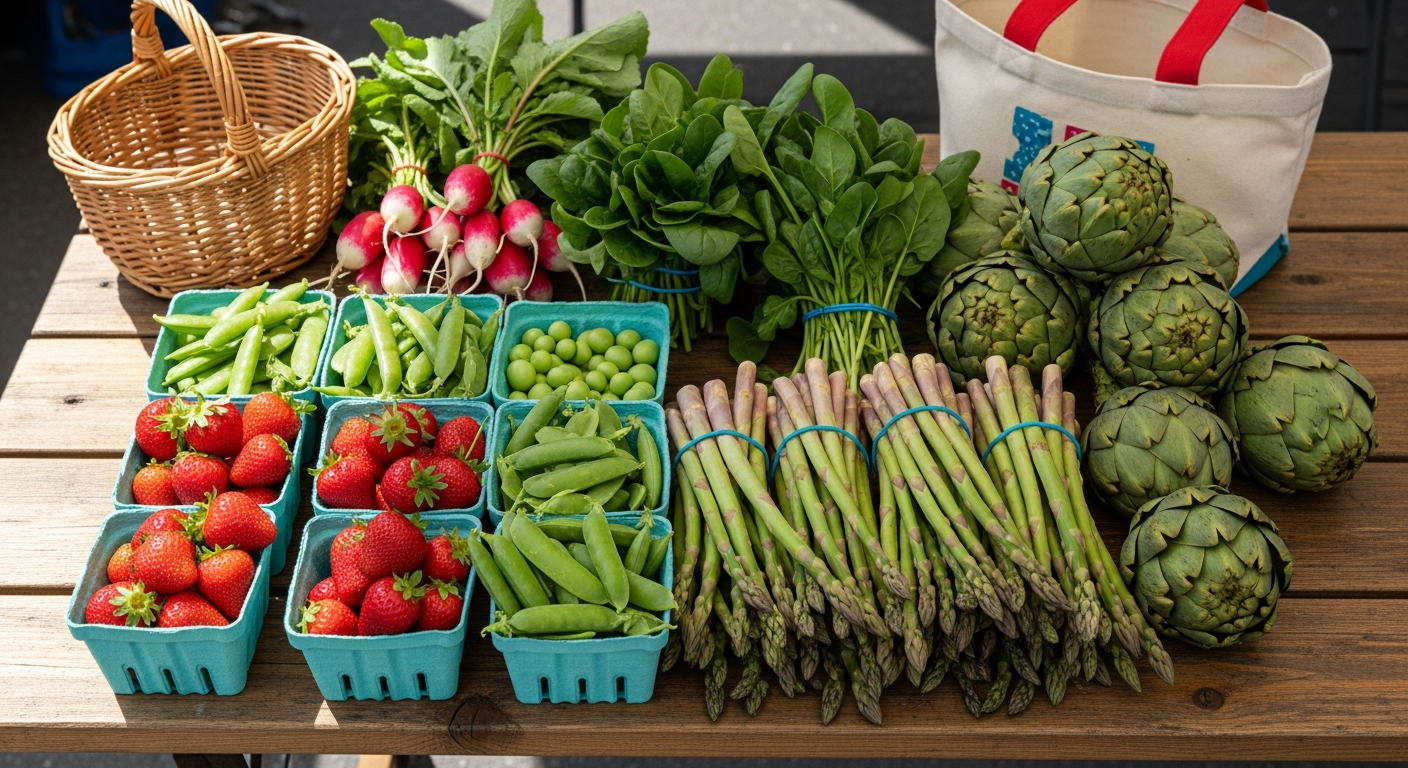
Spring is when the produce aisle gets colorful, and it’s a good time to get picky eaters curious. Here’s what’s in season from March to June, how to cut it safely for babies and toddlers, five easy family recipes, farmers market tips and how to store it all.
Short on time? Scroll down to Kid-Friendly Spring Recipes, where a quick table helps you pick a recipe.
In this article (10 sections)
- What Fruits and Vegetables Are in Season in Spring (March to June)
- How to Cut Spring Produce Safely by Age
- Kid-Friendly Spring Recipes
- How to Get Kids to Try Spring Produce
- What Spring Produce Gives Growing Kids
- Farmers Market With Kids: Tips and Pack List
- Spring Meal Planning: A Seasonal Approach
- How to Store Spring Produce
- Frequently Asked Questions
- Bottom Line: Spring Produce for Families
What Fruits and Vegetables Are in Season in Spring (March to June)
Seasons shift by region. This chart reflects broad U.S. availability: Southern states see these items earlier, Northern states a few weeks later.
| Produce | Peak months | What to look for |
|---|---|---|
| Asparagus | March–May | Firm, bright green stalks; tightly closed tips. |
| Artichokes | March–May | Heavy for their size; tightly packed, dark green leaves. |
| Spinach (baby and full) | March–May | Crisp, deep green; no yellowing or sliminess. |
| Green onions/scallions | March–June | White and light green; no wilting. |
| Peas (snap, snow, shelling) | April–July | Bright green, firm pods; no yellowing. |
| Arugula | April–June | Firm leaves; peppery aroma. |
| Radishes | April–June | Smooth, firm; bright color; fresh tops if attached. |
| Chives | April–June | Bright green; no browning tips. |
| Strawberries | April–June | Deep red all the way through; fragrant; no white shoulders. |
| Rhubarb | April–June | Firm, crisp stalks; bright red through pink. Never eat the leaves. |
| Fava beans | April–June | Plump, bright green pods; heavy feel. |
| Fennel | April–June | White or light green bulb; firm; fresh fronds. |
| Beets | April–July | Smooth, firm; greens still attached and fresh. |
Late spring also brings the first sweet cherries, blueberries, zucchini, new potatoes and fresh herbs like basil, mint and dill, though they peak in summer. Lettuce and Swiss chard start in April and run well into fall.
Carrots, cucumbers, broccoli and cauliflower are available year-round, and often look and taste better in spring depending on your region.
How to Cut Spring Produce Safely by Age
Safety firstFor children under 4, follow these rules with every item in the table below:
- Cut round foods like grapes, cherry tomatoes and strawberries lengthwise, and pit cherries.
- Cook hard or stringy vegetables until soft.
- No raw snap peas, radish slices or raw fennel until about age 4. Finely grated raw radish is fine from about 12 months.
- Peel cucumber. Under 12 months, cook it lightly or grate it finely. From 12 months, thin peeled sticks are a judgment call for confident chewers, always with an adult watching.
- Flatten peas, and smash, halve or quarter blueberries.
- No whole or sliced nuts; use finely ground nuts or seeds instead.
- Little ones sit down and eat with an adult watching.
- No honey for babies under 12 months.
| Produce | Under 12 months | 1-3 years | 4+ |
|---|---|---|---|
| Asparagus | Steamed until very soft; tips or a thick spear to hold. | Cooked very tender; tips or short pieces. | Cooked or raw, in bite-size pieces. |
| Snap peas | Cooked soft, cut small. | Cooked soft, sliced small. | Raw or cooked, sliced (raw from about age 4). |
| Fresh peas | Smashed flat. | Smashed or flattened; never whole. | Whole. |
| Radishes | Cooked soft and mashed only. | Finely grated raw (from about 12 months) or cooked soft; no raw slices. | Thin slices. |
| Cucumber | Peeled and lightly cooked, or finely grated. | Peeled thin sticks for confident chewers, with an adult watching; otherwise grated. | Slices or sticks. |
| Strawberries | Mashed or a large, soft wedge. | Quartered lengthwise. | Sliced or whole. |
| Blueberries | Smashed flat. | Halved, quartered or smashed. | Whole. |
| Cherries | Pitted, cooked and mashed. | Pitted and quartered. | Pitted; halve for younger kids. |
| Cherry tomatoes | Quartered lengthwise and soft. | Quartered lengthwise. | Halved. |
| Raw spinach and arugula | Cooked into food. | Finely chopped or cooked. | Raw leaves. |
| Artichokes | Cooked heart, very soft, mashed or in thin strips. | Cooked heart, cut small; no leaves. | Cooked heart in pieces; leaves scraped with teeth while seated with an adult. |
| Fennel | Cooked very soft, in thin strips or mashed. | Cooked soft and cut small; no raw slices. | Raw and shaved thin, or cooked. |
| Rhubarb | Cooked stalks only, never the leaves. | Cooked stalks only. | Cooked stalks only. |
Safety firstRhubarb leaves are toxic. Trim and throw them away out of children’s reach, since stalks are often sold with leaves attached.
For more on first foods, see our 100 first foods checklist and the baby-led weaning grocery list.
Kid-Friendly Spring Recipes
These five recipes use short ingredient lists and simple techniques, and they work for picky eaters too. Use the table to pick one, then scroll to it. Each recipe notes how to serve it to little ones.
| Recipe | Total time | Key spring produce | Protein | Why kids like it |
|---|---|---|---|---|
| Strawberry Spinach Salad | 10 min | Strawberries, spinach | Feta, seeds | Sweet, crunchy and colorful. |
| Snap Pea Grain Bowl | 35-40 min with pre-cooked grain | Snap peas, radishes, peas | Chicken | Everyone builds their own. |
| Asparagus Egg Frittata | 30 min | Asparagus, peas | Eggs, cheese | Familiar egg and cheese. |
| Spring Vegetable Pasta | 25 min | Asparagus, peas, snap peas | Parmesan | It’s pasta. |
| Strawberry Beet Smoothie Bowl | 10 min | Strawberries, beets | Greek yogurt | Looks like dessert. |
Recipe 1: Strawberry Spinach Salad with Honey Lemon Dressing
This is the salad I make for kids who say they don’t like salad. The strawberries make it sweet, the croutons add crunch, and the dressing takes a minute to whisk.
Safety firstUnder 4s: quarter the strawberries lengthwise and finely chop the spinach. Leave out the raw onion, and crush the croutons into fine crumbs or skip them. Swap the sliced almonds for finely ground almonds or seeds. For babies under 12 months, skip the honey dressing and serve mashed strawberries or a large soft wedge on their own.
Ingredients:
- 4 cups baby spinach, washed and dried.
- 1 cup fresh strawberries, hulled and sliced.
- 1/3 cup crumbled feta cheese.
- 1/4 cup toasted sliced almonds, or sunflower seeds for nut-free. For under 4s, use finely ground almonds or seeds instead.
- 1 cup whole-grain croutons.
- Optional: 2-3 tablespoons red onion, very thinly sliced (skip for under 4s).
Honey Lemon Dressing:
- 3 tablespoons olive oil.
- 1.5 tablespoons fresh lemon juice.
- 1 teaspoon honey (skip for babies under 12 months).
- 1/4 teaspoon Dijon mustard.
- Pinch of salt and black pepper.
Instructions:
- Whisk all dressing ingredients together in a small bowl until emulsified. Taste and adjust — more honey if too tart, more lemon if too flat.
- In a large bowl, combine spinach, strawberries, and feta.
- Drizzle with dressing and toss gently — just enough to coat, not to wilt the spinach.
- Add croutons, seeds/almonds, and red onion if using. Serve immediately.
Picky eater strategy: For kids who reject mixed salads, serve spinach, strawberries, feta and croutons in their own small piles. Put the dressing in a little cup so they can dip.
Recipe 2: Snap Pea and Chicken Spring Grain Bowl
You cook one set of components and everyone builds their own bowl. Nobody gets a separate dinner, and the kid who hates radishes can simply skip them.
Safety firstUnder 4s: shred the chicken finely. Cook, cut or flatten each vegetable as noted in the ingredients below. For babies under 12 months, leave the honey out of the dressing.
Base layer (choose one):
- 2 cups cooked farro, brown rice or quinoa. Leftover or pre-cooked grain keeps the total at 35-40 minutes; cooking it from scratch adds 25-40 minutes.
- Or mixed greens for a lighter version (finely chopped for under 4s).
Protein:
- 1.5 pounds boneless, skinless chicken thighs, seasoned with salt, pepper and garlic powder. Bake at 400°F for 20-22 minutes, until it reaches 165°F inside, then slice or shred.
Spring produce layer:
- 2 cups sugar snap peas, washed, ends snapped off (a kid job). For under 4s, steam until soft and slice small.
- 1 cup thinly sliced radishes. For ages 1-3, finely grate them; for babies, cook them soft and mash.
- 1 large cucumber, halved and sliced. For babies, peel and grate it or cook it lightly; for ages 1-3, cut thin peeled sticks for confident chewers.
- 1/2 cup fresh or thawed frozen peas. Flatten them for under 4s.
- Optional: a handful of baby arugula or spinach per bowl, finely chopped for under 4s.
Simple sesame dressing:
- 3 tablespoons rice vinegar.
- 2 tablespoons low-sodium soy sauce or tamari. Low-sodium is best for little ones; use tamari labeled gluten-free for a wheat-free bowl.
- 1 tablespoon sesame oil.
- 1 tablespoon honey (omit for babies under 12 months).
- 1 teaspoon fresh ginger, grated (or 1/4 teaspoon ground ginger).
- Whisk to combine.
Assembly:
- Set out the parts. Put the grain, chicken and each vegetable in its own bowl, cooked and cut for each child’s age as noted above.
- Build the bowls. Everyone fills their own.
- Finish. Drizzle with dressing and sprinkle with sesame seeds if you like.
Picky eater strategy: Ask everyone to pick at least three bowls. A child who chooses rice, chicken and snap peas with dressing still has a complete meal, and the radishes stay on the table where they can see them.
Recipe 3: Asparagus and Egg Frittata
I make this when asparagus is cheap: one pan, eggs and cheese I usually have on hand, and leftovers for lunch. Baked into egg and cheese, the vegetables look less new to a cautious eater.
Safety firstFor babies and toddlers, cut the frittata into finger-length strips. For under 4s, flatten the peas with a fork before they go in. The asparagus should be soft enough to squash between your fingers.
Ingredients:
- 8 large eggs.
- 1/4 cup milk.
- 1/2 cup shredded gruyere, mozzarella or cheddar.
- 1 bunch asparagus (about 1 pound), woody ends snapped off, cut into 1-inch pieces.
- 1/2 cup frozen peas, thawed.
- 2 green onions, thinly sliced.
- 2 tablespoons olive oil.
- Salt and pepper.
- Optional: fresh dill or chives, chopped, for serving.
Instructions:
- Preheat oven to 375°F.
- In a 10-inch oven-safe skillet (cast iron is perfect), heat olive oil over medium heat. Add asparagus pieces and a pinch of salt. Cook, stirring occasionally, for 3-4 minutes until bright green and slightly tender.
- Add peas and green onions, stir to combine, cook 1 more minute.
- Whisk eggs with milk, 1/4 teaspoon salt, and a few grinds of pepper. Pour over the vegetables in the skillet.
- Sprinkle cheese over the top.
- Transfer to the oven and bake for 14-16 minutes, until the center is fully set and reaches 160°F. The top should be lightly golden. Don’t serve it underdone.
- Let cool 5 minutes before slicing. Serve warm or at room temperature.
Picky eater strategy: Cut the asparagus into pea-size bits so it bakes into the egg, and tell kids it’s there. A familiar topping, like a little ketchup or extra cheese, makes the first bite easier.
Good to knowRefrigerate leftovers within 2 hours. They keep 3-4 days in the fridge; serve cold or reheat to 165°F. For lunchboxes, pack it with an ice pack. More ideas in our spring break lunch ideas.
Recipe 4: Spring Vegetable Pasta with Lemon and Parmesan
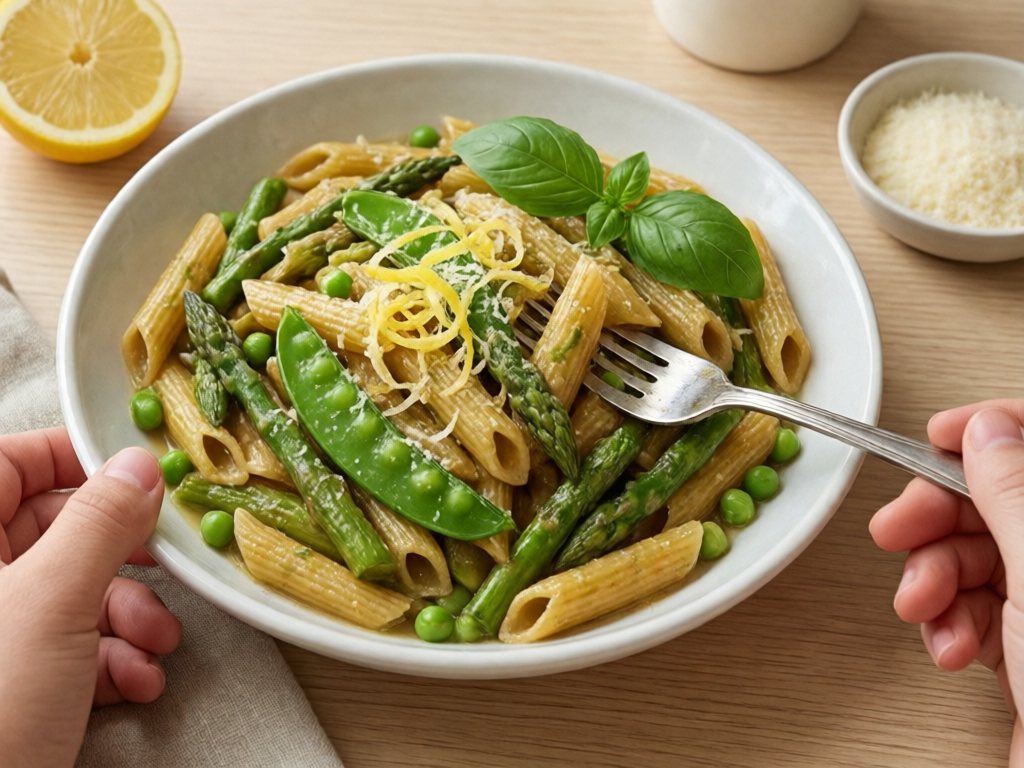
Every family has a pasta night, and spring gives it a lift. Bright vegetables, lemon zest and good parmesan make this taste like restaurant food, and it’s on the table in about 25 minutes.
Safety firstFor under 4s, cook the asparagus in the skillet 2-3 minutes longer (step 2), until very tender. The snap peas only get 2-3 minutes in the pasta water (step 1), so steam a small portion a few minutes more until soft. Cut both small, and flatten the peas on their plate.
Ingredients:
- 12 oz whole-grain penne, fusilli or bow ties.
- 1 bunch asparagus, ends snapped, cut into 1.5-inch pieces.
- 1.5 cups frozen peas, thawed.
- 1 cup snap peas, sliced in half on a diagonal.
- 3 tablespoons olive oil.
- 3 garlic cloves, minced (or 1 teaspoon garlic powder for the anti-garlic-chunk crowd).
- Zest and juice of 1 large lemon.
- 1/2 cup grated parmesan, plus more for serving.
- 1/2 cup pasta cooking water. Reserve it before draining; this matters.
- Salt, black pepper and red pepper flakes (optional, for adults).
- Optional: a handful of fresh basil or mint, torn.
Instructions:
- Cook pasta according to package directions in well-salted water. Drop the snap peas into the pot for the last 2-3 minutes. Before draining, ladle out 1/2 cup of the starchy pasta water and set aside. Drain the pasta and snap peas together and set aside.
- In the same pot (or a large skillet), heat olive oil over medium heat. Add asparagus pieces with a pinch of salt. Cook for 3 minutes, stirring, until bright green and tender-crisp.
- Add garlic, stir for 30 seconds until fragrant.
- Add the drained pasta and snap peas, plus the thawed peas. Toss to combine.
- Add lemon zest, lemon juice, parmesan, and a splash of pasta water. Toss vigorously until a light, creamy sauce forms. Add more pasta water as needed to loosen.
- Season with salt, pepper, and red pepper flakes if using. Top with fresh herbs.
Picky eater strategy: For kids who won’t eat vegetables in pasta, scoop out their pasta before step 4, leaving the snap peas behind, and toss it with olive oil, lemon and parmesan. Set a few peas and asparagus pieces beside it rather than mixed in.
Recipe 5: Strawberry and Beet Smoothie Bowls
Smoothie bowls look like dessert, and the beets and greens go in openly while your kids watch the blender. Frozen strawberries and mango keep the pink base sweet and thick.
Safety firstEach topping below is marked with an age. For babies under 12 months, serve the thick base on a preloaded spoon with only mashed fruit on top. Skip honey, juice, granola, seeds and chips for babies, and stay right with them while they eat. Check granola and chocolate chip labels for wheat, nuts and soy.
Smoothie base:
- 2 cups frozen strawberries.
- 1 medium beet, cooked and peeled. Vacuum-sealed pre-cooked beets from the refrigerated produce section make this easy.
- 1 cup frozen mango chunks, for sweetness and texture.
- 1 cup Greek yogurt (plain or vanilla).
- 1/2 cup orange juice or milk for ages 1+. For babies under 12 months, use breast milk, formula or water instead (small amounts of yogurt mixed into food are fine from about 6 months).
- Optional: 1 cup baby spinach. Tell your kids it’s in there; it turns the base a muted purple-green.
Toppings (the fun part — let kids choose their own):
- Fresh strawberries: mashed for babies, quartered lengthwise for ages 1-3, sliced for 4+.
- Granola: ages 1-3 crushed fine and stirred into the base to soften; 4+ as is. Not for babies.
- Banana: mashed for babies, quartered lengthwise for ages 1-3, sliced for 4+.
- Honey drizzle: ages 1+ only, never under 12 months.
- Coconut flakes: ages 4+ only (chewy and hard to swallow).
- Blueberries: smashed flat for babies, halved or quartered for ages 1-3, whole for 4+.
- Chia seeds: ages 1-3 soaked in a spoonful of yogurt for about 10 minutes first, never sprinkled dry; 4+ sprinkled on top.
- Mini chocolate chips: ages 4+ only, optional (small and hard).
Instructions:
- Blend all smoothie base ingredients on high until completely smooth. It should be very thick — thicker than a drinkable smoothie. Add more juice or milk 1 tablespoon at a time if needed to blend, but keep it thick enough to hold toppings.
- Pour into bowls.
- Let each child choose and arrange their own toppings.
- Eat immediately.
Picky eater strategy: Let kids decorate their own bowl. A child busy arranging strawberries and banana usually ends up tasting the pink base underneath.
How to Get Kids to Try Spring Produce
Kids don’t need a nutrition lesson to try asparagus. What helps more is a little novelty, a job to do and no pressure at the table.
1. Make the Season Feel Like an Event
Treat the season as an event, not a lecture. Try this line: strawberries are only really good for about six weeks, and those six weeks are right now. That grabs a curious kid far more than any talk about vitamin C.
It works at the farmers market too. Telling a child the peas were picked this morning makes vegetables feel new, especially if they’ve never thought about food growing in the ground.
2. Give Them a Sensory Job, Then a Real One
Before asking a child to eat something new, give them a job that’s only about the senses. Ask them to smell a strawberry, listen to a snap pea snap or decide whether the asparagus looks more blue or more green. Eating is off the table for a moment, which takes some of the worry away.
Then hand them real kitchen jobs. They can pick the strawberries at the store: deep red, fragrant, no white at the top. Toddlers and up can rinse the snap peas and, with you right there, snap the woody ends off the asparagus. Wash hands and produce first.
In my kitchen, touching and smelling a new food before tasting it tends to help. My youngest ignored asparagus for weeks, then tried a tip after helping snap the ends one Sunday. Our age-by-age guide to cooking with kids has more jobs to hand out.
3. Keep the First Taste Low-Stakes
Don’t make a new vegetable the main event with everyone watching. Put a few very tender asparagus spears next to a meal they already love, cut to the sizes in the safe-cut table for little ones. No announcement, no fanfare.
If they ask what it is, tell them. If they ignore it, that’s fine. It can take many tries, and each time it shows up on the plate it feels more familiar. Your job on day one is to put it in front of them, not to get them to love it. More ideas are in our guide to introducing new foods without pressure.
Good to knowIf refusals feel stuck, our free picky eater quiz helps you spot your child’s eating style. The guide to the quiz explains what drives each style and which of these tips fit best.
What Spring Produce Gives Growing Kids
Spring produce tastes better, and it brings a few nutrients worth knowing about.
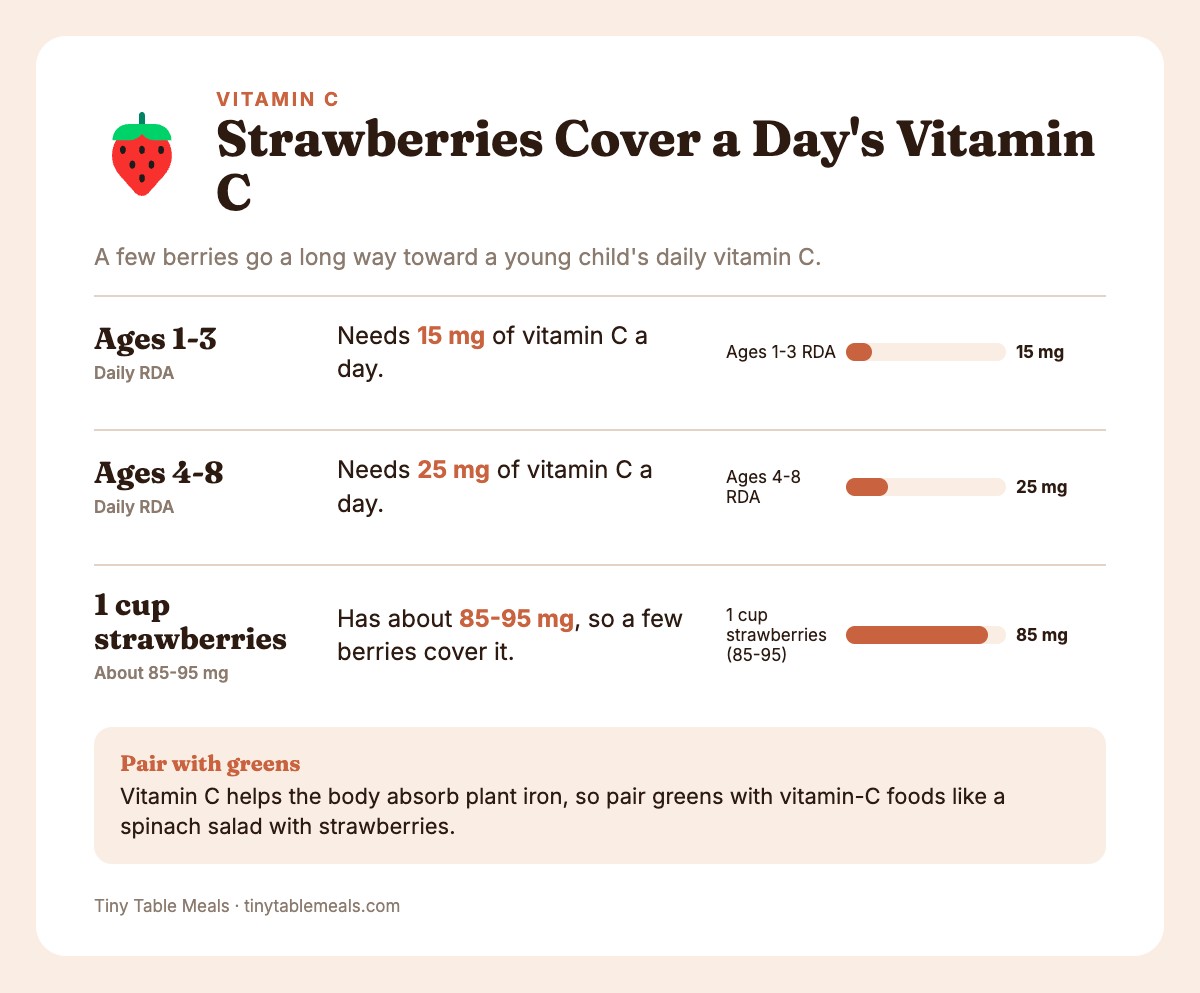
Iron and vitamin C. Leafy spring greens like spinach and chard add some iron. It’s non-heme iron, which the body absorbs less well, so meat, beans and fortified cereals stay the main iron sources for most kids. Vitamin C helps the body absorb plant iron, so pair greens with vitamin-C foods.
Per the NIH Office of Dietary Supplements, the U.S. recommended dietary allowance (RDA) for vitamin C is 15 mg a day for ages 1-3 and 25 mg for ages 4-8. A cup of strawberries has about 85-95 mg (USDA), so a few berries cover it, and snap peas and radishes add some too. Try a spinach salad with strawberries or a grain bowl with arugula and snap peas. For more ideas, see our iron-rich meals and snacks.
Folate. Asparagus, peas, spinach and artichokes are good sources of folate (vitamin B9). Kids need it to make new cells, including red blood cells. Cooked asparagus is an easy way to add some.
Water. Many spring vegetables, like cucumbers and lettuce, are mostly water. As kids spend more time outside, that adds to their fluids, but it doesn’t replace drinking water.
| Nutrient | Why kids need it | Top spring sources |
|---|---|---|
| Iron | Energy and growth. Plant iron is absorbed less well than iron from meat. | Spinach, peas and chard, in small amounts. Pair them with vitamin C; meat, beans and fortified cereals are the main sources. |
| Vitamin C | Iron absorption, immune support and collagen production. | Strawberries, snap peas, radishes. |
| Folate | DNA synthesis, brain development and red blood cells. | Asparagus, spinach, peas, artichokes. |
Good to knowThis is general nutrition information, not medical advice. If you’re worried about your child’s iron or eating, ask your pediatrician.
Farmers Market With Kids: Tips and Pack List
Kids at a farmers market have short legs, strong opinions and a habit of touching every strawberry. A little planning keeps the trip fun.
Before You Go
Pack this list:
- Tote bag
- Water and snacks (a hungry kid at a crowded market melts down fast)
- Wipes
- Cash
- Scavenger hunt list
Set expectations clearly. Before you arrive, explain the plan: we’re picking out food for this week’s dinners, and everyone chooses one treat. Knowing the rule up front cuts down on “can I have this?” at every stall.
Give each child a job. An older child can carry the tote bag, and a younger one can count six radishes into it. A job keeps small hands busy.
Write a scavenger hunt list together. Try: find something purple, something that smells sweet, the smallest vegetable you can and something you’ve never seen before. A kid on a quest is far more curious than one dragged along on an errand.
Go early. The best produce goes fast, and vendors have more time to talk before the crowds arrive. With kids, 8 or 9 a.m. is ideal; by 11, most markets are packed.
At the Market
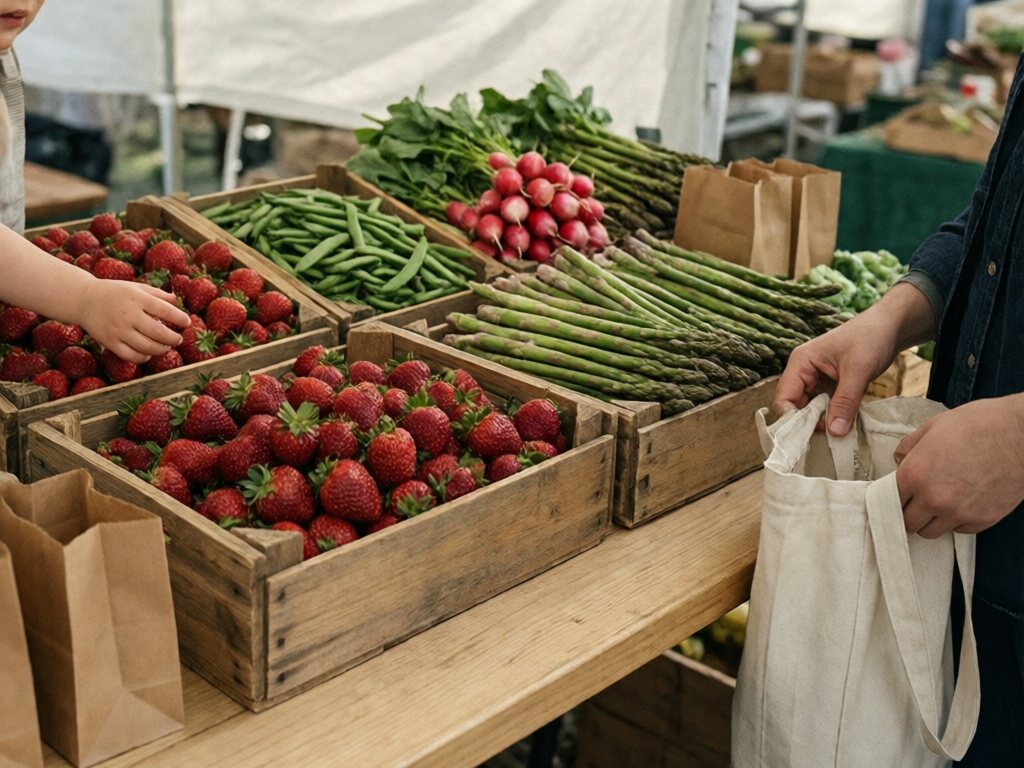
Let kids lead. Ask “What looks interesting to you?” instead of “Do you want to try this?” and let them point, look closely and smell. Then buy one thing they picked, even if you wouldn’t have, since kids are often more willing to eat food they chose.
Sample with care. Many vendors offer tastes in season, and a ripe market strawberry in May shows a child what a strawberry really tastes like. Rinse or wipe samples first, cut them to the safe sizes above for under 4s, and check for allergens.
Talk to the farmers. Even with small kids in tow, ask one quick question, like what they recommend this week or how they cook it. Your kids hear that food comes from a real person and a real farm.
Buy what looks good, not what you planned. Part of the fun is finding what’s best that week, so leave room in your plan for it.
Budget Tips for Families at Farmers Markets
Farmers markets don’t have to be expensive. A few strategies:
- Go in the last hour only if deals matter more than selection. Vendors often discount remaining produce rather than haul it back, but stalls are picked over. With kids, going early (see above) is still the easier outing.
- Buy in bulk when something is exceptional. If strawberries are a great price and you have freezer space, buy extra and freeze most of them.
- Spend market money where freshness shows. Strawberries, fresh herbs and leafy greens taste noticeably better straight from the farm. Buy proteins, pantry staples, frozen vegetables and canned beans at the supermarket.
For more ways to stretch the grocery budget, see our guide to budget meal planning for families.
Spring Meal Planning: A Seasonal Approach
Planning around what’s in season gives you better prices and better flavor. Here’s the five-step approach I use each spring week.
- Check what’s in season. Before you write the grocery list, look at the calendar above and your store’s sales this week. Start there rather than with a recipe.
- Plan 1-2 seasonal feature meals. Pick a dinner that shows off what’s fresh: the frittata at peak asparagus, the spring pasta when snap peas arrive, smoothie bowls when local strawberries show up.
- Build the week around what you bought. Asparagus can go into the frittata on Monday and the pasta on Tuesday. That cuts waste.
- Keep a few staples stocked. Snap peas for snacking, strawberries for breakfast and dessert, baby spinach for salads and bowls, and frozen peas for when fresh runs low.
- Prep on Sunday. Roast a sheet pan of asparagus and snap peas, hard-boil some eggs, and wash and spin a container of greens. Spring is a good time to build batch cooking habits that carry into summer, and those twenty minutes pay off at every weekday lunch.
Sample Spring Week Meal Plan
Dishes in bold have full recipes above; the rest are simple ideas. For more weeknight dinners, see our one-pan spring dinners.
| Day | Breakfast | Lunch | Dinner |
|---|---|---|---|
| Monday | Strawberry Greek yogurt parfait. | Snack plate: cheese, crackers, cucumber sticks and strawberries. | Asparagus and egg frittata (Recipe 3). |
| Tuesday | Smoothie with spinach and banana. | Frittata strips with a side salad. | Spring vegetable pasta (Recipe 4). |
| Wednesday | Eggs on whole-grain toast with chopped arugula. | Leftover pasta with cut strawberries. | Snap pea and chicken grain bowls (Recipe 2). |
| Thursday | Strawberry beet smoothie bowl (Recipe 5). | Leftover grain bowl: rice, chicken and snap peas. | Sheet pan salmon with potatoes and snap peas. |
| Friday | Avocado toast with finely grated radish. | Chopped salad jar with chicken, peas and cucumber. | Family pizza night with spinach, artichoke and fresh tomato. |
| Saturday | Scrambled eggs with chives and market strawberries. | Leftover pizza and fresh fruit. | Strawberry spinach salad (Recipe 1) with grilled chicken. |
| Sunday | Pancakes with fresh strawberry compote. | Grilled chicken wraps with lettuce and cucumber. | Spring pea soup with grilled cheese. |
How to Store Spring Produce
It’s so easy to buy beautiful strawberries on Saturday and find them mushy by Monday. I’ve done it more times than I’d like to admit. Here’s how to store spring produce so it lasts.
The Counter vs. Fridge Divide
Not everything belongs in the fridge. Cold can shorten the life or dull the flavor of some produce.
Keep at room temperature (out of direct sunlight):
- Tomatoes that are still ripening. Cold makes them mealy.
- Lemons and other citrus, for up to about a week.
- Basil, stems in a glass of water.
Keep in the refrigerator:
- Nearly all spring greens and lettuces.
- Asparagus, upright in 1 inch of water like flowers in a vase, loosely covered with a bag. It keeps about a week this way.
- Strawberries, in a single layer on a paper towel, uncovered or loosely covered.
- Snap peas and snow peas.
- Radishes, with the greens removed.
- Fresh herbs except basil, upright in a jar with a little water and loosely covered.
Spring Produce Storage Reference
| Produce | How to store | How long it keeps | Signs it’s past peak |
|---|---|---|---|
| Asparagus | Upright in 1 inch of water, loosely covered, in the fridge | About 1 week | Limp tips; dried-out ends. |
| Strawberries | Single layer on paper towel; loosely covered | 3-5 days | Soft spots; white or gray mold. |
| Snap peas | In a bag with small holes, or unsealed | 4-5 days | Yellowing; shriveling. |
| Baby spinach | Sealed container with a dry paper towel | 5-7 days | Sliminess; yellowing. |
| Radishes | Greens removed; sealed bag | 1-2 weeks | Mushiness; cracks. |
| Fresh herbs (except basil) | Upright in water, lightly covered, in the fridge | 1-2 weeks | Wilting; blackening. |
| Basil | Room temp in water, out of direct light (not the fridge) | 1-2 weeks | Blackening; wilting. |
| Rhubarb | Leaves trimmed off; wrapped loosely in the crisper drawer | 1-2 weeks | Limpness; browning tips. |
| Beets | Greens removed; sealed bag | 2-3 weeks | Softness; mold. |
| Fresh peas in the pod | Unsealed bag | 3-5 days | Yellowing; shriveling. |
| Fresh peas (shelled) | Sealed bag or container | 3-4 days | Wrinkling; dulling color. |
The Paper Towel Trick
For most spring greens and berries, a dry paper towel in the container soaks up extra moisture and helps them last longer. Swap it out if it gets wet. It’s the one storage habit that saves the most strawberries and spinach in my fridge.
Freezing Spring Produce
When strawberries are ripe and on sale, or you’ve bought more peas than you can use, freeze them. At 0°F, blanched vegetables keep good quality for about 8-12 months. Berries and unblanched greens are best used within about 3-6 months.
- Strawberries: Hull, then slice or leave whole. Freeze in a single layer on a sheet pan until solid, then move to a freezer bag. Use in smoothies, baked goods and jams.
- Asparagus: Blanch in boiling water for 2 minutes, then plunge into ice water. Dry well, freeze on a sheet pan, then bag. Use in soups, stir-fries or egg dishes.
- Peas: Blanch 1-2 minutes, cool in an ice bath, dry and freeze in bags. Use them anywhere you’d use store-bought frozen peas.
- Spinach and greens: Wash, dry and freeze in bags. Blanching first keeps better quality; unblanched greens lose texture. Best for smoothies and cooking.
Why bother: you lock in peak flavor at the best price. Berries frozen at their peak usually taste better in winter smoothies and baking than off-season fresh ones.
Mama Munch
Mama Munch is a food-obsessed parent of two who believes every family deserves simple, nutritious meals — even on the busiest weeknights. With a background in nutrition education and years of navigating picky eaters, allergies, and toddler taste buds, she creates practical recipes and meal strategies that actually work for real families.
Frequently Asked Questions
My kids will only eat fruit at breakfast. How do I get spring vegetables into them at other meals?
Start with vegetables that taste a little like fruit. Snap peas are sweet (cooked soft for under 4s), and strawberries in a spinach salad are an easy way into greens. A dip helps too: soft cooked asparagus with hummus, or finely grated radish (from about 12 months) stirred into cream cheese on crackers.
For more structure, take the picky eater quiz to see what kind of eater your child is.
How much spring produce should I actually buy each week for a family of four?
This baseline covers salads, a pasta dish, a frittata and daily snacking for a family of four. Cost varies a lot by region and store, so treat it as a rough guide.
- Asparagus: 2 bunches (about 2 lb)
- Strawberries: 2 quarts, one for fresh eating and one for cooking and smoothies
- Snap peas: 1 lb
- Baby spinach: 2 bags
- Radishes: 1 bunch
- Cherry tomatoes: 1 pint
Is organic worth it for spring produce?
Organic is worth considering if your budget allows. The Environmental Working Group, a consumer advocacy group, publishes a yearly “Dirty Dozen” list, and strawberries and spinach have often been on it. It’s an advocacy list, not a safety standard, and conventional produce is still a healthy choice, with residues regulated by the EPA and FDA.
How should I wash conventional produce, and is it still worth buying?
Yes, it’s still worth buying. Rinse produce under running water just before eating and rub firm items gently. Don’t use soap or produce washes. Conventional fruits and vegetables beat eating none, so don’t let the cost of organic stop you.
My kids are obsessed with strawberries but won’t eat anything else that’s in season right now. Is that okay?
Yes. A strawberry phase is a great place to start: one cup of strawberries has about 85-95 mg of vitamin C (USDA), several times what a young child needs in a day. Use it as an anchor and build out slowly. Try strawberries in a salad with a little finely chopped spinach, or a smoothie bowl with some beet blended in. Later, add strawberries as a topping on a grain bowl next to the snap peas. If it turns into a food jag, our guide can help.
What’s the fastest way to add spring produce to a weeknight dinner when I’m exhausted?
Three things take about five minutes. (1) Stir a handful of baby spinach into whatever pasta you’re already making; it wilts in 30 seconds and adds a mild green flavor. Tell your kids it’s in there. (2) Steam snap peas until tender, slice them small for under 4s, and set them out as a “snack before dinner” while you cook. (3) Slice strawberries over yogurt for dessert. None of them needs a recipe.
How do I explain seasonality to kids in a way they actually understand?
Try this with kids: “This food only grows at certain times of year, like how your birthday only comes once a year. Right now is strawberry time. If we don’t eat them now, we have to wait until next year for the really good ones.” It turns the season into something to look forward to.
For older kids, look up where the produce grows on a map, visit a pick-your-own farm, or grow a pot of herbs on the windowsill. It shows them that food comes from somewhere. Our around-the-world dinner nights bring the same idea to the dinner table.
How do I incorporate more spring produce into school lunches without it going bad in the lunchbox?
Three things help. Always pack an ice pack in an insulated bag; it keeps produce crisp and safe. Keep wet and dry foods apart, like strawberries in their own container so crackers don’t go soggy. And choose hardier produce: cooked snap peas, radish slices (finely grated for under 4s) and quartered cherry tomatoes hold up well, while sliced strawberries don’t. Cut everything to the sizes in the safe-cut table above. For more ideas, the after-school snacks kids can make post has packing tips that work for lunches too.
Bottom Line: Spring Produce for Families
Spring produce has a short window, so buy the strawberries while they’re at their best. Let your kids snap the asparagus, shell the peas and pick the radishes at the market. You don’t need every recipe here; a little curiosity in the produce aisle is enough.