8-Month-Old Feeding Schedule: Sample Day of Meals
The morning I finally wrote down what my daughter actually ate in a day, I felt a little ridiculous. There I was, in a milk-crusted t-shirt at 6:40 AM, jotting times on the back of a grocery receipt because I genuinely could not remember whether she’d had breakfast yet or whether that was yesterday. One hand held a spoon of oatmeal-and-pear purée, the other was fending off a chunk of roasted sweet potato she’d already smeared across her high chair tray, and somewhere in the back of my mind a nap timer was ticking down. That was the day I understood why “8 month old feeding schedule” is one of the most-searched phrases by parents at this exact stage — not because anyone needs a rigid regimen, but because eight months is genuinely the most confusing feeding age. Your baby is straddling two worlds: still mostly nourished by milk, but also expected to be “eating meals” now, with purées in one hand and finger foods in the other, and a nap schedule that refuses to hold still long enough to plan around it.
If you’re standing in your kitchen wondering whether you’re supposed to be doing three meals or two, whether snack time is even a thing yet, or how milk feeds are supposed to fit around all of it — you’re not behind, and you’re not overcomplicating it. You’re just at the one age where the schedule genuinely is more complicated than it was at six months or will be at ten. This post lays out a real sample day, with times, milk feeds, and food ideas, plus a printable version you can stick on the fridge so you stop doing math on grocery receipts like I did.
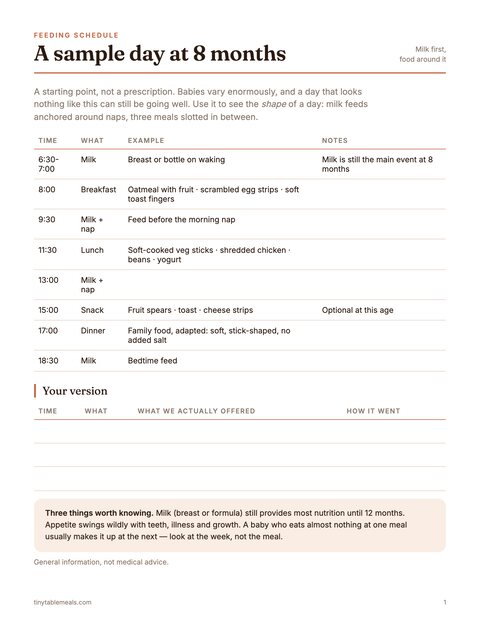
Free printable · 1 pages
8-Month Feeding Schedule
A sample day of milk feeds, meals and naps at 8 months, plus a blank version to fill in with your own.
Free. Your download link appears right here. You'll also join the Sunday Supper Plan. Unsubscribe anytime. Privacy
What an 8-Month-Old Needs in a Day
Before we get to the schedule itself, it helps to know what you’re actually aiming for, because the target at 8 months is genuinely different than it was even a month or two ago.
At this age, most babies are eating two to three solid meals a day, often with a light snack starting to work its way in, while breast milk or formula is still doing the heavy lifting nutritionally. Solids at 8 months are about practice, exposure, and building toward table food — not about hitting calorie counts. Milk is still providing the bulk of your baby’s calories, iron, and fat, which is exactly why a full milk-feeding schedule still anchors the day even as meals multiply.
A few things are true for almost every baby at 8 months, even though every baby’s actual schedule looks a little different:
- Milk still comes first, developmentally. Solids are additive, not a replacement, until closer to 10-12 months.
- Iron becomes a real priority. Babies are typically born with iron stores that start running low around 6 months, so 8-month-old meals should regularly include iron-rich foods like iron-fortified cereal, puréed or shredded meat, lentils, or beans. If you want a deeper dive on this by age, our iron-rich meals and snacks guide breaks down exactly how much and how often.
- Texture is expanding fast. Many 8-month-olds are moving from smooth purées to thicker, lumpier textures and soft finger foods, sometimes in the very same meal.
- Self-feeding is emerging. Even babies who started on purées are usually reaching for food, mashing it in a fist, and attempting to get it to their own mouth by 8 months — messy, but developmentally right on time.
- Naps are still doing a lot of the scheduling for you, whether you like it or not.
Keep those five things in mind, because they explain almost every quirk in the sample schedule below.
The Sample 8-Month-Old Feeding Schedule
Here’s a full sample day — times, milk feeds, meals, and a snack — that you can use as a real starting template. Print it, tape it to the fridge, and adjust the clock times to match your own baby’s wake time; the order and spacing matters more than the exact hour.
Printable: Sample 8-Month-Old Daily Feeding Schedule
| Time | Feed | What It Looks Like |
|---|---|---|
| 7:00 AM | Wake-up milk feed | Nurse or 6-8 oz bottle |
| 7:45 AM | Breakfast | Iron-fortified oat cereal mixed with mashed banana, plus 2-3 soft avocado strips |
| 9:15-10:00 AM | Morning nap | — |
| 10:15 AM | Milk feed | Nurse or 5-6 oz bottle |
| 11:30 AM | Lunch | Mashed sweet potato + shredded chicken + a few steamed broccoli florets |
| 12:30-2:30 PM | Afternoon nap | — |
| 2:30 PM | Milk feed | Nurse or 6 oz bottle |
| 3:30 PM | Snack | Puffs or a few soft mango chunks + a sip of water from an open cup |
| 5:00 PM | Dinner | Lentil-veggie purée with soft-cooked pasta spirals and a strip of scrambled egg |
| 6:00 PM | Milk feed | Nurse or 6-7 oz bottle |
| 7:00 PM | Bedtime routine + final milk feed (if still doing one) | Nurse or 4-6 oz bottle |
| 7:30 PM | Bedtime | — |
That’s a total of roughly 4-5 milk feeds and 3 meals plus one snack — which lines up with typical guidance for this age, whether your baby is exclusively purée-fed, doing baby-led weaning, or (like most 8-month-olds) somewhere in between.
A few notes on using this chart in real life:
- Shift the whole thing around your baby’s actual wake time, not the clock. If your baby wakes at 6:15 or 8:00, slide every block by the same amount.
- Two naps is the norm at 8 months for most babies, though some are already trending toward one long midday nap. Either way, meals go before or after nap transitions, not during them.
- The bedtime milk feed is often the first one to phase out as solids increase — more on that later.
- This is a template, not a prescription. If your baby eats lunch at 11:00 one day and 12:15 the next because naps shifted, that’s normal 8-month chaos, not a schedule failure.
What’s Actually on the Tray: Meal-by-Meal Ideas
The schedule above tells you when; here’s a closer look at what, because “meal” at 8 months can mean wildly different things depending on how your baby eats.
Breakfast ideas:
- Iron-fortified oat or multigrain cereal mixed with mashed fruit
- Scrambled egg strips (a great early protein and, once introduced safely, a common allergen to keep offering regularly)
- Greek yogurt with mashed berries
- Soft-cooked oatmeal with cinnamon and mashed pear
Lunch ideas:
- Shredded or puréed chicken, turkey, or beef with a soft vegetable side
- Lentil or bean purée (great plant-based iron and protein source) with soft-cooked carrot coins, cut into safe shapes
- Whole milk cottage cheese with soft avocado
- Mashed black beans with mashed sweet potato
Dinner ideas:
- Soft-cooked pasta with a mild veggie-lentil sauce
- Baked fish (flaky, boneless) flaked into small pieces with mashed peas
- Purée of butternut squash and chickpea, thinned with breast milk or formula for a familiar taste
- Soft-cooked zucchini rounds with a spoonable protein like yogurt or hummus
Snack ideas (once your baby is reliably taking 3 meals):
- Whole milk yogurt melts or puffs
- A few soft mango or ripe banana pieces
- A single soft rice cake broken into manageable pieces
Protein matters more at this age than a lot of parents realize — it’s not just about growth, it’s about the iron and zinc that often travel alongside it. If you want more structured ideas by age and stage, the high-protein meals and snacks guide is a good companion to keep on hand as your baby’s meals get more substantial.
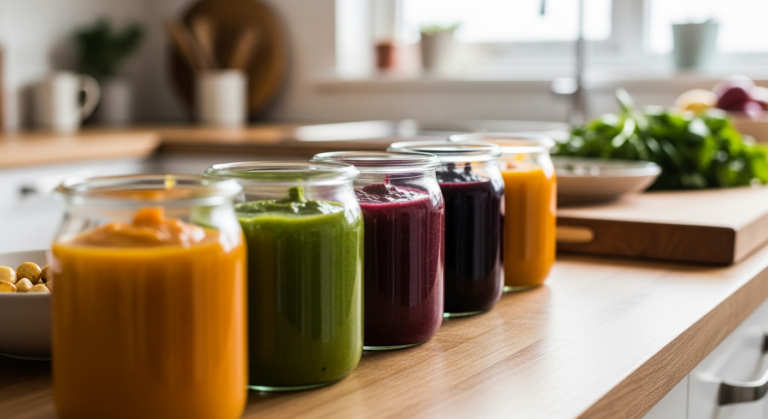
Don’t feel obligated to make every meal from scratch. Plenty of families lean on store-bought purée pouches for convenience meals and homemade or mashed table food for others — both count, and mixing approaches is completely normal at this stage.
Milk Feeds: Amounts and Timing
This is the part of the schedule parents most often skip past, and it’s the part that matters most nutritionally. At 8 months, solids are practice; milk is still the primary source of calories, fat, and (for formula-fed babies) iron.
General guidelines for 8 months:
| Feeding type | Typical daily amount |
|---|---|
| Formula | 24-32 oz total per day, spread across 4-5 feeds |
| Breast milk | Nursing on demand, typically 4-6 sessions, or roughly 24-30 oz if pumping/measuring |
| Milk feeds relative to solids | Milk still comes before solids at most meals during this stage, though some babies naturally start wanting solids first as their appetite for food grows |
A few practical things worth knowing:
- It’s completely fine — expected, even — for milk volume to dip slightly as solid intake climbs, as long as total daily milk stays in a reasonable range. If you’re worried volumes have dropped a lot, that’s worth a quick check-in with your pediatrician rather than something to troubleshoot solo.
- Offering milk before solids at most feeds (rather than after) is a common approach at 8 months, since milk is still nutritionally primary. Some families flip this by mid-9-10 months as solids take on more of the load.
- Water in an open cup can be introduced in small sips alongside meals, mostly for the practice of cup drinking rather than hydration — milk is still doing that job.
- The early-morning and bedtime feeds are usually the last ones to change as your baby grows, even after daytime feeds start shrinking or spacing out.
If your own meals have gone sideways while you’re juggling this many feeding sessions a day, you’re far from alone — a lot of parents at this stage end up eating standing at the counter with a baby on one hip, which is exactly the situation our one-handed meals for new parents roundup was built for.
Purée, Finger Food, or Both? Why 8 Months Is the Overlap Zone
Here’s the thing nobody tells you clearly enough before you get here: 8 months is the messiest transitional age for exactly this reason — most babies aren’t “purée babies” or “baby-led weaning babies” by this point. They’re both, at the same meal, sometimes in the same bite.
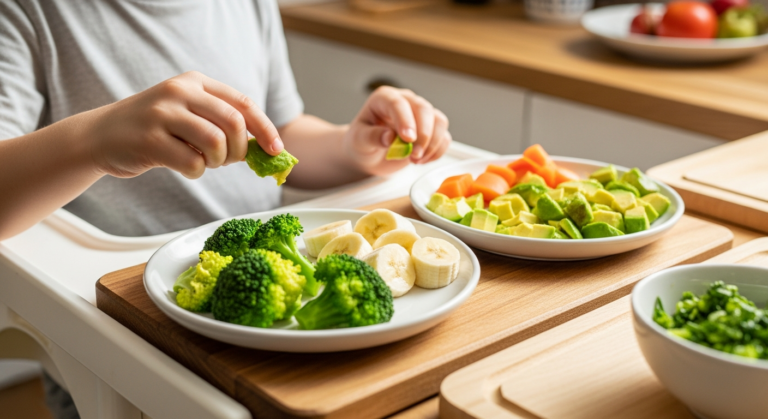
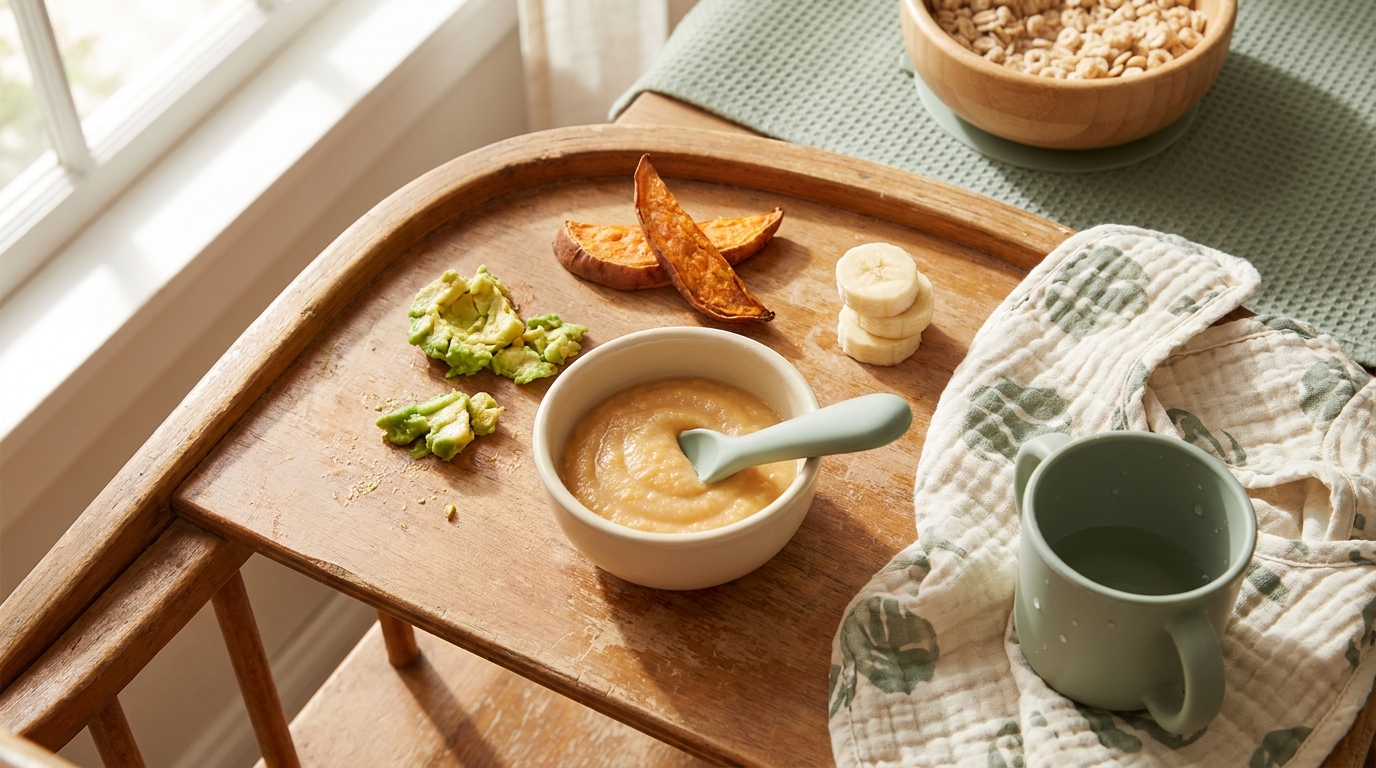
It’s completely normal — and honestly common — for an 8-month-old to eat a spoon-fed purée for the base of a meal and then pick up soft roasted vegetable strips or a piece of ripe avocado with their own fist for the rest of it. Purées let you control texture and pack in iron-dense foods that are harder to offer as finger foods (like lentils or ground meat), while finger foods build the pincer grasp, chewing mechanics, and self-feeding confidence your baby needs heading into toddlerhood.
If you started with purées and are wondering how and when to layer in more self-feeding, our guide to transitioning from purées to table food walks through the texture progression step by step. If you’re leaning baby-led weaning from the start or want to understand the philosophy behind skipping purées largely altogether, the baby-led weaning guide covers safe food shapes and choking-prevention basics in depth. And if you’re just now introducing the first pieces your baby can pick up themselves, first finger foods for babies has a solid starter list organized by texture and safety.
A few things that make the overlap approach work well in practice:
- Offer a finger food alongside almost every purée meal, even if it’s just a strip of soft-cooked vegetable or ripe fruit on the side of the tray.
- Thicken purées gradually as your baby’s teeth (or gums) and jaw strength allow — mashed with small soft lumps is a great bridge texture at 8 months.
- Let mess happen. Self-feeding at this age is genuinely inefficient — more food ends up on the floor than in the mouth for a while, and that’s part of the process, not a sign something’s wrong.
- Don’t feel pressure to pick a “method.” Plenty of babies eat purées off a spoon for lunch and pick up roasted broccoli with their fist for dinner. That’s not indecisive parenting — it’s exactly how this age is supposed to go for most families.
Fitting the Schedule Around Naps
If the sample schedule above looks tidy, know that it took real trial and error to land there — nap timing is the single biggest wrench in any 8-month feeding schedule, and it’s worth planning around rather than fighting.
Most 8-month-olds are still on two naps a day, though a growing number are edging toward the one-nap transition (usually closer to 12-15 months, but every baby’s timeline is different). Either way, a few principles hold up regardless of your baby’s exact nap pattern:
- Feed before nap, not during it. A hungry baby doesn’t nap well, but a baby stuffed too close to nap time often doesn’t settle either — aim to finish meals or milk feeds at least 20-30 minutes before you start the wind-down.
- Anchor meals to wake windows, not clock time. If your baby’s morning wake window runs 7:00-9:15, breakfast and the first milk feed happen inside that window — regardless of whether that’s “supposed” to be 7:45 by the chart.
- Expect the schedule to shift by 15-30 minutes most days. Naps that run long or short ripple through the rest of the day; that’s normal, not a sign you’re doing it wrong.
- Post-nap milk feeds are often the easiest to schedule reliably, since your baby wakes up genuinely hungry rather than needing to be coaxed to eat.
- If naps are unpredictable right now, don’t force meals into fixed slots — instead, keep the order consistent (milk, wake, nap, milk, meal, nap, milk, snack, meal, milk, bed) and let the exact times float. Babies respond better to predictable sequences than to predictable clock times at this age.
Portion Sizes Without the Guesswork
One of the most common questions that comes with any 8-month-old meal plan is simply: how much food is actually normal? The honest answer is that appetite varies enormously between babies — and even day to day for the same baby — but here’s a reasonable range to calibrate against.
| Food type | Typical portion per meal at 8 months |
|---|---|
| Purées (fruit, veggie, protein) | 2-4 tablespoons per food offered |
| Iron-fortified cereal | 3-4 tablespoons, mixed with breast milk/formula or water |
| Soft finger foods | 3-6 small pieces, sized for the baby’s own grasp |
| Protein (meat, beans, egg) | 1-2 tablespoons |
| Yogurt or cottage cheese | 2-3 tablespoons |
A few things worth internalizing about portions at this age:
- These are starting offers, not required amounts. Some babies eat every bit and want more; others eat two bites and turn their head. Both are normal.
- Appetite naturally fluctuates around growth spurts, teething, illness, and even just plain mood — don’t read too much into any single meal.
- Let your baby stop when they signal they’re done — turning away, pushing the spoon, or refusing to open up are all valid “I’m full” cues, even mid-meal.
- Resist the urge to compare to other babies’ portions. Milk is still covering the bulk of nutritional needs at 8 months, so a baby who eats “less” solid food than another baby their age isn’t necessarily behind.
If mealtime refusal or extreme pickiness feels like a bigger pattern than just an off day, our picky eater quiz — written with slightly older toddlers in mind — can still be a useful lens for understanding your baby’s eating style as they grow into it.
Keeping It Varied: A Week of Food Ideas
Repetition is fine at 8 months (babies often need 8-10+ exposures to a new food before accepting it), but building in some rotation helps expand both taste preferences and nutrition — especially iron, which deserves a spot at most meals during this stage.
Here’s a sample week of main-meal ideas to rotate through, mixing purée and finger-food formats:
| Day | Breakfast | Lunch | Dinner |
|---|---|---|---|
| Monday | Oat cereal + mashed banana | Lentil purée + soft carrot | Shredded chicken + mashed peas |
| Tuesday | Scrambled egg strips + avocado | Black bean mash + sweet potato strips | Baked flaky fish + zucchini rounds |
| Wednesday | Yogurt + mashed berries | Beef purée + soft green beans | Pasta with veggie-lentil sauce |
| Thursday | Oatmeal + pear purée | Chickpea mash + roasted squash | Turkey + mashed potato |
| Friday | Cereal + mashed peach | Cottage cheese + soft pear | Lentil-veggie stew, mashed |
| Saturday | Egg + soft toast strips | Shredded chicken + roasted carrots | Salmon flakes + avocado mash |
| Sunday | Yogurt + mashed mango | Bean and veggie mash | Family-meal leftovers, mashed or shredded to texture |
Since it’s early fall as you’re likely reading this, take advantage of what’s actually in season — apples, pears, winter squash, and root vegetables all purée and mash beautifully and tend to be cheaper and more flavorful right now than out-of-season options. Our fall produce guide for families is a handy reference for what to grab at the store or farmers market this month, and most of it converts easily to baby-friendly textures with a fork and a splash of breast milk, formula, or water.
Common Mistakes With 8-Month Schedules
A few patterns come up again and again with parents navigating this exact age — worth flagging so you can sidestep them.
- Dropping milk too fast. As solids ramp up, it’s tempting to assume milk should shrink proportionally. At 8 months, it shouldn’t — milk is still nutritionally primary, and solids are supplementing, not replacing, for several more months.
- Sticking to only purées or only finger foods out of habit. Both formats build different skills; leaning exclusively on one past 8 months can slow the transition toward table food later.
- Skipping iron-rich foods because they feel harder to prepare. Meat, lentils, and beans take more effort than fruit purées, but they matter more nutritionally at this exact age than almost anything else on the tray.
- Following the clock too rigidly. A schedule is a scaffold, not a rulebook — chasing exact times when your baby’s naps or hunger cues say otherwise usually backfires into more fussing, not less.
- Offering only sweet foods. Babies are far more accepting of savory, bitter, and mixed flavors at 8 months than they will be as toddlers — this is genuinely a window worth using for foods like lentils, spinach, or unsweetened yogurt.
- Panicking over one bad eating day. A day of refused meals is common around teething, growth spurts, or illness, and almost never means something’s wrong with the schedule itself.
When to Adjust the Schedule (Looking Toward 9-12 Months)
The schedule above is built specifically for where most babies sit at 8 months — but it won’t stay static for long, and it’s worth knowing what’s coming so the next shift doesn’t feel like it came out of nowhere.
Over the next few months, expect the schedule to gradually shift toward:
- Fewer, larger milk feeds as solid intake climbs — often dropping from 5 feeds to 4, then eventually 3-4 by around a year.
- More finger foods, fewer purées, as chewing skills and the pincer grasp mature.
- Solids offered before milk at meals, rather than after, as food becomes the primary calorie source closer to 12 months.
- A more consolidated nap schedule, which often means meals shift to fit around one midday nap instead of two.
- A true afternoon snack becoming a fixture rather than optional, as three solid meals plus a snack becomes the norm.
Signs your baby may be ready to shift ahead of that general timeline include consistently finishing full portions at meals, actively reaching for and self-feeding most of a meal, seeming less interested in a mid-morning or late-afternoon milk feed, or simply eating on a more predictable rhythm day to day. There’s no need to force any of it — most babies signal readiness pretty clearly once they’re there.
Frequently Asked Questions
How many meals should an 8-month-old eat a day?
Most 8-month-olds are eating two to three solid meals a day, with a light snack starting to fit in for some babies by the end of this stage. Milk still comes first nutritionally, so solids at this age are about building skills and variety rather than replacing milk feeds.
Should I still be feeding purées at 8 months if we started baby-led weaning?
Yes — plenty of baby-led weaning families still use purées occasionally, especially for iron-rich foods like lentils or ground meat that are harder to offer safely as finger foods. Mixing formats at 8 months is common and doesn’t undo the goals of baby-led weaning; it just fills in nutritional gaps while self-feeding skills keep developing.
How much milk should an 8-month-old drink each day?
Formula-fed babies typically take 24-32 oz per day across 4-5 feeds, while breastfed babies usually nurse 4-6 times a day. Milk should still make up the bulk of daily calories at this stage, even as solid meals become more regular.
What if my baby refuses solids at a meal?
Occasional refusal is normal and usually tied to teething, tiredness, a growth spurt, or just plain mood — it isn’t a sign the schedule or the food is wrong. Offer the meal again without pressure, keep milk feeds consistent, and try the same food again in a day or two rather than assuming it’s been rejected for good.
Can I follow a feeding schedule if my baby doesn’t nap predictably?
Yes — focus on keeping the order of milk feeds, meals, and naps consistent rather than locking in exact clock times. Most 8-month-olds respond better to a predictable sequence (wake, milk, meal, nap, repeat) than to a fixed schedule that ignores their actual wake windows.
Is it normal for an 8-month-old to eat very little solid food still?
Yes, especially if your baby started solids a bit later or is still warming up to the process. Milk remains the primary source of nutrition at this age, so a baby who eats small amounts of solid food is usually still getting what they need from milk feeds. If intake feels persistently very low or you’re seeing weight-gain concerns, check in with your pediatrician.
What foods should I avoid at 8 months?
Continue avoiding honey (until after 12 months, due to botulism risk), unpasteurized dairy, added salt and sugar, choking hazards like whole grapes, whole nuts, popcorn, and hard raw vegetables, and cow’s milk as a main drink (though it’s fine cooked into foods like yogurt or mixed into purées). Common allergens like egg, peanut, and dairy can typically continue being introduced and repeated regularly at this age unless your pediatrician has advised otherwise.
When should I stop following a rigid milk-plus-solids schedule?
Most families naturally loosen the schedule as solids take over more of the nutritional load, usually somewhere between 10 and 14 months. Watch for your baby’s own cues — consistently finishing meals, self-feeding more, and losing interest in certain milk feeds — rather than a specific date.
A Gentle Last Word
If today’s schedule looks nothing like the chart above — meals at random times, naps that blew up your whole plan, a baby who ate everything at breakfast and refused dinner outright — you’re still doing this right. Eight months is a genuinely transitional, occasionally chaotic stretch, and the goal isn’t a perfect schedule; it’s a baby who’s getting steady exposure to real food, plenty of milk, and a little more independence at the table each week. Print the chart, pin it up, and let it be a loose guide rather than a rulebook — you and your baby will find your own rhythm inside it soon enough.