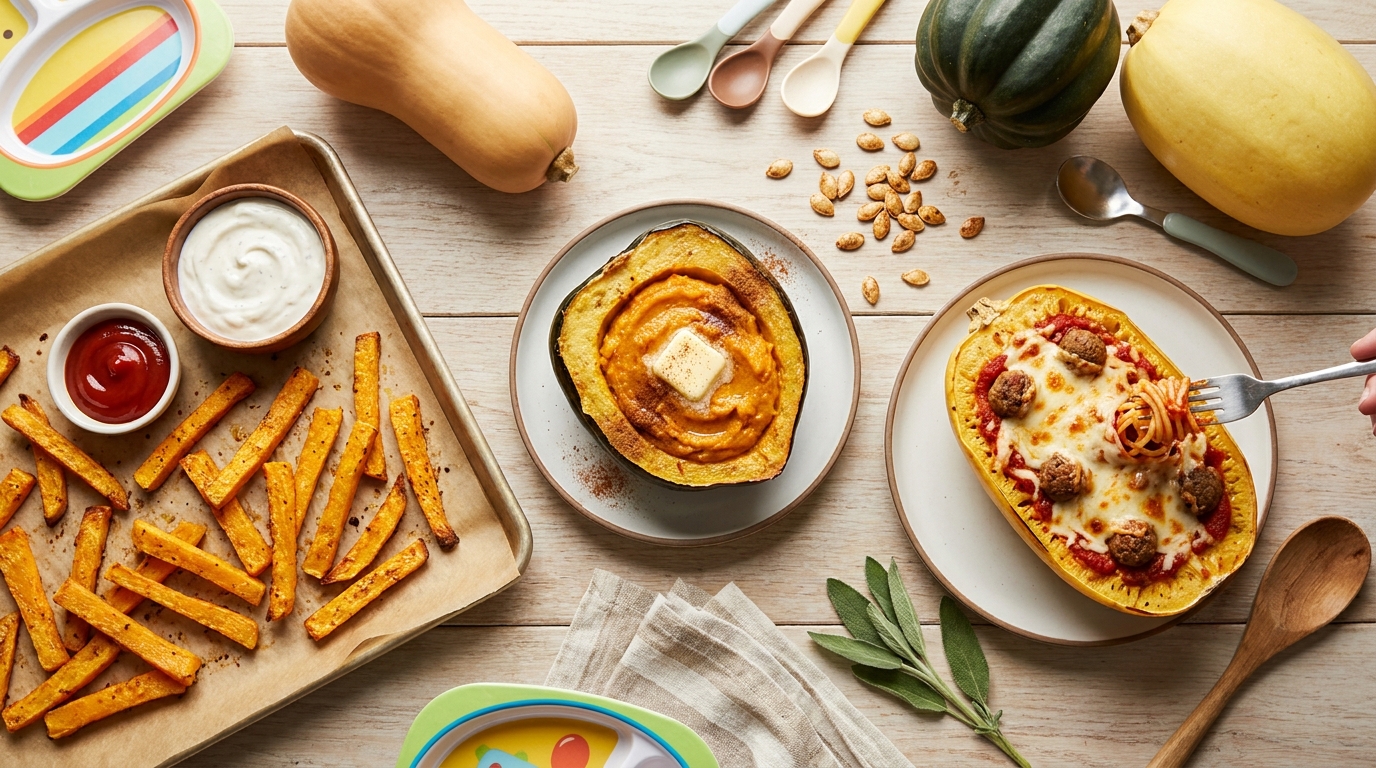
Squash Recipes Kids Will Eat: Butternut, Acorn & Spaghetti
Learn how to transform butternut, acorn, and spaghetti squash into kid-friendly fries, mash, and boats. Discover specific recipes, prep tips, and how to choose and store squash for family meals.
- Transform squash into kid-friendly fries, mash, or cheesy boats to boost appeal.
- Use the guide to pick the best squash for your child's preferences and your cooking style.
- Learn how to choose, store, and safely cut winter squash to make meal prep easier.
- Introduce one new squash format at a time, alongside a familiar, loved food.
- Download a free kit with recipes, a fridge chart, and a meal planner for squash week.
This post contains affiliate links. As an Amazon Associate I earn from qualifying purchases.
Last October I lined up a butternut, a few acorns, and one football-sized spaghetti squash on the counter and felt very good about myself.
My seven-year-old walked in, looked at the lineup, and said, “Are we eating the decorations?”
We were. Below are the three squash recipes kids will eat at my table, each with oven times, toddler-safe tweaks, and a plan for when they say no.
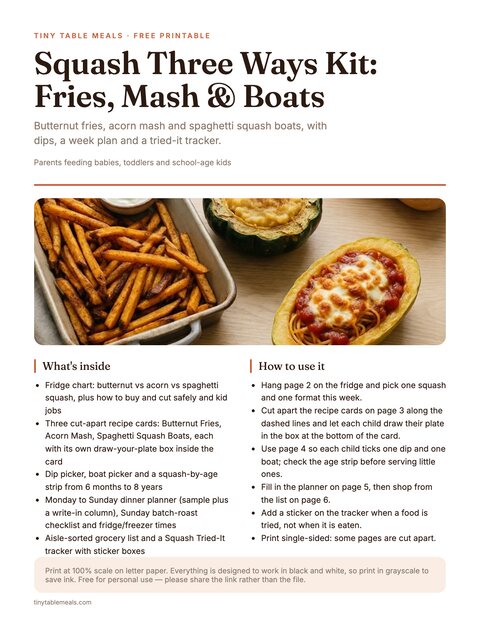
Free printable · 6 pages
Squash Three Ways Kit: Fries, Mash & Boats
A fridge chart comparing butternut, acorn and spaghetti squash, three cut-apart recipe cards with draw-your-plate boxes built in, a dip and boat picker with an age strip, a squash week planner with batch-roast and storage times, and an aisle-sorted grocery list with a Squash Tried-It tracker.
Free. Your download link appears right here. You'll also join the Sunday Supper Plan. Unsubscribe anytime. Privacy
Plenty of kids think the same thing. The squash isn’t the problem. The format is.
Each squash gets its own kid-approved job:
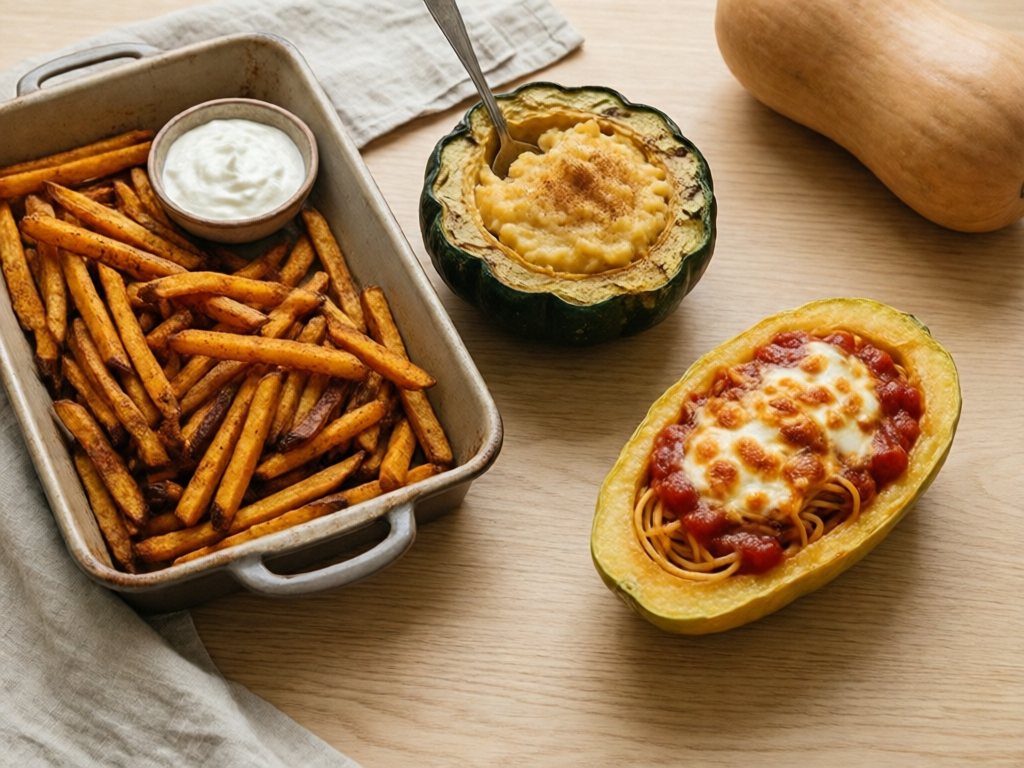
- Butternut squash becomes fries. Crispy edges, a dip, finger food.
- Acorn squash becomes mash. Creamy, sweet, spoonable, and scoopable straight from its own bowl.
- Spaghetti squash becomes boats. Cheesy, saucy, and fun to load up.
In this article (14 sections)
- Butternut, Acorn, and Spaghetti Squash Compared
- How to Choose, Store, and Cut Winter Squash Safely
- Butternut Squash Fries Recipe for Kids
- Acorn Squash Mash Recipe for Kids and Babies
- Spaghetti Squash Boats Recipe for Kids
- Squash by Age: What to Offer and How
- Squash Dinner Ideas for Kids
- How to Get Picky Kids to Eat Squash
- Easy Ways to Add Squash to Meals Kids Already Eat
- Make-Ahead Squash: Storage, Freezing, and Reheating
- Squash Nutrition for Kids
- Common Squash Problems and How to Fix Them
- Frequently Asked Questions
- Give Squash a Fair Shot This Fall
Butternut, Acorn, and Spaghetti Squash Compared
Before you pick a squash, it helps to know what you’re signing up for. Here is the cheat sheet I wish I’d had years ago.
| Butternut | Acorn | Spaghetti | |
|---|---|---|---|
| Hands-on prep time | 15 minutes (peeling and cubing is the work) | 5–10 minutes (halve and scoop) | 5–10 minutes (halve and scoop) |
| Oven time | 25–35 minutes at 425°F | 35–45 minutes at 400°F | 30–40 minutes at 400°F |
| Texture when cooked | Dense, smooth, slightly sweet; crisps at the edges when cut thin | Soft, creamy, slightly nutty; turns silky when mashed | Tender strands that separate with a fork; mild and a bit watery |
| Flavor | Sweet, like a cross between sweet potato and carrot | Mild, nutty, subtly sweet | Very mild, almost neutral |
| Best for picky eaters who hate… | Mushy textures | Strong flavors | Plain vegetables with no “dinner” feel |
| Toddler-friendly? | Yes, as soft sticks or mash | Yes, as mash | Yes, with strands snipped short |
| Leftovers | Reheat in a hot oven or air fryer | Freezes beautifully | Best in the first day or two; strands can go watery |
Butternut takes the longest on your cutting board. It also most reliably wins over kids who “don’t like vegetables” because it tastes like a treat. Acorn is the easiest to start with if you’re nervous about wrestling a squash.
Spaghetti squash is the best choice for kids who want dinner to look like dinner. A boat of marinara and melty mozzarella reads as pizza-adjacent to a lot of small people.
Pick one this week. Don’t try all three at once. The rule I follow with my own kids is one new format at a time, served alongside something they already love.
How to Choose, Store, and Cut Winter Squash Safely
Most squash trouble comes from a dull knife and a slippery board. A few small habits fix nearly all of it.
Choosing a good squash
- Heavy for its size. A light squash is dried out inside.
- Firm, matte skin. Shiny skin often means it was picked early. Avoid soft spots, cracks, or mold near the stem.
- Intact stem. A stem that is still attached keeps moisture in and helps it last longer.
- Butternut: look for an even, tan color and a long neck with a small bulb. More neck means more solid flesh and fewer seeds.
- Acorn: look for mostly dark green skin with a small orange patch where it sat on the ground. A completely orange squash tends to be overripe and can taste stringy.
- Spaghetti: pale yellow to golden. Green means underripe.
Whole winter squash keeps for weeks (butternut can keep for a couple of months) in a cool, dry, dark spot. That is why October is such a good month to stock up. For a broader look at what else is peaking right now, our fall produce guide for families covers the whole season.
The cutting method that actually works
- Soften it first (optional). This works for a squash up to about 3 pounds. Pierce it deeply in 6–8 places with a fork or the tip of a paring knife. Microwave butternut or acorn for 2–3 minutes, or spaghetti squash for 3–5 minutes. Move it with oven mitts and let it rest about 10 minutes, until it is cool enough to hold comfortably. A slightly softened squash is easier to cut. For a bigger squash, skip this step.
- Stabilize the board. Put a damp paper towel or kitchen towel under your cutting board so it doesn’t slide.
- Use a large, sharp chef’s knife. A dull knife slips. A sharp one bites in.
- Make a flat base. Slice a thin piece off the bottom so the squash sits still.
- Cut slowly, away from your body. Set the tip of the knife in near the stem and rock the blade down through the squash. Steady the squash with your other hand flat and well clear of the blade’s path. Don’t saw back and forth. If the knife sticks, pull it out and start again instead of forcing it.
Safety firstIf you microwave the squash, pierce it 6–8 times first, because a sealed squash can burst from trapped steam. Handle it with oven mitts and let it rest about 10 minutes, until it is cool enough to hold comfortably. The inside will still be hot and steamy. Steam escapes at the first cut, so cut away from your body and keep your face back. Keep kids out of the work area until the squash is cut and cool.
For butternut, cut the long neck away from the round bulb first. Two manageable pieces are much easier to work with than one giant one. Peel the neck with a Y-peeler, then slice into planks, then sticks. Scoop the seeds from the bulb before peeling and cubing.
TipMost grocery stores sell pre-cubed butternut squash. The cubes aren’t the right shape for the fries below, but for mash and soup they save about 15 minutes. Frozen cubed butternut works for mash too.
Kids and knives
Kids can help without touching the knife. Jobs a child can safely do:
- Scoop the seeds with a big metal spoon (ages 3 and up, and they love it). The raw seeds go in the bowl, not in mouths.
- Brush oil on the cut sides with a silicone brush.
- Sprinkle seasoning from a small bowl.
- Mash the cooked squash with a potato masher.
- Top the boats at the table with cooled toppings, once an adult has broiled them and they have cooled at least 10 minutes.
If you want a longer roadmap for building kitchen independence, our age-by-age guide to teaching kids to cook lays out which skills fit which ages.
Butternut Squash Fries Recipe for Kids
If you only make one recipe from this post, make this one. Butternut fries are what I serve when I need a squash win from a skeptical audience. They are sweet, they are crispy at the corners, they are finger food, and they come with a dip. A dip gives a wary kid something to do with that first bite.
Ingredients
- 1 medium butternut squash (about 2½ pounds), peeled and seeded
- 2 tablespoons olive oil or avocado oil
- 1 teaspoon cornstarch (optional, but it helps the edges crisp)
- ½ teaspoon salt
- ½ teaspoon smoked or sweet paprika
- ¼ teaspoon garlic powder
- A pinch of cinnamon (optional)
Instructions
- Heat the oven to 425°F and set two rimmed baking sheets inside to preheat while you cut. A hot pan gives the fries a head start on browning.
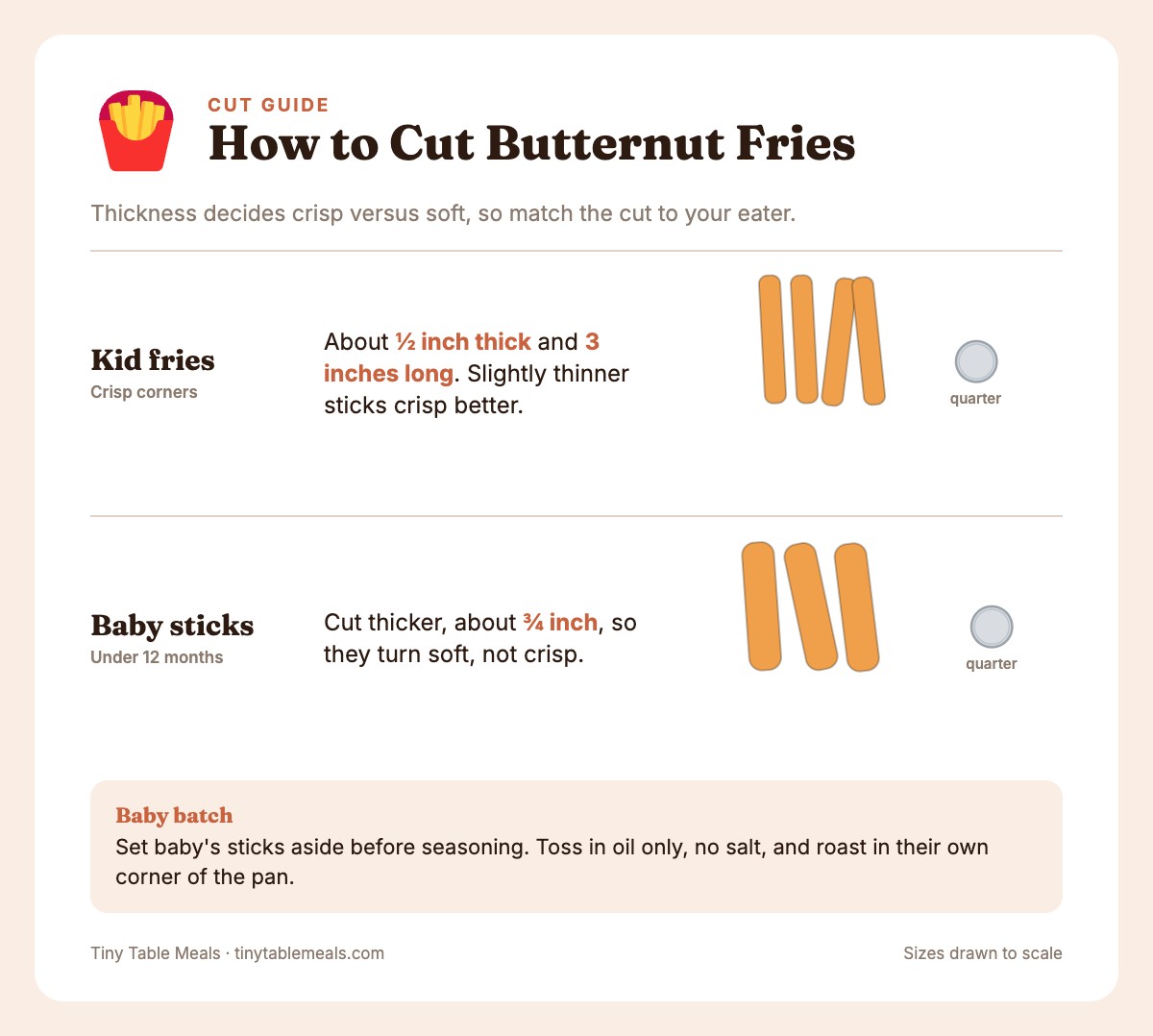
- Cut the squash into sticks roughly ½ inch thick and about 3 inches long. Slightly thinner sticks crisp better; thicker ones get soft and creamy. Both are good, so match it to your kid. (The safe cutting method is in the section above.)
- Toss in a large bowl with the oil, cornstarch, salt, paprika, garlic powder, and cinnamon until every piece is lightly coated. Feeding a baby under 12 months? Set aside a few sticks first, cut thicker (about ¾ inch) so they turn soft instead of crisp. Toss those in oil only, with no salt or seasoning, and roast them in their own corner of the pan.
- Spread on the hot pans in a single layer with space between pieces. Crowding is the number one reason fries steam instead of roast. Use both pans.
- Roast 25–35 minutes total, flipping once halfway. They’re done when the edges are browned and the centers are tender when pierced with a fork. The baby’s sticks are done when they are soft all the way through and squish easily between your fingers. Trim off any browned or crisp edges before serving, or mash the sticks.
- Salt again lightly while they’re hot, leaving the baby’s plain sticks alone. Serve right away with dips.
Dips that make the difference
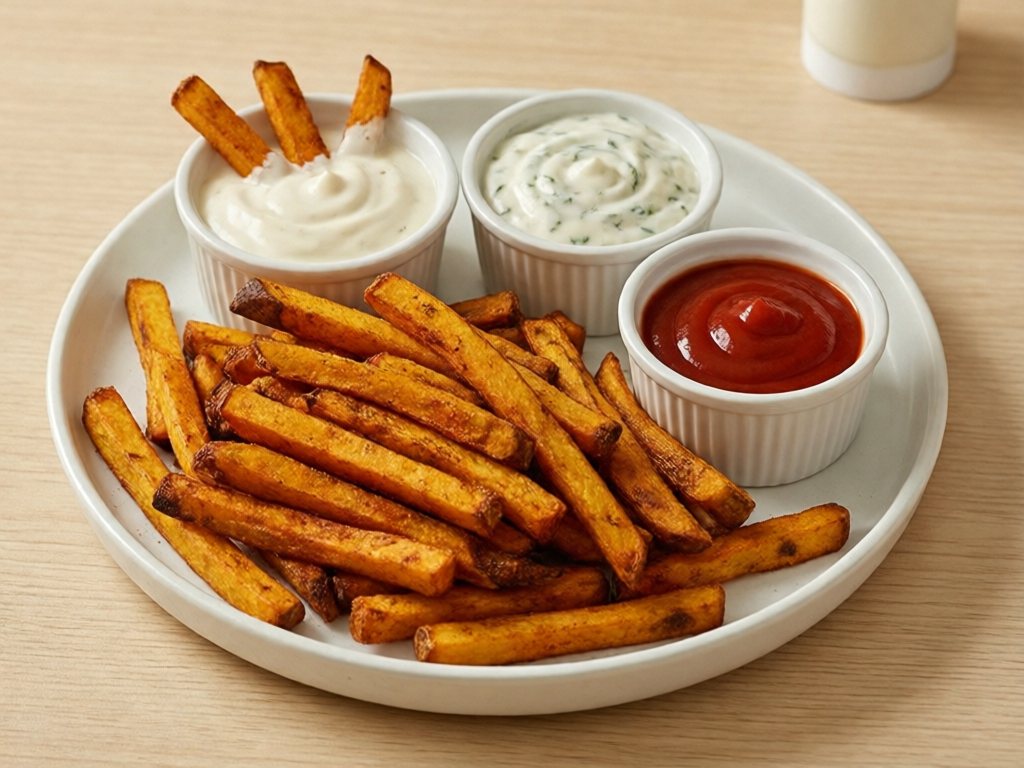
| Dip | How to make it | Who it wins over |
|---|---|---|
| Maple yogurt | ½ cup plain Greek yogurt + 1 teaspoon maple syrup (skip the syrup for kids under 2) | Sweet-leaning kids |
| Ranch-ish yogurt | ½ cup plain yogurt + ¼ teaspoon garlic powder + ¼ teaspoon dried dill + pinch of salt | Kids who dip everything in ranch |
| Ketchup | Straight from the bottle (for kids 2 and up; it has added sugar and salt) | The one who says “it needs ketchup” about everything |
| Maple-mustard | 1 tablespoon mustard + 1 tablespoon yogurt + 1 teaspoon maple syrup (skip the syrup for kids under 2) | The kid who likes tangy |
| Cheese sauce | Warm a spoonful of cheddar-and-milk sauce | The kid who will eat anything dunked in cheese |
Let each child choose one dip to start. Picking their own makes the fry feel like theirs.
Good to knowThe American Academy of Pediatrics advises no added sugar before age 2, so leave the maple out of any dip for a child under 2. Ketchup has added sugar and salt, so save it for kids 2 and up. For babies under 12 months, skip the salt and the cheese sauce too. Offer plain yogurt, once dairy has been introduced.
Why they work (and what to do when they don’t)
Butternut has natural sugars, so it browns and caramelizes well. That brown, crispy edge is what makes kids think of fries. If yours come out soft instead of crisp, the usual culprits are:
- Overcrowded pan. Use two pans.
- Cold pan. Preheat it.
- Cut too thick. Go thinner next time.
- Not enough heat. Make sure your oven is actually at 425°F. An oven thermometer is a worthwhile $8.
Soft fries aren’t a failure, either. Toddlers often prefer them that way, and soft ones mash easily with a fork for a younger toddler.
For a baby under 12 months, serve only the plain sticks you set aside before seasoning. They should be soft enough to squish between your fingers, with no hard or crisp edges. The rest of the batch is salted twice, so it isn’t for them.
An air fryer version
If you have an air fryer, toss the same fries with the oil and seasonings. Cook them in a single layer at 400°F for 15–20 minutes per batch, shaking the basket halfway. Work in batches so the basket isn’t crowded. This is my go-to on nights when I don’t want to heat the oven for 35 minutes.
Acorn Squash Mash Recipe for Kids and Babies
Acorn squash is less sweet than butternut and a little nutty. Roasted and mashed, it turns creamy and mellow. It is also the easiest squash to prep: halve it and scoop it.
Mash is the format for kids who are texture-sensitive in the “nothing with surprises” way. It also suits younger eaters who are still learning to chew.
It’s what I’d offer a 10-month-old, plain, as one food among a varied mix (see the box below). It is also what my own seven-year-old eats when she is tired and doesn’t want dinner to be an event.
Safety firstUnder 12 months: pull your baby’s portion out before adding salt, maple, or cheese. If dairy is already in their diet, a little unsalted butter or plain whole-milk yogurt is fine. Otherwise, thin the plain squash with breast milk, formula, or water. Leave out maple and other added sugar until age 2.
Ingredients
- 2 medium acorn squash
- 1 tablespoon olive oil
- 2 tablespoons butter (or olive oil for dairy-free)
- 2–4 tablespoons milk, or a spoonful of Greek yogurt, to loosen
- ½ teaspoon salt (or to taste)
- Pinch of cinnamon
- 1–2 teaspoons maple syrup (optional; leave it out for kids under 2)
- Optional protein boost: ½ cup mashed white beans or ¼ cup plain Greek yogurt
Instructions
- Heat the oven to 400°F. Line a baking sheet with parchment.
- Soften the whole squash (optional). Pierce it deeply in 6–8 places with a fork or the tip of a paring knife. Microwave 2–3 minutes, then move it with oven mitts. Let it rest about 10 minutes, until it is cool enough to hold comfortably. It will still be hot and steamy inside, so keep kids clear when you cut.
- Halve each squash from stem to tip. Scoop out the seeds and stringy bits with a spoon (save the seeds if you like; see the toasted seeds idea below).
- Brush the cut sides with oil and place them cut side down on the sheet.
- Roast 35–45 minutes, until the flesh gives easily when poked with a fork and the skin is a little wrinkled.
- Flip and let cool 5 minutes. Scoop the flesh into a bowl, leaving the skin intact if you want to reuse the shells as bowls.
- Mash with butter, a splash of milk, salt, cinnamon, and maple (if using). Add white beans or yogurt if you want more staying power. Mash until as smooth or chunky as your kid prefers.
- Serve in the shells as little edible bowls, or scoop onto plates.
Mash variations by eater
- Smooth operator: Blend with an immersion blender and a bit more milk for a silky purée. For babies under 12 months, follow the box above and blend their plain portion separately.
- Cheesy mash: Stir in ¼ cup shredded mild cheddar. It turns into something between mashed potatoes and mac and cheese. Cheese is salty, so this one is not for babies under 12 months.
- Savory mash: Skip the cinnamon and maple. Add a pinch of garlic powder and a tablespoon of grated Parmesan. Parmesan is salty, so this one is not for babies under 12 months.
- Sweet-dessert-for-dinner mash: Cinnamon, a drizzle of maple (skip the maple for kids under 2), and a spoonful of yogurt on top.
- Hidden-boost mash: Stir in a few tablespoons of puréed white beans or cooked red lentils. For a baby, purée them smooth and keep the portion unsalted. If you like this approach, our collection of hidden veggie recipes for kids has plenty more ideas for working extra nutrition in without a standoff.
Using the shells as bowls
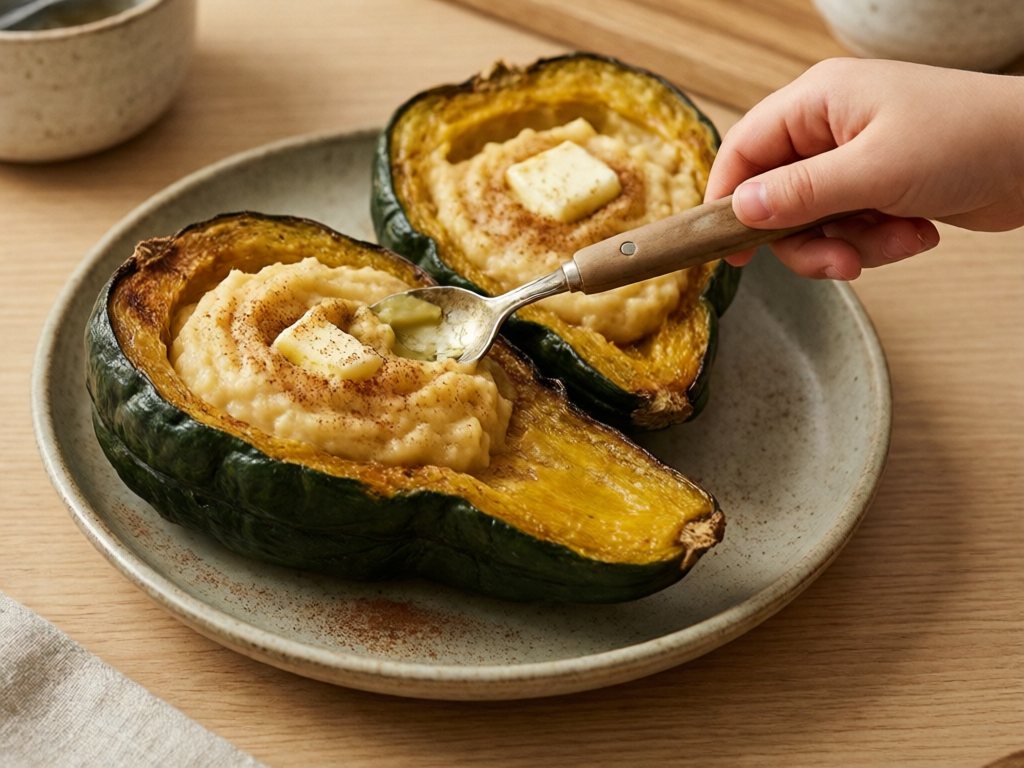
A trick that gets reluctant eaters curious: serve the mash right in the roasted shell, with a small spoon. For some kids, the “bowl you can eat” element is the whole appeal. Others will happily scoop out the flesh and leave the skin, which is fine. The skin on acorn squash is technically edible when roasted, but it can be tough, so I don’t push it.
What to serve it with
Acorn mash is a side that wants a main with some personality:
- Crispy baked chicken tenders
- Sausage and apple meatballs
- A simple roasted chicken
- Baked fish sticks
- Slow-cooker pulled pork, or anything from our slow-cooker fall dinners kids will actually eat
Spaghetti Squash Boats Recipe for Kids
Spaghetti squash gets mixed reviews. It doesn’t actually taste like pasta. Promise a child “spaghetti” and deliver watery yellow strands, and you will lose their trust.
The honest framing is better: this is a squash that turns into stringy noodles, which is cool all by itself. Then you load it with something they already like.
Boats solve the two big problems with spaghetti squash. The squash half is already a boat shape, and the toppings (marinara, mozzarella, mini meatballs) give it a familiar flavor.
Ingredients
- 2 medium spaghetti squash (about 2½–3 pounds each)
- 1 tablespoon olive oil
- ½ teaspoon salt
- 1½ cups marinara sauce, warmed
- 1½ cups shredded mozzarella
- ¼ cup grated Parmesan
- Optional fillings: mini meatballs, cooked ground turkey, white beans, or shredded rotisserie chicken
- Optional garnish: chopped basil, a sprinkle of Italian seasoning
Instructions
- Heat the oven to 400°F. Line a baking sheet with parchment.
- Halve each squash lengthwise. A spaghetti squash can be slippery, so put a damp towel under your cutting board. Softening it first is optional but helps. Pierce it deeply in 6–8 places and microwave 3–5 minutes. Move it with oven mitts and let it rest about 10 minutes, until it is cool enough to hold comfortably. It will still be steamy inside, so keep kids clear and cut from stem to tail.
- Scoop out the seeds and the stringy core with a spoon.
- Brush the cut sides with oil, sprinkle with salt, and place cut side down on the sheet.
- Roast 30–40 minutes, until you can easily press a fork into the skin and the flesh feels tender.
- Flip, let cool 5–10 minutes, then rake the flesh with a fork from the stem end to the tail in long strokes. The strands will come away like noodles. Leave them in the shell.
- Stir in the marinara and any fillings right in the shell. Top with mozzarella and Parmesan. This is an adult job, since the shells are still hot.
- Move the boats to an unlined pan. Set the loaded shells on an unlined rimmed baking sheet or in an oven-safe dish. Keep parchment out from under the broiler, because it can scorch or catch fire at broiler heat.
- Broil 2–3 minutes on high, watching closely, until the cheese is bubbly and spotty gold.
- Cool 10 minutes before serving. The shells and the cheese are very hot straight from the broiler. Kids add their own cooled toppings at the table.
Microwave shortcut for weeknights
On a night when a 40-minute roast isn’t happening, microwave it instead. Halve and seed the squash, then place the halves cut side down in a microwave-safe dish with ¼ cup water. Cover loosely with a plate to hold in the steam. Microwave 10–15 minutes until tender; the time varies by size and microwave.
Finish with sauce and cheese, and broil briefly on an unlined pan if you want the browned top. The texture is slightly wetter than roasted, so drain any pooled liquid before adding sauce.
The watery strand problem
TipTo avoid watery boats, roast the halves cut side down so the steam escapes. After raking, blot the strands with a paper towel before adding sauce. A chunky marinara or a ricotta-based filling holds up better than a thin sauce.
Boat variations kids go for
| Boat | What goes in | Why it works |
|---|---|---|
| Pizza boat | Marinara, mozzarella, finely minced pepperoni or turkey pepperoni (optional) | Tastes like pizza; kids add their own toppings |
| Meatball boat | Marinara, small baked meatballs, Parmesan | Familiar spaghetti-and-meatballs shape |
| Buttery Parm boat | Butter, Parmesan, a pinch of garlic powder | Plain-pasta-with-butter energy for the sauce-averse |
| Taco boat | Seasoned ground turkey, mild salsa, cheddar | Build-your-own with taco toppings on the side |
| Chicken-alfredo-ish boat | Shredded chicken, a spoonful of ricotta, mozzarella, milk to loosen | Creamy and mild |
Let each kid pick their boat and finish it at the table with their own toppings. A boat they had a hand in is more likely to get eaten than one handed to them.
Safety firstAn adult loads the hot shells, broils them, and moves them afterward. Let the broiled boats cool at least 10 minutes before kids touch them, and set each one on a plate or hot pad. Kids then add cooled toppings at the table, like extra shredded cheese or chopped basil. For younger kids, scoop the strands onto a plate and let them top their own portion there.
For toddlers
Spaghetti strands can be a challenge for small eaters. Snip them with kitchen scissors into short lengths (about 1 inch), and mix with sauce and cheese so they clump into soft, scoopable bites. As always, stay with your toddler while they eat and follow the guidance of your pediatrician on textures and readiness.
Safety firstFor children under 4, crumble or finely chop meatballs and mince the pepperoni, or leave it off. Whole round meatballs and coin-shaped pepperoni are choking hazards, and pepperoni is salty.
Squash by Age: What to Offer and How
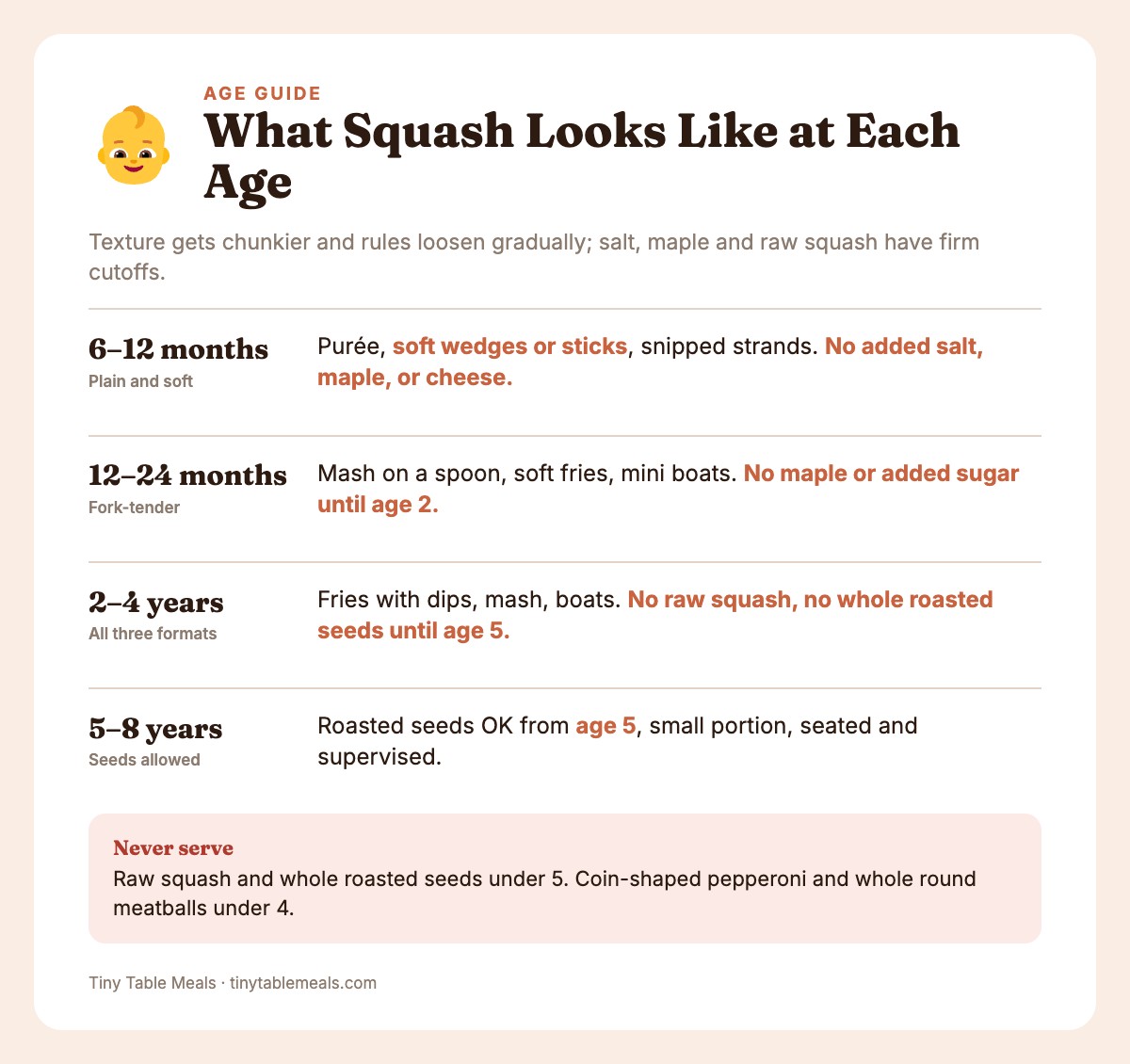
Squash works for everyone at the table. Here is how to adapt it as kids grow.
| Age | What to offer | Texture and safety notes |
|---|---|---|
| 6–9 months | Smooth acorn or butternut purée, or very soft roasted wedges for baby-led weaning | Should squish easily between your fingers. Serve it plain, with no added salt, maple, or cheese. Stay with your baby while they eat. |
| 9–12 months | Lumpier mash, soft butternut sticks, snipped spaghetti squash | Cut strands short and make sure pieces are soft. Still no added salt or maple. |
| 12–24 months | Mash on a spoon, soft butternut fries, mini boats with finely chopped strands | Avoid hard, raw, or crunchy pieces. Cooked squash should be fork-tender. No added sugar or maple until age 2. |
| 2–4 years | All three formats; dips for fries; let them scoop and sprinkle | Cut fries into manageable lengths. No raw squash and no whole roasted seeds until age 5. Under 4, no coin-shaped pepperoni or whole round meatballs, and quarter grapes lengthwise. |
| 5–8 years | Fries, mash, and boats; invite them to top their own boat at the table | Let them help with seeds and mashing. From age 5, roasted seeds are fine in a small portion, seated and supervised. |
| 9+ years | Make the whole dish together; offer a spicier dip if they like heat | Cutting with supervision; discuss knife safety. |
Three things I never serve:
- Raw squash pieces for children under 5
- Whole roasted seeds for children under 5
- Coin-shaped pepperoni or whole round meatballs for children under 4
Feeding a baby? Our baby-led weaning grocery list for beginners includes squash among the first foods to try.
Squash Dinner Ideas for Kids
Each of these recipes is more of a side than a full meal. Here is how I turn them into dinners without much extra work.
| Night | On the table | Time |
|---|---|---|
| Butternut fry night | Butternut fries on two sheet pans. Baked chicken tenders or fish sticks on a third pan. Fruit, like grapes quartered lengthwise or thinly sliced apple. Two dips, one yogurt-based. | About 45 minutes |
| Acorn mash night | Acorn mash. Roasted sausages or a simple roast chicken in the same oven. Steamed green beans with butter. | About 60 minutes, mostly unattended |
| Spaghetti squash boat night | Boats loaded and broiled by an adult, then topped at the table. A small side salad or cucumber sticks with ranch (thin strips for under-4s). Garlic bread. | About 60 minutes, including cooling |
Fry night is “fast food night” at home: everything arrives at once, and it’s all finger food. On mash night, prep takes about ten minutes and the oven does the rest.
If a kid refuses the squash, the garlic bread and cucumbers are still a meal. Always put at least one “safe” food on the table. It lowers the stakes for everyone.
Planning ahead for the busy stretch of fall? Our quick family dinners for fall sports season pair nicely with a roasted-squash side that reheats well after practice.
Stretching one roast across the week
You don’t need squash every night. Pick one or two of these dinners that fit your schedule.
If you roast acorn and spaghetti squash together on Sunday, use the spaghetti halves on Monday or Tuesday. Reheat them, load them, and broil 2–3 minutes on an unlined pan. That is about 10 minutes of work, plus 10 minutes of cooling before the kids dig in. Leftover acorn mash reheats with a splash of milk later in the week.
How to Get Picky Kids to Eat Squash
Recipes are the easy part. Getting a wary child to take a bite is the real work. These are the strategies that have held up at my own table.
Do these
- Serve it alongside something familiar. One new food, one or two comfortable ones.
- Offer small portions. Two fries. One tablespoon of mash. A “learning bite” is not a failure.
- Keep your tone neutral. “This is butternut squash fries” is plenty. Skip the “you’ll love it!” because it creates pressure.
- Let them help. A child who scooped the seeds or sprinkled the cheese is more invested.
- Repeat without pressure. Kids often need many exposures before they accept a new food, and that is normal. A bite today isn’t the goal. Familiarity is.
- Eat it yourself, visibly and happily. Kids copy what they see.
- Change the format, not the pressure. If fries fail, try mash. If mash fails, try the boat. The same squash in a new shape is a fresh start.
Avoid these
- Bribery or “one more bite” bargaining. It makes the vegetable the price of dessert, which teaches kids that vegetables are a chore.
- Disguising it and then announcing it. Hidden veggies are great (more on that in the next section), but springing “surprise, it was squash!” can erode trust.
- Giving up after one try. A refused food isn’t a rejected food. It is a food that needs another exposure.
For a deeper look, our post on how to help kids eat more vegetables covers these strategies in more detail.
A low-pressure tracking trick
My kids love a chart. I keep a simple sheet on the fridge where each new food gets a sticker when it’s tried (not when it’s eaten, just tried). It turns trying into a game and takes the focus off swallowing. If you like that idea, our one new food a week printable tracker is built for exactly that.
Easy Ways to Add Squash to Meals Kids Already Eat
Not every squash has to be a star. Some nights the best strategy is to mix a little squash into something your family already loves. Here are the easiest places to do it.
| Meal | How to add squash | How much to start with |
|---|---|---|
| Mac and cheese | Stir smooth butternut or acorn purée into the cheese sauce; it adds creaminess and a golden color | ¼ cup per 2 cups of sauce, then increase |
| Pancakes or waffles | Whisk mashed acorn or butternut into the batter in place of some of the liquid | 3–4 tablespoons per 2 cups of batter |
| Pasta sauce | Blend roasted butternut into marinara | ½ cup per 2 cups of sauce |
| Muffins | Replace some of the oil or pumpkin in your favorite muffin recipe with mashed squash | ½ cup per 12 muffins |
| Quesadillas | Spread mashed squash with cheese and fold | 2 tablespoons per quesadilla |
| Smoothies | Add a spoonful of cooled, cooked butternut purée to a fruit smoothie | 2 tablespoons |
| Soup | Blend roasted butternut with broth, a little apple, and a pinch of cinnamon | The whole point |
Butternut mac and cheese is the swap I’d start with. The squash makes the sauce thick and creamy, and its sweetness fits with the cheese. The color is so close to boxed mac that most kids don’t blink. Start with a small amount and build.
For more ideas, see our pumpkin recipes for kids that aren’t pumpkin pie. Most of those swaps work just as well with butternut or acorn.
Make-Ahead Squash: Storage, Freezing, and Reheating
Squash is one of the best make-ahead vegetables there is, because roasting a big batch on Sunday sets you up for several easy dinners.
Batch-roasting plan
On a lazy Sunday, roast two squash at once. One acorn and one spaghetti is a good pairing, since they share a 400°F oven. The acorn needs about 5 minutes longer, so it goes in first. While they roast, you have most of an hour for other things.
Plan to use the spaghetti squash on Monday or Tuesday, while the strands are still firm.
Fridge and freezer guide
Safety firstRefrigerate cooked squash within 2 hours of cooking. Store it in shallow airtight containers so it cools quickly. Reheat leftovers until steaming hot, then let them cool to a safe eating temperature for little ones.
| Food | Fridge | Freezer | Reheating tip |
|---|---|---|---|
| Acorn or butternut mash | 3–4 days, airtight | Very good for 2–3 months. Portion into silicone muffin cups or ice cube trays, freeze solid, then bag. Freeze a plain, unsalted baby portion in its own labeled bag. | Reheat with a splash of milk. |
| Roasted spaghetti squash strands | Best within 2 days, safe up to 3–4 days. Store separately from sauce. | Not ideal. They tend to turn watery on thawing. | Drain any liquid, then add sauce and cheese and broil. |
| Roasted butternut cubes | 3–4 days | Mash them first, then freeze like the mash above. | Use in lunch boxes, salads, grain bowls, or quick mash. |
| Raw butternut sticks for fries | Not needed | Okay, not great. Freeze on a tray, then bag. | Roast from frozen. They’ll be softer than fresh. |
| Raw cubed butternut | Not needed | Yes. Freeze on a tray, then bag. | Use for mash or soup. |
Frozen mash cubes are a handy tool for busy nights. Pop two or three into a bowl, microwave, and stir into oatmeal or mac and cheese. The seasoned cubes are for toddlers and older kids, and any made with maple are for kids 2 and up.
For a baby under 12 months, freeze a separate plain portion with no salt, maple, or cheese, and label the bag. Those plain cubes make a quick purée. Stir well and test the temperature before serving to a baby or toddler, since microwaves leave hot spots.
If your week tends to be a scramble, you may also like our freezer-to-Instant-Pot dump meals, which pair well with a pre-roasted side.
Don’t toss the seeds
Rinse and dry butternut or acorn seeds, then toss them in a little oil and salt. Roast at 325°F for about 15–20 minutes, until golden and crunchy.
Safety firstNo whole roasted seeds for children under 5. Small, hard seeds are a choking risk. From age 5, serve a small portion while they sit and you supervise.
Squash Nutrition for Kids
Here is what squash adds to the plate.
- Color means carotenoids. The orange flesh of butternut and acorn squash comes from carotenoids, including beta-carotene, which the body can convert to vitamin A. Vitamin A supports normal vision and immune function.
- Fiber. Squash has fiber, which supports regular digestion. If this matters in your house, check out our guide to fiber-rich meals and snacks kids will actually eat.
- Potassium and vitamin C. Winter squash contains both, in varying amounts depending on the variety.
Spaghetti squash has fewer calories and carbohydrates than the other two and a milder nutrient profile. It isn’t a nutritional replacement for pasta, and growing, active kids don’t need to “save carbs.” I serve it as one part of a meal, not the only thing on the plate. Pair it with protein (meatballs, beans, cheese) so the meal has staying power.
Every child’s needs are different. If you have questions about your child’s diet, growth, or a food allergy, your pediatrician or a registered dietitian is the right person to ask.
Common Squash Problems and How to Fix Them
Hard-to-cut squash, mushy fries, and watery strands are covered in the sections above. These are the fixes that aren’t.
“My acorn squash is stringy.”
It was probably overripe. Next time, buy one with mostly dark green skin. Mashing or blending smooths out this one.
“The squash tastes bland.”
Salt matters more than people think. Season the squash before roasting and again after. Fat (butter or olive oil), a little acid (a squeeze of lemon), and a pinch of warm spice (cinnamon, paprika, nutmeg) all make it taste richer.
“My kid says it’s weird.”
Ask what’s weird: the color, the texture, the smell? Then change that one thing next time. If it’s texture, switch formats. If it’s smell, serve it cooler.
Frequently Asked Questions
What is the easiest squash to start with for kids?
Acorn squash is the easiest to prep: halve, scoop, roast. Butternut is usually the easiest to get kids to like because it’s the sweetest. If you want a quick win, roast butternut fries with a dip. If you want the least work, roast acorn halves and mash them with butter and a pinch of cinnamon.
Do I have to peel butternut squash?
For fries, yes. The skin is tough and doesn’t crisp well. For roasted halves that you scoop and mash, leave the skin on and discard it after. The skin of butternut is technically edible when roasted, but most kids won’t enjoy the texture. Acorn squash skin is also edible but often chewy, so most families skip it.
Can toddlers eat squash?
Yes, cooked squash is a common early food. For babies and toddlers, cook it until very soft. Serve it mashed, or cut into soft sticks that squish easily between your fingers. Snip spaghetti squash strands into short lengths. Skip raw squash and whole roasted seeds for children under 5, since both are choking hazards. Always stay with young children while they eat. Check with your pediatrician if you have questions about when to introduce specific foods or textures.
How do I keep spaghetti squash from getting watery?
Roast the halves cut side down so moisture can escape, then rake the strands and blot them with a paper towel before adding sauce. A thick sauce, like chunky marinara or a ricotta filling, holds up best. The microwave shortcut works too if you drain the pooled liquid.
Can I use frozen or pre-cut squash?
Yes, for mash, soup, and mac and cheese. Pre-cut or frozen butternut cubes are a real time saver, though frozen is softer and won’t crisp. For fries and boats, use fresh whole squash.
How long does cooked squash last, and can I freeze it?
Refrigerate cooked squash within 2 hours, in a shallow airtight container. Cooked acorn or butternut keeps 3–4 days in the fridge. Spaghetti squash strands are best within 2 days and safe up to 3–4 days. Reheat leftovers until steaming hot. Mashed acorn or butternut freezes very well for 2–3 months, which makes it handy for muffin-cup portions you can reheat quickly. Spaghetti squash strands tend to turn watery when frozen and thawed, so they’re best eaten fresh.
My child refuses squash every time. Should I keep offering it?
Yes, but keep the pressure low. Many kids need many repeated exposures before accepting a new food. Offer a small portion next to a familiar food, change the format (fries, mash, or boats), and let your child help prepare it. A refused bite isn’t a failure, and a neutral, calm approach tends to work better than coaxing or bribing. If your child’s eating feels very restricted or worries you, talk with your pediatrician.
Give Squash a Fair Shot This Fall
When my seven-year-old asked whether we were eating the decorations, I laughed. Then I did what I always try to do: I handed her a spoon and asked her to scoop out the seeds. By the time the acorn halves came out of the oven, she had named her squash “Gerald” and wanted to know whether Gerald would taste sweet. (He did. She ate nearly the whole bowl.)
You don’t need a perfect plan, a hidden-veggie masterpiece, or a child who loves vegetables on the first try. Pick one squash and one format, and put it next to something familiar. Then let it show up again next week.