One New Food a Week: A Low-Pressure Printable Tracker
Discover a free, low-pressure 8-week tracker to introduce one new food a week to your child (ages 1-10). You'll learn to log exposure and reactions using a simple scale, focusing on progress rather than just eating.
- Utilize the free 8-week tracker to introduce one new food weekly.
- Track all exposure to new foods, not just eating, using the S-P-K-L-B-E-A reaction scale.
- Log every interaction (seeing, touching, licking) as progress without judgment.
- Keep your tracker private to avoid turning it into a scoreboard for your child.
- Understand that any exposure to a food on the plate counts as progress.
This post contains affiliate links. As an Amazon Associate I earn from qualifying purchases.
Last spring I put a single roasted sweet potato wedge on my daughter’s plate for what I’m fairly sure was the ninth time. She looked at it, pushed it to the very edge of the plate, and said, “That one is still here.” I almost laughed, because she was right. It was still there, and so was I.
That night I wrote it down: one food a week, a small grid, and a column for how many times it showed up. Whether anyone ate it didn’t get a column.
Free printable · 6 pages
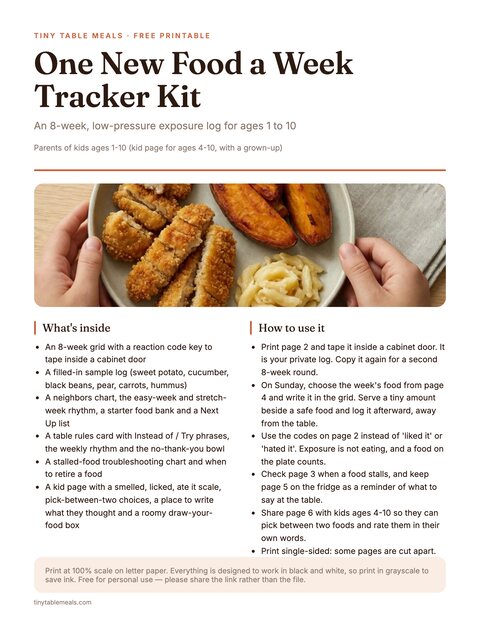
One New Food a Week Tracker Kit
A cabinet-door 8-week tracker with the S-P-K-L-B-E-A reaction key, a filled-in sample log, a pick-your-food page with neighbor foods and a starter food bank, a table-rules fridge card, a stalled-food troubleshooting chart, and a kid page for ages 4-10.
Free. Your download link appears right here. You'll also join the Sunday Supper Plan. Unsubscribe anytime. Privacy
That’s this tracker: an 8-week exposure log for kids ages 1 to 10, with reaction codes, table tips, and safe prep for toddlers. The grid is in the very next section, ready to print or copy, with a plain-text version for your phone.
In this article (15 sections)
- The 8-Week Tracker
- Why Exposure Tracking Works for Picky Eaters
- How Often Should You Introduce a New Food to a Toddler?
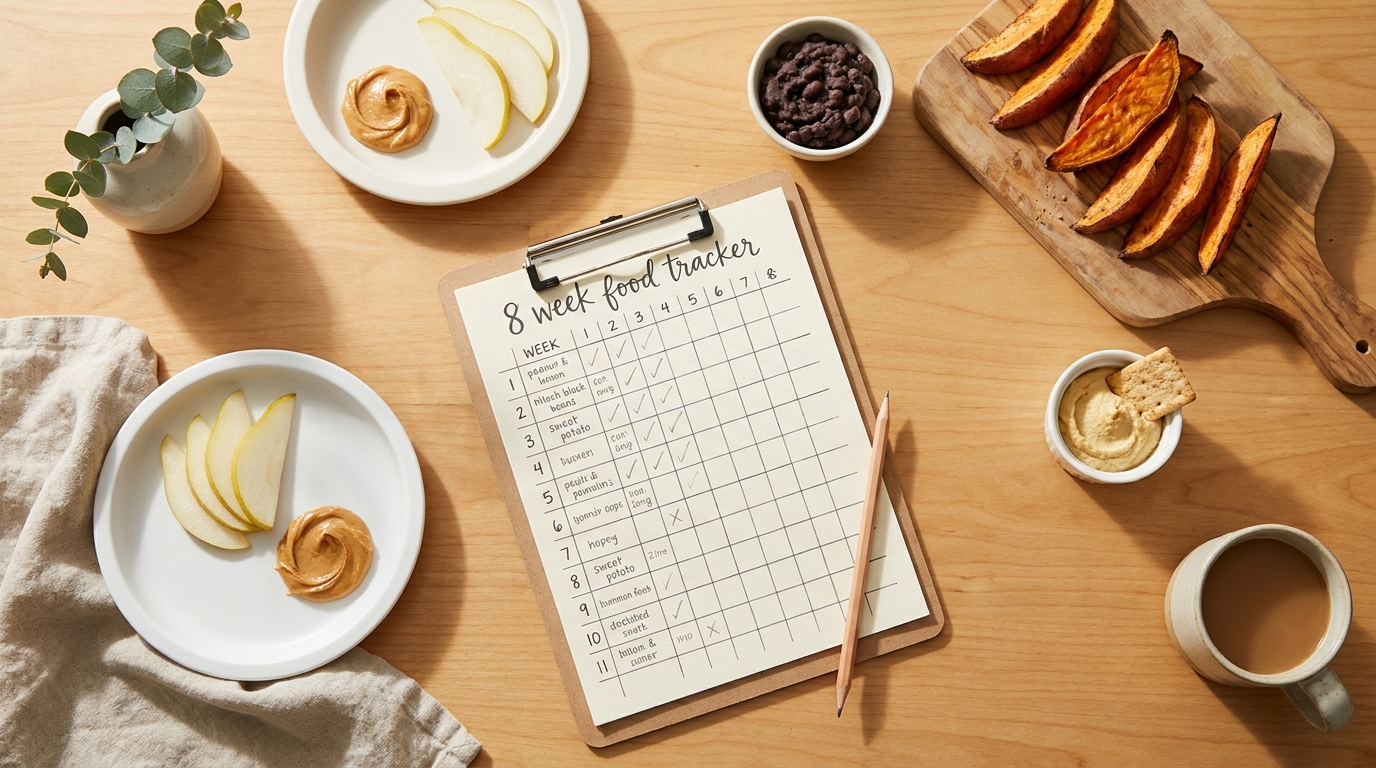
- What a Filled-In Tracker Actually Looks Like
- How to Choose the Food Each Week
- Safe Prep for Toddlers: How to Cut Common Foods
- Food Ideas: A Starter Bank of Weekly Picks
- The Weekly Rhythm: What One New Food a Week Looks Like
- The Table Rules: What to Say (and Not Say)
- Age Adjustments: Ages 1 to 10
- What Counts as Progress (and What to Do When a Food Stalls)
- Keeping the Tracker Going on Busy Weeks
- A Sample Week: Pear Week, Day by Day
- Frequently Asked Questions
- Start With One Food This Week
The 8-Week Tracker
Here’s the grid. Each row is one week. Fill in the food, how you served it, which exposure number this was, and what happened.
Good to knowExposure is not eating. A food on the plate counts, even if nobody touches it.
You’ll see that there’s a column for exposure number, which is the whole point. When that food comes back later in the week, you don’t make a new row. You add a tally (I use a simple I, II, III in the same cell).
| Week | Food offered | How I served it | Exposure # (tally each time) | Reaction (use the scale below) | Notes / what I’d try next |
|---|---|---|---|---|---|
| 1 | |||||
| 2 | |||||
| 3 | |||||
| 4 | |||||
| 5 | |||||
| 6 | |||||
| 7 | |||||
| 8 |
The Reaction Scale
Instead of “liked it” or “hated it,” use a code so the grid stays quick to fill in. This is the scale I use.
| Code | What it means |
|---|---|
| S | Saw it on the table or plate (no interaction) |
| P | Played with it, touched it, or helped prepare it |
| K | Smelled it or kissed it (touched it to their lips) |
| L | Licked it or took a tiny taste and spat it out |
| B | Took a bite and swallowed |
| E | Ate a portion |
| A | Asked for it (the jackpot) |
Everything from S to A is progress. The codes aren’t a ladder your child must climb in order, either. Some kids skip straight to a bite and then regress to S for two weeks. That’s normal and worth logging without judgment.
A Plain-Text Version You Can Paste Anywhere
If you’d rather keep this in a notes app or a text message to yourself, this version copies cleanly:
ONE NEW FOOD A WEEK: 8-WEEK TRACKER

Week 1: Food: ______ | Served as: ______ | Exposures: ___ | Reaction: ___ | Notes: ______
Week 2: Food: ______ | Served as: ______ | Exposures: ___ | Reaction: ___ | Notes: ______
Week 3: Food: ______ | Served as: ______ | Exposures: ___ | Reaction: ___ | Notes: ______
Week 4: Food: ______ | Served as: ______ | Exposures: ___ | Reaction: ___ | Notes: ______
Week 5: Food: ______ | Served as: ______ | Exposures: ___ | Reaction: ___ | Notes: ______
Week 6: Food: ______ | Served as: ______ | Exposures: ___ | Reaction: ___ | Notes: ______
Week 7: Food: ______ | Served as: ______ | Exposures: ___ | Reaction: ___ | Notes: ______
Week 8: Food: ______ | Served as: ______ | Exposures: ___ | Reaction: ___ | Notes: ______

Reaction codes: S=saw  P=played/touched  K=smelled/kissed  L=licked  B=bite  E=ate some  A=asked for it
Where to Keep Your Printed Tracker
Print the tracker in landscape so the notes column has room to breathe. Tape it to the inside of a cabinet door, not the front of the fridge. A tracker your kid can see turns into a scoreboard, and you want it to be your private log.
If your child is older and likes being part of the plan (more on that below), the fridge is fine. Jot a “Next Up” list of foods on the back so a tired Sunday needs no decisions.
Why Exposure Tracking Works for Picky Eaters
A typical food chart asks, “Did my child eat it?” That turns every dinner into a pass-fail test. Kids can feel the stakes even when you keep your face neutral.
An exposure tracker asks something gentler: “Did my child meet this food in a calm, low-stakes way?” Seeing it on the table counts. So does watching you eat it, helping wash it, smelling it, or touching it. Tasting is one possible outcome among many, and often not the first.
- It matches how kids actually learn foods. Feeding specialists often say it can take many repeated exposures, sometimes 10 or more, and it varies a lot by child. Treat that as a guide, not a target. One refusal tells you almost nothing.
- It protects your mood. When a rejected food is just “exposure #3 logged,” it stops feeling like a verdict on your cooking or parenting.
- It protects your child’s relationship with food. Pressure, bribes, and bite-counting tend to backfire. This tracker rewards you for offering, so the pressure lands on the routine and stays off your kid.
- It shows progress you’d otherwise miss. A kid might go from screaming when a food is on the plate, to letting it sit there, to licking it. That is real progress, and a yes-or-no chart would miss all of it.
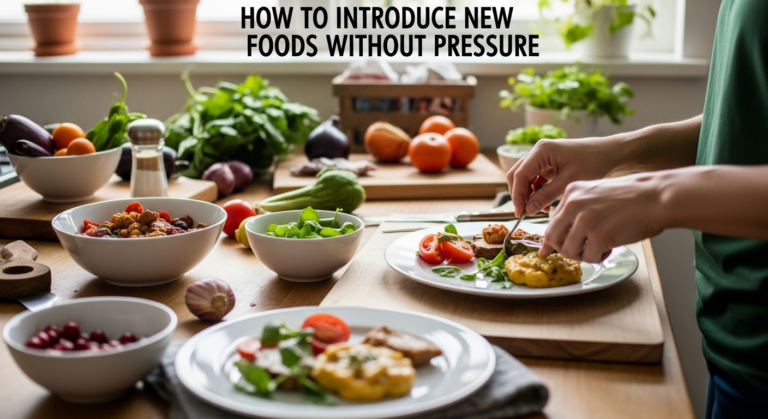
My post on how to introduce new foods with no pressure covers the table rules in more depth. This tracker is the practical companion that turns those rules into a habit.
How Often Should You Introduce a New Food to a Toddler?
There’s no magic number. One new food a week is a pace that works for most families, for four reasons.
- It’s slow enough to be sustainable. A new food every day sounds ambitious and burns out the cook. One a week is a pace you can keep through a flu, a busy soccer season, and a trip to Grandma’s.
- It gives each food room to repeat. The goal is to see the same food several times, not to cycle through fifty foods once. With one new food per week, it can reappear on Tuesday, Friday, and again the next week.
- It keeps the plate mostly familiar. Each meal includes at least one food your child reliably eats, so the new item is a small guest at a comfortable table. When three new things land at once, kids often shut down.
- It’s easy to track. Eight weeks, eight foods, one clear picture.
A few caveats:
- If your child is still in the early introduction of solids and allergens, follow your pediatrician’s guidance on timing and order. This tracker is built for the “keep widening the menu” stage. For first foods, my 100 first foods checklist is the better tool.
- Some kids need more support than a tracker can give. If meals routinely end in distress, or your child’s list of accepted foods is very short, mention it to your pediatrician. The full list of red flags is under “When to Call In Backup” below.
- “New” can be tiny. A familiar food in a new shape, color, or preparation counts as a new exposure, even if you’ve served the ingredient before.
What a Filled-In Tracker Actually Looks Like
A blank grid is easy to nod along with and hard to picture. Here’s a realistic example for a child who eats mostly pasta, crackers, yogurt, and chicken nuggets, and doesn’t love vegetables.
This grid is a made-up example to show how the codes work. It is not a real log. Each tally is the total number of exposures so far. Week 6 (pear) is broken down day by day in “A Sample Week” further down.
| Week | Food offered | How I served it | Exposure # | Reaction | Notes |
|---|---|---|---|---|---|
| 1 | Roasted sweet potato | Wedges beside regular fries | III | S, S, P | Poked it, said “squishy” |
| 2 | Cucumber | Thin sticks with ranch | IV | S, K, L, B | Licked ranch off first. Bite on 4th try. |
| 3 | Avocado | Mashed on toast | II | S, S | Still ignoring it. Sweet potato returned as a side twice (P, L) and is now a “maybe” |
| 4 | Black beans | Soft beans, lightly flattened, on the side | III | S, S, S | No interaction. Try mashed next week. |
| 5 | Black beans, mashed | Spread inside quesadilla | II | S, B | One bite, no comment |
| 6 | Pear | Sliced, then with yogurt dip, then baked | IV | S, P, B, E | First bite came with the dip. Ate one warm baked slice. |
| 7 | Cooked carrots | Soft coins, glazed with butter | IV | S, S, L, B | Not a hit, but not a battle |
| 8 | Hummus | Spoonful beside crackers | III | P, K, L | Smelled it for a full minute |
Look at what this grid tells you that a “ate it / didn’t eat it” chart wouldn’t:
- Sweet potato went from avoided to a “maybe” over weeks 1 and 3. It came back as a repeat instead of being written off.
- Black beans went nowhere on their own but got a bite once they were mashed into a quesadilla. That’s a useful clue about texture.
- Pear with a yogurt dip was an easy win, and the dip was the bridge. Worth remembering.
- Nothing here would have felt like success on a typical “did they eat it?” chart. On this one, almost every row shows movement.
How to Choose the Food Each Week
The most common reason a tracker fizzles is that the first food is ambitious. Pick something that can win.
Start with “Neighbors” of Foods They Already Eat
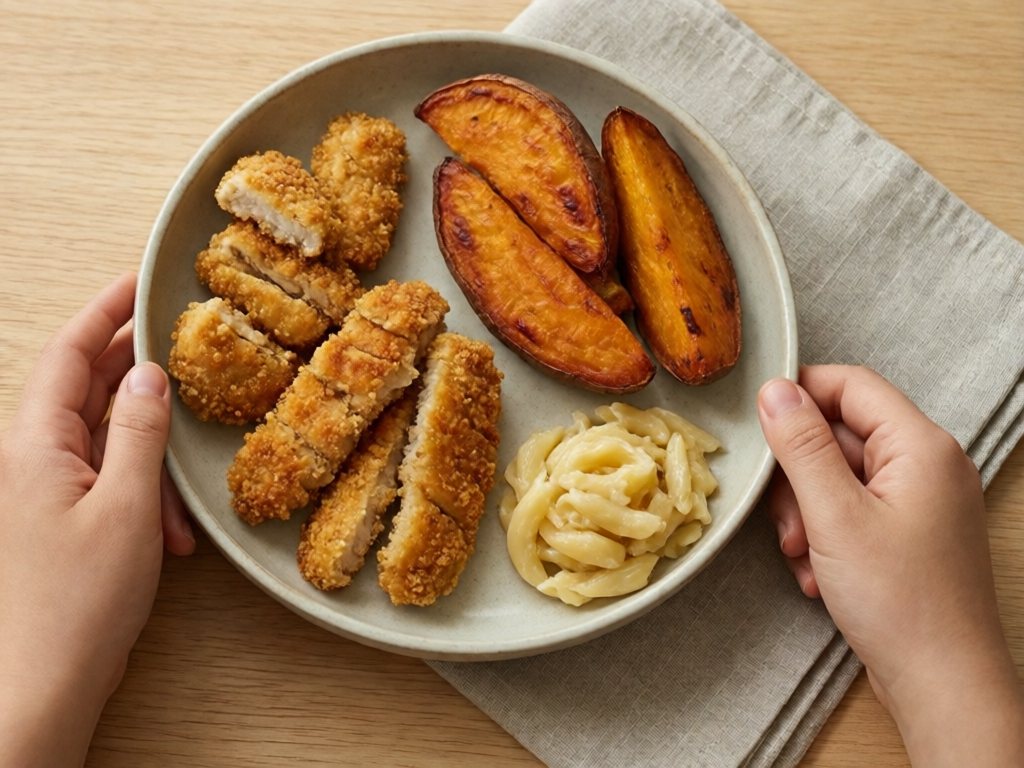
Kids often accept foods that look or taste a little like what they already eat. This is the idea behind food chaining, where you move gradually from an accepted food to a similar one. Many feeding therapists use it, and very restricted eaters may need professional guidance.
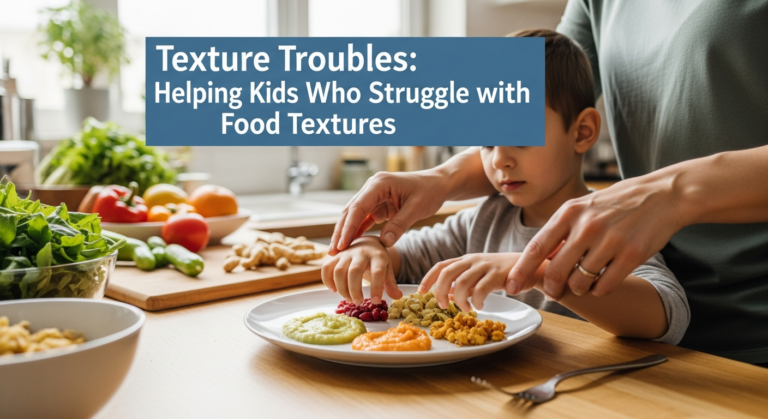
I explain the full method in the food chaining guide for picky eaters. For the tracker, it means your week-one pick can be a close cousin of a safe food.
| Safe food your child eats | Neighbor to try this week |
|---|---|
| Chicken nuggets | Baked chicken tenders with a similar crumb |
| French fries | Roasted sweet potato wedges |
| Plain pasta | Pasta with a smooth, mild sauce |
| Crackers | A different cracker shape or whole-grain version |
| Applesauce | Soft diced pears or baked apple slices |
| Cheese quesadilla | Quesadilla with a thin layer of mashed beans |
| Pancakes | Pancakes with mashed banana mixed in |
Mix Easy Weeks and Stretch Weeks
I plan the 8 weeks as a rhythm, not a staircase:
- Weeks 1, 3, 5, 7: “neighbor” foods. Close cousins of safe foods. Low stakes, likely wins.
- Weeks 2, 4, 6, 8: “stretch” foods. Something new in color, texture, or flavor that you actually want in the rotation, such as a green vegetable, a legume, or a fish dish.
That rhythm keeps momentum and avoids the discouraging run of eight hard foods in a row.
Use a Short List of “Worth the Effort” Foods
You don’t need to introduce everything. Think about what’s nutritionally useful and realistically available in your house. If iron or protein is on your radar, my guides to iron-rich meals and snacks by age and high-protein meals for kids can help you pick foods that earn their spot on the plate. Treat those as idea lists, not assignments.
Safe Prep for Toddlers: How to Cut Common Foods
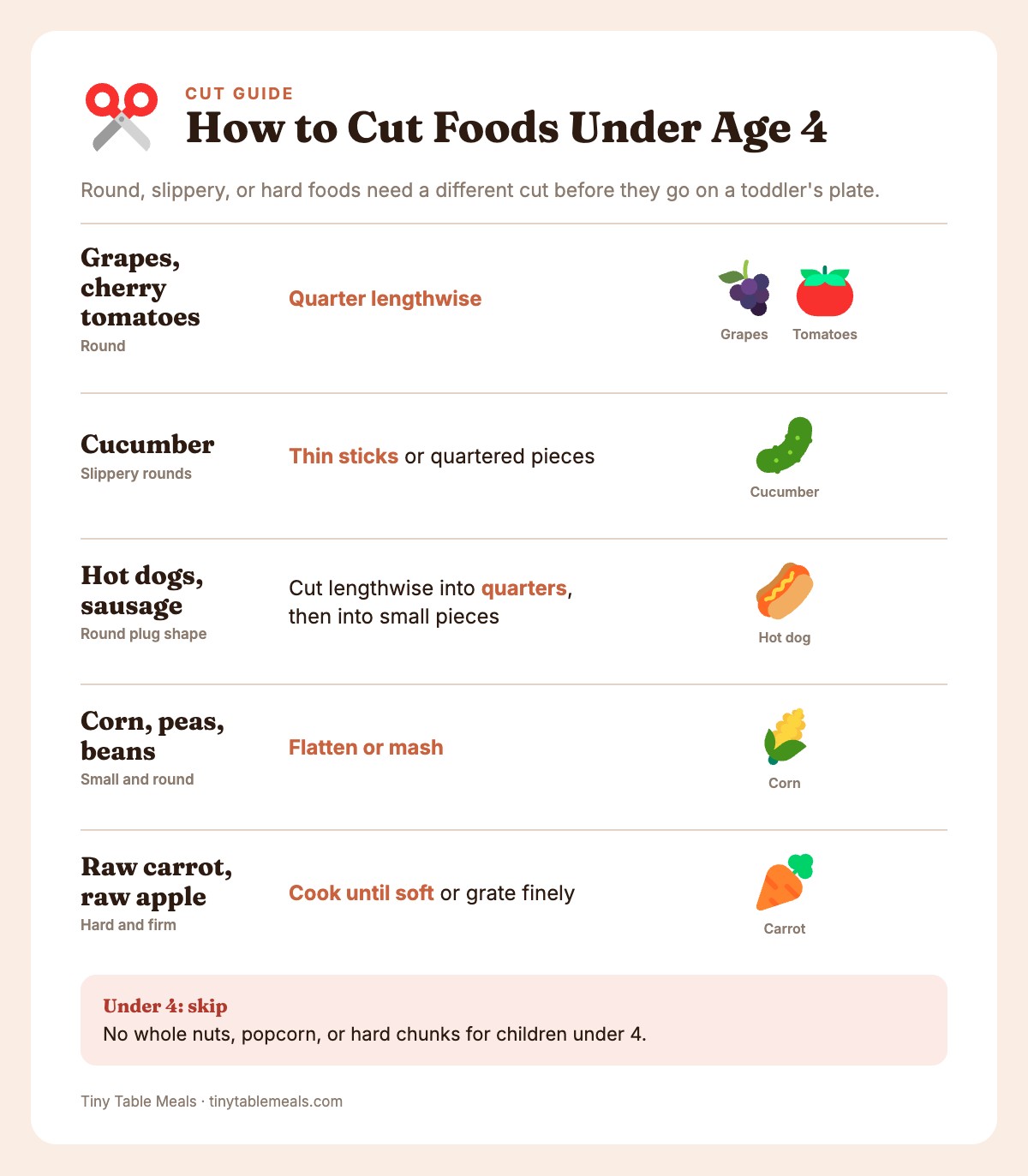
Safety firstHow you serve a food matters as much as which food you pick. Run through this list before any new food hits the plate.
- Stay with your child for the whole meal.
- Keep kids seated while they eat.
- Skip eating in the car or while walking.
- No food while crying, lying down, or running.
- No whole nuts, popcorn, or hard chunks for children under 4.
- If your child has not yet had a major allergen (peanut, egg, milk, wheat, soy, fish, shellfish, tree nuts, sesame), introduce it on its own first, following your pediatrician’s guidance. Then it can become a tracker food. My guide to introducing allergens covers that stage.
- Any past reaction to a food means a doctor visit before you offer it again.
- Call emergency services for trouble breathing, swelling of the lips or face, or repeated vomiting soon after eating.
- Consider taking an infant and child CPR and choking course.
Here is how to cut or cook common picks for children under 4.
| Food | Why it’s a risk | Safer prep under age 4 |
|---|---|---|
| Grapes, cherry tomatoes | Round, can block the airway | Quarter lengthwise |
| Berries | Small and round | Halve or quarter blueberries and similar round berries until age 4 (flatten or mash for the youngest). Slice strawberries thin. |
| Cucumber | Slippery rounds | Thin sticks or quartered pieces |
| Raw carrot, raw apple | Hard and firm | Cook until soft or grate finely. Avoid raw hard slices, sticks, or chunks under age 4. |
| Corn, peas, beans | Small and round | Flatten or mash |
| Hot dogs, sausage | Round plug shape | Cut lengthwise into quarters, then into small pieces |
| Tofu, meat, cheese, melon | Chunks can lodge | Small, soft pieces |
| Nut butters | Thick and sticky | Spread thinly on toast or a cracker, never by the spoonful |
Food Ideas: A Starter Bank of Weekly Picks
These foods tend to work well as weekly picks:
| Category | Ideas | Prep note |
|---|---|---|
| Fruits | Pears, kiwi, mango, ripe peaches, berries, roasted apples, melon | Halve or quarter berries; cook or grate apples; small soft melon pieces |
| Vegetables | Roasted sweet potato, cucumber, cooked carrots, roasted broccoli, peas, zucchini “fries” (baked until soft), bell pepper strips (cooked soft for young kids), corn | Cucumber as thin sticks; flatten or mash peas; cut or mash corn kernels, or use creamed corn or polenta under age 4 |
| Proteins | Black beans, lentils, hummus*, scrambled eggs*, flaked salmon*, meatballs, tofu* | Flatten beans; check fish for bones; small pieces of meatball and tofu |
| Grains and starches | Quinoa, brown rice, whole-wheat pasta*, couscous*, polenta, oat pancakes* | Short, soft pasta shapes |
| Flavor and texture tries | A new dip, a different cheese*, a seasoned version of a plain food, a crunchy topping | Skip hard, crunchy toppings under age 4 |
* Contains or may contain a major allergen. If your child hasn’t had it yet, introduce it on its own first, following your pediatrician’s guidance. Then it can become a tracker food.
If you’re not sure how to prepare a food safely for your child’s age, check with your pediatrician.
The Weekly Rhythm: What One New Food a Week Looks Like
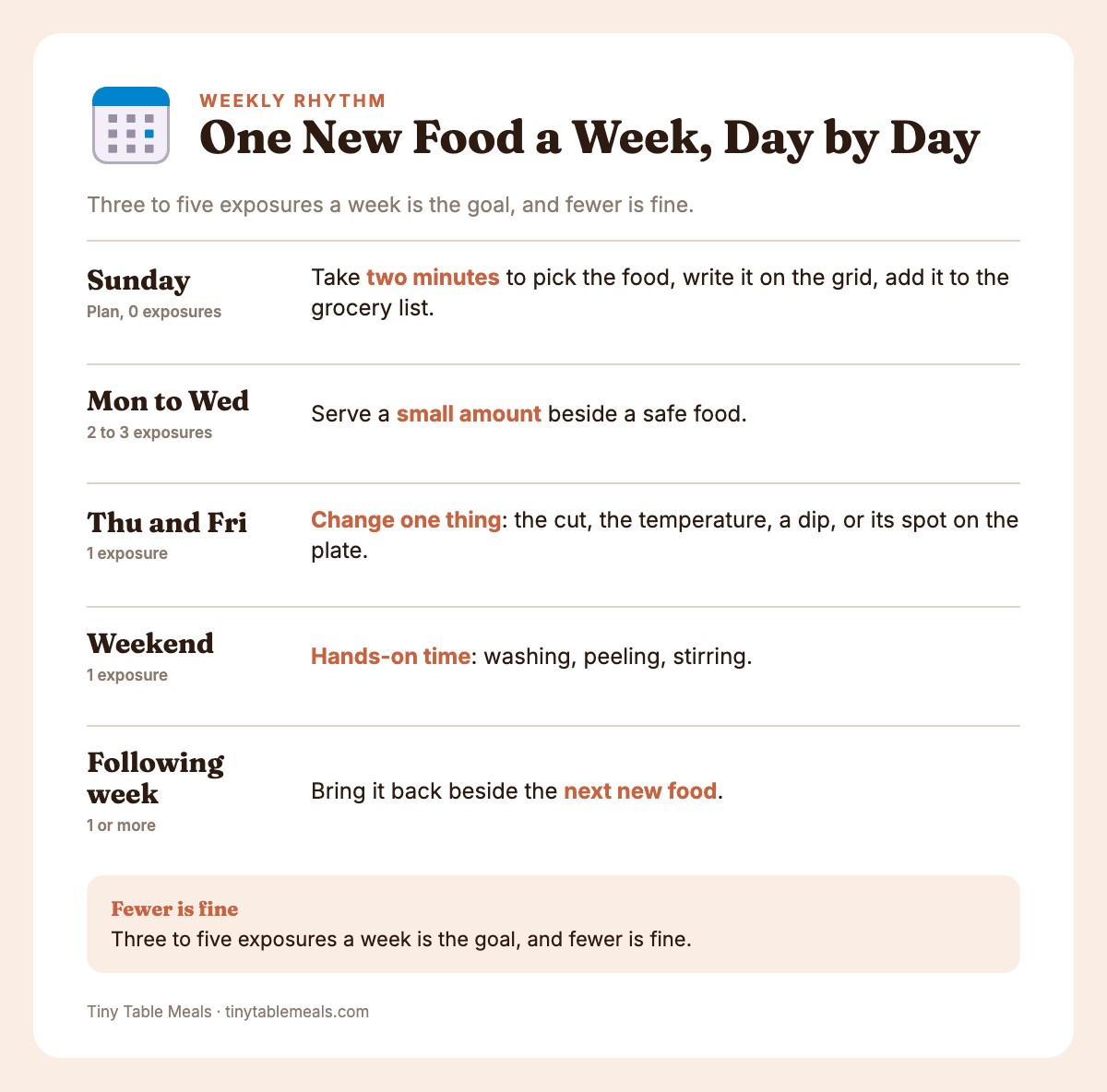
A tracker works only if the routine behind it is light. This rhythm is light enough to survive sports season, sick days, and a few too many takeout nights. Three to five exposures a week is the goal, and fewer is fine.
| When | What to do | Target exposures |
|---|---|---|
| Sunday | Take two minutes to pick the food, write it on the grid, and add it to the grocery list. No prep needed. | 0 |
| Monday to Wednesday | Serve a small amount beside a safe food | 2 to 3 |
| Thursday and Friday | Change one thing: the cut, the temperature, a dip, or its spot on the plate | 1 |
| Weekend | Hands-on time: washing, peeling, stirring | 1 |
| The following week | Bring it back beside the next new food | 1 or more |
Monday to Wednesday: First Exposures
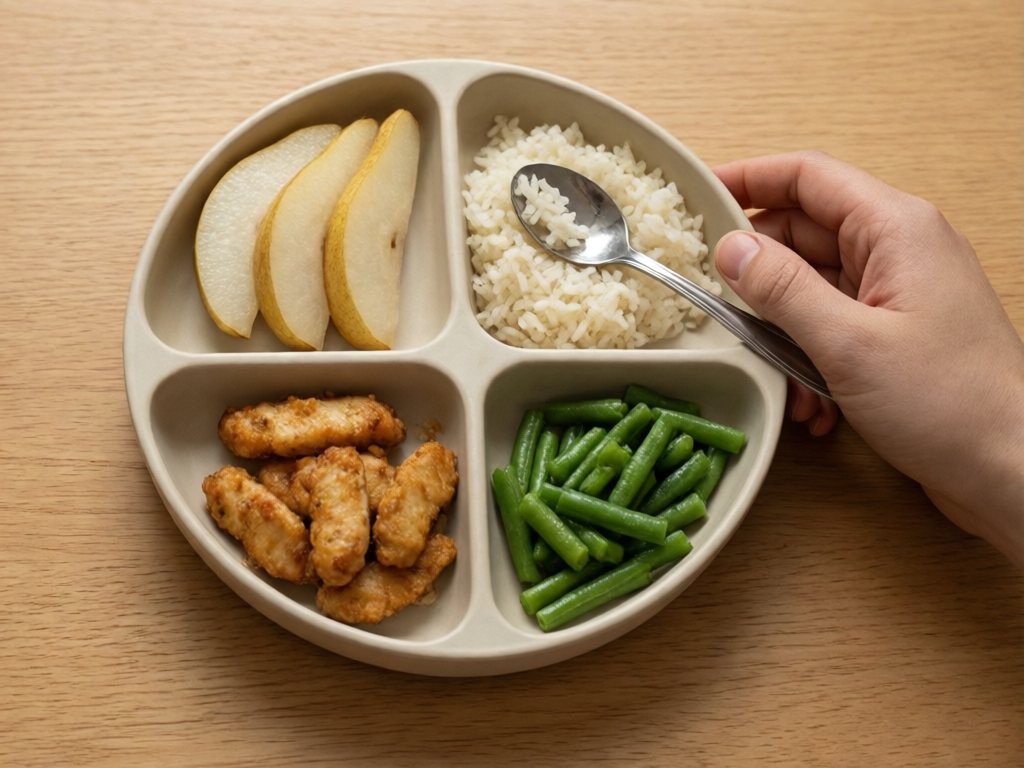
Serve a small amount of the new food alongside at least one safe food. Aim for two or three exposures in the first half of the week. They can be at different meals: a tiny portion at dinner Monday, a slice at lunch Wednesday.
TipDon’t comment on whether it gets eaten. Log it afterward, away from the table.
Thursday and Friday: Change the Format
If the food has been sitting there unchanged, change one thing. Cut it differently, serve it warm instead of cold, add a dip, or move it to a different spot on the plate. This is not a trick. It’s a new exposure, and it tells you which format your child might accept.
Weekend: Let Them Interact
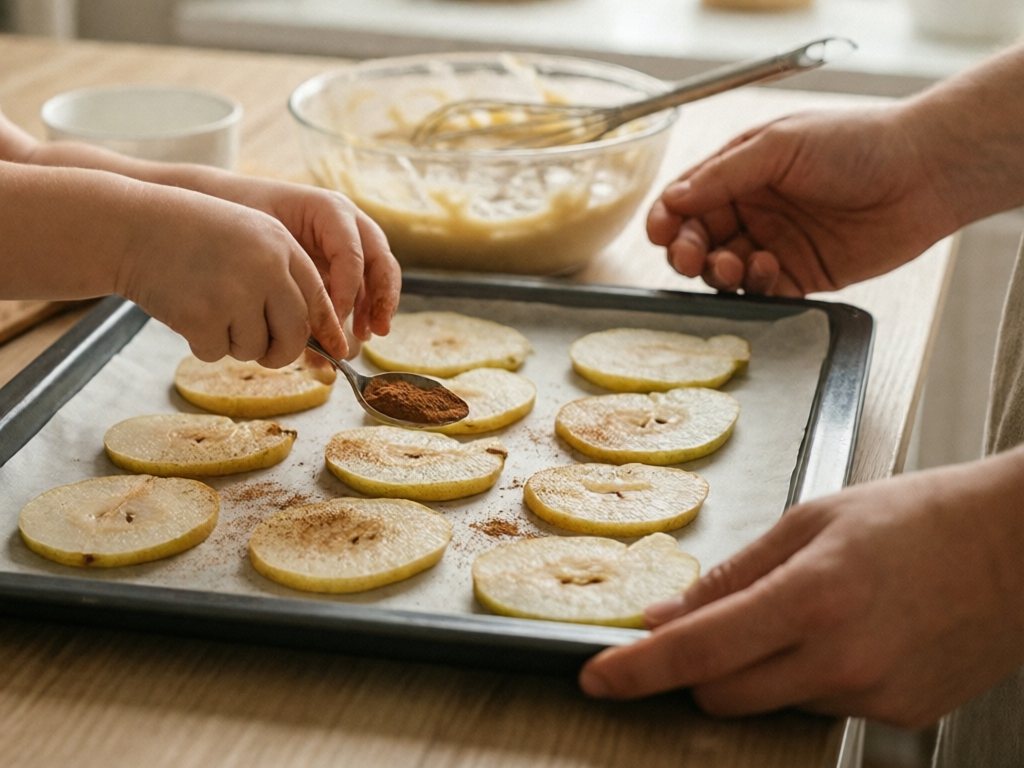
Weekends are best for hands-on exposures. Let your child help wash, peel, stir, or taste-test while you’re cooking. Kitchen involvement counts as exposure, and for many kids it’s the most powerful kind.
Supervise knives, stoves, and hot pans. Keep little ones away from the oven door. For age-appropriate jobs, the age-by-age guide to teaching kids to cook breaks down what kids can handle at each stage.
The Following Week: Repeat and Rotate
When you introduce next week’s food, bring the previous week’s food back at least once. It doesn’t need to be a big deal. A single slice or spoonful counts, and the tally keeps going in the exposure column.
The Table Rules: What to Say (and Not Say)
The tracker only works if the table stays calm. These are the rules I follow, and the scripts I use when I’m tempted to slip.
The Division of Responsibility
The tracker rests on Ellyn Satter’s Division of Responsibility, which many feeding professionals use with toddlers and older kids. I walk through it in the Division of Responsibility in feeding explained.
It’s simple: you decide what, when, and where food is served. Your child decides whether to eat it and how much. You’re in charge of the offering, and your child is in charge of the eating.
Phrases That Help
| Instead of… | Try… |
|---|---|
| “Just one bite.” | “That’s here if you want it.” |
| “Eat your vegetables first.” | (Say nothing. Serve it with the rest.) |
| “You’ll like it, I promise.” | “Some people like it, some don’t. It’s okay to figure it out.” |
| “If you eat that, you can have dessert.” | (Skip the deal. Serve dessert, if you serve it, the same way every time.) |
| “Why won’t you just try it?” | “You don’t have to eat it. You can smell it or touch it if you want.” |
| “Good job eating your broccoli!” | “Looks like you’re really exploring tonight.” |
Praise is tricky. Over-celebrating a bite can create performance pressure, and kids sometimes dig in harder when they feel watched. Quiet, neutral comments work better than cheering.
Other Rules That Matter More Than You’d Think
- Serve the food even if you expect a no. Exposure counts without eating.
- Keep portions tiny. A teaspoon or a single piece of a new food is plenty. A big pile feels like a demand.
- Eat it yourself. Kids learn from watching you enjoy a food. You don’t have to narrate it. Just eat it.
- Keep one safe food on the plate. Always. It lowers anxiety.
- Let them say no politely. A “No, thank you” is a perfectly good response, and it often makes a kid more willing to try next time.
- End the meal on time. Don’t cook a separate meal. If dinner ends with the new food untouched, the next planned meal or snack comes at its usual time. If your child is hungry before then, the safe food from the plate is fine to offer again.
Age Adjustments: Ages 1 to 10
The tracker works across a wide age range, but what you do with it changes as your child grows.
Ages 1 to 3: Make It Sensory and Tiny
Toddlers are developmentally wired to be wary of new foods. It’s a normal phase, not a failure. For this age group:
- Serve tiny portions: one pea, one piece of pear.
- Let them touch, squish, and smear. Messy play counts as exposure.
- Offer new foods at a regular meal or snack when your child is hungry but not exhausted, always beside a safe food.
- Expect strong, changing opinions. A food accepted on Monday may be rejected on Thursday.
- Keep the tracker private. They won’t care about it, and you don’t need them to.
If your toddler is also in an “only eats one thing” stage, I cover how to ride that out in my post on food jags. The short version: keep offering variety without chasing them with it.
Ages 4 to 6: Make It a Game (Gently)
Preschoolers and kindergartners love ownership. They want choices, and they want to help.
- Let them pick between two options for the week’s new food (“Pears or kiwi?”).
- Give them a job: washing, stirring, arranging, choosing the plate.
- Introduce the reaction scale in kid language: “Did you smell it, lick it, or eat it?”
- Use a “learning plate” or a small side dish where new foods can sit with no expectation.
One thing that helps at this age is a “no thank you” bowl. It’s a small bowl at the table where any food can be politely set aside, no bite needed, so refusing doesn’t mean dumping it on the floor.
Ages 7 to 10: Invite Them Into the Plan
School-age kids can handle real participation, and many do better when they feel in control.
- Show them the grid. Explain that the goal is exploring, not eating everything.
- Let them choose some of the weekly foods from a list you’ve pre-approved.
- Have them rate the food themselves using the scale. Their own words and notes are fine.
- Involve them in cooking. At this age, they can make simple dishes and snacks, which builds pride and curiosity. Stay nearby for knives, stoves, ovens, and hot liquids, and stick to no-cook snacks for younger school-age kids. My list of after-school snacks kids can make themselves is a good place to start.
At this age, kids also care about what peers eat. If a food is a hit at school, it may be easier to accept at home.
What Counts as Progress (and What to Do When a Food Stalls)
Even with a perfect routine, some foods won’t move for a while. Here’s how to read the grid and decide what to do next.
Signs of Progress
- Your child tolerates the food on their plate without protest.
- They touch it, smell it, or comment on it (“It’s orange”).
- They help prepare it.
- They take a lick or a tiny taste, even if it’s spit out.
- They accept a similar food that was refused before.
- They ask what’s for dinner and show curiosity about the menu.
Any of these on the grid means the process is working.
When a Food Has Stalled
| What you’re seeing | What to try |
|---|---|
| Still at “S” after 4 or 5 exposures | Change the format: raw to cooked, whole to mashed, cold to warm. Try serving it earlier in the day. |
| Refuses anything touching the new food | Use a divided plate or a separate small bowl. |
| Accepts it only with a dip | Keep the dip. It’s a bridge, not a crutch. |
| Fine at home, refuses at school or Grandma’s | Normal. Log home exposures and let other settings be separate. |
| Went from accepting to refusing | Common, especially with toddlers. Keep serving it without comment. |
| Gags on the texture | Go back a step to a smoother or softer version. If gagging is frequent or intense, talk to your pediatrician. |
| No movement on any food after several weeks | Check the basics: regular meal and snack times, no grazing or juice in between, tiny portions beside a safe food, a calm table. If all of that is in place, ask your pediatrician. |
| Wants the food only once you stop offering it | Very common. Keep offering in a low-key way, and don’t make a fuss when interest shows up. |
| Siblings comment on the new food | Make it a family rule that no one comments on anyone else’s plate. “We don’t yuck someone’s yum” works in many households. |
| Your child is stressed by seeing the tracker | Consider putting it away. It works just as well as a private, parent-only log. |
When to Retire a Food (For Now)
Ten is my own rule of thumb, not a research number or a deadline. If a food has had ten or so calm exposures with no movement at all, it’s reasonable to pause it and bring it back in a month or two.
You’re pausing, not quitting, and plenty of foods need more tries than that. Taste preferences shift, and a food that’s been off the table for six weeks often feels new again.
When to Call In Backup
Safety firstA tracker can’t fix everything. Talk with your pediatrician if you see any of these.
- A very short list of accepted foods
- Foods that drop off the list and don’t come back
- Slow growth or weight loss
- Coughing or choking during meals
- A pattern of gagging or vomiting
- Signs of nutrient deficiency
- Meals that regularly end in distress
They may refer you to a feeding therapist or dietitian. Bring the tracker along, because weeks of concrete notes make that conversation easier.
Keeping the Tracker Going on Busy Weeks
The short version:
- Add the new food to a meal you’re already making.
- Pick what’s in season.
- Keep a “Next Up” list so a tired night needs no decisions.
- Skip a week without doubling up.
- Give other caregivers the three rules: small portions, no pressure, neutral comments.
Fold New Foods Into Meals You’re Already Making
You don’t need to cook separate meals. A scoop of black beans beside tacos can be enough. So can a few roasted sweet potato wedges beside whatever protein is on the menu, or a spoonful of a new dip beside crackers.
Big-batch cooking helps too, since you can set aside small portions of a new food without extra work. My freezer-to-Instant-Pot dump meals are handy when you want dinner handled and your attention free for the table. My picky eater meal plan pairs well with the tracker if you want the rest of the week’s dinners sorted.
Match the Season
Seasonal produce is cheaper and tastes better, which helps a new food make a good first impression. In the fall, think pears, apples, sweet potatoes, squash, and carrots. If you want ideas, our fall produce guide for families lists what’s fresh and how to use it.
Keep a “Next Up” List
Keep a running list of foods you’d like to try, in your phone or on the grid’s back. When the week arrives and you’re tired, you don’t have to decide. Just pick the next item.
Expect Skipped Weeks
TipMissed a week? Don’t double up. Pick up where you left off. The grid is yours, and it’s allowed to have blank rows.
Share It With Other Caregivers
If a grandparent, co-parent, or babysitter is feeding your child, show them the grid and the simple rules: small portions, no pressure, neutral comments. A shared approach prevents mixed messages. You don’t need everyone to follow the full program, but a quick conversation helps.
On the Nights It Feels Like Failing
You’re not failing. A refused food on the table is a successful exposure. If you served it calmly and logged it, you did the job. The grid exists to remind you of that on the nights it doesn’t feel true.
A Sample Week: Pear Week, Day by Day
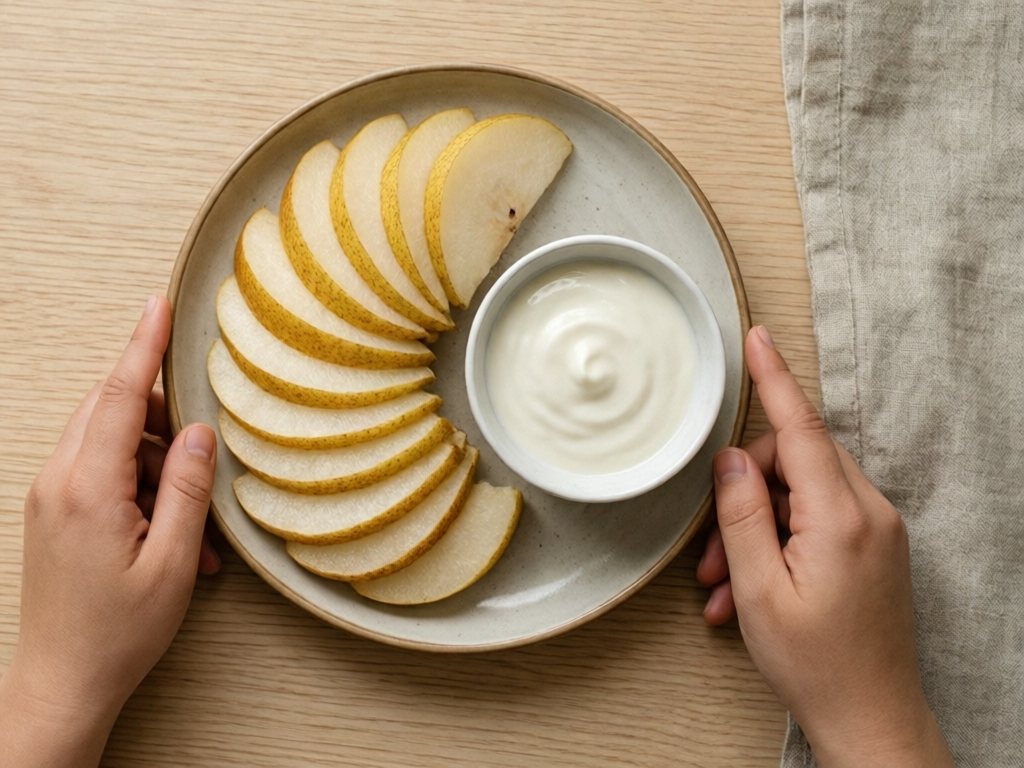
Here’s the pear week from the example grid, day by day. It’s a made-up illustration, meant to show how little extra work it is.
| Day | What happened | Log |
|---|---|---|
| Sunday | I chose pears as the week’s food and added them to the grocery list. | Planned |
| Monday | Dinner was baked chicken tenders, rice, and green beans. I put three thin pear slices on the side of the child’s plate. They ignored them. I ate mine. | Exposure 1, S |
| Tuesday | Lunch was quesadilla and yogurt. I added a couple of pear cubes to the yogurt. The child picked them out and put them on a napkin. | Exposure 2, P |
| Thursday | Snack time. I sliced a pear and offered plain yogurt for dipping. The child dipped, licked the yogurt, and then took a tiny bite of pear. | Exposure 3, B |
| Saturday | We baked pear slices with cinnamon while making pancakes. The child helped sprinkle the cinnamon, and I handled the oven. They ate one slice warm. | Exposure 4, E |
Four exposures, a few minutes of added effort across the whole week, and the “that one is still here” energy had changed. There was no pear victory parade. We just moved forward.
Frequently Asked Questions
How many times should I offer a food before giving up?
There’s no exact number. As noted above, it can take many exposures, sometimes 10 or more, and it varies a lot by child. My own rule of thumb: if a food has had ten or so calm exposures with no movement at all, it’s fine to pause it for a month or two and try again. Taste changes with age, so a “no” today isn’t permanent.
Does touching or smelling a food really count as an exposure?
Yes. Exposure means any positive, low-pressure encounter with a food: seeing it, smelling it, touching it, helping prepare it, or watching you eat it. Tasting is one possible step, but it’s not required for the exposure to count. That’s why the tracker logs interaction, not just eating.
What if my child refuses the new food every single time?
Keep serving it in small amounts without comment, and try changing the format: raw versus cooked, whole versus mashed, plain versus with a dip. Look for tiny signs of progress, like tolerating it on the plate or smelling it. If the refusals are intense, your child’s list of accepted foods is very short, or mealtimes are regularly distressing, check in with your pediatrician about whether a feeding specialist could help.
How many new foods can I introduce per week?
One a week is plenty for most kids. Too many new items at once can overwhelm a wary eater and make it harder to see which foods are making progress. If your child is adventurous and enjoys new things, feel free to add a second “easy” new food, such as a familiar fruit in a new form. Keep the pace comfortable for your whole family.
Should I show the tracker to my child?
It depends on age and temperament. Toddlers don’t need to see it. Many 4-to-6-year-olds enjoy picking the weekly food and helping fill in a simple version. Older kids often like being involved in the plan. If seeing the chart makes your child anxious or turns eating into a performance, keep it private. It works just as well as a parent-only log.
What if my child eats a new food once and then refuses it again?
That’s common, especially with toddlers. Acceptance often comes and goes before it settles. Log the exposure, keep serving the food occasionally without commenting, and don’t treat the first bite as a guarantee. Think of it as a trend over weeks, not a single result.
Does this work if my child is going through a food jag?
Yes, but go gently. During a jag, keep the safe food available, serve tiny portions of the new food alongside it, and focus on exposure rather than eating. Many jags pass on their own, and a calm routine keeps variety in the picture while they do. If a jag lasts for a long time or your child’s diet keeps narrowing, bring it up with your pediatrician.
Start With One Food This Week
You don’t need a perfect plan, a fancy chart, or a child who eats everything. You need one food, a small spoonful, and a place to write down that it showed up. Copy the grid, pick something friendly for week one, and let the tally do the encouraging.
Some weeks the pear will end up on a napkin, and some weeks it will end up in a small, surprised mouth. Either way, you showed up and kept the table calm, and that is the part you control. Eight weeks from now you’ll have a page of proof that all those quiet, boring exposures were adding up the whole time.