
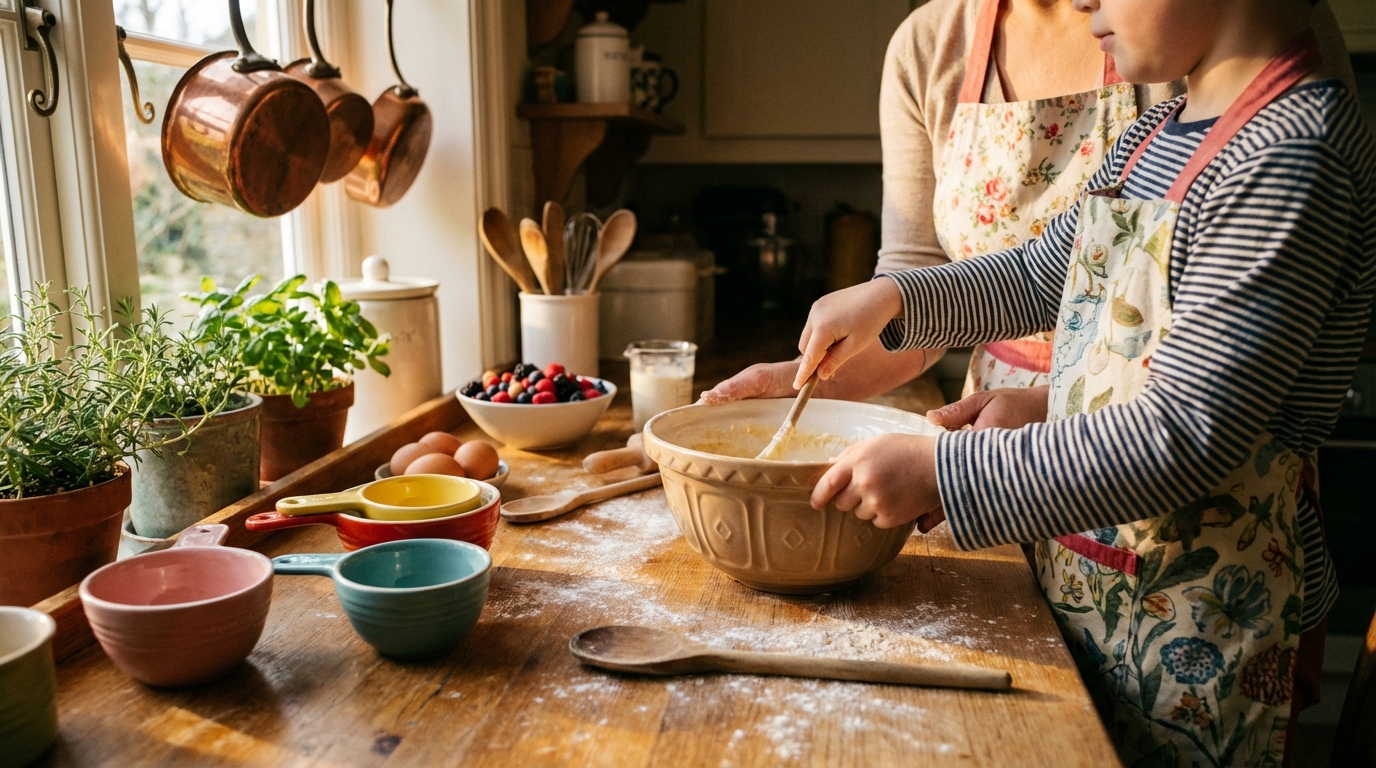
Teaching Kids to Cook: The Complete Age-by-Age Guide to Kitchen Skills
This guide helps you teach your kids to cook, explaining why it's crucial for their development and providing age-by-age skills, safety guidance, and practical advice for making it work in your actual life.
- Discover why teaching your kids to cook builds crucial life skills like math, science, and independence.
- Understand that cooking with kids is messy at first but offers immense long-term developmental benefits.
- Boost your child's nutrition literacy and willingness to try new foods by involving them in cooking.
- Embrace cooking as a core part of fostering real-world competence and an 'analog childhood'.
- Get age-specific skills, safety guidance, and practical advice for every stage from toddler to teen.
You’re standing at the stove on a Wednesday night, stirring pasta sauce with one hand and answering a math homework question with the other, and your seven-year-old wanders in and says, “Can I help?” And you almost say yes. You really do. But you look at the tomato sauce bubbling, and the sharp knife on the cutting board, and the clock that says 6:14 p.m. which means you needed dinner done four minutes ago, and you say what you always say: “Maybe next time, bud.”
Next time never comes. Or it comes once, and there’s flour on the ceiling and egg on the floor, and you quietly decide that “cooking with kids” is one of those Pinterest fantasies that looks great in a reel and is a nightmare in real life. I get it. I’ve been there. I once let my four-year-old “help” make muffins and spent longer cleaning up than it took to bake, eat, and digest the actual muffins. There was batter in places I didn’t know batter could reach.
But here’s what I’ve learned after years of slowly, messily, imperfectly bringing my kids into the kitchen: teaching kids to cook is one of the single most valuable things you can do as a parent. Not because it makes dinner easier (it won’t, at least not at first). Not because it looks adorable on social media (though it does, if you crop out the mess). But because cooking is the intersection of every life skill we say we want our kids to have — math, science, reading, patience, creativity, independence, confidence, nutrition literacy, and the ability to feed themselves actual food when they leave your house someday. That last one keeps me up at night more than I’d like to admit.
This guide is the one I wish I’d had when my oldest first climbed up on the step stool and reached for the spatula. It covers every age from toddlerhood through the teenage years, with specific skills, realistic expectations, safety guidance, and practical advice for making it work in your actual life — not in a fantasy kitchen with unlimited time and a professional cleaning crew.
Why Teaching Kids to Cook Matters More Than Ever
There’s a quiet revolution happening in parenting right now. You’ve probably felt it, even if you haven’t named it. Parents in 2026 are pushing back against the idea that childhood should be a screen-mediated experience, and they’re looking for ways to give their kids real-world competence. The “analog childhood” conversation is everywhere — and cooking sits right at the center of it.
The Case for Kitchen Confidence
When a child cooks, they’re not just making food. They’re doing applied math (measuring, doubling, halving, fractions). They’re doing chemistry (what happens when baking soda meets vinegar, why eggs bind ingredients, how heat transforms dough into bread). They’re practicing reading comprehension every time they follow a recipe. They’re building executive function skills — planning, sequencing, time management — in a context that actually matters to them because there’s something delicious at the end.
Research backs this up. A 2024 study in the Journal of Nutrition Education and Behavior found that children who participated in cooking activities at home were significantly more likely to choose fruits and vegetables, try new foods, and have a positive relationship with eating. Another study from the University of Alberta found that kids who cook regularly score higher on measures of self-efficacy and are more willing to eat what they’ve prepared — even foods they’d previously rejected.
That tracks with what I’ve seen at my own table. My daughter, who once refused anything green that wasn’t a gummy bear, now eats salad she’s tossed herself. Not because I lectured her about vegetables (though I did, ineffectively, many times). Because she made it, so it was hers. If you’re working on getting your kids to expand their palate, cooking together is one of the best strategies for helping kids eat more vegetables — way more effective than bargaining or hiding cauliflower in brownies.
Beyond Nutrition: Life Skills That Last
Cooking teaches kids to fail gracefully. Pancakes will be burned. Cookies will be flat. Rice will be crunchy. And that’s fine. Learning to recover from a kitchen mistake — to scrape the burned parts, adjust the recipe, try again — builds resilience in a low-stakes environment. Nobody’s getting a grade. Nobody’s keeping score. You’re just making dinner, and sometimes dinner doesn’t go as planned, and that’s an incredibly useful thing for a child to experience.
It also teaches patience, which is a vanishing skill in a world of instant everything. You have to wait for water to boil. You have to wait for bread to rise. You have to wait for cookies to cool before you frost them (the hardest wait of all, as any parent knows). In a life dominated by instant downloads and same-day delivery, the kitchen is one of the last places where kids learn that good things take time.
And honestly? Cooking together is one of the best ways to actually talk to your kids. Not the “how was school” / “fine” exchange that happens in the car. Real conversations. Something about standing side by side, hands busy, eyes on the task — it opens kids up in a way that sitting face-to-face doesn’t. Some of my best conversations with my kids have happened while we were chopping onions or waiting for water to boil.
The Age-by-Age Kitchen Skills Breakdown
Here’s the core of this guide: what kids can realistically do at each age, what they need help with, and what to skip entirely. I want to emphasize the word realistically. Every child is different, and developmental readiness matters more than the number on the birthday cake. Use these as guidelines, not rules.
Ages 2-3: The Tiny Helpers
Your toddler wants to be where you are and do what you’re doing. That’s not a nuisance — that’s biology. Toddlers learn by imitation, and the kitchen is the most fascinating room in the house as far as they’re concerned. The goal at this age isn’t to produce food. It’s to build positive associations with the kitchen and let them participate in a way that’s safe and genuinely helpful (even if “helpful” is a generous interpretation).
Skills they’re ready for:
- Washing fruits and vegetables under running water (with supervision — toddlers and running water can go sideways fast)
- Tearing lettuce and herbs by hand
- Stirring ingredients in a large bowl (cold mixtures only)
- Pouring pre-measured dry ingredients into a bowl
- Pressing cookie cutter shapes into soft dough
- Mashing soft foods like bananas or avocado with a fork
- Sprinkling toppings (cheese, herbs, sprinkles)
- Putting items in the trash or recycling
What they need from you:
- A sturdy step stool or learning tower (non-negotiable — this is the single best kitchen investment for toddler inclusion)
- Pre-measured ingredients in small, easy-to-grip bowls
- Large mixing bowls that won’t tip easily
- Patience. So much patience. More patience than you think you have, and then some more.
- A designated workspace away from the stove and sharp tools
What to skip entirely:
- Any heat source
- Sharp tools of any kind
- Anything involving raw meat or eggs (salmonella risk plus they will put their hands in their mouths)
- Electric appliances
Starter activities: Mashing bananas for banana bread. Tearing lettuce for salad. Washing cherry tomatoes. Stirring pancake batter. Pressing cookie cutters into rolled dough. Sprinkling cheese on pizza.
If you need snack ideas that align with what toddlers can actually help with, these healthy toddler snack ideas include several that work beautifully as tiny-helper projects.
Ages 4-5: The Enthusiastic Apprentices
This is the golden age of kitchen enthusiasm. Four- and five-year-olds are desperate to do “real” jobs, not just sprinkle cheese. Their fine motor skills are developing rapidly, and they can handle more complex tasks — though their attention span is still short and their confidence often exceeds their coordination.
Skills they’re ready for:
- Everything from the 2-3 list, with more independence
- Spreading soft things (cream cheese, hummus, peanut butter) with a butter knife or child-safe spreader
- Kneading dough (they love this — it’s basically sanctioned mess-making)
- Cracking eggs into a bowl (expect shells; teach the two-handed crack method)
- Peeling bananas and oranges
- Cutting soft foods with a child-safe nylon knife (bananas, strawberries, soft cheese)
- Measuring with cups and spoons (with guidance)
- Rolling dough with a small rolling pin
- Mixing salad dressing in a sealed jar (shake, shake, shake)
- Setting the table
- Helping load the dishwasher (unbreakable items)
What they need from you:
- Child-safe nylon knives (invest in a decent set — the $5 ones from the dollar store are useless)
- Clear, simple, one-step-at-a-time instructions
- Demonstration before each new skill (“Watch me first, then you try”)
- Freedom to get messy within a defined space
- A damp towel nearby at all times
What to skip entirely:
- The stove and oven
- Regular knives
- Blenders, food processors, and electric mixers
- Anything that requires sustained focus over 15-20 minutes
Starter activities: Assembling personal pizzas on pre-made crusts. Making trail mix by measuring and combining ingredients. Building sandwiches. Mixing muffin batter. Tossing salad. Making ants on a log.
Ages 6-8: The Real Cooks
Here’s where it gets exciting. School-age kids have the fine motor skills, the attention span, and the cognitive ability to follow multi-step recipes and produce actual meals. This is the age where you shift from “helping in the kitchen” to “cooking with guidance.” It’s a meaningful difference.
Skills they’re ready for:
- Using a real (small) knife with direct supervision and proper technique training
- Peeling vegetables with a Y-peeler
- Grating cheese with a box grater (knuckle-watch supervision)
- Measuring independently (both wet and dry ingredients)
- Reading and following simple recipes
- Using the microwave independently
- Cracking eggs cleanly (most of the time)
- Making simple stovetop items with direct supervision (scrambled eggs, grilled cheese, pasta)
- Operating a toaster independently
- Washing dishes
- Basic food safety (understanding cross-contamination, handwashing, temperature)
What they need from you:
- A proper knife skills lesson (claw grip, bridge cut — YouTube has great demonstrations, but do it together in person first)
- Clear expectations about what requires asking first and what they can do independently
- Supervision near heat, but increasingly from across the kitchen rather than hovering
- Permission to own certain meals (“Saturday morning eggs are your job now”)
What to skip entirely:
- Using the oven independently
- Deep-frying or high-heat oil cooking
- Complex knife work (dicing, chiffonade, julienne)
- Pressure cookers and instant pots
| Skill | Age 6 | Age 7 | Age 8 |
|---|---|---|---|
| Butter knife cutting | Independent | Independent | Independent |
| Small knife (supervised) | Learning | Practicing | Becoming comfortable |
| Microwave | With permission | Independent | Independent |
| Stovetop (scrambled eggs, etc.) | Direct supervision | Supervised but hands-on | Growing independence |
| Reading a recipe | With help | Mostly independent | Independent |
| Measuring | Needs checking | Mostly accurate | Independent |
| Cleaning up workspace | With reminders | With reminders | Should be habitual |
Starter recipes: Scrambled eggs. Grilled cheese sandwiches. Simple pasta with jarred sauce. Quesadillas. Fruit smoothies (with blender supervision). Basic green salad with dressing. Pancakes from a mix. If your kids are in this age range and want to flex their independence, the after-school snacks kids can make themselves list is a perfect starting point for building their solo confidence.
Ages 9-11: The Independent Operators
This is the turning point. Nine-to-eleven-year-olds can genuinely cook. Not “help cook” — cook. They can follow a full recipe from start to finish, manage multiple steps, and use most kitchen equipment with appropriate supervision. Your role shifts from instructor to supervisor to consultant. You’re still in the kitchen, still available, but increasingly you’re answering questions rather than directing every move.
Skills they’re ready for:
- Using a full-size chef’s knife with proper technique (supervised)
- Operating the oven (setting temperature, placing items in and removing with oven mitts)
- Stovetop cooking (sauteing, boiling, simmering)
- Following complex recipes with multiple steps
- Doubling and halving recipes (applied fractions!)
- Meal planning and grocery list writing
- Understanding food safety principles (internal temperatures, cross-contamination, storage)
- Using a hand mixer or stand mixer
- Making simple baked goods from scratch (muffins, cookies, quick breads)
- Cooking grains (rice, pasta, quinoa)
- Cleaning as they go
What they need from you:
- Trust (this is the big one)
- Availability, not hovering
- Encouragement to problem-solve rather than immediate rescue (“The sauce is too thin — what do you think you could do?”)
- Responsibility for one regular meal per week (this is transformative)
What to skip entirely:
- Deep frying
- Pressure cooker operation
- Working with very hot oil or sugar (candy-making, tempering)
- Canning and preserving
Starter recipes: Stir-fry with rice. Homemade mac and cheese. Simple soup (chicken noodle, tomato). Baked chicken with roasted vegetables. Tacos from scratch. Banana bread. Pasta with homemade sauce. Sheet pan dinners.
Ages 12-14: The Kitchen Apprentices
Middle schoolers are capable of near-complete kitchen independence for standard home cooking. They have the physical coordination, the cognitive ability to manage multiple timers and temperatures, and — crucially — the motivation to make food they actually want to eat. This is the age where cooking stops being a parenting exercise and starts being a genuine life skill in active development.
Skills they’re ready for:
- Full use of all standard kitchen equipment
- Planning and executing a complete meal (protein, starch, vegetable, timed to all be ready together)
- Following recipes from cookbooks, websites, or videos independently
- Adapting and substituting ingredients
- Basic baking from scratch
- Understanding seasoning and tasting as you go
- Safe knife skills with all cuts
- Using the grill (with supervision initially)
- Shopping for ingredients independently
- Cooking for the family on a regular rotation
What they need from you:
- A regular cooking assignment (one dinner per week is the sweet spot)
- A modest budget for ingredients
- Feedback that’s constructive and specific (“The chicken was a little dry — next time, try checking the temperature at 20 minutes” rather than “Good job!”)
- Willingness to eat what they make, even when it’s not great
- Access to cookbooks and cooking content that matches their level and interests
Developmental milestone to aim for: By the end of this stage, your child should be able to plan, shop for, and execute a complete dinner for the family with no help. That’s a reasonable and achievable goal.
Ages 15-18: The Home Chef in Training
Teenagers who’ve been cooking with you since childhood are now capable of running the kitchen. They can follow complex recipes, improvise, host dinner parties for friends, and — most importantly — feed themselves nutritious meals when they leave for college or their first apartment. That’s the whole point. Every messy toddler muffin session and every slightly burned batch of cookies has been building to this.
Skills they’re ready for:
- Complete kitchen independence
- Complex baking (yeast breads, pastries, multi-component desserts)
- Grilling and outdoor cooking independently
- Meal planning and budget meal planning for the family
- Cooking for special dietary needs
- Batch cooking and meal prep
- Advanced techniques (braising, roasting whole poultry, making stock)
- Teaching younger siblings to cook (this is a beautiful full-circle moment)
- Understanding nutrition in the context of cooking choices
The college-readiness cooking checklist:
Before your teenager leaves home, make sure they can confidently make:
- [ ] Scrambled, fried, and hard-boiled eggs
- [ ] Pasta with at least two different sauces
- [ ] Rice that isn’t crunchy or mushy
- [ ] A simple stir-fry
- [ ] Roasted vegetables
- [ ] A pot of soup
- [ ] Baked chicken (thighs or breasts)
- [ ] A basic salad with homemade dressing
- [ ] Grilled cheese and tomato soup
- [ ] Pancakes or waffles from scratch
- [ ] At least one slow cooker meal
- [ ] A grocery list based on a week’s meal plan
That list isn’t aspirational. It’s the bare minimum for feeding yourself as an adult without relying entirely on takeout and frozen meals. If your kid can do all twelve of those things, you’ve done your job.
Kitchen Safety: The Non-Negotiables at Every Age
I’m not going to sugarcoat this section because safety is the reason most parents hesitate to let kids cook, and honestly, it should be taken seriously. The kitchen has knives, fire, boiling liquids, and hot surfaces. Kids can get hurt. But kids can also learn to navigate these hazards safely, the same way they learn to cross streets and ride bikes — with instruction, practice, and graduated independence.
Universal Kitchen Rules (Post These on the Fridge)
- Wash your hands before cooking and after touching raw meat, eggs, or your face
- Ask before using any tool or appliance you haven’t been cleared for
- Handles in — pot handles always turned inward so they can’t be bumped
- Dry hands before touching anything electrical
- Walk, don’t run — ever, for any reason, in the kitchen
- Tell an adult immediately if you cut or burn yourself
- Clean as you go — spills on the floor are a slip hazard
- When in doubt, ask — there’s no stupid question when it comes to safety
Knife Safety by Age
| Age Group | Knife Type | Supervision Level | Key Technique to Teach |
|---|---|---|---|
| 2-3 | None | N/A | N/A |
| 4-5 | Nylon/child-safe | Direct, side-by-side | “Flat side down” (stable base) |
| 6-8 | Small paring or kid’s knife | Direct supervision | Claw grip, bridge cut |
| 9-11 | Full chef’s knife | Nearby supervision | Rocking motion, curl fingers, eyes on blade |
| 12-14 | All standard knives | Available but not hovering | All basic cuts (dice, mince, julienne) |
| 15+ | All knives independently | On request | Knife maintenance (honing, sharpening) |
The claw grip is the single most important knife safety technique to teach. Every child who uses a real knife should know it: curl the fingertips of the non-cutting hand under, so the knuckles are the closest thing to the blade. It’s counterintuitive at first, but it becomes second nature with practice. Demonstrate it every single time until they do it automatically.
Heat Safety Progression
Stage 1 (ages 2-5): No heat. Period. The stove is off-limits, the oven is off-limits, even the toaster is off-limits. Hot food is carried by an adult.
Stage 2 (ages 6-8): Supervised heat. Microwave is the entry point. Then toaster. Then stovetop with a parent next to them — not across the kitchen, next to them. Use the back burners. Start with low-heat tasks (warming soup, scrambling eggs on medium-low). Teach them about steam burns (a commonly overlooked danger — lifting a pot lid toward your face is a burn risk many adults still get wrong).
Stage 3 (ages 9-11): Supervised independence. They can operate the stove and oven with you in the room. They understand not to leave heat unattended. They can remove items from the oven with mitts. You’re available for questions but not directing every move.
Stage 4 (ages 12+): Independence with check-ins. They can cook unsupervised for standard tasks. They know to tell you if anything goes wrong. They understand that grease fires get a lid or baking soda, never water (make sure you’ve taught this explicitly — it could prevent a serious accident).
Food Safety Basics to Teach Early
- Raw chicken doesn’t touch anything that cooked chicken will touch
- Wash the cutting board between raw meat and other foods
- Hands get washed after touching raw meat or eggs — every time, no shortcuts
- If food falls on the floor, it goes in the trash (the five-second rule is a myth in the kitchen)
- Leftovers go in the fridge within two hours
- When in doubt, throw it out
Setting Up Your Kitchen for Kid Success
The physical setup of your kitchen can either invite kids in or shut them out. A few strategic adjustments make an enormous difference.
The Kid-Accessible Kitchen Station
You don’t need a kitchen renovation. You need:
- A learning tower or sturdy step stool. This is the gateway to kitchen participation for kids under about eight. Without it, they can’t reach the counter, and everything is harder than it needs to be. Get one that’s stable and wide enough for them to move around on safely.
- A designated kid drawer or shelf. Stock it with their tools: child-safe knives, a small cutting board, a set of measuring cups and spoons, a whisk, a spatula, a small mixing bowl. When kids have their own equipment, they feel ownership. It’s theirs. They’re not borrowing your stuff — they’re using their tools.
- Aprons that fit. An adult apron dragging on the ground is a tripping hazard and makes kids feel like they’re playing dress-up rather than doing real work. Get a kid-sized apron that they’ve chosen. This is a small thing that matters.
- Recipe cards at eye level. Whether you print recipes, use a tablet on a stand, or write steps on index cards, put them where kids can see them without craning or reaching.
- A cleanup station. A damp towel, a small broom and dustpan, a sponge they can reach. Making cleanup part of the cooking process from day one prevents the “cooking is fun, cleaning is punishment” mindset.
Essential Kid-Friendly Kitchen Tools
| Tool | Ages | Why It Matters |
|---|---|---|
| Learning tower / step stool | 2-7 | Counter access without tippy chairs |
| Nylon knife set | 3-6 | Cuts soft food, won’t cut fingers |
| Kid-sized chef’s knife (e.g., Opinel Le Petit Chef) | 6-10 | Real knife with finger guard, builds proper technique |
| Y-peeler | 6+ | Easier and safer than a swivel peeler |
| Small cutting board | 3+ | Right-sized for small hands |
| Silicone spatula (small) | 3+ | Scraping, stirring, flipping — the multi-tool |
| Measuring cups (dry) | 4+ | Scoop and level — real cooking skills |
| Liquid measuring cup (clear, small) | 6+ | Reading measurements, understanding volume |
| Whisk (small) | 4+ | Eggs, batter, dressing |
| Oven mitts (kid-size) | 8+ | Proper fit means proper protection |
| Timer (visual/analog for young kids) | 4+ | Builds time awareness and patience |
You don’t need to buy everything at once. Start with a step stool, a nylon knife, and a small cutting board. Add tools as skills develop.
How to Actually Make It Work (The Honest Version)
Let me be real with you. Everything above sounds great on paper. In practice, cooking with kids is messy, slow, occasionally frustrating, and rarely Instagram-worthy. Here’s how to make it work in the reality of your actual life.
Start With Saturday Morning, Not Tuesday Night
Do not — I repeat, do not — try to introduce cooking skills on a busy weeknight when you’re already stressed and hungry and behind schedule. That’s a recipe for everyone crying. Start on a weekend morning when there’s no time pressure. Make pancakes. Make eggs. Make smoothies. It doesn’t matter what you make. What matters is that nobody’s watching the clock.
Once your kid has a few recipes they’re comfortable with, then you can start incorporating them into weeknight dinners. But the learning phase needs breathing room.
Give Them Ownership of One Meal
This is the single most effective strategy I’ve found. Pick one meal per week that belongs to your child. For younger kids (6-8), it might be Saturday breakfast. For older kids (9-12), it could be Wednesday dinner. They plan it. They help shop for it. They cook it (with age-appropriate supervision). They serve it.
Ownership changes everything. It’s the difference between “helping Mom cook” and “making my dinner for the family.” The pride is different. The engagement is different. The learning is exponentially deeper.
Accept the Mess
I need you to hear this: your kitchen will be messier than if you cooked alone. There will be flour on the counter and egg on the floor and spills and crumbs and a cutting board that looks like a crime scene. This is normal. This is good. This is what learning looks like.
Build cleanup into the cooking process from the very beginning. Not as punishment after the fun part — as an integrated part of cooking. “First we measure, then we mix, then we wipe the counter, then we pour the batter.” Real chefs clean as they go. Teach your kids the same habit.
Start With Recipes That Are Forgiving
Not all recipes are created equal for learning. The best beginner recipes are:
- Forgiving of mistakes — a slightly overmixed muffin batter still makes edible muffins
- Quick — attention spans are short, especially for younger kids
- Visually rewarding — kids are motivated by the end product looking good
- Delicious — they need to want to eat what they’ve made
- Repeatable — mastery comes from making the same thing multiple times
Bad first recipes: souffles, anything with yeast (too much waiting), complex sauces, anything that requires precision timing. Good first recipes: scrambled eggs, muffins from a mix, smoothies, quesadillas, pasta with jarred sauce, personal pizzas on flatbread.
Don’t Correct Everything
This is the hardest one. Your kid is going to spread peanut butter unevenly. They’re going to cut the vegetables into wildly different sizes. They’re going to over-season or under-season. They’re going to assemble the most chaotic-looking sandwich you’ve ever seen.
Let them. Unless it’s a safety issue, let the imperfection stand. Correcting every small thing teaches kids that their effort isn’t good enough, which is the fastest way to kill kitchen enthusiasm. Save your corrections for the things that matter (safety, food safety, major proportion errors that will affect the outcome) and let the rest go.
If you’re building a kitchen culture of positivity and encouragement, it connects to building a positive mealtime environment overall. The way you react in the kitchen during cooking directly shapes how your child feels about food at the table.
Cooking With Kids When You’re Already Overwhelmed
I want to address something directly, because I know who reads articles like this. You’re not the parent who already has a picture-perfect kitchen routine. You’re the parent who’s drowning a little — maybe with a new baby, maybe with a demanding work schedule, maybe just with the relentless grind of feeding a family three meals a day, seven days a week, forever.
If that’s you, I want you to know that teaching kids to cook is ultimately a time investment that pays you back. Not immediately. Not next week. But by the time your kid is nine or ten and can genuinely make a meal, you’ll get that time back tenfold. Every overwhelmed parent I know who pushed through the messy early stages says the same thing: “I wish I’d started earlier.”
The Five-Minute Version
If you can’t do a full cooking session, do a five-minute inclusion:
- Let them tear the lettuce for tonight’s salad
- Have them measure the rice while you prep the protein
- Ask them to stir the sauce while you set the table
- Let them sprinkle cheese on the casserole before it goes in the oven
- Give them a butter knife and let them spread hummus on the crackers for snack time
Five minutes of involvement is infinitely more valuable than zero minutes. Don’t let the perfect be the enemy of the good.
If You Have a New Baby
I know this season. You’re exhausted, you’re touched out, you have no free hands, and your older kid is desperate for attention. Cooking together can actually help — it gives your older child focused, side-by-side attention while the baby naps or sits in a bouncer nearby. Keep it simple. Keep it short. Use the one-handed meals for new parents concept and adapt it: prep ingredients that can be assembled one-handed if you need to hold the baby midway through. It’s not elegant, but it works.
The “I Don’t Even Know What to Make” Problem
If you’re starting from zero — your kids have never cooked, you’re not sure what to try, and the whole thing feels overwhelming — here’s your first-week plan:
| Day | Activity | Time Needed | Age 4-6 | Age 7-9 | Age 10+ |
|---|---|---|---|---|---|
| Saturday | Make smoothies together | 10 min | Pour ingredients | Measure and blend | Independent |
| Sunday | Assemble personal pizzas on flatbread | 15 min | Spread sauce, add toppings | Full assembly | Full assembly + oven |
| Tuesday | Help with one dinner component | 5 min | Wash & tear salad greens | Make the salad with dressing | Make a side dish |
| Thursday | Make after-school snack together | 10 min | Ants on a log | Trail mix or yogurt parfait | Quesadilla or smoothie bowl |
| Saturday | Repeat a favorite from the week | 10-15 min | With less help | With less help | With less help |
That’s it. One week of tiny kitchen moments, and you’ve established a pattern. The second week is easier. The third week, they’ll ask to help without being invited.
Cooking Skills Across Cultures: Teaching Heritage Through Food
One of the most beautiful things about teaching kids to cook is the opportunity to pass down cultural food traditions. Every family has dishes that connect them to their heritage, their grandparents, their homeland, or simply to memories of childhood. Teaching your child to make your grandmother’s chicken soup or your mom’s tamales or your dad’s Sunday sauce isn’t just cooking — it’s cultural preservation.
Making Heritage Recipes Kid-Accessible
Many traditional family recipes weren’t written for children. They involve techniques that take years to master (hand-pulled noodles, complex spice blends, layered pastry doughs) or they’re described in non-recipe terms (“a handful of this, cook it until it smells right”). Here’s how to bridge the gap:
- Break the recipe into kid-appropriate and adult-only tasks. A child can’t roll out homemade pasta dough perfectly, but they can help mix and knead it. They can’t deep-fry spring rolls, but they can fill and roll them.
- Write down the recipe with measurements if it’s a “pinch of this, handful of that” family tradition. Doing this with your child is itself a meaningful project — interviewing a grandparent about their recipe, then testing and recording the actual quantities, is a multi-generational activity that creates something lasting.
- Start with the simplest version. If your heritage dish has twenty steps, find the three-step entry point. The child learns the flavors and the context first, then adds complexity as they grow.
Building Food Literacy and Curiosity
Cooking with kids from diverse food traditions naturally builds food curiosity. When a child makes miso soup, they want to know what miso is. When they fold dumplings, they want to know where dumplings come from. When they grind spices for curry, they want to smell each one individually.
This is food literacy in the most organic sense. It can’t be taught from a textbook. It has to be experienced with hands and noses and taste buds. And it creates kids who grow up to be adventurous, curious eaters — which is ultimately what we’re all after.
What to Cook: Age-Appropriate Recipes to Get Started
Here’s a practical reference of recipes organized by age group, categorized by meal type. I’ve focused on recipes that are genuinely kid-friendly to prepare (not just kid-friendly to eat) and that build progressively on skills from earlier stages.
Breakfast Recipes by Age
| Recipe | Age 4-5 | Age 6-8 | Age 9-11 | Age 12+ |
|---|---|---|---|---|
| Yogurt parfait | Layering | Independent | Independent | Independent |
| Scrambled eggs | Watch only | Hands-on with supervision | Independent | Independent |
| Pancakes (mix) | Stir batter | Full prep + griddle with help | Independent | Independent |
| Pancakes (scratch) | Measure dry | Measure + mix | Full recipe | Independent |
| French toast | Dip bread | Dip + supervised griddle | Independent | Independent |
| Smoothie | Add ingredients | Measure + blend (supervised) | Independent | Creates own recipes |
| Oatmeal (stovetop) | Stir | Measure + stir on stove (supervised) | Independent | Independent |
| Egg muffin cups | Crack eggs (with help) | Full prep | Full prep + oven | Independent |
Lunch and Snack Recipes by Age
| Recipe | Age 4-5 | Age 6-8 | Age 9-11 | Age 12+ |
|---|---|---|---|---|
| PB&J / sandwich | Spread + assemble | Independent | Independent | Independent |
| Quesadilla | Fill (adult cooks) | Fill + supervised cooking | Independent | Independent |
| Hummus + veggies | Scoop hummus | Cut soft veggies | Make hummus from scratch | Independent |
| Wrap/pinwheel | Place fillings | Roll with guidance | Independent | Independent |
| Ants on a log | Spread + place | Independent | Independent | Independent |
| Trail mix | Pour + stir | Measure + mix | Creates own blend | Independent |
| Fruit salad | Tear soft fruits | Cut with kid knife | Full prep | Independent |
| Grilled cheese | Watch only | Assemble + supervised cooking | Independent | Independent |
For more kid-made snack ideas, especially for the after-school window, check out the full guide on after-school snacks kids can make themselves with 20 options sorted by skill level.
Dinner Recipes by Age
| Recipe | Age 4-5 | Age 6-8 | Age 9-11 | Age 12+ |
|---|---|---|---|---|
| Pasta + jarred sauce | Stir sauce | Cook pasta (supervised) | Independent | Independent, makes sauce |
| Tacos | Add toppings | Brown meat (supervised), full assembly | Independent | Independent |
| Stir-fry | Wash vegetables | Cut soft veggies, stir at the wok | Full recipe (supervised) | Independent |
| Sheet pan chicken + veggies | Place veggies on pan | Season + arrange | Full prep + oven | Independent |
| Homemade pizza | Top pre-made crust | Make dough with help | Full recipe | Independent |
| Simple soup | Add ingredients to pot | Measure + stir | Full recipe | Independent |
| Mac and cheese (scratch) | Stir | Measure, stir | Full recipe (supervised) | Independent |
| Baked chicken | Watch only | Season with guidance | Full prep + oven | Independent |
Getting enough protein into kid-cooked meals doesn’t have to be complicated. This guide to high-protein meals and snacks for kids has plenty of ideas that kids at various age levels can help prepare.
Troubleshooting Common Kitchen Challenges With Kids
Even with the best preparation, things go sideways. Here are the most common issues and how to handle them.
“I Don’t Want to Help Anymore” (Mid-Recipe Abandonment)
This will happen. Especially with kids under seven, whose enthusiasm often exceeds their stamina. Don’t force it. Say, “That’s okay, you did a great job on [specific thing they did]. I’ll finish up.” Never make cooking feel like a punishment or an obligation. Next time, choose a shorter recipe.
The Perfectionist Child
Some kids freeze up because they’re afraid of making a mistake. The egg won’t crack perfectly. The cookies won’t be identical. For these kids, lean heavily into the “imperfection is part of cooking” message. Show them your imperfect results. Tell them about the time you burned the rice or over-salted the soup. Normalize mistakes vocally and frequently.
The “I Only Want to Bake Cookies” Kid
Desserts are a gateway. Don’t fight it. A child who learns to bake cookies is learning measuring, timing, temperature, following instructions, and patience. Those skills transfer directly to savory cooking. Let them bake for a few months, then gradually introduce savory recipes that use similar skills. “You know how you cream butter and sugar for cookies? That same mixing technique works for biscuits, which we eat with dinner.”
Sibling Kitchen Conflicts
If you have multiple kids, assign specific roles before you start. “You’re the measurer, you’re the mixer, you’re the assembler.” Rotate roles each time. Give each child their own tools and workspace. If conflict is chronic, cook with one child at a time — it’s actually better for learning anyway, and the one-on-one time is incredibly valuable.
The Mess Is Overwhelming You
If the mess is genuinely triggering your stress response (and for some parents, it really does), try these strategies:
- Lay down a cheap plastic tablecloth or an old sheet under the cooking area
- Pre-measure everything before the child joins (mise en place — it’s not just for chefs)
- Have a “cleaning break” halfway through the recipe
- Accept one messy area and keep the rest of the kitchen clean
- Cook outside when weather permits (mess matters less on a patio)
Frequently Asked Questions
What age should kids start cooking?
Kids can start participating in kitchen activities as early as two years old. At that age, they’re tearing lettuce, stirring cold ingredients, washing produce, and sprinkling toppings. It’s not “cooking” in the traditional sense, but it builds familiarity, comfort, and positive associations with the kitchen. Real cooking with heat and knives typically begins around age six to eight, depending on the child’s maturity and fine motor development. The earlier you start with age-appropriate tasks, the more natural the progression to real cooking feels.
How do I teach knife skills safely?
Start with child-safe nylon knives around age three to four for cutting soft foods (bananas, strawberries, soft cheese). Around age six to eight, introduce a small, real knife (like the Opinel Le Petit Chef, which has a finger guard) and teach two fundamental techniques: the claw grip (curling the fingertips of the non-cutting hand under so knuckles are closest to the blade) and the bridge cut (making a bridge with thumb and index finger over the food, cutting through the middle). Always demonstrate first, then supervise closely. Practice with soft foods before progressing to harder ones. Never rush this — it’s better to spend months on the basics than to push a child into advanced knife work before they’re ready.
My kid is a picky eater — will cooking together help?
Research consistently shows that kids who participate in food preparation are more likely to try and accept the foods they’ve helped make. The mechanism is a combination of exposure (seeing, touching, smelling the food before it reaches the plate), ownership (they made it, so they feel invested), and familiarity (the food is no longer an unknown). That said, cooking isn’t a magic picky-eating cure. Don’t pressure your child to eat what they’ve cooked — that turns cooking into another mealtime battle. Let the exposure do its work over time. Some kids will try new things immediately; others need many cooking sessions before they take a bite. Both are normal.
What if I’m not a confident cook myself?
This is actually a superpower, not a limitation. When you learn alongside your child, you model that it’s okay to be a beginner. You model reading instructions carefully, asking for help, making mistakes, and trying again. Your child doesn’t need a culinary school graduate for a parent — they need someone willing to figure it out together. Start with simple recipes that are new to both of you. Watch cooking videos together. Make the learning visible: “I’ve never made this before either — let’s figure it out!” Some of the best cooking memories come from shared experiments, including the ones that don’t turn out perfectly.
How do I handle food allergies when cooking with kids?
Food allergies add a layer of complexity but shouldn’t prevent kids from cooking. Teach allergy awareness early: even young children can learn “we don’t use peanuts in our kitchen because they make your sister sick.” For the allergic child specifically, cooking is actually empowering — they learn to identify safe ingredients, read labels, and prepare food they know is safe for them. Always read labels together as part of the cooking process. Keep a clearly labeled “safe ingredients” section in your pantry. And teach all children in the household about cross-contamination, not just the allergic one — it builds empathy and awareness that will serve them in social settings throughout their lives.
How often should kids cook to build real skills?
Consistency matters more than frequency. Cooking once a week with genuine engagement builds more skill than cooking five days a week with a distracted, impatient parent rushing through it. For most families, one dedicated cooking session per week (like Saturday morning breakfast or Sunday dinner) plus small daily involvements (setting the table, washing vegetables, stirring a sauce) is the sweet spot. As kids get older and more capable, increase their responsibility gradually. By age ten to twelve, aiming for one independently prepared meal per week is both realistic and transformative.
What’s the best first recipe for a kid who’s never cooked?
Scrambled eggs — but only if they’re old enough for stovetop work (around age seven to eight with supervision). For younger kids, start with no-heat assembly: ants on a log, yogurt parfaits, personal pizzas on pre-made crusts, or trail mix. The ideal first recipe is something short (under 15 minutes), forgiving of mistakes, and delicious enough that the child wants to eat the result and make it again. Avoid anything that requires precision, long wait times, or techniques they haven’t practiced. Success in the first cooking experience is critical — it determines whether they’ll want a second one.
The Long Game: What You’re Really Teaching
I want to leave you with this, because on the hard days — the days when there’s batter on the ceiling and your kid is crying because the pancake ripped and it’s only 8 a.m. — it helps to remember what you’re actually doing here.
You’re not just teaching your child to crack an egg. You’re teaching them that they’re capable. That they can take raw ingredients and transform them into something nourishing through their own effort and skill. That feeding yourself and the people you love is one of the most fundamental acts of care there is.
You’re teaching them that failure isn’t final. That burned cookies can be scraped and flat bread can be toasted and over-salted soup can be diluted and life goes on and you try again tomorrow.
You’re teaching them that food is connection. That the act of cooking for someone — measuring the ingredients, stirring the pot, setting the table — is an act of love that transcends language and age and everything else.
And someday, when they’re twenty-two and living in their first apartment and they make themselves a pot of soup on a cold Tuesday night using a recipe they learned in your kitchen, they’ll think of you. They won’t call you about it, because they’re twenty-two and they think they’re invincible. But they’ll think of you. And the soup will taste like home.
That’s what you’re teaching them. Even on the days when the kitchen is a disaster zone and the smoke alarm is going off and nobody wants to eat what you made. Especially on those days.
Start where you are. Start this weekend. Start with scrambled eggs and a Saturday morning with nowhere to be. Your future self — and your future adult children — will thank you.