
Around-the-World Dinner Nights: How to Introduce Your Kids to Global Cuisines (With Easy Recipes)
You can break free from dinner ruts by introducing your kids to global cuisines with monthly Around-the-World Dinner Nights, featuring easy recipes and a free printable passport kit. Discover how to make mealtime an adventurous, educational, and fun family tradition.
- Introduce global flavors: Expose your kids to diverse cuisines like Italian, Mexican, and Japanese through monthly themed dinners.
- Use free passport kit: Download the free printable kit with 6 menus, recipes, and activities for your culinary journey.
- Engage kids in cooking: Assign age-appropriate kitchen jobs and let them choose countries to foster adventurous eating.
- Prioritize safety & allergens: Always check allergen notes and food labels for age-appropriate and safe meal preparation.
This post contains affiliate links. As an Amazon Associate I earn from qualifying purchases.
Monday is pasta. Tuesday is tacos. Wednesday is chicken and rice. Thursday is… pasta again? Friday you give up and order pizza.
If your dinner rotation feels like a broken record, you’re in good company. We cook what’s fast and what our kids will eat, and months go by without anything new.
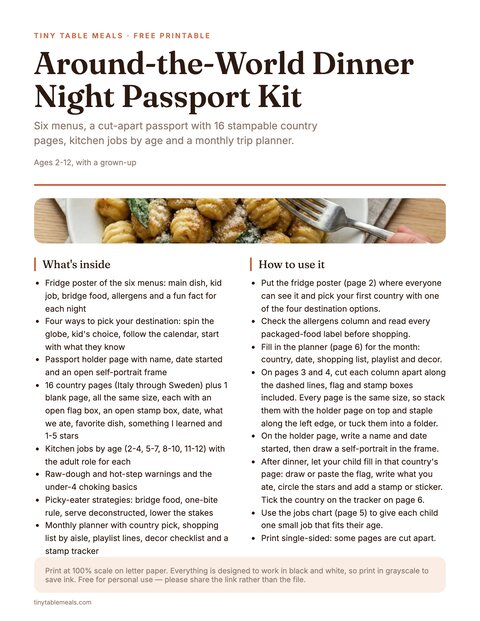
Free printable · 6 pages
Around-the-World Dinner Night Passport Kit
A fridge poster of the six menus (Italy, Mexico, Japan, India, Korea, Morocco) with allergen notes, a cut-apart passport with a holder page, 16 country pages and a blank page, an age-by-age kitchen jobs chart with picky-eater strategies, and a monthly planner with shopping list, playlist, decor checklist and stamp tracker.
Free. Your download link appears right here. You'll also join the Sunday Supper Plan. Unsubscribe anytime. Privacy
Around-the-World Dinner Nights turn one dinner a month into a trip: a simple kid-friendly meal, some music, and a couple of fun facts. Below are six menus (Italy, Mexico, Japan, India, Korea, Morocco) with easy recipes, tips for picky eaters, and a free passport printable your kids can stamp after each trip.
In this article (13 sections)
- Six Menus at a Glance
- Why Try Global Dinner Nights
- How to Set Up a Monthly Around-the-World Tradition
- Italy Night: Beyond Spaghetti and Meatballs
- Mexico Night: Build-Your-Own Taco Fiesta
- Japan Night: Sushi Rolls, Teriyaki, and Edamame
- India Night: Gentle Spices for Tiny Palates
- Korea Night: Riding the K-Food Wave
- Morocco and Mediterranean Night: Couscous, Hummus, and Flatbreads
- Tips for Picky Eaters at Global Dinner Night
- DIY Around-the-World Dinner Night Passport
- Frequently Asked Questions
- Your Passport to Better Dinners Starts Tonight
Six Menus at a Glance
| Night | Main dish | Kid job | Familiar bridge food | Allergens to watch |
|---|---|---|---|---|
| Italy | Gnocchi, flatbread pizza | Pressing gnocchi on a fork | Pizza | Wheat, egg, milk |
| Mexico | Build-your-own tacos, churros | Running the toppings bar | Tortillas and cheese | Milk, wheat, egg; check taco seasoning for wheat, milk and soy |
| Japan | Hand-roll sushi (rice bowl for under 4), teriyaki chicken | Choosing fillings and rolling (under 4: choosing fillings for a rice bowl) | Rice and chicken | Soy, wheat, sesame, fish, shellfish, milk, egg |
| India | Mild butter chicken, naan | Tearing naan, stirring the lassi | Naan and rice | Milk, wheat; check the naan label for egg and soy |
| Korea | Bulgogi lettuce wraps | Building wraps | Rice | Soy, wheat, sesame, egg, fish, shellfish, milk |
| Morocco | Mezze platter, couscous | Arranging the platter | Pita and bread | Sesame, wheat, milk, chickpeas (a legume) in hummus and falafel |
The allergen column covers the main ingredients in each menu. Packaged items like taco seasoning, naan, falafel, miso and kimchi can hide wheat, milk, soy, egg or sesame, so read the label every time.
Safety firstAll recipes are for children 12 months and up. For younger babies, serve only plain, unsalted, un-sauced components in safe textures (no honey, soy sauce, added salt or whole nuts), and ask your pediatrician about allergens. Sesame is a major US allergen and hides in tahini, sesame oil and seeds. Children under 4 need small, soft pieces (see the choking guide below).
Why Try Global Dinner Nights
Here’s what a monthly trip does for your family.
Adventurous eaters. Feeding specialists generally find that repeated, low-pressure exposure helps kids accept more foods, though some pickiness is normal and developmental. The more flavors and textures kids meet without pressure, the more familiar new food feels.
A child who has tasted mild curry, sushi rice, and tzatziki has simply met more flavors than one who has only seen ketchup and ranch.
More variety. Different cuisines lean on different ingredients. Japanese food brings seaweed and fermented flavors. Indian cooking brings legumes and warm spices like turmeric and cumin. Mexican cooking brings beans, avocados, and fresh herbs.
Rotating through them broadens what your family eats without feeling like a nutrition lesson.
Curiosity about other families. When your child learns that kids in Japan eat onigiri (rice balls) for lunch the way American kids eat sandwiches, difference starts to feel normal. Hearing that a thali is a plate of several small dishes, a common way to eat in India, opens up talk about how people eat around the world.
A tradition to look forward to. Kids help choose the country, help cook, and learn something new together. In many homes it becomes a night kids ask for.
How to Set Up a Monthly Around-the-World Tradition
You don’t need a culinary degree or a passport to make this work. Here’s how to set it up so it’s sustainable, fun, and something your family actually sticks with.
Choosing Your Destination
Option 1: Spin the Globe. If you have a globe or world map, close your eyes and point. Wherever your finger lands, that’s dinner’s destination. (If you land on the ocean, spin again.) Kids love the randomness of this method.
Option 2: Let Kids Choose. Give each family member a turn picking the country. A child who feels ownership over the choice is more likely to engage with the food.
Option 3: Follow the Calendar. Align dinner nights with cultural holidays or events — Chinese New Year, Cinco de Mayo, Bastille Day, Diwali. This adds natural context and makes the learning component effortless.
Option 4: Start with What They Know. If your kids already love pizza, start with Italy Night. If they devour tacos, begin with Mexico Night. Building outward from familiar favorites reduces resistance and sets up early wins.
Making It an Experience
The food is the main event, but the extras are what turn dinner into an adventure.
Music: Play a short playlist from the featured country while you cook and eat. Searching “[country] kids’ songs” on any music app is enough.
Fun Facts: Share 2-3 interesting facts about the country during dinner. How many people live there? What language do they speak? What do kids eat for school lunch? Older kids can research and present the facts themselves.
Decor (Keep It Simple): Print out the country’s flag and tape it to the wall. Use a tablecloth in a matching color. Fold napkins in a new way. You don’t need to go overboard — a small visual cue sets the scene.
The Passport: Print our Around-the-World Dinner Night Passport (see below) and let kids “stamp” it after each country. This creates a tangible record of their culinary travels and builds anticipation for the next one.
Getting Kids Involved in Cooking
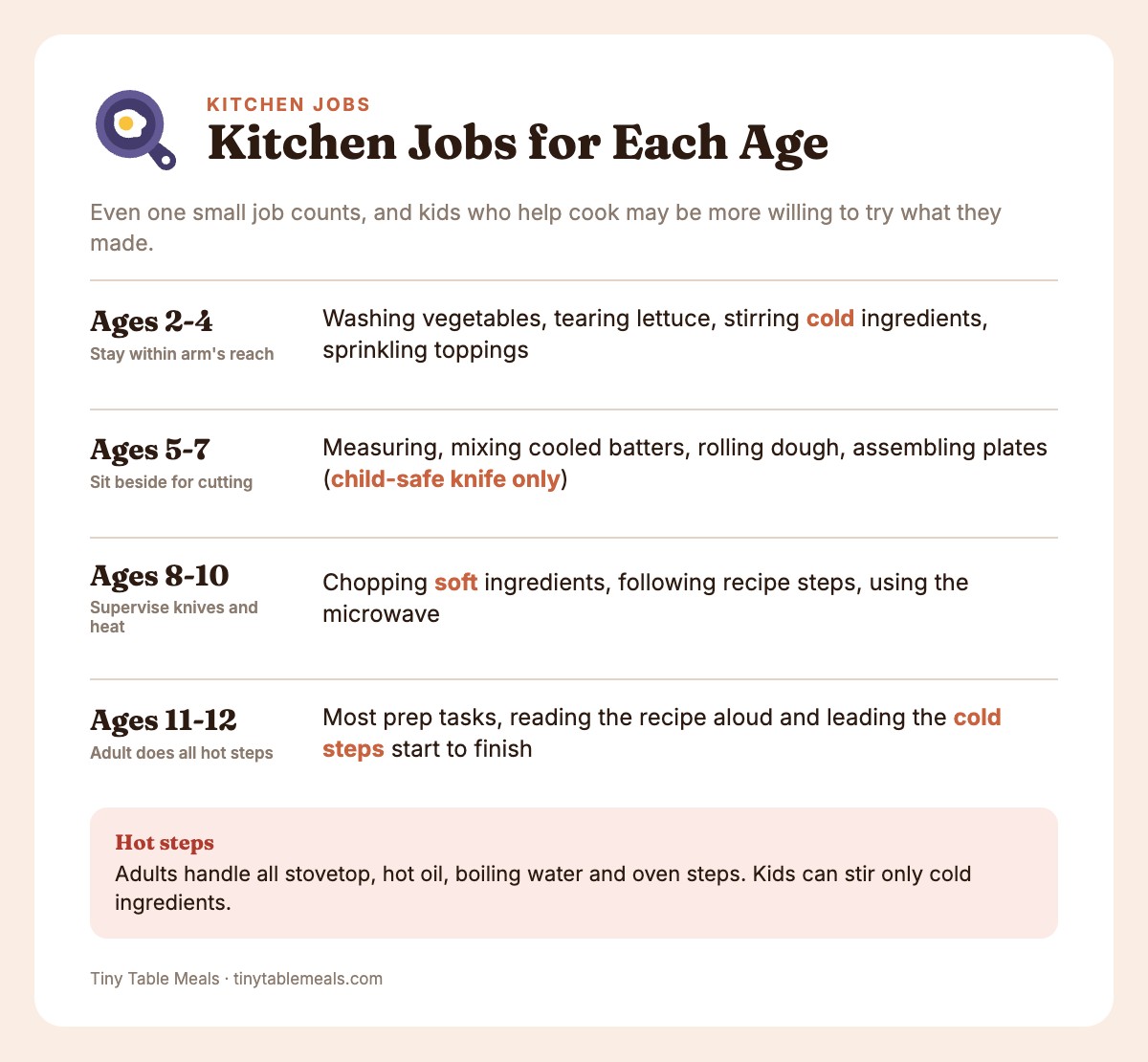
If you can, let them help. Even one small job counts, and kids who help cook may be more willing to try what they made. Here are jobs that fit each age:
| Age | Jobs | Adult role |
|---|---|---|
| 2-4 | Washing vegetables, tearing lettuce, stirring cold ingredients, sprinkling toppings | Stay within arm’s reach |
| 5-7 | Measuring, mixing cooled batters, rolling dough, assembling plates (nylon or child-safe knife only) | Sit beside them for any cutting |
| 8-10 | Chopping soft ingredients, following recipe steps, using the microwave | Supervise knives and heat |
| 11-12 | Most prep tasks, reading the recipe aloud and leading the cold steps from start to finish | Adult does every stovetop, oven, hot-oil and boiling-water step |
The goal isn’t a picture-perfect meal. It’s hands in the food, questions being asked, and everyone contributing. For more ideas by age, see our age-by-age guide to teaching kids to cook.
Safety firstAdults handle all stovetop, hot oil, boiling water and oven steps. Kids can stir only cold ingredients. Wash hands and surfaces after touching raw meat, chicken or eggs, and cook all poultry to 165°F (74°C).
Choking guide for under 4Quarter cherry tomatoes and grapes lengthwise. Grate or cook carrots, and slice cucumber and pepper thin. For children under 2, cook or steam vegetables until soft.
Finely chop raisins or leave them out. Pit dates and mash them into a paste. Pit and chop olives, shell and halve edamame, and quarter or slice mini mozzarella balls. Skip toothpicks and skewers.
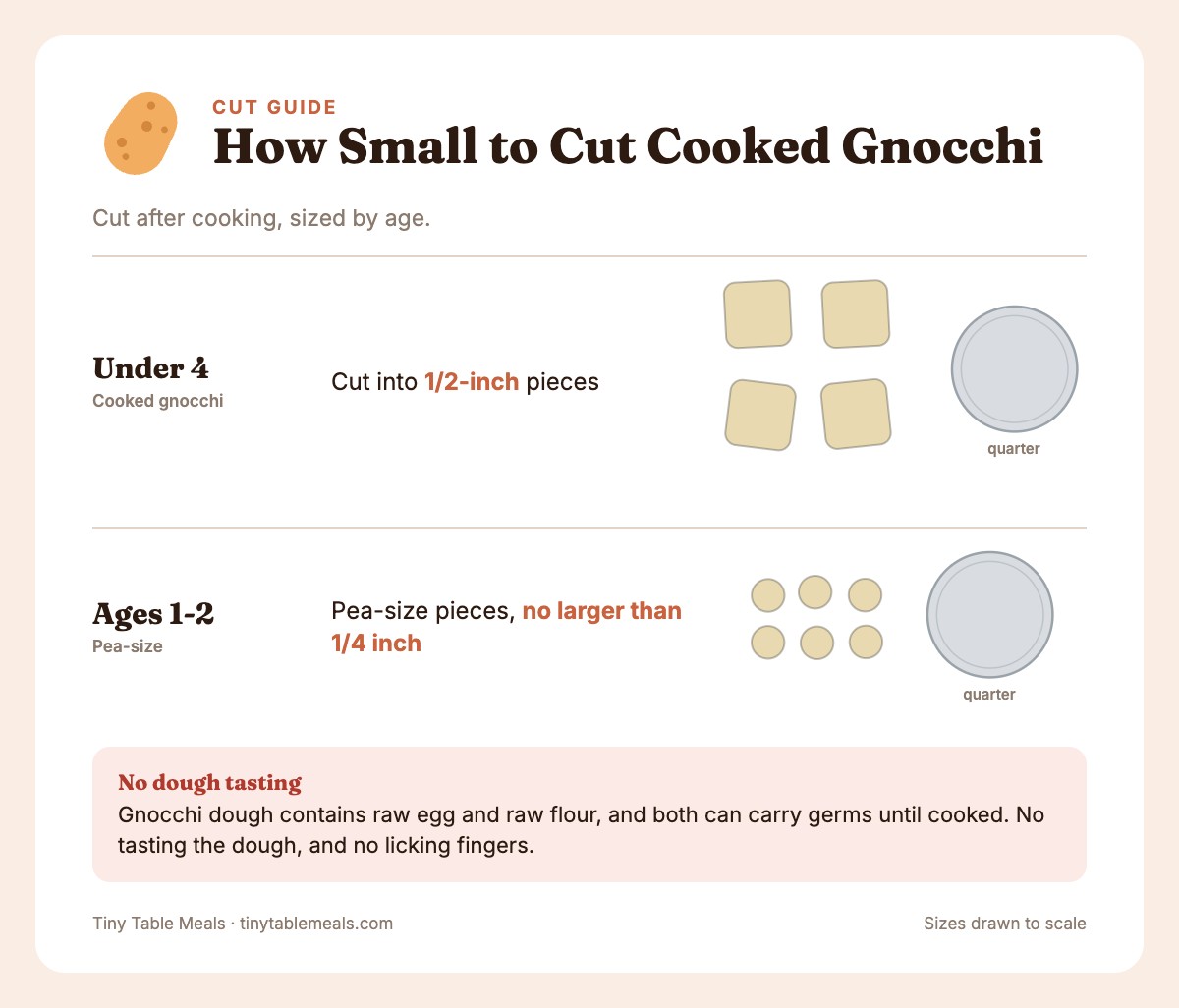
Cut cooked gnocchi into 1/2-inch pieces, or pea-size pieces (no larger than 1/4 inch) for ages 1 to 2. Cut churros into small pieces. Serve ground taco meat in small, moist crumbles, and mash black beans and corn (or leave the corn out).
Skip the nori cone and serve a soft rice bowl in small bites instead, with an adult watching. Finely chop or shred bulgogi beef and teriyaki chicken, and serve them over rice rather than in whole strips or chunks.
Italy Night: Beyond Spaghetti and Meatballs
Pasta and pizza are already a hit in most homes, so Italy Night is the easiest win of all. The trick is going beyond the spaghetti-and-jar-sauce routine and exploring the incredible range of Italian cooking.
Easy Gnocchi with Butter and Sage
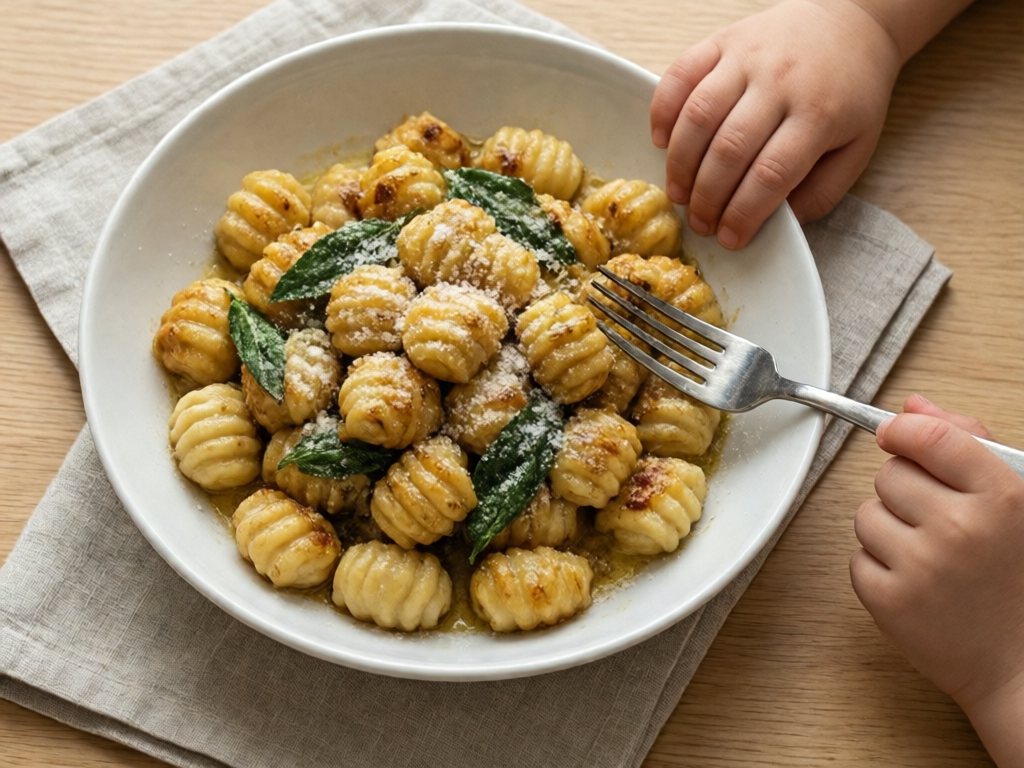
Total time: about 60 minutes (best for a weekend) | Serves: 4
Ingredients:
- 2 pounds russet potatoes
- 1 cup all-purpose flour (plus more for dusting)
- 1 egg
- 1/2 teaspoon salt
- 4 tablespoons butter
- Fresh sage leaves (or 1 teaspoon dried sage)
- Grated Parmesan cheese
Instructions:
- Boil potatoes whole until fork-tender (about 30-40 minutes, depending on size). Peel while still warm.
- Rice or mash the potatoes until smooth — no lumps.
- Make a well in the potatoes, add egg, salt, and flour. Gently mix until a soft dough forms. Don’t overwork it, and don’t taste the dough raw because it contains raw egg.
- Roll dough into long ropes about 3/4 inch thick. Cut into 1-inch pieces. After cooking, cut gnocchi into 1/2-inch pieces for children under 4, and into pea-size pieces (no larger than 1/4 inch) for ages 1 to 2.
- Roll each piece over a fork to create ridges (this is the fun part for kids).
- Boil gnocchi in salted water. They’re done when they float to the surface (about 2 minutes).
- In a pan, melt butter and cook sage leaves until the butter turns golden brown and smells nutty.
- Toss gnocchi in the brown butter. Top with Parmesan.
Kid involvement: Let them roll the dough ropes and press gnocchi on the fork. Do the shaping at the table, well away from the pot of boiling water. It feels like Play-Doh, but it’s not for eating raw.
Safety firstGnocchi dough contains raw egg and raw flour, and both can carry germs until cooked. No tasting the dough, and no licking fingers. Everyone washes hands with soap after shaping, and you wipe down the counter before dinner goes on it.
Margherita Flatbread Pizza
Prep time: 15 minutes | Serves: 4 (one naan each)
Use store-bought naan or flatbread as the base. Spread a thin layer of marinara sauce, top with fresh mozzarella slices and a few basil leaves. Bake at 425 degrees for 8-10 minutes until the cheese melts and bubbles. Drizzle with olive oil.
The beauty of flatbread pizza: every family member makes their own. Set out toppings in small bowls and let kids build. This is the most fight-free dinner in the entire guide.
Italy Night Sides
- Caprese salad cups: Quartered cherry tomatoes, halved mini mozzarella balls (quartered or sliced for children under 4) and torn basil. Serve in a small bowl and drizzle with olive oil and balsamic.
- Garlic bread: Butter, garlic, and parsley on sliced baguette, broiled for 3 minutes.
- Simple green salad with olive oil and lemon dressing.
Fun Fact for the Table
Italy has hundreds of pasta shapes, many designed to hold different sauces. Challenge your kids: how many pasta shapes can they name?
Mexico Night: Build-Your-Own Taco Fiesta
Taco night is already beloved in most households, so Mexico Night is about leveling it up with fresh components and a festive atmosphere. That makes it an easy place to start.
Build-Your-Own Soft Tacos
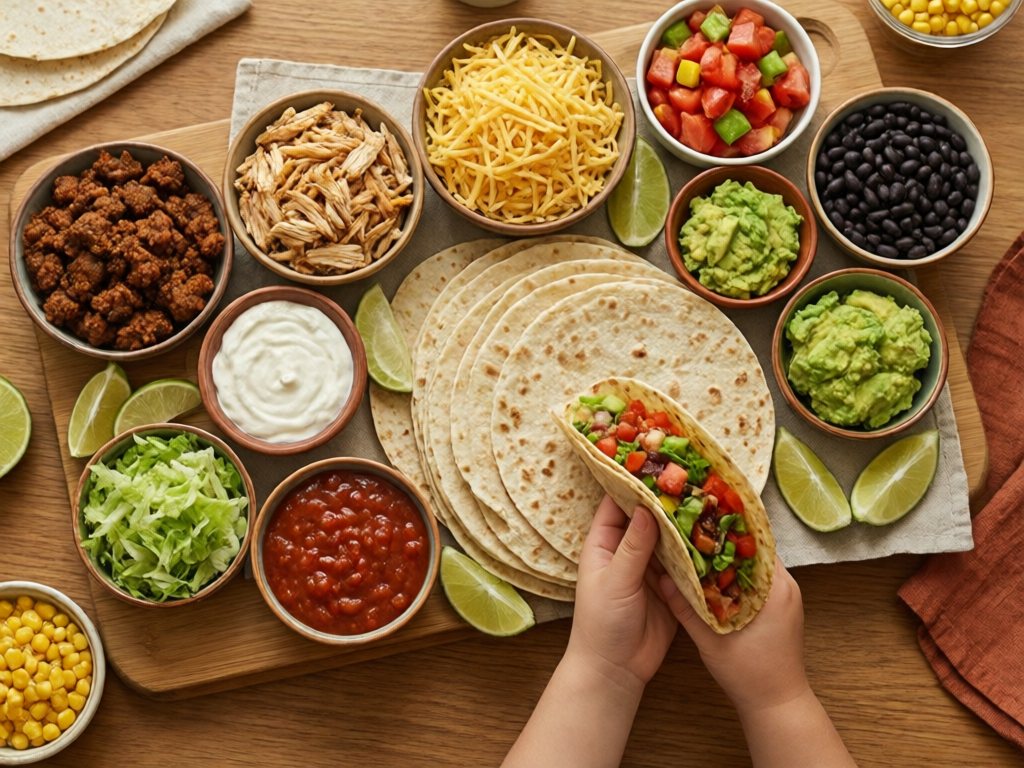
Prep time: 25 minutes | Serves: 4
The protein base (choose one or offer both):
- Seasoned ground beef or turkey: Brown 1 pound of meat with 2 tablespoons taco seasoning and 1/4 cup water, then simmer 5 minutes. Push the crumbles into a pile and check with a food thermometer. Beef should reach 160°F (71°C). Turkey, or any beef-and-turkey mix, should reach 165°F (74°C). Check the seasoning label for wheat, milk and soy.
- Slow cooker shredded chicken: Place 1.5 pounds thawed chicken breasts (not frozen) with 1 cup salsa in the slow cooker. Cook on low for 4-6 hours with the lid on. Check that the thickest part reaches 165°F (74°C), then shred with forks.
The toppings bar:
- Warm soft tortillas (flour or corn)
- Shredded cheese
- Sour cream
- Mild salsa and/or pico de gallo
- Shredded lettuce
- Diced tomatoes
- Mashed avocado or guacamole
- Canned black beans (warmed; lightly mash for under 4)
- Corn kernels (cut off the cob; mash or leave out for under 4)
- Lime wedges
Set everything out in bowls and let everyone build their own. This is the single best strategy for families with picky eaters — everyone gets exactly what they want.
Easy Homemade Bean Dip
Prep time: 5 minutes | Serves: 4
Blend one can of pinto or black beans (drained), 1/4 cup sour cream, 1 teaspoon cumin, a squeeze of lime, and salt to taste. Serve warm with tortilla chips. It takes five minutes, and kids can help with the blending (adult on the blender button).
Cinnamon Sugar Churros (Oven-Baked)
Total time: 35 minutes (20 prep, 15 bake) | Serves: 4-6
Ingredients:
- 1 cup water
- 1/2 cup butter
- 1 tablespoon sugar
- 1/4 teaspoon salt
- 1 cup all-purpose flour
- 3 eggs
- Cinnamon sugar for rolling
Instructions:
- Heat water, butter, sugar, and salt in a saucepan until boiling.
- Add flour all at once and stir vigorously until a ball forms.
- Let the dough cool until just warm to the touch (an adult step), then beat in eggs one at a time.
- Pipe dough into 4-inch strips on a parchment-lined baking sheet using a star-tip piping bag (or a zip-lock bag with the corner cut off).
- Bake at 425 degrees for 15 minutes until golden.
- Let the churros cool a few minutes, then roll in cinnamon sugar. Cut into small pieces for children under 4.
Kid involvement: Let them pipe the dough (it’s messy and they’ll love it) and roll the warm churros in cinnamon sugar.
Safety firstChurro dough has raw egg in it, and the flour isn’t fully cooked until the churros are baked. No tasting the dough or licking the piping bag. Wash hands with soap after piping.
Fun Fact for the Table
Chocolate comes from cacao first used in ancient Mesoamerica, where the Maya and Aztecs drank it as a bitter, spicy drink, very different from the hot cocoa we know today.
Japan Night: Sushi Rolls, Teriyaki, and Edamame
Japan Night sounds ambitious, but it’s doable with a hand-roll sushi approach. The key is making it interactive so kids build their own food instead of facing something unfamiliar on a plate.
Honest trade-off: this is the costliest night here, and you may need a second grocery stop for nori and sushi rice.
- Sushi rice
- Nori sheets
- Rice vinegar
- Low-sodium soy sauce
- Sesame oil
- Frozen edamame
Hand-Roll Sushi (Temaki)
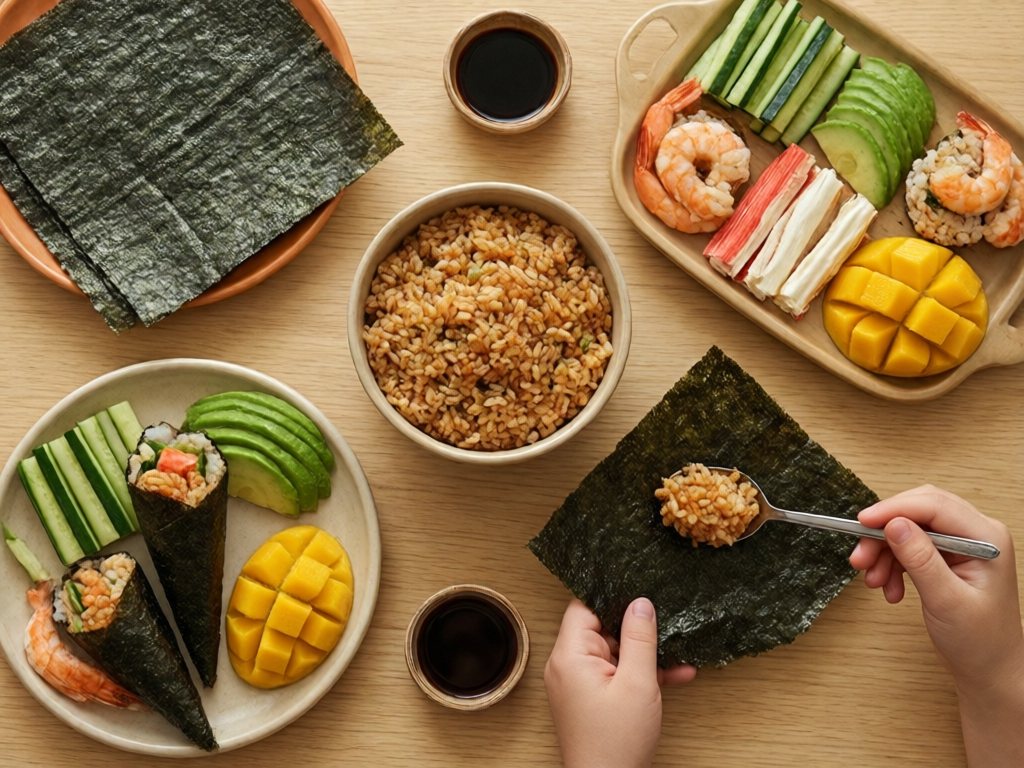
Prep time: 30 minutes (including rice) | Serves: 4
Ingredients:
- 2 cups sushi rice, cooked and seasoned with rice vinegar, sugar, and salt
- Nori seaweed sheets, cut in half
- Filling options: thin cucumber strips, avocado slices, cooked chicken, cream cheese strips (contains milk), finely grated carrot, mango slices
- Optional seafood fillings: imitation crab, real crab or cooked shrimp. Shellfish is a top allergen, so skip it unless already tolerated. Imitation crab is made from fish and often contains shellfish extract, egg and wheat, so check the label.
Instructions:
- Cook sushi rice according to package directions. Season while warm.
- Set out nori sheets and fillings in a spread across the table.
- Each person places a nori half flat in their palm, adds a spoonful of rice, chooses fillings, and rolls into a cone shape.
- Dip lightly in low-sodium soy sauce (a little goes a long way for kids) and eat immediately.
- For children under 4, skip the nori cone. Spoon rice and their chosen fillings into a bowl in small bites instead.
Safety firstNori is tough and chewy, and sticky rice is a choking risk for children under 4. Skip the whole nori cone for them: offer rice and fillings in small bites, or a soft rice bowl, and stay close. Introduce shellfish and sesame separately from other new foods, and keep soy sauce to a small dip. Refrigerate leftover rice within 1 to 2 hours (1 hour in hot weather). Keep it up to 3 to 4 days, and reheat it until steaming hot.
Why this works: Hand rolls remove all the intimidation of sushi. There’s no raw fish required, no rolling mat needed, and kids control exactly what goes inside their roll. Many kids who say they hate sushi have never built their own. Eating with their hands and choosing the fillings changes the dynamic.
Easy Teriyaki Chicken
Prep time: 20 minutes | Serves: 4
Ingredients:
- 1 pound chicken thighs, cut into bite-size pieces
- 1/4 cup soy sauce
- 2 tablespoons honey (use maple syrup if any child at the table is under 12 months)
- 1 tablespoon rice vinegar
- 1 teaspoon sesame oil
- 1 clove garlic, minced
- 1 teaspoon cornstarch mixed with 1 tablespoon water
Instructions:
- Mix soy sauce, honey, rice vinegar, sesame oil, and garlic in a bowl.
- Cook chicken pieces in a hot skillet until golden and cooked through (about 6-7 minutes). Check that the thickest piece reaches 165°F (74°C).
- Pour sauce over chicken, add cornstarch slurry, and stir until the sauce thickens and glazes the chicken (about 2 minutes).
- Serve over rice and sprinkle with sesame seeds (skip them if sesame is an allergen for your family). Finely chop or shred the chicken for children under 4.
This sauce is sweet enough for kids without being sugary, and the sesame oil adds depth. For children under 2, use half the soy sauce (or a low-sodium version) and skip any extra dipping.
Edamame with Sea Salt
Steam frozen edamame pods for 3-4 minutes and toss with a pinch of sea salt. Kids love squeezing the beans out of the pods. For children under 4, shell the beans yourself and halve or mash them. It’s the kind of snack that keeps little hands busy while the main course finishes cooking.
Japan Night Extras
- Miso soup: Instant miso soup packets are perfectly fine. Add cubed tofu and sliced green onions. Most packets contain fish-based dashi, so check the label if fish is an allergen or hasn’t been introduced yet.
- Mandarin oranges: A simple, refreshing end to the meal.
- Chopstick challenge: Give everyone chopsticks and see who can pick up the most edamame beans in 30 seconds. Training chopsticks with connectors at the top work great for younger kids.
Fun Fact for the Table
In Japan, onigiri (rice balls) are a common lunchbox food, much like sandwiches here. Want noodles on a future Japan night? Try our build-your-own noodle bar dinner.
India Night: Gentle Spices for Tiny Palates
Indian cuisine sometimes intimidates parents because they associate it with intense heat. But Indian food is really about layered flavor, not necessarily spice level. A mild butter chicken is a friendly place to start.
Mild Butter Chicken
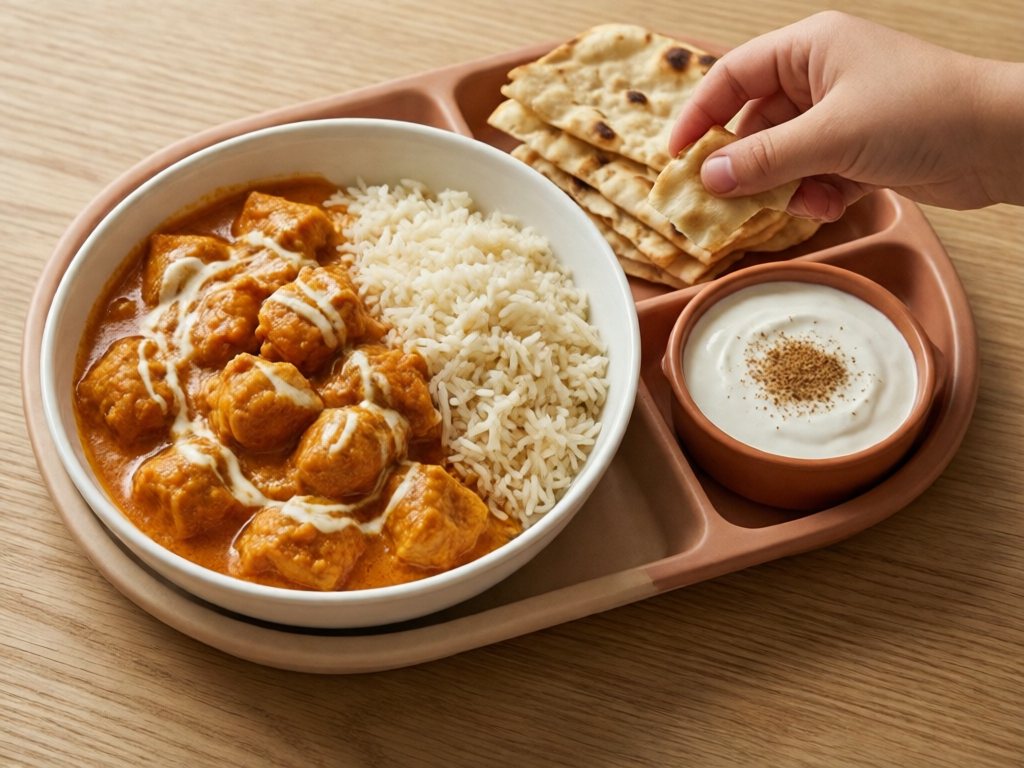
Prep time: 30 minutes | Serves: 4-6
Ingredients:
- 1.5 pounds boneless chicken thighs, cut into chunks
- 1 tablespoon butter + 1 tablespoon oil
- 1 onion, finely diced
- 3 cloves garlic, minced
- 1 tablespoon fresh ginger, grated (or 1 teaspoon ground ginger)
- 1 tablespoon garam masala
- 1 teaspoon turmeric
- 1 teaspoon cumin
- 1 can (14 oz) crushed tomatoes
- 1/2 cup heavy cream
- 2 tablespoons butter (to finish)
- Salt to taste
Instructions:
- Brown the chicken in oil on the outside only; it will finish cooking in the sauce. Move it to a clean plate with a clean utensil, then wash your hands and anything that touched the raw chicken.
- In the same pan, melt 1 tablespoon butter. Cook onion until softened (about 5 minutes).
- Add garlic and ginger, cook 1 minute until fragrant.
- Add garam masala, turmeric, and cumin. Stir for 30 seconds — you’ll smell the spices bloom.
- Pour in crushed tomatoes, stir, and simmer 10 minutes.
- Return chicken to the sauce and simmer about 10 more minutes, until the largest piece reaches 165°F (74°C).
- Stir in heavy cream and the remaining 2 tablespoons butter. The sauce will turn that gorgeous orange color.
- Serve over basmati rice.
For very spice-sensitive kids: Reduce garam masala to 1/2 tablespoon and skip the cumin. The cream and butter mellow everything significantly. This sauce is rich, slightly sweet from the tomatoes, and gently warming without any heat.
Naan Dippers with Yogurt Sauce
Warm store-bought naan in the oven for 3 minutes, then cut into strips. Serve with a simple dipping sauce: 1/2 cup plain yogurt mixed with a squeeze of lemon, a pinch of salt, and a sprinkle of cumin. Naan is basically fancy bread, which kids tend to love.
Mango Lassi
Prep time: 3 minutes
Blend 1 cup frozen mango chunks, 1 cup plain yogurt, and 1/2 cup milk until smooth. Add up to 2 tablespoons honey if you like. Pour into glasses. Serves 3-4.
Good to knowSkip the honey and any other added sweetener for children under 2; ripe mango is sweet enough. Honey is never safe under 12 months, and cow’s milk as a drink is for 12 months and older.
The yogurt adds protein, so it counts as part of the meal. Kids think they’re getting a milkshake.
Fun Fact for the Table
India has one of the largest vegetarian populations in the world. Many Indian families eat delicious, protein-rich meals made entirely without meat — using lentils, chickpeas, and paneer cheese instead.
Korea Night: Riding the K-Food Wave
Korean food has exploded in popularity, thanks in large part to K-pop and Korean drama culture filtering down to younger generations. Korean flavors tend to be bold but approachable for kids when you focus on the sweeter, less fermented end of the spectrum.
Bulgogi Lettuce Wraps
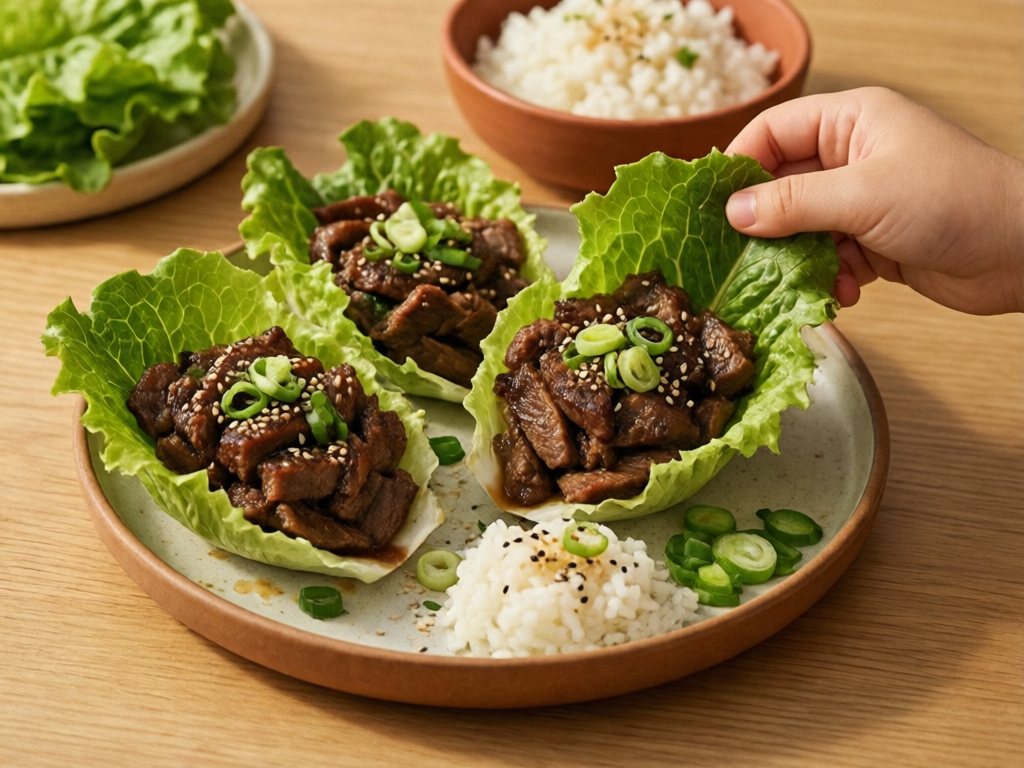
Prep time: 25 minutes (plus 30 minutes marinating) | Serves: 4
Ingredients:
- 1 pound thinly sliced beef (ribeye or sirloin, partially frozen for easier slicing)
- 3 tablespoons soy sauce
- 1 tablespoon sesame oil
- 1 tablespoon brown sugar
- 2 cloves garlic, minced
- 1 teaspoon grated ginger
- 1 Asian pear or regular pear, grated (this is the secret tenderizer)
- Butter lettuce leaves for wrapping
- Rice for serving
- Sesame seeds (optional; skip for sesame allergy) and sliced green onions for topping
Instructions:
- Mix soy sauce, sesame oil, brown sugar, garlic, ginger, and grated pear in a bowl.
- Add sliced beef, toss to coat, and marinate for at least 30 minutes (or overnight in the fridge).
- Cook beef in a hot skillet in batches — don’t crowd the pan. You want caramelized edges, not steamed meat. Thin slices cook in about 2-3 minutes per batch; cook until browned and no longer pink inside. For children under 2, use half the soy sauce or a low-sodium version.
- Serve the beef in butter lettuce cups with a scoop of rice, topped with sesame seeds and green onions. For children under 4, finely chop or shred the beef and serve it over rice instead of in whole strips.
Why lettuce wraps work for kids: They’re hands-on, customizable, and the butter lettuce is soft enough that even texture-sensitive kids tolerate it. If lettuce is a hard no, just serve the bulgogi over rice in a bowl — it’s equally delicious.
Introducing Kimchi (Gently)
Kimchi is Korea’s signature fermented vegetable dish, and it’s a tough sell for most kids right out of the gate. Here’s the gentle on-ramp:
Start with kimchi pancakes (kimchijeon). Dice kimchi finely and mix into a simple pancake batter (1 cup flour, 1 cup water, 1 egg, 1/2 cup finely chopped kimchi). Pan-fry in a little oil over medium heat, about 3 minutes per side, until golden and crisp. This makes about 4 small pancakes. Cut them into small pieces for children under 4.
Safety firstKimchi is salty and often spicy from chili flakes. For toddlers, rinse it or choose a non-spicy white kimchi, and keep the amount small. Most kimchi is also made with fish sauce or salted shrimp. Check the label, and choose a fish-free (vegan) kimchi if your child has a fish or shellfish allergy or hasn’t tried those foods yet. The pancake batter contains raw egg and raw flour, so no tasting it before it’s cooked, and wash hands after mixing.
Cooking mellows the pungent flavor. The crispy pancake is far more kid-friendly than a cold, fermented side dish. Serve with a dipping sauce of soy sauce and rice vinegar.
If they like the pancakes, next time offer a small dish of mild kimchi on the side. Mild means a non-spicy white kimchi, or regular kimchi rinsed under water. No pressure to eat it. Just exposure.
Korea Night Extras
- Steamed rice: A must. Korean meals are always anchored by rice.
- Seaweed snacks: Available at most grocery stores. Kids either love these immediately or need a few exposures. Crisp sheets can stick to the roof of the mouth, so for children under 4, skip whole sheets and crumble a little into rice instead. Seaweed is salty and high in iodine, so keep it to a small, occasional portion for toddlers. Choose a low-sodium version and stay close while they eat.
- Banana milk: A beloved Korean drink. Blend 1 banana with 1 cup milk. The banana is sweet enough on its own, so skip the honey for children under 2. The 12-month honey rule is only about botulism; added sweeteners are best left out until age 2. Cow’s milk as a drink is for 12 months and older.
Fun Fact for the Table
Traditionally, in many Korean families, elders start eating first as a sign of respect.
Morocco and Mediterranean Night: Couscous, Hummus, and Flatbreads
Middle Eastern and North African cuisines are built around foods that kids already tend to love — bread, dips, and foods you eat with your hands. A mezze-style spread is one of the most picky-eater-friendly dinners in this guide.
This menu is a regional mix: couscous is Moroccan, tzatziki is Greek, and hummus and falafel are found across the Middle East.
The Mezze Platter
Prep time: 20 minutes | Serves: 4
A mezze platter is essentially a collection of small dishes and dips served with bread. It’s communal, interactive, and there’s something for everyone. Build yours with:
Hummus (store-bought is fine, or make your own): Blend one can of chickpeas with 2 tablespoons tahini, 1 clove garlic, juice of 1 lemon, 2 tablespoons olive oil, and salt. Add water to reach your preferred consistency (makes about 1.5 cups). Drizzle with olive oil and a sprinkle of paprika. Tahini is made from sesame, so check labels or leave it out if sesame is an allergen for your family. Sesame is a major allergen, so if your child hasn’t had it yet, introduce it on its own first rather than at a dinner full of new foods.
Many people prefer homemade hummus, and it takes about 5 minutes. Honestly, though, no shame in opening a container.
Warm pita bread: Cut into triangles and warm in the oven for 3 minutes.
Tzatziki: Mix 1 cup Greek yogurt with grated cucumber (squeeze out the excess water), 1 clove minced garlic, 1 tablespoon lemon juice, 1 tablespoon olive oil, and a pinch of salt and dill. This creamy, cool dip is a hit with kids who like ranch dressing — the flavor profile is surprisingly similar.
Falafel (baked for simplicity): Use a store-bought falafel mix or frozen falafel. Bake according to package directions. Homemade is great if you have the time, but the store-bought versions are solid and save 30 minutes.
Falafel is made from chickpeas, and store-bought versions may contain sesame or wheat, so check the label. Break it into small pieces for children under 4.
Fresh vegetables: Thin cucumber slices, quartered cherry tomatoes, thin bell pepper strips, and grated or lightly steamed carrot for kids under 4. For children under 2, steam the vegetables until soft.
Olives and feta: For the more adventurous eaters. Not mandatory. Pit the olives, and chop them for kids under 4.
Easy Couscous
Prep time: 10 minutes | Serves: 4
Couscous is the most forgiving grain you’ll ever cook. An adult boils 1 cup water or chicken broth with a tablespoon of butter. Remove from heat, stir in 1 cup couscous, cover, and let sit 5 minutes. Fluff with a fork.
Add diced cucumber, quartered cherry tomatoes, a small handful of finely chopped raisins, and a squeeze of lemon. For children under 4, you can leave the raisins out. For children under 2, swap the raw cucumber for soft steamed vegetables.
Couscous has the texture of tiny pasta, which makes it immediately familiar to kids. The raisins add sweetness that younger palates appreciate.
Morocco Night Extras
- Dates: Sweet, chewy, and a traditional Moroccan offering to guests. Pit them, and mash them into a paste for children under 4.
- Oranges with cinnamon: Sliced oranges with a pinch of cinnamon make a simple Moroccan-style dessert. Remove the seeds and cut into small pieces for children under 4.
Fun Fact for the Table
In Morocco, people traditionally eat with their right hand, using bread to scoop up food instead of using forks and spoons. Tonight, try eating your hummus and bread without any utensils!
Tips for Picky Eaters at Global Dinner Night
Global dinner nights can feel risky if you have a child who melts down at the sight of anything unfamiliar. Here’s how to make it work without tears or wasted food.
The Bridge Food Strategy
Always include at least one familiar food alongside the new cuisine. If you’re doing Japan Night and your child only eats rice and chicken, teriyaki chicken over rice is Japanese food.
They’re joining the theme without being pushed outside their comfort zone. Over time, they may reach for a piece of edamame or try the hand-roll sushi because they’ve seen everyone else enjoying it.
The One-Bite Exploration Rule
Invite (don’t force) your child to take one small bite of a new food. If they don’t like it, they can spit it discreetly into a napkin and move on. Feeding experts often say it can take many tries, sometimes 10 or more, before a child accepts a new food. One bite tonight isn’t about loving it — it’s about reducing the unfamiliarity for next time.
| Night | Bridge food on the table |
|---|---|
| Italy | Plain gnocchi with butter |
| Mexico | Tortilla and cheese |
| Japan | Rice and teriyaki chicken |
| India | Naan and rice |
| Korea | Rice and plain beef |
| Morocco | Pita and couscous |
TipPut one bridge food on the table every night, and never make it a reward for eating the new dish.
Serve Deconstructed
Instead of plating a fully assembled dish, serve components separately and let kids build their own. This works for almost every cuisine:
- Sushi: Hand rolls with chosen fillings (rice bowls for under 4)
- Tacos: Build-your-own toppings bar
- Indian: Rice, sauce, and chicken in separate bowls
- Korean: Lettuce wraps with rice and meat as separate components
- Mezze: Individual dips with bread and veggies
When kids control what goes on their plate, they feel safe. That safety is what eventually leads to tasting something new.
Lower the Stakes
Try saying: “You don’t have to eat it, but it stays on the table.” You choose what is served and when; your child chooses whether and how much. Taking the pressure off can leave room for curiosity. Our guide to the division of responsibility in feeding explains this approach, and our picky eater meal plan has more ideas. For more on easing in new foods, see how to introduce new foods with no pressure.
Make It About Fun, Not Food
If the night is full of music, fun facts, globe-spinning, passport-stamping, and family laughter, the food becomes secondary. Even if your picky eater only nibbles bread and rice, they may be building positive associations with new cuisines and slowly widening their comfort zone. That counts.
Good to knowSome pickiness is normal. If your child eats a very limited range of foods (roughly under 15-20), gags often, has weight concerns, or has dropped foods they used to eat, talk to your pediatrician or a feeding therapist.
DIY Around-the-World Dinner Night Passport
Our free Around-the-World Dinner Passport Kit (just below) has everything ready to print. If you’d rather make your own, here’s what to include:
- Cover: title, child’s name, date started, and space for a photo or self-portrait
- Country name and flag (print or draw), plus date of visit
- What we ate and my favorite dish
- Something I learned and a 1-5 star rating
- Stamp or sticker space
Countries: Italy, Mexico, Japan, India, Korea, Morocco, Thailand, Greece, Ethiopia, France, China, Brazil, Lebanon, Vietnam, Jamaica, Sweden.
The first six have menus in this guide. The rest are passport-only for when you want to explore on your own.
How to make stamps: Use a small round ink stamp, a sticker, or let kids draw a small picture representing each country. Dollar store stamp sets work perfectly.
Pro tip: Keep the passport in the kitchen or dining room so kids see it regularly. The visual reminder of past adventures builds anticipation for the next one.
Mama Munch
Mama Munch is a food-obsessed parent of two who believes every family deserves simple, nutritious meals — even on the busiest weeknights. With a background in nutrition education and years of navigating picky eaters, allergies, and toddler taste buds, she creates practical recipes and meal strategies that actually work for real families.
Frequently Asked Questions
How often should we do Around-the-World dinner nights?
Once a month is the sweet spot for most families. It builds a tradition without feeling like pressure, and you can move to twice a month if everyone is enthusiastic. Picking a set night, like the first Friday, makes it easy to plan.
My kids only eat plain pasta and chicken nuggets. Is this going to be a disaster?
Not if you use the bridge food strategy. Every cuisine in this guide has something familiar to offer. Italy Night is pasta. Mexico Night has tortillas and cheese. Japan Night has rice and chicken. Start with the cuisines closest to what your kids already eat, include familiar foods alongside new ones, and lower the pressure. A picky eater who eats plain rice at Korea Night is still participating — and that matters.
What if I’m not a confident cook? Some of these recipes seem challenging.
Most recipes here are weeknight-friendly (gnocchi is better for a weekend), and nothing requires advanced skills. If something feels daunting, simplify it. Use store-bought naan instead of making bread. Buy pre-made falafel. Use a rotisserie chicken for taco or burrito fillings. The goal is the experience, not culinary perfection. A store-bought hummus served on a fun tablecloth with Moroccan music playing is still Morocco Night.
How do I handle food allergies with global cuisines?
Check the allergens in each menu first. Wheat is in flour, soy sauce, couscous, naan and pita, and it can hide in taco seasoning and store-bought falafel. Milk is in butter, cheese, yogurt, cream and cream cheese. Egg is in gnocchi, churros and kimchi pancakes.
Soy is in soy sauce, edamame, miso and tofu. Sesame, a major US allergen, is in tahini, sesame oil and seeds. Fish hides in instant miso (dashi), imitation crab and most kimchi (fish sauce). Shellfish means crab and shrimp, plus the salted shrimp in many kimchis.
Check the label on instant miso, imitation crab and kimchi every time. If needed, skip the sesame oil and seeds in the teriyaki and bulgogi, and the tahini in hummus. Use a tamari labeled gluten-free in place of soy sauce, remember that corn tortillas aren’t automatically gluten-free, and read every packaged label, including peanut and tree nut warnings.
If your child has a diagnosed allergy, or you haven’t introduced an allergen yet, talk to your allergist or pediatrician first, and see our guide to introducing allergens to babies.
At what age can kids start participating in Around-the-World dinner nights?
Kids as young as two can help by tearing lettuce, sprinkling toppings, stirring cold ingredients, and tasting new foods. Babies under 12 months can join in too, with plain, unsalted, un-sauced parts of the meal in safe textures (no honey, soy sauce, added salt or whole nuts). The recipes themselves are for 12 months and up. Early, repeated exposure to varied flavors tends to help, but it’s never too late. Even a twelve-year-old who has been eating the same five foods for a decade can benefit from low-pressure, fun-first food exploration.
How do I research cuisines I’m not familiar with?
Start with a simple search for “easy [country] recipes for families.” YouTube is an incredible resource — watching someone make a dish is often more helpful than reading a recipe. For cultural context, search “[country] food traditions” or “[country] family meals.” You don’t need to become an expert. A few fun facts, one authentic recipe, and a willingness to try is all it takes. Your kids will be more impressed by the adventure than the authenticity of your gnocchi ridges.
Your Passport to Better Dinners Starts Tonight
You don’t need to be a world traveler or a trained chef to do this. You just need a willingness to try one new thing.
Start small. Pick the cuisine that feels most familiar — probably Italy or Mexico. Make one recipe from this guide. Put on some music. Share a fun fact. Let your kids help cook. See what happens.
Maybe your toddler takes one lick of hummus and declares it gross. Maybe your eight-year-old discovers she loves hand-roll sushi. Maybe your whole family decides that butter chicken is the new favorite dinner. Or maybe everyone just eats rice and bread, and that’s okay too, because they showed up for the adventure.
And once your kids start asking, “Where are we going for dinner this month?” you’ll know it stuck.
Grab a globe. Pick a country. Start cooking.