Transitioning from Purees to Table Food
Learn how to smoothly transition your baby from purees to table food, recognizing readiness signs and navigating the stages of texture progression. This guide helps you understand what to serve and how to handle common challenges like gagging.
- Watch for readiness signs like munching, pincer grasp, and interest in your food.
- Introduce textures gradually, moving from thicker purees to soft lumps and finger foods.
- Don't delay texture introduction; there's a critical window between 6-10 months.
- Expect some gagging or pushing food out; it's a normal part of learning new textures.
This post contains affiliate links. As an Amazon Associate I earn from qualifying purchases.
There was a moment around my daughter’s ninth month when I opened yet another pouch of pureed peas, squeezed it onto a spoon, and watched her clamp her mouth shut and swat it away like an offended cat. She then reached across the high chair tray, grabbed a piece of toast off my plate, and shoved it into her mouth with the confidence of someone who’d been eating solid food her whole life. She chewed. She swallowed. She reached for more. And I stood there holding a dripping spoon of pureed peas, thinking: okay, message received.
The shift from purees to table food is one of those milestones that feels both exciting and terrifying. Your baby is growing up, they’re ready for real food with real texture, and you’re somewhere between thrilled and absolutely panicked about choking. If you’re standing at this crossroads wondering how to get from smooth purees to actual meals your baby eats with the family, this guide walks through every step of the journey—what to expect, what to serve, and how to handle the inevitable gagging (theirs and yours).
In this article (5 sections)
Signs Your Baby Is Ready to Move Beyond Purees
Most babies start showing readiness for textured foods between 7 and 9 months, though every child develops at their own pace. Here are the specific signs to watch for—your baby doesn’t need all of them, but several together signal it’s time to start introducing more texture:
- They’re using a “munching” jaw movement instead of just sucking food off the spoon. Watch their mouth—if you see an up-and-down chewing motion (even without teeth), their jaw muscles are developing the strength for textured food.
- They’re picking up small objects with a pincer grasp. When your baby can hold a Cheerio or puff between their thumb and forefinger, they have the fine motor skills to self-feed soft pieces of food.
- They show interest in what you’re eating. Reaching for your food, staring intently at your fork, opening their mouth when they see you take a bite—these are invitations. Your baby wants in on the real food action.
- They’re losing interest in purees. Clamping their mouth shut, turning their head, spitting purees back out, or refusing the spoon altogether often means they’re bored with smooth textures and craving something more interesting.
- They can sit upright with minimal support in the high chair and have good head and neck control. This is essential for safe swallowing of textured foods.
If your baby is around 8-9 months and showing several of these signs, it’s time to start the transition. And here’s something important: don’t wait too long. Research suggests there’s a critical window for texture introduction between roughly 6 and 10 months. Babies who aren’t exposed to lumpy, textured foods during this period can have more difficulty accepting them later.
The Texture Progression: From Smooth to Table Food
You don’t jump straight from silky purees to a chicken drumstick. The transition happens in stages, and moving through them gradually gives your baby’s mouth muscles and swallowing coordination time to develop. Think of it as a staircase, not a leap.
Stage 1: Thicker Purees and Mashes (Around 7-8 Months)
Start by making your purees less smooth. Instead of blending until perfectly silky, leave them a bit thicker and chunkier. Mash foods with a fork instead of a blender. Good first options:
- Mashed banana (leave some small soft lumps)
- Mashed avocado with tiny pieces left in
- Sweet potato mashed with a fork, not pureed
- Thick oatmeal with some texture to it
- Mashed cooked pears or peaches
Your baby might make faces, gag a little, or push the lumpier food around with their tongue. This is normal. Their mouth is learning to process texture instead of just swallowing smooth liquid.
Stage 2: Soft Lumps and Finger Foods (Around 8-9 Months)
Now introduce foods with distinct soft pieces alongside continued mashed textures. This is also when finger foods enter the picture—and they’re a game-changer for developing self-feeding skills and hand-eye coordination.
- Well-cooked pasta (small shapes like orzo, ditalini, or stars) tossed in a little butter or olive oil
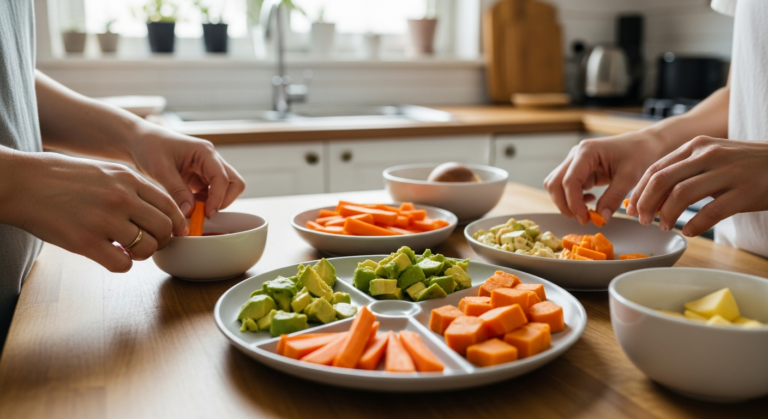
- Soft-cooked vegetable pieces: steamed broccoli florets, roasted sweet potato cubes, steamed carrot coins
- Ripe fruit pieces: banana slices, soft pear chunks, ripe mango strips, blueberries (halved or quartered)
- Scrambled egg pieces—soft, moist, and torn into small bits
- Well-cooked beans, slightly mashed (black beans and chickpeas work great)
- Shredded cheese
The key here is that everything should pass the “squish test”: if you can easily mash it between your thumb and forefinger, it’s soft enough for your baby. If it requires real pressure to squish, cook it longer.
Stage 3: Mixed Textures and Family Food (Around 9-11 Months)
This is where things get really exciting. Your baby starts eating modified versions of what the rest of the family eats:
- Pasta with a chunky vegetable sauce
- Rice with soft-cooked chicken pieces torn into shreds
- Soft toast strips spread with nut butter or cream cheese
- Pancakes torn into small pieces
- Ground meat (cooked and crumbled into tiny, moist pieces)
- Fish (flaked into small pieces, bones removed carefully)
- Soft casseroles and stews cut into baby-appropriate pieces
Stage 4: Table Food with Minimal Modifications (11-12+ Months)
By now, your baby can handle most of what the family eats with simple modifications—cutting food into appropriate sizes, avoiding choking hazards, and skipping added salt. Many one-year-olds are eating nearly the same meals as their parents, just with smaller pieces and lower seasoning.
Gagging vs. Choking: Understanding the Difference
This is the section that matters most for your peace of mind. Gagging during the transition to textured food is not only normal—it’s actually a protective mechanism. But it can look terrifying if you don’t know what you’re seeing.
Gagging is your baby’s safety reflex. When food touches too far back on their tongue before they’ve learned to manage it, the gag reflex pushes it forward. During gagging, your baby will:
- Open their mouth wide
- Push their tongue forward
- May cough or make retching sounds
- Eyes may water
- Face may turn red briefly
- They can still breathe and make noise
Gagging is loud, dramatic, and usually resolves on its own within a few seconds. Your baby might look startled but will typically continue eating after the gag passes.
Choking is a medical emergency. It happens when food actually blocks the airway. During choking, your baby will:
- Be unable to cry, cough, or make sounds
- Look panicked with wide eyes
- May turn blue or pale, especially around the lips
- Make no sound or only high-pitched squeaking sounds
- May clutch at their throat (older babies)
What to do about gagging: Stay calm. Keep your expression neutral or even reassuring. Say “You’re okay, just move it around” in a calm voice. Your reaction matters enormously—if you gasp, scream, or grab your baby every time they gag, they may develop a fear of textured food that makes the transition much harder.
What to do about choking: Take an infant CPR class before starting the transition to table food. Every parent and caregiver should know how to perform back blows and chest thrusts for an infant. You can find classes through your local Red Cross, hospital, or community center, and many are now available online. Knowing what to do transforms your confidence during mealtimes.
Practical Tips for Making the Transition Smoother
These are the strategies that made the biggest difference in our transition from purees to table food, learned through feeding three babies over five years:
Offer both textures at the same meal. During the transition, it helps to serve a familiar puree alongside new textured foods. Your baby has the safety net of their known food while exploring the new stuff. Over time, gradually decrease the puree and increase the textured options.
Let them get messy. I know it’s hard. The mess is astounding—food will be in their hair, on the floor, in their ears somehow. But messy self-feeding is how babies learn to manage food in their mouths. Squishing, smearing, and exploring food with their hands builds the sensory comfort they need to actually eat it. Spread a mat under the high chair, put them in a long-sleeved bib, and let it happen.
Serve food in appropriate shapes. For early finger foods, strips or sticks about the size of your index finger work best. Babies at 7-8 months grab with their whole fist, so they need food that sticks up above their grip. As their pincer grasp develops (around 9-10 months), you can transition to smaller pieces—about the size of a pea or chickpea.
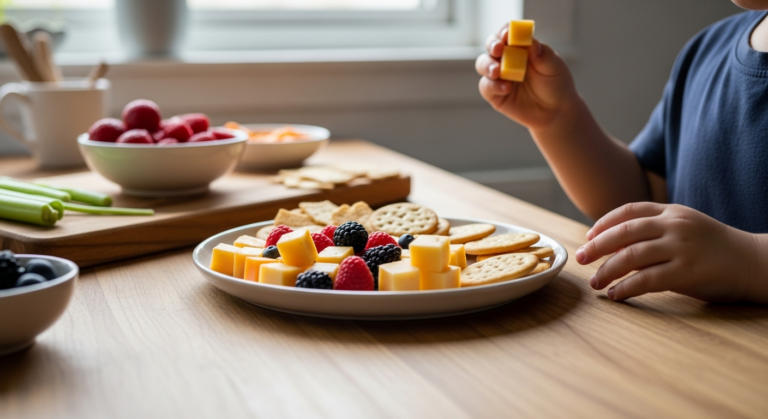
Always supervise eating and follow safety rules. Never leave a baby eating alone. Ensure they’re seated upright in a proper high chair (not reclined). Avoid high-risk choking foods: whole grapes (cut lengthwise into quarters), hot dogs (cut lengthwise then into small pieces), whole cherry tomatoes (quarter them), raw carrots, popcorn, nuts, large globs of nut butter, and chunks of hard cheese.
Eat together whenever possible. Babies learn to eat by watching you eat. When they see you chewing, swallowing, and enjoying textured food, it normalizes the whole experience. Family meals also give them motivation to try what everyone else is having.
Easy First Table Food Recipes Your Baby Will Love
These recipes are specifically designed for the transition period—soft enough for developing mouths, flavorful enough to keep babies interested, and simple enough for tired parents.
Banana Egg Pancakes (2 Ingredients)
Mash one ripe banana and mix with one beaten egg. Cook small silver-dollar-sized pancakes in a lightly oiled non-stick pan over medium heat, about 2 minutes per side. These are soft, naturally sweet, and perfect for little hands to grip. Tear into strips for younger babies or small pieces for those with a pincer grasp. Makes about 8 mini pancakes.
Slow-Cooker Chicken and Veggie Stew
Place 2 boneless chicken thighs, 2 diced carrots, 1 diced potato, 1 diced zucchini, and 1 cup of low-sodium chicken broth in a slow cooker. Cook on low for 6 hours. The chicken will be so tender it practically falls apart, and the vegetables will be perfectly soft. Shred the chicken and mash the vegetables lightly with a fork. This makes multiple meals and freezes in portions beautifully. The rich, savory broth soaks into everything and makes this incredibly flavorful.
Avocado Toast Fingers
Toast a slice of whole wheat bread lightly (you want it just firm enough to hold together but not crunchy). Spread ripe avocado thickly on top—the avocado acts like a grip surface so baby can hold the strip without it sliding out of their fingers. Cut into finger-width strips. For extra nutrition, sprinkle a tiny bit of hemp seeds on top. This takes exactly 90 seconds to prepare and my babies never turned it down.
Mini Veggie Meatballs
Combine 1 pound of ground turkey with 1/2 cup finely grated zucchini (squeeze out excess moisture), 1/4 cup breadcrumbs, 1 egg, and a pinch of garlic powder. Roll into marble-sized balls and bake at 375 degrees Fahrenheit for 15-18 minutes. These are the perfect size and softness for self-feeding, and the zucchini keeps them incredibly moist. They freeze wonderfully—I make a triple batch and defrost a few each day.
The transition from purees to table food isn’t a single moment—it’s a gradual, messy, sometimes nerve-wracking journey that unfolds over weeks and months. There will be gagging that stops your heart, meals that end up entirely on the floor, and days when you wonder if your baby will ever eat real food. But one evening, you’ll look across the dinner table and see your little one picking up pieces of chicken, munching on steamed broccoli, and grinning at you with pasta sauce on their cheeks—eating the same meal as the rest of the family. And you’ll realize that all those messy, uncertain meals were building toward exactly this.
Mama Munch
Mama Munch is a food-obsessed parent of two who believes every family deserves simple, nutritious meals — even on the busiest weeknights. With a background in nutrition education and years of navigating picky eaters, allergies, and toddler taste buds, she creates practical recipes and meal strategies that actually work for real families.