
The Food Chaining Method: Expand Picky Eaters’ Diets
Learn how the food chaining method can help expand your picky eater's diet by building small, manageable bridges from accepted foods to new ones. You'll understand how to make tiny, sensory-specific changes to introduce variety without overwhelming your child.
- Use food chaining to expand diets by changing one sensory property at a time.
- Detail your child's accepted foods, including brands, prep, and temperature.
- Identify sensory patterns from their current diet (e.g., crunchy, smooth).
- Build chains by introducing new foods that are only slightly different.
This post contains affiliate links. As an Amazon Associate I earn from qualifying purchases.
My son ate exactly eleven foods for nearly two years. I could list them in my sleep: chicken nuggets, plain pasta, white bread, cheddar cheese, apples, bananas, French fries, plain crackers, yogurt (vanilla only), dry cereal, and milk. That was it. Every meal, every day, some rotation of those eleven items. I tried everything—hiding vegetables in smoothies, offering rewards for trying new foods, making cute bento box shapes, and yes, crying quietly in the kitchen when he rejected another meal I’d spent an hour preparing.
Then our feeding therapist introduced me to food chaining, and over the course of about four months, my son went from eleven foods to nearly forty. Not because we forced him, tricked him, or bribed him—but because we finally understood how picky eaters’ brains work and used that knowledge to build tiny, manageable bridges from foods they already love to foods they’ve never tried. If your child’s accepted food list is shrinking instead of growing, food chaining might be the approach that changes everything.
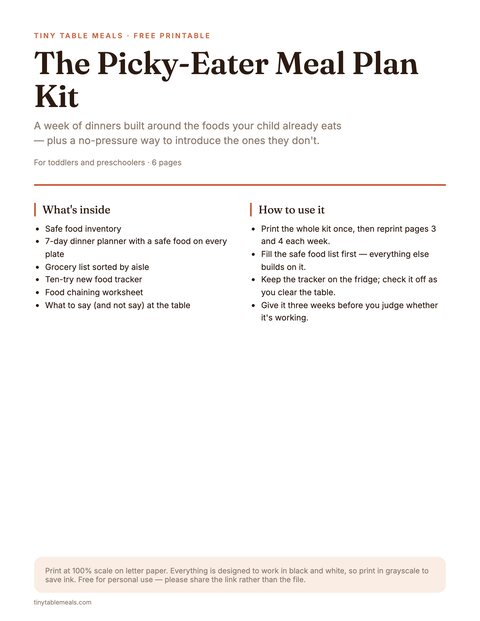
Free printable · 7 pages
The Picky-Eater Meal Plan Kit
A week of dinners built around the foods your child already eats, plus a no-pressure way to introduce new ones.
Free. Your download link appears right here. You'll also join the Sunday Supper Plan. Unsubscribe anytime. Privacy
In this article (5 sections)
What Is Food Chaining and How Does It Work?
Food chaining is a therapeutic feeding approach developed by Cheri Fraker, a speech-language pathologist, along with a team of pediatric feeding specialists. The core idea is elegant in its simplicity: instead of asking a picky eater to leap from chicken nuggets to grilled salmon (which feels like crossing a canyon to them), you build a chain of tiny steps between the two. Each step changes just one small thing about a food the child already accepts.
The method is based on an important observation about how picky eaters process food: they categorize foods by very specific sensory properties—taste, texture, temperature, appearance, and even smell. A child who eats chicken nuggets isn’t thinking “I like chicken.” They’re thinking “I like this specific crunchy coating, this exact softness inside, this particular shape, this temperature, and this brand.” Understanding this level of specificity is the key to the whole approach.
A food chain works by changing just one sensory property at a time, so each new food feels only slightly different from the last one. The child’s brain processes the new food as “familiar enough” rather than “completely foreign and terrifying.” Over time, these small steps accumulate into genuinely diverse eating.
Here’s what a chain looks like in practice, starting from a single accepted food:
- McDonald’s chicken nuggets (the accepted food)
- Tyson frozen chicken nuggets (same shape and texture, different brand)
- Homemade breaded chicken strips (similar coating, different shape)
- Baked chicken tenders with light breading (less coating, still crunchy)
- Grilled chicken strips (no coating, but same shape as tenders)
- Grilled chicken breast, sliced (different shape, same flavor and texture)
- Grilled chicken in a mild sauce (adding a new flavor element)
Each step is small enough to feel safe but moves meaningfully toward the goal of broader eating. The child doesn’t experience any single step as a huge challenge, yet by the end of the chain, they’ve traveled an enormous distance from where they started.
How to Build Food Chains for Your Child
You don’t need a feeding therapist to start using food chaining basics at home (though professional help is wonderful if it’s accessible to you). Here’s my step-by-step process for creating chains that actually work:
Step 1: Map Your Child’s Accepted Foods
Write down every single food your child currently eats willingly—including specific brands, preparations, and temperatures. Be detailed. Not just “crackers” but “Goldfish crackers, original flavor, from the bag (not stale).” Not just “yogurt” but “Chobani vanilla yogurt, cold, eaten with a spoon from the container.” This specificity reveals the sensory patterns your child is drawn to.
Step 2: Identify Sensory Patterns
Look at your list and group foods by shared properties:
- Texture preferences: Does your child favor crunchy foods (crackers, nuggets, dry cereal)? Smooth foods (yogurt, applesauce)? Does your child avoid mixed textures?
- Flavor preferences: Mostly salty? Sweet? Mild and bland? Do they avoid anything with visible seasonings?
- Temperature: Room temperature only? Cold only? Does your child refuse hot foods or cold foods?
- Color and appearance: Mostly beige/white foods? Does your child avoid anything green? Do they reject foods that are “touching” other foods?
- Shape and size: Small, bite-sized pieces? Whole items they can hold? Specific shapes they expect?
These patterns are your roadmap. They tell you exactly which properties to preserve as you introduce new foods and which ones you can begin to nudge.
Step 3: Choose Your Starting Food and Build the Chain
Pick one accepted food and brainstorm a chain of 4-7 steps leading toward a target food. Change only ONE property per step. Here are real chains I’ve used with my kids:
From plain pasta to pasta with meat sauce:
- Plain buttered penne (accepted food)
- Penne with butter and a tiny sprinkle of Parmesan cheese
- Penne with butter and a heavier coating of Parmesan
- Penne with a thin drizzle of plain tomato sauce on the side for dipping
- Penne lightly tossed in tomato sauce
- Penne in tomato sauce with tiny bits of ground beef mixed in
- Penne with full meat sauce
From French fries to roasted sweet potato:
- Regular French fries (accepted food)
- Thick-cut oven fries (homemade, similar shape)
- Oven fries seasoned with a tiny bit of paprika
- Sweet potato fries from a restaurant or frozen bag
- Homemade baked sweet potato fries with a light crispy coating
- Roasted sweet potato wedges (less crispy, more soft)
- Mashed or cubed roasted sweet potato
From vanilla yogurt to fruit smoothie:
- Vanilla yogurt (accepted food)
- Vanilla yogurt with a tiny drizzle of strawberry puree swirled on top
- Strawberry yogurt (pre-mixed, same brand)
- Strawberry yogurt blended with a frozen strawberry (smoothie texture)
- Smoothie made with yogurt, strawberries, and banana
- Smoothie with yogurt, strawberries, banana, and a handful of spinach (color changes but flavor is masked)
The Timeline: How Long Food Chaining Takes
This is the question every parent asks first, and the honest answer is: it depends on your child. But here are realistic expectations so you don’t get discouraged:
Each step in a chain takes 3-10 exposures. Some kids accept the next link after trying it three times. Others need a week or more of repeated exposure. Both are completely normal. Don’t rush it—moving to the next step before your child is comfortable with the current one can cause them to reject the whole chain and retreat to the original food.
A single chain of 5-7 steps typically takes 3-8 weeks. That might sound slow, but compare it to the alternative—months or years of no progress at all. And once your child successfully completes one chain, subsequent chains tend to move faster because they’ve learned that new foods can be safe and enjoyable.
You can run multiple chains simultaneously. Once you’re comfortable with the process, start 2-3 chains at different meals. A breakfast chain, a lunch chain, and a dinner chain can all progress independently, tripling the rate of new food acceptance.
Expect some regression. A child who accepted step 4 last week might suddenly reject it this week. That’s normal. Don’t panic. Just step back one link in the chain and try again in a few days. Illness, schedule disruptions, and big life changes (new sibling, starting school) can all temporarily set back food acceptance.
Common Mistakes That Derail Food Chaining
I made every one of these mistakes before I figured out what actually works. Save yourself the frustration:
Changing too many things at once. The whole point of food chaining is tiny, incremental steps. If you go from plain crackers to crackers with hummus and cucumber on top, that’s three changes at once (adding a spread, adding a vegetable, changing the texture dramatically). Your child’s brain can’t process that as “similar enough.” One change at a time. Always.
Skipping steps because your child seems ready. Even if your child happily accepts step 2, don’t jump straight to step 5. Each step builds familiarity and confidence. The chain works because of the cumulative effect of many small successes, not because of any single leap.
Pressuring or drawing too much attention to the new food. Present each new chain link casually alongside accepted foods. Don’t say “Look, I made something NEW for you! Try it!” That creates pressure and raises your child’s defenses. Just put it on the plate as if it’s the most normal thing in the world. If they try it, stay calm and positive. If they don’t, stay calm and neutral.
Giving up after a rejection. A child rejecting a chain link doesn’t mean the chain has failed. It might mean you need more exposures at the current step, or that the jump between steps was slightly too big. Add an intermediate step. Keep offering. Patience is the fuel that makes food chaining work.
Only chaining at dinner. Dinner tends to be the highest-pressure, most-exhausted meal of the day for everyone. Try introducing new chain links at breakfast or lunch when both you and your child have more energy and flexibility. Snack time is also a great low-pressure opportunity.
When to Seek Professional Help
Food chaining at home works beautifully for many children with typical picky eating. But some situations benefit from professional guidance from a pediatric feeding therapist (usually an occupational therapist or speech-language pathologist with feeding specialization):
- Your child eats fewer than 10 foods total and the list is shrinking
- They gag, vomit, or have strong physical reactions to new food textures
- They have a diagnosed sensory processing disorder, autism spectrum condition, or developmental delay
- Mealtimes consistently involve extreme distress (prolonged crying, panic, refusal to sit at the table)
- Your child has not made progress with home food chaining after 6-8 weeks of consistent effort
- There are concerns about nutritional deficiency or growth
- You’re feeling overwhelmed, anxious, or depressed about your child’s eating
A feeding therapist can create customized chains based on a thorough sensory assessment, address underlying oral-motor or sensory issues, and provide support and accountability for the process. Many families see dramatic progress within 3-6 months of professional food chaining therapy.
Food chaining isn’t a quick fix—it’s a patient, systematic approach that meets your child exactly where they are. It doesn’t require your child to be brave or adventurous. It doesn’t require you to be a gourmet chef. It just requires small steps, consistency, and the belief that your child can expand their food world when the path forward feels safe enough to walk. And from the mom who watched her son go from eleven foods to forty, I can tell you with absolute certainty: it works.
Mama Munch
Mama Munch is a food-obsessed parent of two who believes every family deserves simple, nutritious meals — even on the busiest weeknights. With a background in nutrition education and years of navigating picky eaters, allergies, and toddler taste buds, she creates practical recipes and meal strategies that actually work for real families.