The Ultimate Guide to Baby-Led Weaning: First Foods & Safety Tips
Discover baby-led weaning (BLW), an approach where your baby feeds themselves soft finger foods from the start. This guide teaches you what BLW is, how it differs from traditional weaning, and the key readiness signs to look for before you begin.
- Offer soft finger foods and let your baby self-feed from the start.
- Look for all readiness signs, like sitting upright and losing the tongue-thrust reflex.
- Develop your baby's motor skills and encourage varied tastes and textures early.
- Remember milk is your baby's primary nutrition until around their first birthday.
- Include your baby in family meals by offering modified versions of your food.
This post contains affiliate links. As an Amazon Associate I earn from qualifying purchases.
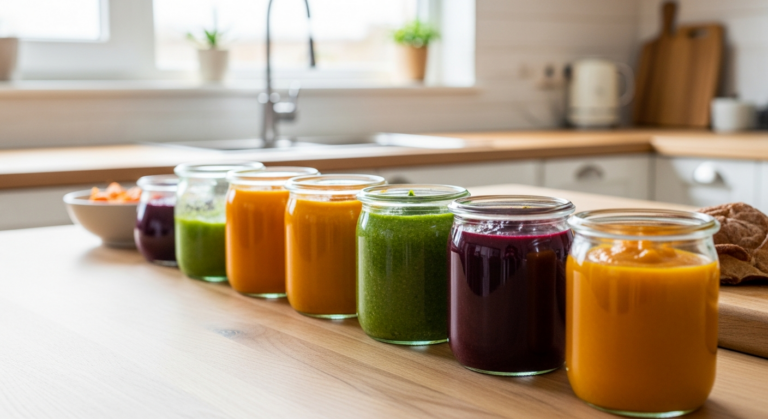
When my first baby was ready for solids, I spent hours pureeing every vegetable known to mankind, freezing tiny cubes, and carefully spooning them into a mostly uninterested mouth. With my second, I discovered baby-led weaning—and it completely changed our approach to feeding.
Baby-led weaning, or BLW, lets babies feed themselves right from the start of their solid food journey. Instead of spoon-feeding purees, you offer soft, appropriately-sized pieces of food and let your baby explore eating at their own pace.
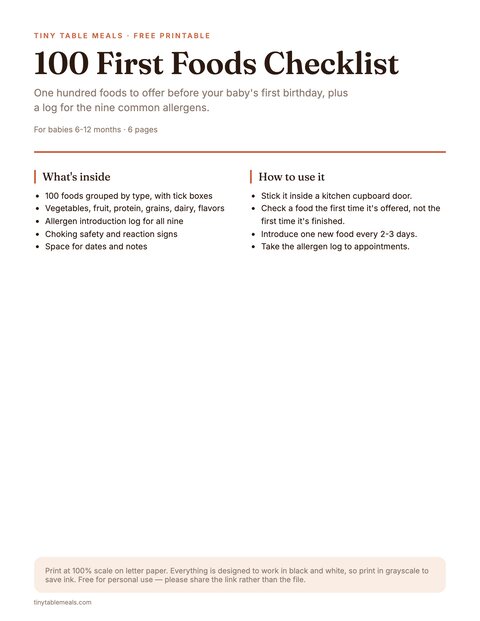
Free printable · 7 pages
100 First Foods Checklist + Allergen Log
One hundred foods to offer before the first birthday, with a log for the nine common allergens.
Free. Your download link appears right here. You'll also join the Sunday Supper Plan. Unsubscribe anytime. Privacy
If you’re curious about this approach or feeling overwhelmed by all the information out there, this guide covers everything you need to know to get started safely and confidently.
In this article (11 sections)
- What Is Baby-Led Weaning?
- Signs Your Baby Is Ready for BLW
- BLW vs. Traditional Weaning: What’s the Difference?
- Benefits of Baby-Led Weaning
- BLW Safety: The Most Important Section
- Best First Foods for Baby-Led Weaning
- How to Prepare Foods Safely
- Sample First Week BLW Meal Plan
- Common BLW Mistakes to Avoid
- Frequently Asked Questions
- Conclusion
What Is Baby-Led Weaning?
Baby-led weaning is exactly what it sounds like—letting your baby take the lead when it comes to eating solid foods. Rather than purees on a spoon guided by a parent, babies are offered appropriately prepared finger foods that they can grasp, explore, and eat independently.
The term was popularized by British health visitor Gill Rapley, who noticed that babies seemed more engaged with food when given the opportunity to feed themselves. Her research showed that babies have an innate ability to regulate their food intake when they’re in control of the process.
With BLW, babies sit at the table during family meals and eat the same foods as everyone else (modified for safety, of course). This approach emphasizes exploring tastes and textures rather than consuming specific amounts.
It’s important to note that BLW is about starting solids, not about stopping breastfeeding or formula. Milk remains the primary source of nutrition until around age one, with solid foods complementing rather than replacing it.
Signs Your Baby Is Ready for BLW
Most babies are developmentally ready for solid foods around six months, though every baby is different. Before starting BLW, look for these readiness signs:
- Can sit upright with minimal support: Good trunk control is essential for safe eating
- Has lost the tongue-thrust reflex: This reflex pushes food out of the mouth and typically disappears around 4-6 months
- Shows interest in food: Watches you eat, reaches for your plate, opens mouth when food approaches
- Can bring objects to mouth: Hand-eye coordination needed for self-feeding
- Can make chewing motions: Moving jaw up and down even without teeth
All of these signs should be present together. Age alone isn’t a reliable indicator—a baby might be five months old and show all signs, or seven months and still developing some skills.
Introducing Allergens to Baby: A Safe Step-by-Step Guide
BLW vs. Traditional Weaning: What’s the Difference?
Traditional weaning typically involves spoon-feeding smooth purees, gradually progressing to thicker textures, and eventually introducing finger foods around 8-9 months. The parent controls how much and how fast the baby eats.
Baby-led weaning skips the puree stage entirely. Babies start with soft finger foods right away and control their own intake from day one. Here’s a quick comparison:
| Aspect | Traditional Weaning | Baby-Led Weaning |
|——–|——————–|——————–|
| First foods | Smooth purees | Soft finger foods |
| Who controls eating | Parent | Baby |
| Pace | Parent determines | Baby determines |
| Texture progression | Gradual | Immediate variety |
| Family meals | Separate baby food | Same food as family |
| Utensils | Spoon (parent-guided) | Hands initially |
Neither approach is wrong—many families do a combination of both. The best approach is whatever works for your family and feels comfortable for your baby.
Benefits of Baby-Led Weaning
Research and anecdotal evidence suggest several potential benefits to the BLW approach:
Develops motor skills: Self-feeding helps babies practice hand-eye coordination, pincer grasp, and chewing skills early on.
Encourages adventurous eating: Babies exposed to varied textures and flavors from the start may be more willing to try new foods later.
Simplifies family meals: Everyone eats the same food (modified for baby), which means less separate meal prep.
Supports appetite regulation: When babies control their own intake, they may better learn to recognize hunger and fullness cues.
Reduces mealtime stress: Without battles over how many spoonfuls baby ate, meals can be more relaxed and enjoyable.
Promotes independence: Babies develop self-feeding skills earlier and often transition to utensils more smoothly.
That said, BLW isn’t magic, and traditionally-weaned babies can also become great eaters. Choose the approach that fits your family best.
BLW Safety: The Most Important Section
Safety is the number one concern for parents considering BLW, and rightfully so. Let me address the biggest worry first: choking.
Gagging vs. Choking: These are not the same thing. Gagging is a normal, protective reflex that helps babies move food around in their mouths. It’s loud, dramatic, and usually resolves on its own. Choking is silent, dangerous, and requires intervention.
Babies actually have a strong gag reflex that’s positioned further forward on the tongue than in adults. This means they’re more likely to gag (and therefore less likely to choke) when learning to eat.
Essential safety guidelines:
- Always supervise your baby during meals—never leave them alone with food
- Baby should be sitting upright at 90 degrees, not reclined
- Avoid high-risk choking hazards (listed below)
- Take an infant CPR course before starting solids
- Cut foods into appropriate shapes (more on this below)
- Never put food in baby’s mouth yourself
Foods to avoid:
- Whole grapes or cherry tomatoes (cut lengthwise)
- Whole nuts and seeds
- Hard raw vegetables (carrots, apples)
- Hot dogs (even cut up)
- Popcorn
- Sticky foods like nut butters (unless thinly spread)
- Whole chunks of meat
- Round, coin-shaped foods
- Hard candies
Best First Foods for Baby-Led Weaning
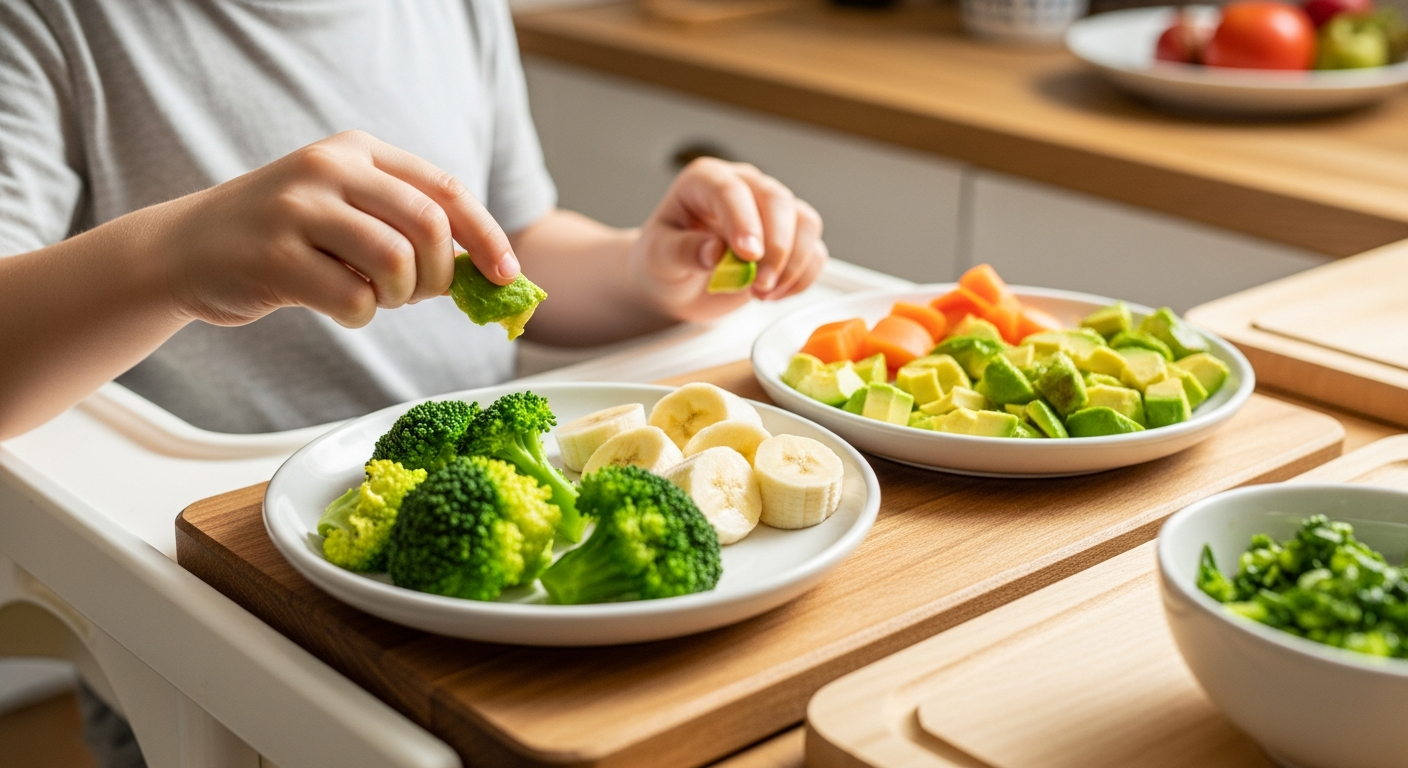
When you’re ready to start, choose foods that are soft enough to mash with gentle pressure between your finger and thumb, and cut into shapes baby can easily grasp. For young babies just starting out, stick-shaped pieces work best—they can hold one end and eat the other.
Great starter foods:
- Ripe avocado strips
- Steamed broccoli florets
- Banana (leave some peel for grip or roll in coconut)
- Soft cooked sweet potato spears
- Roasted butternut squash strips
- Steamed carrot sticks (very soft)
- Strips of ripe mango
- Soft cooked apple slices
- Eggs (scrambled, omelet strips, or hard-boiled quartered)
- Toast strips with thin spread
- Soft cooked pasta in large shapes
- Flaked salmon or soft fish
As baby develops the pincer grasp (around 8-9 months), you can introduce smaller pieces like peas, blueberries (quartered), and diced soft foods.
Easy Homemade Baby Food Recipes: Stage 1-3 Complete Guide
How to Prepare Foods Safely
Proper food preparation is crucial for BLW success and safety. Here’s a general guide:
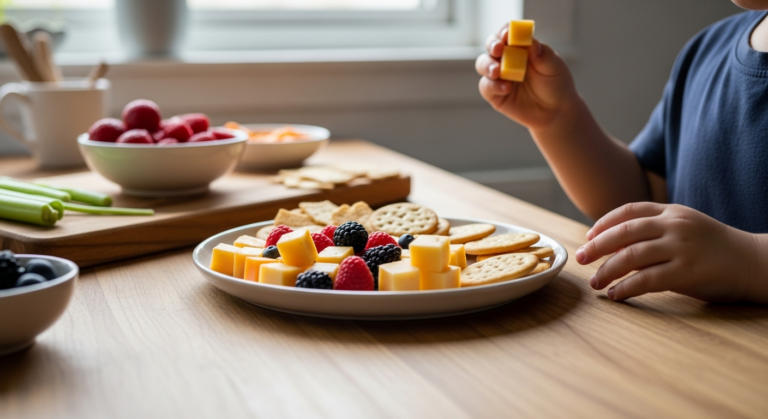
For beginners (6-7 months): Cut foods into long strips about the size and shape of your finger. Baby will hold one end and gnaw on the other. Foods should be very soft.
As skills develop (8-9 months): Start offering smaller pieces as pincer grasp develops. Continue offering some stick-shaped foods too.
Approaching one year: Most foods can be cut into bite-sized pieces. Baby is becoming more skilled at chewing and handling varied textures.
Cooking methods that work well:
- Steaming until very soft
- Roasting until tender
- Poaching or baking fish
- Boiling until easily mashed
Always test temperature before serving. Babies can’t tell you if something is too hot, and their mouths are sensitive.
Sample First Week BLW Meal Plan
Here’s what a first week of BLW might look like. Start with one meal per day (usually breakfast or lunch when baby is alert and happy) and gradually increase:
Day 1: Ripe avocado strips
Day 2: Steamed broccoli florets
Day 3: Banana with skin left on bottom half
Day 4: Soft scrambled eggs
Day 5: Roasted sweet potato spears
Day 6: Toast fingers with thin mashed avocado
Day 7: Steamed carrot sticks and soft pear slices
Remember, at this stage it’s about exploration, not nutrition. Milk is still providing most of their calories and nutrients. Expect most food to end up on the floor, in their hair, or mushed on the tray—that’s all part of learning!
Common BLW Mistakes to Avoid
After going through this journey twice, here are the pitfalls I’d warn new BLW parents about:
Starting before baby is ready: Wait for all the developmental signs, even if you’re eager to begin.
Offering too much food: Start with 2-3 pieces of food. Too many options can be overwhelming.
Hovering anxiously: Your stress becomes their stress. Take a deep breath and trust the process.
Expecting them to eat a lot: In the beginning, exploration is the goal. Actual eating comes later.
Giving up too quickly on rejected foods: It can take 15+ exposures for a baby to accept a new food.
Not modifying family meals: You can’t just hand baby whatever you’re eating—foods need to be prepared appropriately.
Skipping the mess: Yes, BLW is messy. Embrace it. A splat mat and a good bib are your friends.
Mama Munch
Mama Munch is a food-obsessed parent of two who believes every family deserves simple, nutritious meals — even on the busiest weeknights. With a background in nutrition education and years of navigating picky eaters, allergies, and toddler taste buds, she creates practical recipes and meal strategies that actually work for real families.
Frequently Asked Questions
Will my baby get enough nutrition with BLW?
In the first few months of solids, breast milk or formula remains the primary source of nutrition. As baby becomes more skilled at eating (usually around 9-12 months), they’ll naturally eat more solid food. If you have concerns, talk to your pediatrician.
What if my baby has no teeth?
Babies don’t need teeth to eat! Their gums are surprisingly strong and can mash soft foods effectively. Many babies start BLW before any teeth appear.
How do I know if my baby is eating enough?
Track wet diapers and growth rather than food intake. As long as baby continues to have adequate wet diapers and follows their growth curve, they’re getting enough nutrition between milk and solids.
Can I do a combination of BLW and purees?
Absolutely! Many families do a mixed approach. You might offer finger foods for baby to self-feed while also providing some purees on a preloaded spoon. Do what works for your family.
When should I introduce allergenic foods?
Current guidelines recommend introducing common allergens (eggs, peanuts, tree nuts, fish, shellfish, wheat, soy, sesame) early—around 6 months—and continuing to offer them regularly. Always introduce one new allergen at a time and watch for reactions.
Conclusion
Baby-led weaning can be a wonderful way to introduce your baby to the world of food. It encourages independence, makes family mealtimes easier, and helps babies develop a healthy relationship with eating from the very start.
The most important things to remember: wait until baby is truly ready, prioritize safety, keep it low-pressure, and trust your baby’s ability to learn. The mess is temporary, but the foundation you’re building for healthy eating habits lasts a lifetime.
Ready to start your BLW journey? Begin with one soft, safe food at your next family meal and watch your baby explore. You might be surprised by how capable they are!
—